Climate change – more costly than we expected
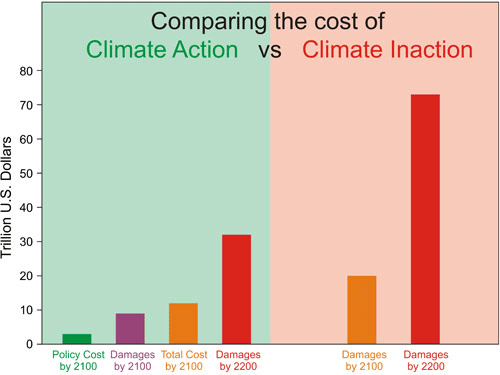
The result of this failure by economists is that world leaders understand neither the magnitude of the risks to lives and livelihoods, nor the urgency of action. How and why this has occurred is explained in a recent report by scientists and economists at the London School of Economics and Political Science, the Potsdam Institute for Climate Impact Research and the Earth Institute at Columbia University. One reason is obvious: Since climate scientists have been underestimating the rate of climate change and the severity of its effects, then economists will necessarily underestimate their costs.
- But it’s worse than that. A set of assumptions and practices in economics has led economists both to underestimate the economic impact of many climate risks and to miss some of them entirely. That is a problem because, as the report notes, these “missing risks” could have “drastic and potentially catastrophic impacts on citizens, communities and companies.”One problem involves the nature of risk in a climate-altered world. Right now, carbon dioxide is at its highest concentration in the atmosphere in three million years (and still climbing). The last time levels were this high, the world was about five degrees Fahrenheit warmer and sea level 32 to 65 feet higher. Humans have no experience weathering sustained conditions of this type……..
A second difficulty involves parameters that scientists do not feel they can adequately quantify, like the value of biodiversity or the costs of ocean acidification. Research shows that when scientists lack good data for a variable, even if they know it to be salient, they are loath to assign a value out of a fear that they would be “making it up.”……A third and terrifying problem involves cascading effects. One reason the harms of climate change are hard to fathom is that they will not occur in isolation, but will reinforce one another in damaging ways. In some cases, they may produce a sequence of serious, and perhaps irreversible, damage…….
The urgency and potential irreversibility of climate effects mean we cannot wait for the results of research to deepen our understanding and reduce the uncertainty about these risks. This is particularly so because the study suggests that if we are missing something in our assessments, it is likely something that makes the problem worse.
This is yet another reason it’s urgent to pursue a new, greener economic path for growth and development. If we do that, a happy ending is still possible. But if we wait to be more certain, the only certainty is that we will regret it. https://www.nytimes.com/2019/10/23/opinion/climate-change-costs.html
No comments yet.
1 This Month


Tell the Ukrainian Government to Drop Prosecution of Peace Activist Yurii Sheliazhenko

Petition to revoke the licensing of the Near Surface Nuclear Disposal Facility (NSDF) at Chalk River. https://www.ourcommons.ca/petitions/en/Petition/Details?Petition=e-7247


of the week – STOP SMALL MODULAR REACTORS IN CANADA
To see nuclear-related stories in greater depth and intensity – go to https://nuclearinformation.wordpress.com
-
Archives
- March 2026 (212)
- February 2026 (268)
- January 2026 (308)
- December 2025 (358)
- November 2025 (359)
- October 2025 (376)
- September 2025 (258)
- August 2025 (319)
- July 2025 (230)
- June 2025 (348)
- May 2025 (261)
- April 2025 (305)
-
Categories
- 1
- 1 NUCLEAR ISSUES
- business and costs
- climate change
- culture and arts
- ENERGY
- environment
- health
- history
- indigenous issues
- Legal
- marketing of nuclear
- media
- opposition to nuclear
- PERSONAL STORIES
- politics
- politics international
- Religion and ethics
- safety
- secrets,lies and civil liberties
- spinbuster
- technology
- Uranium
- wastes
- weapons and war
- Women
- 2 WORLD
- ACTION
- AFRICA
- Atrocities
- AUSTRALIA
- Christina's notes
- Christina's themes
- culture and arts
- Events
- Fuk 2022
- Fuk 2023
- Fukushima 2017
- Fukushima 2018
- fukushima 2019
- Fukushima 2020
- Fukushima 2021
- general
- global warming
- Humour (God we need it)
- Nuclear
- RARE EARTHS
- Reference
- resources – print
- Resources -audiovicual
- Weekly Newsletter
- World
- World Nuclear
- YouTube
-
RSS
Entries RSS
Comments RSS
 nuclear-news
Leave a comment