Restriction of defence arguments in the trial of Catholic peace activists
 Convicted Anti-Nuclear Activists Speak Out: “Pentagon Has Brainwashed People” https://truthout.org/articles/convicted-anti-nuclear-activists-speak-out-pentagon-has-brainwashed-people/?eType=EmailBlastContent&eId=177551ee-b430-44b8-afe2-cbe78a6a6b09 Marjorie Cohn, Truthout, 28 Oct 19,
The seven Catholic peace activists who were convicted on October 24 for their symbolic protest against nuclear weapons at the Kings Bay Naval Base are now facing a two-to-three-month wait to hear their prison sentences. They could face more than 20 years in prison.
“We understand the efficiency of the State is a formidable force, and we ourselves are not surprised with the guilty verdict on all counts,” Hennessy told Truthout. “In a time of withdrawing from nuclear treaties and promoting violence in foreign policy, we are left to wonder what the future may hold for the world.”
Facing a Jury Without Opinions on Nuclear Risks
 The jury that convicted the Kings Bay Plowshares 7 activists was self-avowedly apathetic about the risks posed to humanity by nuclear weapons, and the judge and prosecution worked together to prevent the defendants from sharing information or arguments to raise jurors’ consciousness on the issue.
Sam Husseini, communications director at the Institute for Public Accuracy, a progressive nonprofit organization, attended the three-day trial. “It was a subtly but insidiously controlled courtroom with the judge and prosecution working hand in glove,” Husseini told Truthout. “The defendants were allowed to speak about their religious beliefs and to some degree how they relate to nuclear weapons. But it was all presented as subjective, and expert testimony on international law, and justification and necessity of urgent action were excluded.”
The defendants, who said they were following the command of the biblical prophet Isaiah to “beat swords into plowshares,” were denied the right to present the defenses of necessity, which allows one to commit a crime in order to avoid a greater harm. They were also denied the right to discuss the Religious Freedom Restoration Act, which “ensures that interests in religious freedom are protected.” Thus, they were limited to their own testimony about their subjective motivations for their acts.
“Defendants were allowed to briefly discuss their moral objections to nuclear weapons but were cut off quickly. No outside evidence or testimony was allowed,” defense attorney Bill Quigley told Truthout.
Husseini added: “The manner that the judge allowed the case to be made did not make it clear that the house was indeed on fire — or even that there was a house. The reality of the nuclear weapons, the threat they pose, and certainly their illegality, were not objectively communicated” to the jury.
Speaking with Truthout in an exclusive email interview, defendant Patrick O’Neill shared an anecdote that further highlights the degree to which the jury reflected the widespread ignorance about nuclear risks that exists in the U.S. now.
“When Judge Lisa Wood asked the entire jury pool: ‘Do any of you have a strong opinion about nuclear weapons — pro or con, would you raise your hand?’ Of 73 people, not one raised a hand,” O’Neill told Truthout. “That is an indication that people living in the throes of the nuclear age, at 2 minutes to midnight on the Doomsday Clock, have come to see [weapons of mass destruction] as inconsequential — nuclear weapons on hair-trigger alert 24/7 is now a ‘normal’ part of people’s lives.”
O’Neill added, “The Pentagon has brainwashed people to just trust a government that is imperiling the earth and risking the end of life as we know. That’s why we went to Kings Bay — to hopefully wake people up.”
(2) that she sincerely believed and reasonably acted to prevent imminent harm. The Bulletin of Atomic Scientists says the world is closer to nuclear devastation than ever before. President Trump repeatedly declared that “all options are on the table” and threatened North Korea with “fire and fury like the world has never seen.”
(3) that she reasonably believed her action could help to avoid that harm. “Only by symbolically disarming these nuclear weapons is there any hope for real disarmament.”
(4) that she reasonably believed there were no legal alternatives to breaking the law. “Defendants have each spoken, written, prayed, petitioned, and lobbied for nuclear disarmament and peace for decades. These actions are the only ones left which might make a difference.”
Quigley’s brief cited the 2018 Nuclear Posture Review, which would allow the United States to use nuclear weapons in response to a non-nuclear attack. The Doomsday Clock, maintained by the Bulletin of Atomic Scientists, continues to stand at 2 minutes to midnight. The U.S. refuses to join the majority of the nations of the world in ratifying the Treaty on the Prohibition of Nuclear Weapons. Trump withdrew the U.S. from the Iran nuclear deal, and he may well pull out of the New START Treaty as well, “which would leave nuclear weapons free from all controls” Quigley wrote.
Refusal to Allow Expert Testimony on Illegality of Nuclear Weapons“Tellingly,” Quigley wrote, “the Magistrate granted the Government the right to preclude the jury from hearing evidence about nuclear weapons without never once discussing or even acknowledging the uncontested lethality of nuclear weapons.”
Moreover, the judge denied the defense motion to present the expert testimony of Professor Francis Boyle about the illegality of nuclear weapons under both international and U.S. law.
Refusal to Allow Religious Freedom Restoration Act DefenseThe judge also denied the defense motion to argue that the prosecution violated their rights to religious exercise protected by the Religious Freedom Restoration Act (RFRA). Although the judge concluded that the defendants had established the prima facie elements of a RFRA defense, the government demonstrated a compelling interest in prosecuting the defendants for their actions at Kings Bay, citing the safety of individuals on the base, the security of the assets there, and the smooth operation of the base.
The judge also denied the defense motion to argue that the prosecution violated their rights to religious exercise protected by the Religious Freedom Restoration Act (RFRA). Although the judge concluded that the defendants had established the prima facie elements of a RFRA defense, the government demonstrated a compelling interest in prosecuting the defendants for their actions at Kings Bay, citing the safety of individuals on the base, the security of the assets there, and the smooth operation of the base.
Reactions to the Verdict
The Kings Bay Plowshares 7 are asking people to sign a worldwide petition urgently requesting that the charges against them be dropped.
Peace activist and retired Col. Ann Wright summed up the irony of the prosecution of the Kings Bay Plowshares 7, writing on Facebook, “The US nuclear weapons are so poorly protected that the 7 were able to get into the more secure area! They should be rewarded for pointing out how poorly guarded the weapons are instead of being on trial!!!”
“I don’t see [what I did] that’s the crime,” defendant Liz McAlister said on Democracy Now! “I think the crime is the weapons. The crime is the money spent on the weapons. The crime is the money taken from the real needs in our country and in our world to spend it on these weapons of mass destruction. And we need to stop that. And that’s the message that I want to continue to stand behind.”
Meanwhile, defense attorney Quigley told Truthout that he thinks the verdict will “make convictions easier and defenses harder” in the future.
“If the jury would have heard the facts about the nuclear bombs headquartered at Kings Bay — with 3,800 times the destructive power of Hiroshima and the real possibility of ending all life on the planet — they would probably have come to a different decision about the legality of what these courageous people did,” he said.
Assange’s lawyers’ plea to Australian government for help – falls on deaf ears
 Why is it that the Australian government is so helpful to Australian murderers and drug dealers imprisoned overseas, but so relentlessly unhelpful to an Australian whose only crime is to tell the truth?
Assange legal team asks for Australian government help amid growing health fears, https://www.theage.com.au/politics/federal/assange-legal-team-asks-for-australian-government-help-amid-growing-health-fears-20191028-p534xw.html, By Rob Harris
The WikiLeaks founder has been held in HM Prison Belmarsh since his April 11 arrest at the Ecuadorian embassy, where he had lived in asylum for almost seven years.
Australian officials told a Senate estimates hearing on Thursday that diplomats had not heard back from Assange’s lawyer since writing to her last week asking that she raise with him their offer of consular assistance.
The 48-year-old is fighting US attempts to extradite him to face 17 counts of spying and one of computer hacking in relation to WikiLeaks’ release of thousands of classified Pentagon files regarding the Iraq and Afghanistan wars.
Barrister Greg Barns, an adviser to the Australian Assange campaign, told The Age and The Sydney Morning Herald his UK lawyers on Friday requested consular assistance following a recent inquiry from the Department of Foreign Affairs and Trade.
“Julian’s lawyers are asking for the Australian government’s assistance in dealing with their client’s inhumane conditions in Belmarsh prison which has led to, and is continuing to cause, serious damage to Julian’s health,” Mr Barns said.
His supporters say he is being kept in solitary confinement and is allowed out of his cell for only 45 minutes a day. At a court appearance last week, he appeared gaunt and disorientated.
Assange was due to be released on September 22 but was told at a court hearing last month he would be kept in jail because there were “substantial grounds” for believing he would abscond.
ALA national president Andrew Christopoulos said it was an important issue about the rule of law and protecting an Australian in a vulnerable position overseas.
“This is about standing up for the rule of law, fairness and the freedom to expose wrongdoing,” he said. “The reported decline of Julian Assange’s physical and mental health heightens the need for urgent government intervention. The government has intervened in cases like this before and should do so in this circumstance.”
If the case goes to a series of appeals, Assange could remain in a UK jail until at least 2025.
Foreign Minister Marise Payne last week acknowledged the publicity around the case and that Assange had high-profile and loyal supporters. She said it was important to let the legal process run its course.
“He has been offered consular services … like any other Australian would,” Senator Payne told the Senate committee. “I think it’s important to remember that as Australia would not accept intervention or interference in our legal processes, we are not able to intervene in the legal processes of another country
Climate change – more costly than we expected
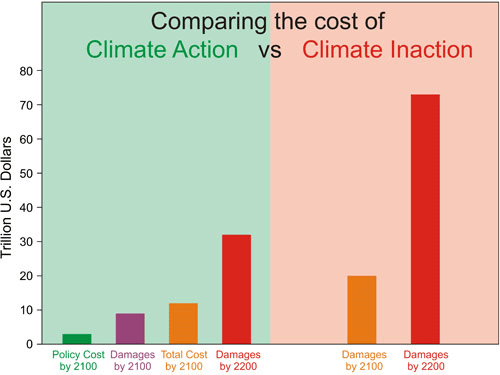
The result of this failure by economists is that world leaders understand neither the magnitude of the risks to lives and livelihoods, nor the urgency of action. How and why this has occurred is explained in a recent report by scientists and economists at the London School of Economics and Political Science, the Potsdam Institute for Climate Impact Research and the Earth Institute at Columbia University. One reason is obvious: Since climate scientists have been underestimating the rate of climate change and the severity of its effects, then economists will necessarily underestimate their costs.
- But it’s worse than that. A set of assumptions and practices in economics has led economists both to underestimate the economic impact of many climate risks and to miss some of them entirely. That is a problem because, as the report notes, these “missing risks” could have “drastic and potentially catastrophic impacts on citizens, communities and companies.”One problem involves the nature of risk in a climate-altered world. Right now, carbon dioxide is at its highest concentration in the atmosphere in three million years (and still climbing). The last time levels were this high, the world was about five degrees Fahrenheit warmer and sea level 32 to 65 feet higher. Humans have no experience weathering sustained conditions of this type……..
A second difficulty involves parameters that scientists do not feel they can adequately quantify, like the value of biodiversity or the costs of ocean acidification. Research shows that when scientists lack good data for a variable, even if they know it to be salient, they are loath to assign a value out of a fear that they would be “making it up.”……A third and terrifying problem involves cascading effects. One reason the harms of climate change are hard to fathom is that they will not occur in isolation, but will reinforce one another in damaging ways. In some cases, they may produce a sequence of serious, and perhaps irreversible, damage…….
The urgency and potential irreversibility of climate effects mean we cannot wait for the results of research to deepen our understanding and reduce the uncertainty about these risks. This is particularly so because the study suggests that if we are missing something in our assessments, it is likely something that makes the problem worse.
This is yet another reason it’s urgent to pursue a new, greener economic path for growth and development. If we do that, a happy ending is still possible. But if we wait to be more certain, the only certainty is that we will regret it. https://www.nytimes.com/2019/10/23/opinion/climate-change-costs.html
Warning on Fukushima fallout for Tokyo 2020 Olympians,
Warning on Fukushima fallout for Tokyo 2020 Olympians, https://www.theaustralian.com.au/sport/olympics/warning-on-fukushima-fallout-for-tokyo-2020-olympians/news-story/ed7bf1f0415ca7eb05ce9587b6d1989f, VICTORIA LAURIE. SENIOR REPORTER. OCTOBER 29, 2019
The Australian Olympic Committee has been urged to inform its athletes and team members about the ongoing health effects of the 2011 Fukushima nuclear reactor disaster for those attending the 2020 Tokyo Games.
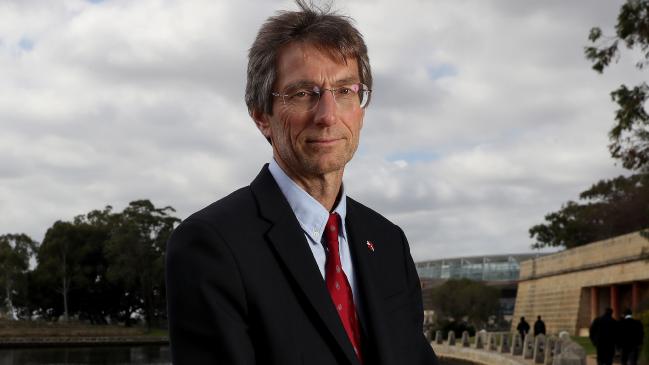 Tilman Ruff, a public health expert who co-founded the Nobel Peace Prize-winning International Campaign to Abolish Nuclear Weapons (ICAN) in Melbourne, said he had written to the AOC to warn that levels of radioactivity in certain areas could be above the recommended maximum permissible exposure level. He said the Japanese Olympic Committee planned to host baseball and softball competitions and part of the torch relay in Fukushima City, 50km away from the ruins of the Fukushima Dai-ichi nuclear power plant.
In 2011, multiple nuclear meltdowns at the damaged facility caused radioactivity to leak out across Japan and the Pacific.
“It was a catastrophe comparable only to the nuclear meltdown of Chernobyl,” he said. While contamination was not as severe as at Chernobyl, “it was widespread and persists”.
At least 50,000 residents have not yet been able to return to the most affected areas in Fukushima prefecture. “The Japanese government is making a concerted effort to present the Fukushima nuclear disaster as over and effectively dealt with in the lead-up to the Olympics. Some of these efforts are misleading and should not be accepted at face value,” Dr Ruff said.
He said thyroid cancers had notably increased among young people in Fukushima, with a total of about 200 cases.
He has made several visits to Fukushima since 2011, the latest in May when he provided radiation health advice to the Fukushima prefectural government.
Dr Ruff said he then wrote to the AOC urging it to “properly inform and safeguard the best interests of the Australian staff and team, and their accompanying families, especially women who may be pregnant and young children”.
He said short-term visits to areas contaminated by radioactive fallout “now involve low to minimal risk”.
“However, if any (AOC) members or athletes plan to be based in Fukushima or neighbouring contaminated prefectures for weeks or months, they should be informed about the health risks of radiation exposure,” Dr Ruff said.
International physician groups have criticised the Japanese government’s decision shortly after the 2011 disaster to increase the maximum permissible radiation dose for Japanese citizens from one to 20 millisieverts. “Eight years later, it has not reversed that decision,” Dr Ruff said. “No other government in the world has ever accepted such a high level of radiation beyond the immediate emergency phase of a nuclear disaster for its citizens.”
An AOC spokesman said Tokyo 2020 provided regular updates to the IOC regarding the situation. “We have been given assurances that radiation levels in Fukushima City are safe, noting that the IOC Co-ordination Team has made several visits to the region and that ongoing monitoring is conducted independently of the Japanese government,” the spokesman said.
Fukushima’s continued struggle with radioactive waste
 How Japan still struggles with the Fukushima nuclear waste http://www.ejinsight.com/20191028-how-japan-still-struggles-with-the-fukushima-nuclear-waste/ Kenji Cheung, Oct 28, 2019 It’s been more than eight years since the nuclear disaster occurred at the Fukushima Daiichi power plant in Japan.
Yet even to this day, the Japanese government is struggling with the issue of nuclear cleanup, waste disposal and storage. To say the least, the threat is still very much there.
Earlier this month, Typhoon Hagibis swept across the Kanto region of Honshu, leading to deadly floods and landslides across the area.
The Asahi Shimbun reported that a temporary repository where some 2,667 bags of highly radioactive nuclear cleanup waste collected from the Fukushima Daiichi nuclear power plant were stored was completely flooded.
It’s been more than eight years since the nuclear disaster occurred at the Fukushima Daiichi power plant in Japan.
Yet even to this day, the Japanese government is struggling with the issue of nuclear cleanup, waste disposal and storage. To say the least, the threat is still very much there.
Earlier this month, Typhoon Hagibis swept across the Kanto region of Honshu, leading to deadly floods and landslides across the area.
The Asahi Shimbun reported that a temporary repository where some 2,667 bags of highly radioactive nuclear cleanup waste collected from the Fukushima Daiichi nuclear power plant were stored was completely flooded. To make matters worse, many local workers who handled the bags were cutting corners, and didn’t tie them tightly, not to mention that most of the bags, which totaled over 10 million in 2015, were only piled outdoors, unlike other nuclear waste handling plants which generally have facilities to store or cover the nuclear waste inside.
According to Japanese media reports, most of the bags containing the nuclear cleanup waste from the Fukushima Daiichi nuclear plant have not been handled properly. This suggests that the Japanese government and the subcontractors were negligent on the nuclear issue.
It may be a matter of time before the waste poses a huge threat to the environment again.
Given the fact that environmental damage caused by nuclear waste contamination can be both catastrophic and limitless, it is of utmost importance for mankind to learn the lesson of history and not to repeat the mistakes of the 1986 Chernobyl disaster.
This article appeared in the Hong Kong Economic Journal on Oct 18 Translation by Alan Lee
Suppression of media freedom in Australia

‘It is all part of the same disease’: media and other key institutions under threat, https://www.theage.com.au/politics/federal/it-is-all-part-of-the-same-disease-media-and-other-key-institutions-under-threat-20191028-p534z6.html, By Nick O’Malley, October 28, 2019 —The prosecution of journalists, cuts to the ABC budget and the appointment of “dud” politically connected officials to roles in key agencies present an unprecedented threat to democracy in Australia.“Media provides crucial accountability and transparency functions,” said a report by the Centre for Public Integrity, due to be released this week. “Investigative journalists often unearth wrongdoing long before any public integrity agencies investigate, for example the recent Crown Casino investigation by Nick McKenzie at The Age [and The Sydney Morning Herald], and the Four Corners investigation of police corruption in Queensland that triggered the Fitzgerald Inquiry.
“Media outlets have faced attacks in the form of centralisation of private ownership, funding cuts to public broadcasters, and potential prosecution of journalists, including News Corp journalist Annika Smethurst.”
One of the report’s authors, Geoffrey Watson, SC, former counsel assisting the Independent Commission Against Corruption, said he had been shocked by how quickly the brutal type of politics that evolved in the United States and the United Kingdom, and partly led to the ascendancy of Donald Trump and Boris Johnson, had taken root in Australia.
“One day you see the judiciary attacked and the next someone in the media,” said Mr Watson, who is a director of the Centre for Public Integrity. “On the third day it might be the CSIRO, they even attack our scientists. Some people don’t recognise it as the same problem, but it is all part of the same disease.”
He said the effectiveness of the media in Australia as a watchdog was not only threatened by personal and legal attacks by the government, but by regulations that had allowed ownership of newspapers to be reduced to an effective duopoly.
The report, entitled “Protecting the Integrity of Accountability Institutions”, said that a range of institutions – including the judiciary and the Administrative Appeals Tribunal, the public service, integrity commissions such as the ICAC, statutory authorities such as the Human Rights Commission and the Fair Work Commission, and the CSIRO – had all been targeted in recent years by interested parties seeking to undermine their independence and public trust.
“These institutions are important not only because they ensure actual accountability, transparency and good governance but because they build confidence and trust within the Australian community,” it said. “When this confidence and trust is diminished, divisiveness and conflict increase. This impacts social cohesiveness and the economy, and the welfare of all Australians suffers. Ultimately, as international experience has shown, it is a threat to democracy itself.”
It cited as examples of interference attempts by federal ministers to influence the Victorian Court of Appeal in 2017 terrorism cases, sustained funding cuts and personal attacks on the ABC, and the de-skilling of the public service through the outsourcing of up to 50 per cent of government departments to contractors.
The report listed a series of principles that needed to be respected in order to protect the independence of the threatened institutions. They include protection from political retribution, secure and sufficient funding, secure tenure of senior officials and public access to advice to the government from accountability institutions, as well as the creation of an effective federal integrity watchdog.
The Centre for Public Integrity, a independently funded think tank, was formed earlier this year in part to champion the case for a such a body. The report comes in the midst of a campaign by Australian media, including the Herald and The Age, to defend the public right to information in the face of increasing attempts by government and government agencies to suppress information, prosecute whistleblowers and criminalise legitimate public interest journalism.
The hazards of nuclear submarines
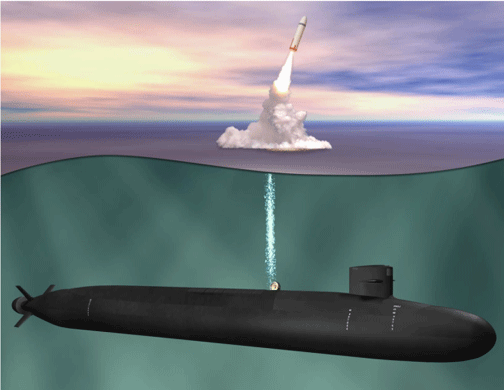
In 2019, a new set of nuclear dangers emerged for Southasia. The growing danger was underscored during the military crisis between India and Pakistan in February 2019, when India put one or more of its nuclear submarines on “operational deployment mode.” During the crisis, the Pakistani Navy claimed to intercept an Indian submarine. No one has confirmed if this interception involved an Indian submarine carrying nuclear weapons. With India and Pakistan on an accelerated programme of acquiring and developing nuclear submarines, Southasia needs to pay urgent attention to the risks of nuclear accidents at sea.
The expansion of nuclear operations to the sea also raises issues about who has the ability to authorise the use of these weapons, especially in a crisis. This is of particular concern in the case of India because it has already deployed such weapons. According to a November 2018 announcement by Prime Minister Narendra Modi, the Arihant nuclear-powered submarine successfully completed its maiden “patrol”.
A further source of concern is the August 2019 announcement by India’s defence minister to the effect that the country’s ‘No First Use’ (NFU) policy – which pledges not to attack with nuclear weapon unless attacked first – “would depend on the circumstances.” His comments, made during a period of increased tension between India and Pakistan following the amendment to Article 370 of India’s Constitution conferring special status to Jammu & Kashmir, underscore these risks.
India’s nuclear submarines……… Strategic competition with China in the Indian Ocean may be another factor. Serving and retired members of India’s Navy publicly express concerns about the deployment of Chinese submarines, warships and tankers in the Indian Ocean.
India’s growing arsenal also makes it a more valuable ally for the United States in its efforts to deal with the growth in China’s political and military power. For some time now, the US and India have been conducting joint naval exercises.
Pakistan’s naval force
Pakistan, for its part, announced the setting up of a Naval Strategic Force Command in 2012. Pakistan’s Navy has started preparing to put nuclear-armed cruise missiles on conventional submarines. The cruise missile is expected to be the 450-kilometer range Babur, which had a successful underwater test launch in 2018. There are reports that Pakistan is seeking to develop or acquire a nuclear-powered submarine…..
Submarine accidents
Almost all the countries operating nuclear-powered or nuclear-armed submarines have experienced accidents, often with significant loss of life and the spread of radioactivity in the environment. There have been over 40 accidents involving nuclear-powered submarines, claiming a total of over 650 lives. Of these accidents, more than half involved Soviet/Russian submarines resulting in over 400 deaths. The United States comes next, with at least a dozen submarine accidents leading to well over 200 deaths.
Two accidents have involved India’s nuclear submarines. …….
It would be unreasonable to expect that no more accidents involving nuclear submarines would ever take place. Nuclear submarines involve many technologies that are susceptible to a range of accidents affecting the submarine, nuclear reactor, missiles and nuclear weapons. All of these are operating under challenging conditions: deep under water, with limited supplies of air and water, possibly under attack. None of these factors is likely to change…….. Should a naval nuclear-reactor accident occur, especially at or near a naval base, coastal city or town the consequences could extend far beyond the vessel and its crew……
Pathways to war
The introduction of nuclear armed submarines, whether diesel or nuclear-fuelled, increases the likelihood of conventional conflicts escalating to a nuclear one. Any use of nuclear weapons would have devastating consequences, especially if the use of nuclear weapons by one country sets off a nuclear response from the other side.
In a military crisis, nuclear armed submarines increase the potential for nuclear war because they open up new risk pathways. The Australian strategist Desmond Ball pointed out in 1985 that “the sea is the only area where nuclear weapon platforms [of adversary states] … actually come into physical contact” and this contact can lead to accidents from several kinds of what seem to be typical naval operations.
There have already been incidents of Indian and Pakistani naval platforms coming into physical contact, for example in 2011, when the Pakistani vessel PNS Babur brushed past India’s INS Godavari. Contact between Navy forces from India and Pakistan might also result from deliberate attempts to attack submarines. Both countries are known to be acquiring anti-submarine warfare capabilities.The consequences of such events could be worse if submarines come into contact with each other during periods of heightened tensions or crises.
During a crisis, there may be inadvertent attacks on submarines carrying nuclear weapons, because these are intermingled with submarines carrying only conventional weapons. One notable instance occurred during the Cuban Missile Crisis, when US ships used practice depth charges against Soviet nuclear-armed submarines. This almost led to the use of nuclear weapons by the Soviet submarine.
Challenges to controlling nuclear weapons
A significant new challenge resulting from the deployment of nuclear weapons at sea is managing command and control. To the extent that such things are publicly known, India and Pakistan were believed to keep their nuclear weapons on land separate from the delivery vehicles, be they missiles or aircraft. This separation makes it harder for the weapons to be used without proper authorisation. With submarines armed with nuclear weapons at sea, this separation may not be possible and so the risk of unauthorised use is greater.
At the same time, one purpose of the nuclear-armed submarine is to be a final fail-safe means of nuclear attack even if a country’s political leadership is killed and its cities destroyed. To serve this role, the nuclear weapons on the submarine cannot rely on timely launch orders from political authorities. A further problem for submarines is that they are supposed to remain hidden from the enemy. Constant communication from the submarine to the military or civilian leadership may make it easier to detect. All of this means that during the time of a crisis, the personnel in a nuclear submarine might be the ones making decisions on whether or not to use nuclear weapons.
Southasians need to consider how they feel about trusting their lives in some future crisis to the restraint of Indian or Pakistani submariners far from home and fearful that their vessel is under attack, trying to decide about launching their nuclear missiles in a ‘use them or lose them’ scenario. The consequences would be devastating.
~Zia Mian is co-director of Princeton University’s Program on Science and Global Security, where he also directs the Project on Peace and Security in South Asia.
~M V Ramana is the Simons Chair in Disarmament, Global and Human Security at the Liu Institute for Global Issues in the School of Public Policy and Global Affairs at the University of British Columbia in Vancouver, Canada.
~Abdul H Nayyar is a physicist and a founder and former President of the Pakistan Peace Coalition, a national network of peace and justice groups. https://himalmag.com/nuclear-dangers-of-the-naval-kind-2019/?fbclid=IwAR0G8NZSV5ANg7Ag7KcuJU_80iv3pNJiqb6E_T12sylV9BaJWIvcZ3Vb_j0
 |
ReplyForward
|
World Nuclear Waste Report (WNWR) to be launched 11th November
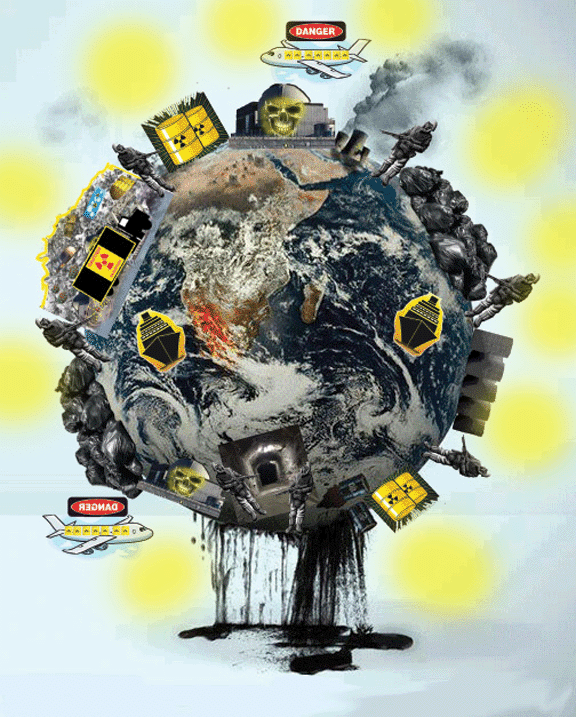 Heinrich-Böll-Stiftung (accessed) 28th Oct 2019, The first edition of the World Nuclear Waste Report (WNWR) – Focus Europe assesses how much waste countries have generated, how much is stored and disposed of. Heinrich-Böll-Stiftung (accessed) 28th Oct 2019, The first edition of the World Nuclear Waste Report (WNWR) – Focus Europe assesses how much waste countries have generated, how much is stored and disposed of.It provides an overview about the estimated costs for management, storage and disposal of nuclear waste and how governments try
to secure funding for these costs. Finally, the report presents a short history of how countries worldwide have been struggling up until today to advance in the search for repositories. The report offers a selection of country studies, including the Czech Republic, France, Germany, Hungary, Sweden, Switzerland, the United Kingdom, and the United States. To be launched in Berlin on 11th November.
https://calendar.boell.de/en/event/launch-world-nuclear-waste-report-wnwr-focus-europe |
|
China Rejects Policy of Nuclear Launch on Warning of an Incoming Attack
Cong also asked nuclear weapons states to take additional steps to diminish the role of nuclear weapons in their national security doctrines, including joining China in publicly committing to never use nuclear weapons first.
The Chinese Foreign Ministry’s criticism of launch on warning comes less than two weeks after Russian president Vladimir Putin announced China was cooperating with Russia “to model a national early warning system.” At present only the United States and Russia have systems that allow them to detect missile launches.
Those systems give both nuclear-armed nations the option to launch a retaliatory response as soon as the system warns them of an incoming missile attack. Russia and the United States keep their missiles on high alert so they are ready for rapid launch on warning.
Both the Russian and the US early warning systems have a history of generating false warnings. The practice of combining those systems with preparations for rapid launch creates the danger that either country could start a nuclear war by mistake.
China’s current policy is to wait to retaliate until after being struck first. It protects its small nuclear force of several hundred nuclear capable missiles from an enemy first strike by hiding them in a large network of underground tunnels. The missiles are kept off alert and the warheads are stored separately. They would be brought together and mated with the missiles only after the Chinese leadership gave the order to prepare for a launch.
Some Chinese officials are concerned recent improvements to US satellite reconnaissance, forward-based radars, precision guidance systems and ballistic missile defenses might lead US decision makers to believe China’s nuclear forces could be neutralized, allowing the United States to strike China first without fear of nuclear retaliation. Recent improvements to Chinese nuclear forces, in particular the development of a longer range intercontinental ballistic missile that can carry multiple warheads, are intended to convince US decision-makers not to take that risk.
Several years ago researchers at the Chinese Academy of Military Science (AMS) suggested China could eliminate concerns about the vulnerability of its nuclear forces by moving to a launch on warning posture. Fu Cong responded to a question about the AMS suggestion by stating that in his view a launch on warning posture would be incompatible with China’s long-standing promise not to use nuclear weapons first under any circumstances.
Cong also said he was unaware of Putin’s statement on cooperation on an early warning system, but that the existence of such a project did not imply that China would change its nuclear policy and shift to a launch on warning posture. Such a change would also require China to keep its missiles on constant alert with warheads attached so that they could be launched quickly. A former director of China’s nuclear weapons lab told me privately that the cooperative project with Russia on warning technology would increase China’s overall situational awareness but would not lead to a change China’s nuclear doctrine, policy or practice.
New plan for dealing with Fukushima’s radioactive water
FoE Japan 5th Oct 2019, Fukushima, On October 3, the Citizens’ Committee on Nuclear Energy, whose members include academics, technical experts, and NGOs, made a new proposal to deal with contaminated water from the damaged Fukushima Daiichi Nuclear Plant after the water has been treated.
The proposal, submitted to Ministry of Economy, Trade and Industry (METI), the Ministry of the Environment (MOE), and the Nuclear Regulation Authority, is to convert the treated water to solid form by mixing with mortar, and storing it on land. Citizens’Comittee on Nuclear Energy (CCNE).
Brexit’s threat to Scotland’s environmental protection
Environment Protection Agency, the national regulator, said there was a
need for a “new and coherent” governance system to act as a safeguard once
EU protections and oversight disappear after Britain’s departure from the
bloc. Last year, The Herald revealed Scottish Environment LINK’s concerns
that Scotland’s rarest species north of the Border face being obliterated
in the fall-out from Brexit unless urgent new laws and funding are brought
in to safeguard vital conservation work.https://www.heraldscotland.com/news/17996856.scots-natural-environment-risk-inadequate-brexit-plans/
Misuse of funds in South Africa”s nuclear reactor project
Is this outfit similar to Australia’s ANSTO and its Lucas Heights reactor? They both seem like mavericks running their own show without accountability
The letter reveals that Necsa has been making massive operating losses since 2014, which have deteriorated over the years, and has resulted in various ring-fenced funds being irregularly used to meet operating expenses, including salaries.
For example, the letter says that in financial year (FY) 2018/19, Necsa raided R268-million from the Safari low-enriched uranium (LEU) spent Fuel Waste Disposal Fund, which was meant for future disposal of spent nuclear fuel waste, in order to meet operating costs.
The Safari-1 reactor became one of Necsa’s cornerstone facilities, especially during the mid 1990’s, where it’s main application was to be a cost-sustainable facility operating as a commercial production facility of radioisotopes and the rendering of irradiation services.
Furthermore, in FY 2017/18, the letter indicates that Necsa borrowed R58,5-million from its subsidiary, NTP Radioisotopes, which was to be repaid in 2019, but was subsequently unilaterally extended to 2021 when it became clear that Necsa could not afford to repay NTP Radioisotopes.
In FY 2016/17, Necsa is said to have used R100-million of investments of the Safari LEU Spent Fuel Waste Disposal Fund as security for a R100-million overdraft facility from Nedbank, which the bank later withdrew due to the absence of a turnaround strategy to address Necsa’s strained financial position.
This, according to the letter, then forced Necsa to raid R100-million from the Safari LEU Spent Fuel Waste Disposal Fund to meet operating costs, and this R100-million was later repaid to the Fund from government grant funding.
The effect of the unconventional funding interventions in previous years, says the letter, was that about R445-million of ring-fenced funds were used for operations, despite being meant for other purposes, thus negatively affecting Necsa’s liquidity and solvency.
The letter further says that Necsa has been technically bankrupt since about 2016, and has survived using ring-fenced funds, which has cumulatively had an impact on the going concern status on the entity – a challenge which the current board is now faced with.
This letter from the new Necsa board to Parliament follows a damning audit report by the Auditor General of South Africa detailing the maladministration and irregular expenditure under the former Necsa board. The qualified audit report was attached Necsa’s financial statements for FY 2017/18, which were tabled about six months late by the former board.
Necsa’s financial statements for FY 2018/19 are also late, as the new board grapples with the political turmoil and disruptive actions by labour union NEHAWU. It is expected that there will be further explosive revelations by the Auditor General.
The entire former board of Necsa was removed by the former minister of energy, Jeff Radebe, in December 2018, and there is ongoing litigation in this regard.
Group Opposed to Nuclear Bailout Turns to Courts After Petition Drive Fails
Ohioans Against Corporate Bailouts says they didn’t have enough signatures to qualify for a referendum by the deadline.
The group’s Gene Pierce says their referendum drive has been met with heavy opposition, including ads, mailers, and canvassers who allegedly blocked and harassed signature collectors.
“The bottom line is that the smear campaign and the lies and deceit of the House Bill 6 supporters were successful in confusing Ohioans and discouraging them from signing our petition,” Pierce said.
The anti-nuclear bailout group is still hoping a federal court will extend the deadline to collect signatures based on their arguments that they’ve faced unconstitutional hurdles.
“We’re very disappointed we couldn’t put an immediate stay on the very bad bill from going into effect but we’re hoping that the courts will recognize the constitutional rights that we have,” Pierce said.
France’s government demands that EDF fix Flamanville nuclear reactor within one month
EDF given a month to draw up a fix for Flamanville’s nuclear woes French energy group under pressure to address faults highlighted in a new report. https://www.ft.com/content/877eedae-f987-11e9-a354-36acbbb0d9b6 David Keohane in Paris, 28 Oct 19.

Ratification of Coal Mine? NO!! NO!! NO!! —

Originally posted on Keep Cumbrian Coal in the Hole: sent to press COUNCIL PLAN TO RATIFY OUTRAGEOUS ‘YES’ TO COAL MINE Back in spring of this year the first deep coal mine in the UK in decades was given unanimous approval by Cumbria County Council. COKING COAL AND JOBS. Following the threat of legal action…
1 This Month
Chernobyl: The Lost Tapes – A good documentary on Chernobyl on SBS available On Demand for the next 3 weeks– https://www.sbs.com.au/ondemand/tv-program/chernobyl-the-lost-tapes/2352741955560

of the week–London Campaign for Nuclear Disarmament

Tell the Ukrainian Government to Drop Prosecution of Peace Activist Yurii Sheliazhenko
To see nuclear-related stories in greater depth and intensity – go to https://nuclearinformation.wordpress.com
-
Archives
- April 2026 (126)
- March 2026 (251)
- February 2026 (268)
- January 2026 (308)
- December 2025 (358)
- November 2025 (359)
- October 2025 (376)
- September 2025 (257)
- August 2025 (319)
- July 2025 (230)
- June 2025 (348)
- May 2025 (261)
-
Categories
- 1
- 1 NUCLEAR ISSUES
- business and costs
- climate change
- culture and arts
- ENERGY
- environment
- health
- history
- indigenous issues
- Legal
- marketing of nuclear
- media
- opposition to nuclear
- PERSONAL STORIES
- politics
- politics international
- Religion and ethics
- safety
- secrets,lies and civil liberties
- spinbuster
- technology
- Uranium
- wastes
- weapons and war
- Women
- 2 WORLD
- ACTION
- AFRICA
- Atrocities
- AUSTRALIA
- Christina's notes
- Christina's themes
- culture and arts
- Events
- Fuk 2022
- Fuk 2023
- Fukushima 2017
- Fukushima 2018
- fukushima 2019
- Fukushima 2020
- Fukushima 2021
- general
- global warming
- Humour (God we need it)
- Nuclear
- RARE EARTHS
- Reference
- resources – print
- Resources -audiovicual
- Weekly Newsletter
- World
- World Nuclear
- YouTube
-
RSS
Entries RSS
Comments RSS
 nuclear-news