Desertification and Drought – Sahara
|
COMBATING DESERTIFICATION AND DROUGHT
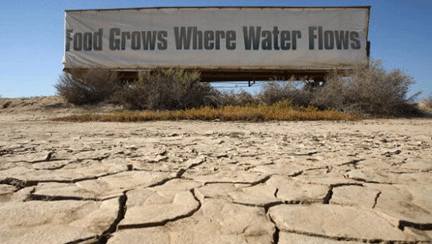
Displaced by the Desert: An expanding Sahara leaves Broken Families and Violence in its Wake, IPS News By Issa Sikiti da Silva 25 Oct 19, “……… In 2012, various groups of Tuareg rebels grouped together to form and administer a new northern state called Azawad. The civil strife that resulted drove many from their homes, with communities often fleeing with their livestock, only to compete for scarce natural resources in vulnerable host communities, according to the United Nations.
After the security situation began to improve in 2013, many returned home to rebuild their lives and livelihoods. But soon it was the turn of the expanding Sahara Desert, drought and land degradation that became the next driver of their displacement. “As time went by, the land became useless and we found ourselves having no more land to work on. Nothing would come out that could feed us, and our livestock kept dying due the lack of water and grass to eat, ” Abdoulaye recalls. “Drought across the Sahel region, followed by conflict in northern Mali, caused a major slump in the country’s agricultural production, reducing household assets and leaving many of Mali’s poor even more vulnerable,” FAO says. “We used to move up and down with our livestock, looking for water and grass, but most of the times we found none. Life was unliveable. The Sahara is coming down, very fast,” Abdoulaye says emotionally……….. Threatened with creeping desertification …The U.N. says nearly 98 percent of Mali is threatened with creeping desertification, as a result of nature and human activity. Besides, the Sahara Desert keeps expanding southward at a rate of 48 km a year, further degrading the land and eradicating the already scarce livelihoods of populations, Reuters reported. The Sahara, an area of 3.5 million square miles, is the largest ‘hot’ desert in the world and home to some 70 species of mammals, 90 species of resident birds and 100 species of reptiles, according to DesertUSA. And it is expanding, its size is registered at 10 percent larger than a century ago, LiveScience reported. The Sahel, the area between The Sahara in the north and the Sudanian Savanna in the south, is the region where temperatures are rising faster than anywhere else on Earth. The cost of land degradation is currently estimated at about $490bn per year, much higher than the cost of action to prevent it, according to UNCCD recent studies on the economics of land desertification, land degradation and drought. Roughly 40 percent of the world’s degraded land is found in areas with the highest incidence of poverty and directly impacts the health and livelihoods of an estimated 1.5 billion people, according to the U.N. In a country where six million tonnes of wood is used per year, reports say Malians are mercilessly smashing their already-fragile landscape, bringing down 4,000 square kilometres of tree cover each year in search for timber and fuel……….. What is being done?Projects such as the U.N. Convention to Combat Desertification’s Land Degradation Neutrality project aimed at preventing and/or reversing land degradation are some of the interventions to stop the growing desert.
Everyone, including terrorists are equal in the face of the expanding SaharaBut there remain gaps and many in Mali still remain affected. Community leader Hassan Badarou spent several years teaching Islam in rural Mali and Niger. He tells IPS Mali has a very complex situation. “It is not easy to live in these areas. People there face double threats. It is double stress to flee from both armed conflict and desertification. And such people need to be welcomed and assisted, and not be seen as a threat to locals livelihoods……….. http://www.ipsnews.net/2019/10/displaced-desert-expanding-sahara-leaves-broken-families-violence-wake/?utm_source=English+-+IPS+Weekly&utm_campaign=2391e81e36-EMAIL_CAMPAIGN_2019_10_24_01_01&utm_medium=email&utm_term=0_eab01a56ae-2391 |
|
1 Comment »
Leave a comment
1 This Month



Tell the Ukrainian Government to Drop Prosecution of Peace Activist Yurii Sheliazhenko

Petition to revoke the licensing of the Near Surface Nuclear Disposal Facility (NSDF) at Chalk River. https://www.ourcommons.ca/petitions/en/Petition/Details?Petition=e-7247


of the week – STOP SMALL MODULAR REACTORS IN CANADA
To see nuclear-related stories in greater depth and intensity – go to https://nuclearinformation.wordpress.com
-
Archives
- March 2026 (222)
- February 2026 (268)
- January 2026 (308)
- December 2025 (358)
- November 2025 (359)
- October 2025 (376)
- September 2025 (258)
- August 2025 (319)
- July 2025 (230)
- June 2025 (348)
- May 2025 (261)
- April 2025 (305)
-
Categories
- 1
- 1 NUCLEAR ISSUES
- business and costs
- climate change
- culture and arts
- ENERGY
- environment
- health
- history
- indigenous issues
- Legal
- marketing of nuclear
- media
- opposition to nuclear
- PERSONAL STORIES
- politics
- politics international
- Religion and ethics
- safety
- secrets,lies and civil liberties
- spinbuster
- technology
- Uranium
- wastes
- weapons and war
- Women
- 2 WORLD
- ACTION
- AFRICA
- Atrocities
- AUSTRALIA
- Christina's notes
- Christina's themes
- culture and arts
- Events
- Fuk 2022
- Fuk 2023
- Fukushima 2017
- Fukushima 2018
- fukushima 2019
- Fukushima 2020
- Fukushima 2021
- general
- global warming
- Humour (God we need it)
- Nuclear
- RARE EARTHS
- Reference
- resources – print
- Resources -audiovicual
- Weekly Newsletter
- World
- World Nuclear
- YouTube
-
RSS
Entries RSS
Comments RSS
 nuclear-news
Great post 😊