Why nuclear reactors are the perfect missile target in the Middle East, or anywhere, really
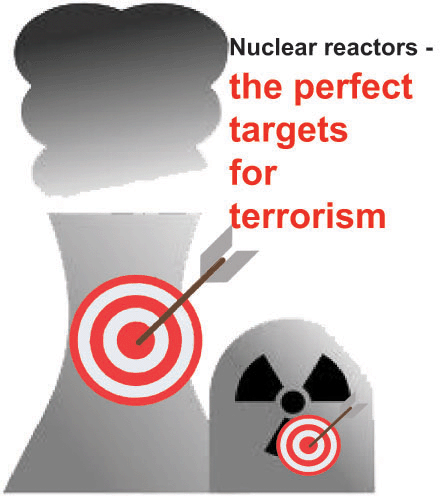
Saudi Arabia has plans to build an array of large nuclear power plants. Next door, the United Arab Emirates is spending $20 billion to complete four commercial reactors at Barakah. Egypt and Turkey both have begun constructing two massive Russian-designed nuclear power plants. Meanwhile, Iran has two operating reactors and has begun constructing two more. After Iran’s Sept. 14 missile attack against Saudi Arabia, though, all of these plants risk being wiped out.
Precision guided missiles are the reason why. Shortly after the Iranian attack on Saudi Arabia, pictures revealed each of the oil tanks struck at Abqaiq were hit in the exact same spot. The missiles’s estimated accuracy was one meter. That makes even the hardiest of large reactors easy marks. Rather than target the most protected part of the plant, the large concrete containment building covering the reactor’s core, accurate missiles can put key auxiliary reactor facilities at risk.
One such aim point is the power plant’s emergency electrical diesel generator building. Knock the generators out and you deprive the reactor of emergency backup power needed to keep its safety and coolant pump systems operating when external, grid-supplied electricity is cut off by blackouts, storms, or attacks.
Then, there are the main electrical power lines coming into the plant. Hit both of these and the emergency diesel backup generators and you rob the plant’s coolant pumps and safety systems of all power. Reactor core meltdowns and fuel fires in the reactor’s spent fuel storage pond are assured (similar to Fukushima).
Yet, another aim point is the reactor’s control room, which is often located outside the reactor’s containment walls. Knock it out and you lobotomize the plant, which again will set the reactor on a meltdown trajectory.
Finally, there’s the reactor’s spent fuel storage pond building. If it is hit and subsequently drained of coolant, the spent fuel it contains will catch fire, risking a major release of radioactivity.
How large of a release? The U.S. Nuclear Regulatory Commission estimated a spent fuel fire at a typical power plant would likely discharge 100 times as much damaging radiation as was spread in the Fukushima accident. Accordingly, the Nuclear Regulatory Commission projected a desired evacuation area more than 700 times larger than what the Fukushima accident required.
Some nuclear reactor owners recognize the risks of aerial attacks. Belarus just announced its deployment of modern air and missile defenses to counter possible military attacks against its new nuclear plant. Iran and Algeria have air-defended their reactors, as has Israel. UAE officials also have suggested they have such systems.
But will they work against the kind of high-accuracy missiles Iran fired at the Saudis? In the September attack, all 25 of the low-flying attack drones and missiles flew undetected. None of Riyadh’s air defenses (which included U.S. Patriot, German Skyguard, and French Shahine systems) engaged.
Yet, some experts doubt any current air defense system could do any better. The Pentagon’s top policy official and Israel’s prime minister were both rattled by the Saudi attack. The United States publicly warned that NATO currently can’t cope with such low-flying missiles. Israeli Prime Minister Benjamin Netanyahu called for a crash multibillion-dollar Israeli air defense development program to deal with them. Securing such defenses won’t be easy.
In the meantime, Middle Eastern states need more large reactors like a hole in the head. That goes for Iran, Turkey, Egypt, the UAE, Jordan, Morocco, and Algeria, as well as Saudi Arabia. In fact, no one in the natural gas and the sun-drenched Middle East needs nuclear power. Renewable and gas-fired electricity are much cheaper, quicker to build, and far less provocative…..https://www.washingtonexaminer.com/opinion/the-ultimate-middle-east-missile-target-nuclear-reactors
No comments yet.
1 This Month

of the week – Shut Down Drone Warfare!


Tell the Ukrainian Government to Drop Prosecution of Peace Activist Yurii Sheliazhenko

Petition to revoke the licensing of the Near Surface Nuclear Disposal Facility (NSDF) at Chalk River. https://www.ourcommons.ca/petitions/en/Petition/Details?Petition=e-7247
To see nuclear-related stories in greater depth and intensity – go to https://nuclearinformation.wordpress.com
-
Archives
- March 2026 (230)
- February 2026 (268)
- January 2026 (308)
- December 2025 (358)
- November 2025 (359)
- October 2025 (376)
- September 2025 (257)
- August 2025 (319)
- July 2025 (230)
- June 2025 (348)
- May 2025 (261)
- April 2025 (305)
-
Categories
- 1
- 1 NUCLEAR ISSUES
- business and costs
- climate change
- culture and arts
- ENERGY
- environment
- health
- history
- indigenous issues
- Legal
- marketing of nuclear
- media
- opposition to nuclear
- PERSONAL STORIES
- politics
- politics international
- Religion and ethics
- safety
- secrets,lies and civil liberties
- spinbuster
- technology
- Uranium
- wastes
- weapons and war
- Women
- 2 WORLD
- ACTION
- AFRICA
- Atrocities
- AUSTRALIA
- Christina's notes
- Christina's themes
- culture and arts
- Events
- Fuk 2022
- Fuk 2023
- Fukushima 2017
- Fukushima 2018
- fukushima 2019
- Fukushima 2020
- Fukushima 2021
- general
- global warming
- Humour (God we need it)
- Nuclear
- RARE EARTHS
- Reference
- resources – print
- Resources -audiovicual
- Weekly Newsletter
- World
- World Nuclear
- YouTube
-
RSS
Entries RSS
Comments RSS
 nuclear-news
Leave a comment