Why nuclear reactors are the perfect missile target in the Middle East, or anywhere, really
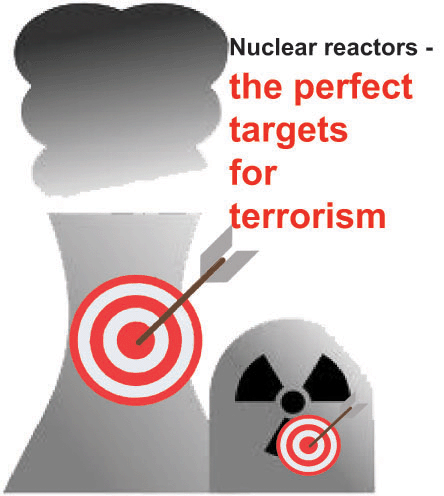
Saudi Arabia has plans to build an array of large nuclear power plants. Next door, the United Arab Emirates is spending $20 billion to complete four commercial reactors at Barakah. Egypt and Turkey both have begun constructing two massive Russian-designed nuclear power plants. Meanwhile, Iran has two operating reactors and has begun constructing two more. After Iran’s Sept. 14 missile attack against Saudi Arabia, though, all of these plants risk being wiped out.
Precision guided missiles are the reason why. Shortly after the Iranian attack on Saudi Arabia, pictures revealed each of the oil tanks struck at Abqaiq were hit in the exact same spot. The missiles’s estimated accuracy was one meter. That makes even the hardiest of large reactors easy marks. Rather than target the most protected part of the plant, the large concrete containment building covering the reactor’s core, accurate missiles can put key auxiliary reactor facilities at risk.
One such aim point is the power plant’s emergency electrical diesel generator building. Knock the generators out and you deprive the reactor of emergency backup power needed to keep its safety and coolant pump systems operating when external, grid-supplied electricity is cut off by blackouts, storms, or attacks.
Then, there are the main electrical power lines coming into the plant. Hit both of these and the emergency diesel backup generators and you rob the plant’s coolant pumps and safety systems of all power. Reactor core meltdowns and fuel fires in the reactor’s spent fuel storage pond are assured (similar to Fukushima).
Yet, another aim point is the reactor’s control room, which is often located outside the reactor’s containment walls. Knock it out and you lobotomize the plant, which again will set the reactor on a meltdown trajectory.
Finally, there’s the reactor’s spent fuel storage pond building. If it is hit and subsequently drained of coolant, the spent fuel it contains will catch fire, risking a major release of radioactivity.
How large of a release? The U.S. Nuclear Regulatory Commission estimated a spent fuel fire at a typical power plant would likely discharge 100 times as much damaging radiation as was spread in the Fukushima accident. Accordingly, the Nuclear Regulatory Commission projected a desired evacuation area more than 700 times larger than what the Fukushima accident required.
Some nuclear reactor owners recognize the risks of aerial attacks. Belarus just announced its deployment of modern air and missile defenses to counter possible military attacks against its new nuclear plant. Iran and Algeria have air-defended their reactors, as has Israel. UAE officials also have suggested they have such systems.
But will they work against the kind of high-accuracy missiles Iran fired at the Saudis? In the September attack, all 25 of the low-flying attack drones and missiles flew undetected. None of Riyadh’s air defenses (which included U.S. Patriot, German Skyguard, and French Shahine systems) engaged.
Yet, some experts doubt any current air defense system could do any better. The Pentagon’s top policy official and Israel’s prime minister were both rattled by the Saudi attack. The United States publicly warned that NATO currently can’t cope with such low-flying missiles. Israeli Prime Minister Benjamin Netanyahu called for a crash multibillion-dollar Israeli air defense development program to deal with them. Securing such defenses won’t be easy.
In the meantime, Middle Eastern states need more large reactors like a hole in the head. That goes for Iran, Turkey, Egypt, the UAE, Jordan, Morocco, and Algeria, as well as Saudi Arabia. In fact, no one in the natural gas and the sun-drenched Middle East needs nuclear power. Renewable and gas-fired electricity are much cheaper, quicker to build, and far less provocative…..https://www.washingtonexaminer.com/opinion/the-ultimate-middle-east-missile-target-nuclear-reactors
No such thing as a zero- or close to zero-emission nuclear power plant.
 David Lowry, Guardian 21st Oct 2019: in the analysis
 of MPs’ voting record on bills to combat climate change (Tories five times more likely than other MPs to vote against bills to tackle climate crisis, 12 October), both Jeremy Corbyn and Caroline Lucas are marked as 92% supportive on the basis they voted to
“keep nuclear power subsidies relatively low”.
Proposed Solution to Global Warming, Air Pollution, and Energy Security, in
his forthcoming book, 100% Clean, Renewable Energy and Storage for
Everything, Jacobson argues: “There is no such thing as a zero- or close to
zero-emission nuclear power plant. Even existing plants emit due to the
continuous mining and refining of uranium needed for the plant. Overall
emissions from new nuclear are 78 to 178g of CO2/kWH, not close to 0.”
https://www.theguardian.com/environment/2019/oct/21/tory-boasts-on-climate-action-are-full-of-hot-air
Climate change: Permafrost is now becoming a carbon emitter
|
Climate change has turned permafrost into a carbon emitter, Tundra plants can’t absorb enough carbon in summer to make up for carbon released in winter, CBC, Bob Weber · The Canadian Press Oct 22, 2019 Research has found Arctic soil has warmed to the point where it releases more carbon in winter than northern plants can absorb during the summer.
The finding means the extensive belt of tundra around the globe — a vast reserve of carbon that dwarfs what’s held in the atmosphere — is becoming a source of greenhouse gas emissions responsible for climate change. “There’s a net loss,” said Dalhousie University’s Jocelyn Egan, one of 75 co-authors of a paper published in Nature Climate Change. “In a given year, more carbon is being lost than what is being taken in. It is happening already.” The research by scientists in 12 countries and from dozens of institutions is the latest warning that northern natural systems that once reliably kept carbon out of the atmosphere are starting to release it………. Emissions speeding upWhat’s more, the pace of the emissions is likely to increase. Under a business-as-usual scenario, emissions from northern soil would be likely to release 41 per cent more carbon by the end of the century. But the Arctic is already warming at three times the pace of the rest of the globe. Even if significant mitigation efforts are made, those emissions will increase by 17 per cent, said the report. Egan notes the research didn’t measure methane, a greenhouse gas about 30 times more potent than carbon dioxide that is also released from soil. Her findings echo previous studies. Last summer, research suggested that larger, hotter wildfires are turning boreal forests into carbon sources. Another paper found that instead of melting slowly and steadily, permafrost is subject to sudden collapses that speed up the rate of carbon release. Mitigation won’t stop the problem any more, said Egan, but it will help.https://www.cbc.ca/news/technology/permafrost-climate-change-1.5330144 |
|
|
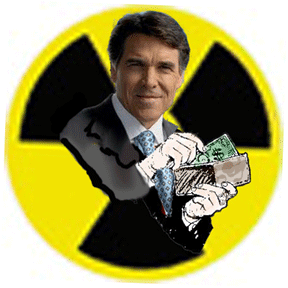
Rick Perry, as Energy Secretary, “solved” nuclear waste problem by reclassifying high level waste as low level
|
Perry’s Odd Definition of Progress on Nuclear Waste https://www.nrdc.org/experts/caroline-reiser/perrys-odd-definition-progress-nuclear-waste, October 22, 2019 Caroline Reiser
After months of suspense, Energy Secretary Rick Perry finally confirmed he will resign, boasting in a farewell tweet that under his leadership the Department of Energy “made environmental progress unseen for decades cleaning up the legacy of the Manhattan Project.” —What’s that now? Where exactly are the “numerous” legacy sites that Perry claims the Department tackled? All the Department of Energy has done under Perry is weaken standards and renege on promises by finding ways to abandon the world’s most toxic chemical and radioactive waste in place. To give a brief history of the legacy Perry is referring to, the Manhattan Project is the name of the World War II era research and development effort that led to the first several nuclear weapons, including those used to destroy Hiroshima and Nagasaki. In the atomic arms race of the Cold War, the Department of Energy and its predecessor agencies continued to design, test, and manufacture nuclear weapons but on a vaster scale—ultimately manufacturing over 30,000 nuclear weapons. Making nuclear weapons is not a clean business. Every country that has built a nuclear arsenal has harmed its own people and environment in the process. Nuclear production created a so-called “legacy” of profoundly contaminated radiological and chemical waste sites. There are dozens of these legacy waste sites across the United States; the largest three are the Idaho National Engineering and Environmental Laboratory, the South Carolina Savannah River Site, and the Washington Hanford site (which many consider one of the most contaminated sites in the Western Hemisphere). To give you a picture of the scale in terms of size and danger, the Hanford site hosts 177 tanks. The tanks range from 55,000 gallons to more than a million gallons of radioactive and chemical waste each. That’s from about 20 semi-trucks full to about two Olympic sized swimming pools. And even brief exposure to a small portion of that waste can be deadly. So what happened at these sites under Perry? Not much. The most far-reaching action the Department of Energy took under Secretary Perry was to give itself permission to “reclassify” highly toxic radioactive waste. The Department’s new stance is that it can magically decide that certain High-Level Waste is now Low-Level Waste without oversight from the Environmental Protection Agency, states, or tribes. With this authority, the Department of Energy no longer has to permanently isolate from the environment High-Level Waste, but instead can abandon hundreds of gallons of the most toxic waste at sites like Hanford. So really the only way Perry could be said to have cleaned up this toxic waste is by “recategorizing” it as something less dangerous than it is, and then (metaphorically) washing his hands of it. The Perry-led Department of Energy will also be remembered for breaking promises. In addition to the promises the Department is breaking by reclassifying High-Level Waste, the Department is also breaking promises to clean up smaller sites as well. For example, the Santa Susana Field Laboratory sits in the golden hills of California, right on the outskirts of Los Angeles’s urban sprawl. In 2010, the Energy Department agreed to clean up the site to what’s called “background levels,” meaning the normal levels of radiation one could expect to find at the site before industry intervened. But the Perry Energy Department decided this agreement didn’t matter – it now plans to leave in place the vast majority of the contamination and to act without consent from California. Both Washington and California are pushing back against the Department of Energy’s broken promises. And it’s clear that if the Department gets away with it at these sites, it will do the exact same thing at other sites across the country. So, for Secretary Perry’s tweet to be true, he must have a strange definition of “progress.” Maybe he means progress in abandoning the Department of Energy’s obligation to clean up the mess it made. Maybe he means progress in speeding up transferring the responsibility of managing highly toxic sites back to states, tribes, and local communities. Maybe he means progress in cutting corners to favor cost over health and safety. All I can say is that I hope the next Secretary and I have a more similar idea of what progress looks like. The Department of Energy can do better. President Trump has already nominated Dan Broulliette as a replacement for Perry. If Broulliette wants to make actual progress on America’s nuclear waste legacies, he needs to stop wasting time trying to get away with doing less – do the work and do it right. Given the track record of the last few years, there’s ample reason for skepticism. But I would love to be proven wrong. |
|
Highly toxic nuclear waste being imported into Russia, from Germany
 Russia Is Importing Toxic Nuclear Waste From Germany, Greenpeace Warns, https://www.themoscowtimes.com/2019/10/23/russia-is-importing-toxic-nuclear-waste-from-germany-greenpeace-warns-a67873 A European uranium enrichment firm has resumed shipments of a highly toxic and radioactive waste product from Germany to Russia, Greenpeace Russia warned Wednesday. Russia Is Importing Toxic Nuclear Waste From Germany, Greenpeace Warns, https://www.themoscowtimes.com/2019/10/23/russia-is-importing-toxic-nuclear-waste-from-germany-greenpeace-warns-a67873 A European uranium enrichment firm has resumed shipments of a highly toxic and radioactive waste product from Germany to Russia, Greenpeace Russia warned Wednesday.
The enrichment firm Urenco and Russia’s state nuclear company Rosatom halted the radioactive waste imports from Germany in 2009 over revelations that the waste was stored in the open. German media reported Tuesday that Urenco had resumed exports of the toxic compound used to enrich uranium, sending up to 3,600 metric tons to central Russia in May-October 2019. “Russia should not become a radioactive burial ground for the rest of the world,” Greenpeace’s energy campaigner Rashid Alimov said, demanding the release of government documents and punishment of officials responsible for resumed shipments. Urenco plans to send 12,000 metric tons of uranium hexafluoride to Russia in 2019-2022, the Die Tageszeitung newspaper reported, citing officials’ communications. Greenpeace estimates that Russia has stored 1 million metric tons of the uranium hexafluoride, a waste product known as “tails.” Vyacheslav Alexandrov, the head of the state-run radioactive waste management operator’s Novouralsk branch where Urelco had reportedly sent the “tails,” said Russia prohibits nuclear-waste imports and expressed surprise over Greenpeace’s warning. In comments to the Znak.com news website, Alimov agreed with Alexandrov that “Russia formally observes the law” but contended that about 90% of the imported toxic “tails” remain in Russia after enrichment. |
|
UK govt postpones decision on Wylfa nuclear project
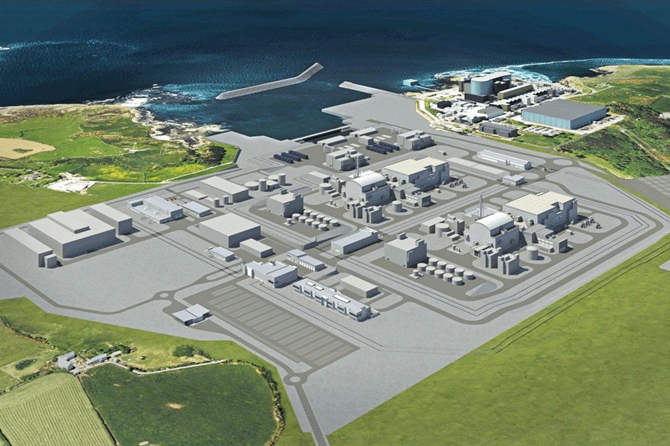 Wylfa: Anglesey nuclear power plant planning decision deferred, BBC,
She had been widely expected to back the proposals, granting what is known as a development consent order (DCO).
Hitachi shelved the scheme, the biggest energy project ever proposed in Wales, over funding issues.
Developers Horizon Nuclear Power had earlier said the decision would “heavily influence” how the project progresses.
Ms Leadsom has now given a deadline by the end of the year – and invited comments from Natural Resources Wales, the Office for Nuclear Regulation, Anglesey council and other bodies. She wants more assurances on various aspects – from biodiversity, visual impact, flooding and construction noise – and any risk to the Sandwich tern, which has a colony nearby.…….
Opponents of nuclear power have called on Ms Leadsom to dismiss the planning application and focus on renewable sources of electricity. Dylan Morgan of People Against Wylfa B said it was “obvious the developers are keen to get planning permission in order to try and sell the site”.
“But that’s easier said than done at the moment given the pretty perilous state of the global nuclear industry and the hopeless economics.”……. https://www.bbc.com/news/uk-wales-50139360
Uninsurable – and for good reason – nuclear power
|
Nuclear energy is too costly and risky; better alternatives exist https://www.jhnewsandguide.com/opinion/columnists/common_ground/nuclear-energy-is-too-costly-and-risky-better-alternatives-exist/article_71a11439-581d-572f-87c7-88dad34ddf74.html Common Ground / By Paul W. Hansen , 23 Oct 19 In last week’s Guest Shot the director of the Idaho National Lab (INL) Mark Peters wrote to open a dialogue with News&Guide readers about nuclear energy. I want to take him up on his offer. First, what we agree on. Nuclear energy produces about 20% of the nation’s electricity, which is about 8% of our total energy use. Overall, we need to produce and use energy that minimizes greenhouse gases. Looking at the troubled history, poor economics, attendant risk and unsolved problem of nuclear waste disposal, I think there are much better alternatives for producing carbon free energy. Today, there are 97 nuclear reactors in 29 states that produce electricity. Thirty-four reactors have been shut down. More orders for nuclear plants have been canceled than plants have been built. Only one plant has come online in the last 25 years. Early claims that nuclear power would be “too cheap to meter” proved false. Despite extensive public subsidies, nuclear plants across America have faced significant cost overruns. For example, the Washington Public Power Supply System defaulted on $2.25 billion in municipal bonds when cost overruns on two units caused the cancellation of two other units. The Shoreham Nuclear Power Plant on Long Island was completed in 1985, but never operated when an evacuation plan could not be implemented. The plant was decommissioned. The $6 billion cost of the unused plant was passed on to Long Island residents. Attempts to build new nuclear plants have been even more challenging. During the 1980s, the cost of Plant Vogtle’s first two nuclear units near Augusta, Georgia, jumped from an estimated $660 million to $8.87 billion. Regardless, 20 years later Georgia Power wanted to build the “next generation” of nuclear power plants. In August 2008, it was estimated that Plant Vogtle reactors 3 and 4 would cost $14.3 billion and begin operations in 2017. Today, updated estimates put the cost at $28 billion with an operation date of November 2022. The project is projected to be $14 billion over budget and more than 5 years behind schedule. The builder of the reactors, Westinghouse, has declared bankruptcy. In 2017, a similar two-unit plant in South Carolina, the V.C. Summer plant, was abandoned — costing about $5 billion. Concerns over the transportation and storage of highly radioactive spent nuclear fuel have prevented any nuclear waste repositories from being developed in the U.S. Spent fuel rods are stored onsite at nuclear plants. When uranium fuel is used up, usually after about 18 months, the spent rods are generally moved to deep pools of circulating water to cool down for about 10 years. The radioactive material is then transferred to metal casks. The waste remains dangerously radioactive for about 10,000 years. There is no plan for permanent disposal of this waste. This brings me to my biggest concern — the fact that those in our society whose business it is to determine risk will not insure nuclear power. If you own a home, look at your homeowner’s insurance policy. You are not covered in the event of a nuclear accident. No one is. The nuclear industry exists only due to the liability limitations granted by Congress in the Price Anderson Act. Price Anderson requires the nuclear industry to fund an account of $12.6 billion. Any liability above that is supposed to be covered by taxpayers. Then there are the issues of long-term decommissioning costs, nuclear accidents or terrorists. In Chernobyl and Fukushima, nuclear accidents have left large areas uninhabitable. What if the 9/11 terrorists had managed to crash those planes into the Indian Point Nuclear Power Plant north of New York City? While the reactor containment vessel might have survived the impact, the spent fuel rod pools may not have, leaving much of the New York metropolitan area uninhabitable. Nuclear energy has not worked out as planned. Far more carbon-free power can be generated at far less cost and risk by renewable energy and energy efficiency programs. |
|
High Radiation Along Planned Moscow Highway Route
Greenpeace Finds High Radiation Along Planned Moscow Highway Route, Moscow Times, Oct. 21, 2019, Soil samples taken along the route of a planned highway in Moscow are emitting radiation levels that pose cancer risks to residents, Greenpeace Russia said Monday.
Activists have warned that the eight-lane highway, which authorities hope to start building next year and finish by 2024, will release buried radioactive dust into the air and the Moscow River.
“We now have official proof that radioactive waste lies on the route and not somewhere nearby,” Greenpeace Russia said Monday.
Greenpeace demanded in July that construction be halted, months after state-run safety tests revealed radiation levels near the planned highway 200 times higher than the norm.
The NGO and hired experts found five locations on the highway route between the Moscow Polymetals Plant and the Moskvorechye commuter rail station where topsoil emitted up to eight times the normal level of radiation.
“Borehole measurements half a meter deep showed greater [radiation] values than on the surface,” Greenpeace said…….https://www.themoscowtimes.com/2019/10/21/greenpeace-finds-high-radiation-along-planned-moscow-highway-route-a67834
Columbia nuclear fuel factory in trouble again, with safety problems
The Westinghouse nuclear plant discovered last week that it had a device in place that was not adequate to prevent uranium from leaking into chemical supply drums at the site, federal records show.
That’s potentially significant because the drums were in a “non-favorable’’ position, which under certain circumstances could increase chances of a radiation burst inside the 1,000-employee plant.
The Nuclear Regulatory Commission is looking into the matter, reported by Westinghouse to the agency Oct. 16. Westinghouse shut down part of the plant where the improper equipment was found, a spokesman for the NRC said this week………
The nuclear fuel factory, one of only three of its kind in the country, has a long history of incidents, including events in which some workers were exposed to radiation or injured. But concerns have intensified in recent years among people who live in eastern Richland County, near the plant.
Since 2016, the facility has run afoul of federal regulators for allowing uranium to build up in an air pollution control device, leaking uranium through a hole in the plant floor and failing to notify authorities of historic leaks on the property. This past summer, federal officials learned that water had dripped through a rusty shipping container onto a barrel of nuclear waste, causing a leak into the ground. Officials also learned about a small fire this summer that erupted in a container that held nuclear material.
Groundwater beneath the site is polluted with an array of toxins, including nitrate, solvents and nuclear materials, dating as far back as the 1980s. Neighbors near the plant are leery, with some saying they don’t trust Westinghouse to safeguard the environment. The company has pledged to do better.
Westinghouse’s plant supplies fuel rods for atomic power plants across the country. Located between Interstate 77 and Congaree National Park, the 550,000-square-foot factory has been a key part of the Columbia economy since opening in 1969. The plant employs about 1,000 people. Operators are now seeking to renew a federal license, as well as state discharge permits. https://www.thestate.com/news/local/environment/article236495448.html
Russian obfuscation over nuclear accident is a dangerous precedent
|
|
The “water footprint”of solar and wind power is far less than for coal and nuclear
 Solar, wind power can alleviate water stress https://www.businesstimes.com.sg/energy-commodities/solar-wind-power-can-alleviate-water-stress, MON, OCT 21, 2019 – Solar, wind power can alleviate water stress https://www.businesstimes.com.sg/energy-commodities/solar-wind-power-can-alleviate-water-stress, MON, OCT 21, 2019 –
SOLAR and wind power could be in for another boost once policy makers begin accounting for the vast volumes of water needed to keep the lights on.
That’s the conclusion of research published this week by the European Union’s Joint Research Centre, which is urging the bloc’s leaders to pay closer attention to the amount of water used by traditional coal, natural gas and nuclear power plants. It takes more than 1,300 litres of water – enough to fill four bathtubs – to generate the electricity each European resident uses each day. “For the EU, to decarbonise and increase the share of renewables of its energy supply, it needs to formulate policies that take the water use of energy sources into account,” wrote water and energy researchers led by Davy Vanham. Solar, wind, geothermal and run-of-river hydropower account for a “small fraction” of water used compared with what is consumed by biofuels and traditional thermal plants, they said. The findings focus attention on the rising competition for water resources among households, industry and agriculture, exacerbated by a string of heatwaves and lower rainfall levels that have prompted shutdowns at power plants across the continent during periods of peak strain. Some of those incidents have been traced back to climate change. The issue has been replicated in the US, India and China, underscoring how policies that touch on water, energy and food supplies tend to have impacts in all three spheres. Coal, oil and nuclear plants account for about 30 per cent of the water needed to produce the electricity that Europeans consume. That compares with a 1.7 per cent share for all renewables combined, including solar, wind, geothermal and hydropower combined. “The choice of which renewables to promote is essential to alleviate water stress and maintain ecosystems and their services,” the peer-reviewed paper said. “Policies on future energy investments therefore need to consider which renewables have low unit water footprints.” Thermal power plants need water to cool reactions and use the steam to turn giant turbines for electricity. Solar panels and wind turbines can turn sunshine and air currents directly into electricity without producing the residual heat. The researchers looked at energy consumption and generation data from the 28 EU nations, overlayed with information on climate change and water resources. They pinpointed areas in France, Poland and Spain where big power plants rely on large volumes of water. “Recent summer droughts and heatwaves, such as in 2003, 2006, 2015 and 2018, which will only become more frequent due to climate change, have already led to water being a limiting resource for energy production throughout the EU,” they wrote. BLOOMBERG |
|
|
Bill Gates still hoping for tax-payer funding for his small nuclear reactor project
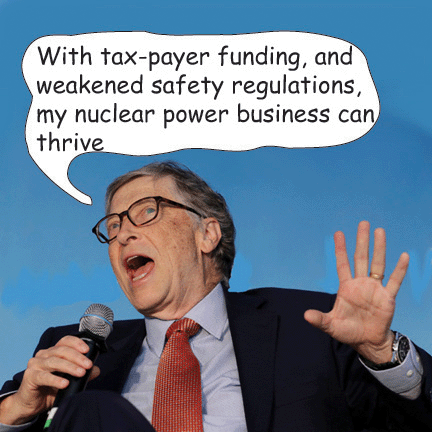
Bill Gates’ Nuclear Reactor Hits a Roadblock,
Engineering.com , October 21, 2019 Bill Gates is optimistic about the future—and the role of nuclear energy as an environmentally friendly energy source—but he faces significant obstacles along the way.
His company, TerraPower, is working on new technologies to revolutionize nuclear power. One of them is a traveling wave reactor (TWR). ………
One major problem with a TWR power plant is the price. It will cost about $3 billion to build a demonstration reactor. Even Bill Gates isn’t rich enough to fund it himself. TerraPower had signed a promising agreement with China to build a demonstration reactor, but the project has been shuttered due to China-U.S. trade tensions. The company is now lobbying Congress for a public-private partnership to fund the reactor. ……
October 23 Energy News — geoharvey

Science and Technology: ¶ “Tiny Shell Fossils Reveal How Ocean Acidification Can Cause Mass Extinction” • Ocean acidification caused a mass extinction of marine life a little less than 66 million years ago, research into tiny shell fossils has shown. This could have implications for the current climate crisis, which is also making the oceans […]
A young Hannah Rabin was the peace movement’s Greta — IPPNW peace and health blog

Older members of the peace movement remember 16-year-old Hannah Rabin, who campaigned to prevent nuclear war in the early 1980s.
via A young Hannah Rabin was the peace movement’s Greta — IPPNW peace and health blog
1 This Month


Tell the Ukrainian Government to Drop Prosecution of Peace Activist Yurii Sheliazhenko

Petition to revoke the licensing of the Near Surface Nuclear Disposal Facility (NSDF) at Chalk River. https://www.ourcommons.ca/petitions/en/Petition/Details?Petition=e-7247


of the week – STOP SMALL MODULAR REACTORS IN CANADA
To see nuclear-related stories in greater depth and intensity – go to https://nuclearinformation.wordpress.com
-
Archives
- March 2026 (204)
- February 2026 (268)
- January 2026 (308)
- December 2025 (358)
- November 2025 (359)
- October 2025 (376)
- September 2025 (258)
- August 2025 (319)
- July 2025 (230)
- June 2025 (348)
- May 2025 (261)
- April 2025 (305)
-
Categories
- 1
- 1 NUCLEAR ISSUES
- business and costs
- climate change
- culture and arts
- ENERGY
- environment
- health
- history
- indigenous issues
- Legal
- marketing of nuclear
- media
- opposition to nuclear
- PERSONAL STORIES
- politics
- politics international
- Religion and ethics
- safety
- secrets,lies and civil liberties
- spinbuster
- technology
- Uranium
- wastes
- weapons and war
- Women
- 2 WORLD
- ACTION
- AFRICA
- Atrocities
- AUSTRALIA
- Christina's notes
- Christina's themes
- culture and arts
- Events
- Fuk 2022
- Fuk 2023
- Fukushima 2017
- Fukushima 2018
- fukushima 2019
- Fukushima 2020
- Fukushima 2021
- general
- global warming
- Humour (God we need it)
- Nuclear
- RARE EARTHS
- Reference
- resources – print
- Resources -audiovicual
- Weekly Newsletter
- World
- World Nuclear
- YouTube
-
RSS
Entries RSS
Comments RSS
 nuclear-news