Hurricane Hagibis Spreads Fukushima Radiation (But No, 2,667 Bags of Decontaminated Waste were NOT Washed Away!)
 Nuclear HotSeat BY NHADMIN OCTOBER 16, 2019 Fukushima Hurricane Hagibis Flooding – deluge of water washes full bags of “decontaminated” soil, plants, and other radioactive matter into Furumichi river near the Japanese city of Tamura in Fukushima Prefecture (above). No report yet on how much radioactive material from the decomposing, torn waste bags was washed back into the environment. http://nuclearhotseat.com/2019/10/16/fukushima-hurricane-hagibis-flooding-spreads-radiation-risks/
|
Below are brief extracts – transcript from this important podcast.
Hurricane Hagibis – Alarms went off – City said an unknown number of radioactive waste bags were lost…
Each bag weighs more than one tonne…. some bags not swept away but still damaged
Nancy Faust of SimplyInfo.org. “- not enough information yet… Tepco did have time to prepare for the typhoon.
Tepco phrased it vaguely about the readings of radioactivity – equipment is monitored – readings showed that rain-water was leaking in to various facilities. They measured only the water itself, not radiation. Tepco has not talked about how much water is coming in to the reactor. We worry about how much water is coming in , and then washing things out.”
Question: Do we know how many bags of radioactive material were washed away?
“One report from one city Tamara City – has 2667 bags onsite – did not say how many were washed away -said that 6 were found….. We don’t know yet how many were washed away
We also don’t know the condition of these bags at the storage site. Older bags at higher risk of breaking. They have a lifespan of about 6 years. Also we don’t know what the level of radioactivity is in these bags.
We may get some bits of information about how much radiation was dispersed over the next weeks. Simply Info will be looking for differences in radiation level reports. Tepco not legally obliged to give this information.
From Arnie Gunderson.
Sean McGee reminds that there will be dispersal of radiatioactive material after the area dries out, and from the mountains.
The story that all 2667 bags were swept away is incorrect . That imprecision in the report was in the headline.
The Japanese government and Tepco will try to obscure the facts. It’s incumbent upon us to be accurate. |
|
Nuclear power to combat climate change? This cure is worse than the disease
|
Think fossil fuels are bad? Nuclear energy is even worse .
Some tout nuclear energy as ‘clean,’ but it’s hardly that, even with technological advancements. https://www.marketwatch.com/story/think-fossil-fuels-are-bad-nuclear-energy-is-even-worse-2019-10-17 By JURICA
DUJMOVIC Nuclear power, as it is today, is a poor substitute for fossil fuels.
Not long ago, I wrote about nuclear plants and the large number of “incidents” (many of which go under the radar) that occur every year, despite upgrades, updates, technological advancements and research that’s put in nuclear energy.
Researchers from the Swiss Federal Institute of Technology have come up with an unsettling discovery. Using the most complete and up-to-date list of nuclear accidents to predict the likelihood of another nuclear cataclysm, they concluded that there is a 50% chance of a Chernobyl-like event (or larger) occurring in the next 27 years, and that we have only 10 years until an event similar to Three Mile Island, also with the same probability. (The Three Mile Island Unit 2 reactor, near Middletown, Pa., partially melted down on March 28, 1979. This was the most serious commercial nuclear-plant accident in the U.S.)
Companion stories: The energy revolution is already here and California’s mass power outage shows we don’t really know the costs or effects of climate change Nuclear waste Then there’s the problem of nuclear waste. Just in the U.S., commercial nuclear-power plants have generated 80,000 metric tons of useless but highly dangerous and radioactive spent nuclear fuel — enough to fill a football field about 20 meters (65 feet) deep.
Over the next few decades, the amount of waste will increase to 140,000 metric tons, but there is still no disposal site in the U.S. or a clear plan on how to store this highly dangerous material.
While some would say that this amount of nuclear waste is nothing compared with the tons of trash polluting our seas and toxic gasses destroying our atmosphere, let’s not forget this isn’t ordinary waste. Nuclear waste will remain dangerous — deadly to humans and toxic to nature — for hundreds of thousands of years. Digging deep wells and tunnels in which it can be stored is simply kicking a very dangerous can down the road — a can that can break open and contaminate the environment because of earthquakes, human error and acts of terrorism.
Ocean dumping Let’s also not forget that the majority of developed countries have felt the need to use seas and oceans as nuclear-dumping sites. Although the practice was prohibited in 1994, the damage was already done. The current amount of nuclear waste in world seas greatly exceeds what’s currently stored in the U.S. And that’s just documented waste, so the exact number may be much higher. Some may be comforted by the fact that 2011 data suggest the damage to the environment was minimal, but let’s not forget that these containers will eventually decay and their contents will spill and mix with water, polluting marine life and changing the biosphere. Finally, all of this contamination comes back to us in the form of food we eat, water we drink and air we breathe.
The question I was asked when writing this article was: “Is there a place for nuclear energy in a carbon-free world?” If we keep storing dangerous nuclear waste in places where it can come in contact with our immediate environment and where isolation isn’t 100% secure, and if we keep lying to ourselves that nuclear power plants are safe and clean, even though the data clearly show otherwise, then the answer is no.
Clean’ energy?
The nuclear-energy industry wants to participate in the clean-energy movement by positioning itself as an environmentally friendly alternative to fossil fuels. However, fossil-fuel pollution can be reversed. Nuclear waste is here to stay for hundreds of thousands of years. You may think I oppose nuclear energy in any shape or form, but that’s not true. Key problems that plague the industry are waste management and safety. Once those burning issues are appropriately addressed, I’d be more than happy to support nuclear power. But for now, if we use nuclear to fight fossil-fuel-based pollution, we’re simply replacing one problem with one that is much worse. The majority of models from the United Nation’s climate-research body calls for an increase in nuclear power. The goal here is precisely what I warned about: To reduce the carbon output while paying the high cost of producing more nuclear waste. This, they say, should be done by bringing about an additional 17 gigawatts from nuclear power plants a year. If this plan were put into action, it would effectively double the number of nuclear power plants in the world by 2040. If that happens, it will be clearer to everyone why nuclear energy — in its current shape and form — is not the tool to battle climate change. |
|
News media -Don’t call nuclear power “clean” or “green”


 Ann Darling: Nuclear power should not be linked with words like ‘clean’ or ‘green’ https://www.gazettenet.com/Darling-letter-28945232, 10/14/2019 I got behind on my reading and am just now going through your series on climate change and climate activism. I’ve learned a lot. Thank you. Ann Darling: Nuclear power should not be linked with words like ‘clean’ or ‘green’ https://www.gazettenet.com/Darling-letter-28945232, 10/14/2019 I got behind on my reading and am just now going through your series on climate change and climate activism. I’ve learned a lot. Thank you.
I’m writing because I’ve been trying to get your writers and editors to think twice when you see mention of nuclear power in association with adjectives like clean or green. I see I have to keep on trying. Buried in your article Sept. 19 extolling the green virtues of Holyoke Gas & Electric, I found this: HSG&E “provides an enormous advantage when looking to improve the city’s commitment to reducing greenhouse-gas emissions. The source of energy HG&E draws from are around 90 percent carbon-free, including nuclear and hydro.” To begin, creating no greenhouse gasses during the actual generation of energy is not the litmus test for clean and green. Good science demands that we also ask, is the power source sustainable? Does the extraction of the fuel pollute the planet? Does the waste from producing the energy pollute the planet? In the case of nuclear power, the answers are all these questions is a resounding no. Uranium is a finite source of fuel. Its mining consumes tremendous amounts of water and leaves radioactive tailings that are still being cleaned up and have poisoned mostly Native American communities for decades. The radioactive waste generated during power production, the most toxic thing known to humankind, is with us forever, and there is no good way to neutralize or segregate it. Let’s not forget the link to nuclear weapons. The radioactive waste is used in weapons. Yes, during electricity generation, nuclear power facilities don’t emit greenhouse gasses. Thinking that nuclear power is, therefore, a good or useful thing to address climate change is short-sighted and just plain bad science. If we have learned anything, it should be that we have to consider all the consequences of a means of power production before we adopt it. I call on HG&E to divest of nuclear power and on the Gazette to think more incisively and critically about this. I challenge you to run a series on nuclear power generation and its supposed “greenness.” |
|
China Calls for Maintaining Global Strategic Stability and Reducing Nuclear Conflicts Risks
|
China Calls for Maintaining Global Strategic Stability and Reducing Nuclear Conflicts Risks https://www.fmprc.gov.cn/mfa_eng/wjbxw/t1708327.shtml–2019/10/16 The 16th PIIC Beijing Seminar on International Security was held in Shenzhen, China on the 16th October, 2019. It is organised by China Arms Control and Disarmament Association (CACDA), Program for Science and National Security Studies (PSNSS),and Nuclear Threat Initiative (NTI). Scholars and experts from China, the U.S., Russia, the U.K.,Germany, Italy, Belgium, Japan, South Korea, Mongolia and other countries participated in this seminar. The Director-General of the Department of Arms Control of the Foreign Ministry Fu Cong attended the opening ceremony and made a keynote speech, calling for maintaining global strategic stability and reducing risks of nuclear conflicts. Fu Cong said that the global strategic security situation has dramatically worsened over the past few years. Unilateralism and hegemonism is rising in international relations, posing major threats to the international order based upon international law. Returning to the cold war mentality, the U.S. has withdrawn from or renegaded on a host of multilateral arms control agreements, with the aim of seeking unilateral and overwhelming military superiority. With these actions, mutual trust and cooperation between major powers have been severely eroded, the global strategic stability is being seriously undermined, the international norms and multilateral regimes are under severe stress, and the deficit of global security governance is becoming more prominent. Fu Cong emphasized that continued erosion of global strategic stability would inevitably lead to a relapse of nuclear arms race. And the risks of nuclear conflicts would increase. All nuclear-weapon States should take measures to diminish the role of nuclear weapons in their national security doctrines. Nuclear-weapon States should provide unconditional and unambiguous security assurances to non-nuclear-weapon States. Countries should exercise restraint in building and deploying strategic capabilities. Nuclear disarmament should be pursued in a reasonable and pragmatic manner. Nuclear-weapon States should enhance dialogue on nuclear doctrines and strategies. Nuclear non-proliferation issues should be resolved through political and diplomatic means. And the challenges created by emerging technologies should be properly addressed. Fu Cong said that China expresses its deep regret over the U.S.’s withdrawal from the INF Treaty. It is of China’s view that the U.S. withdrawal will have a direct negative impact on global strategic stability, on peace and security in Europe and Asia-Pacific region, as well as the international arms control regime. The fact that the U.S. has conducted a ground-based intermediate-range cruise missile test less than three weeks after its withdrawal from the Treaty shows that its withdrawal was meant to free its hands in developing advanced weaponry in order to seek unilateral military advantage. . China firmly opposes the U.S. deployment of ground-based intermediate-range missiles in the Asia-Pacific region. The U.S. missiles, if deployed in the region against others’ expectations, would be virtually on China’s doorsteps. Should that happen, China would have no choice but to take necessary countermeasures in defence of its national security. China urges the U.S. and other countries concerned to exercise restraint and prudence on this matter. Fu Cong also briefed on China’s efforts in maintaining global strategic stability, including China’s “no first use” policy, and stressed that China has shown maximum transparency in its nuclear strategy, exercised the utmost restraint on the development of its nuclear force, and adopted an extremely prudent attitude toward the use of nuclear weapons. China will remain committed to peaceful development and continue to advocate for multilateralism. And China will always be a positive force for international arms control and disarmament efforts and a contributor to the lofty cause of safeguarding peace and security of the mankind. |
|
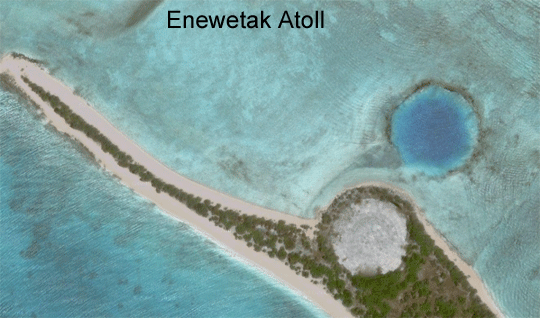
Marshall Islands’ nuclear clean-up workers concerned about radiation leaking
|
Nuclear warning: Toxic waste equivalent to 2,000 Hiroshima bombs could be leaking in sea https://www.express.co.uk/news/science/1191538/nuclear-waste-cold-war-cleanup-hiroshima-us-news-nuclear-bomb
A CONCRETE dome filled with nuclear waste could be leaking into the ocean, with experts urging the US government to act urgently as humans “cannot wait”.By SEAN MARTIN, Wed, Oct 16, 2019 |Enewetak Atoll is a series of small islands in the South Pacific which the US government used to test its nuclear weapons following World War 2 from 1948 to 1958. Over a ten year period, 30 megatons of weapons – equivalent to 2,000 Hiroshima bombs – were dropped on the islands during the Cold War. When the US had finished its testing, it built a concrete barrier known as the Runit dome to store the debris of 43 nuclear explosions in a clean-up operation lasting from 1977 to 1980.
However, employees who worked on the clean-up believe the dome could be leaking radioactive waste into to the ocean.
In response, the US has invested $1,689,000 (£1.32m) in a mission to analyse the dome, but there are claims that it could be too late as the waste could have seeped into the ocean, which would have an effect on the marine ecosystem.
Paul Griego, a former radiochemist who worked on the cleanup operation from June 1977 to October 1978, said: “We need the very same funding and for the very same analysis – the dome can wait for radiochemical analysis but we are human and we cannot wait.
While the US government said staff were subjected to just low-levels of radiation and wore all the necessary protective gear, Mr Griego has said this was not the case. The 62-year old added: “We are certain we have the very same radionuclides in our bodies that that would be found in the dome. “We were bombarded with radiation while building the dome, we drank the contaminated water, inhaled the dust-filled air, absorbed contaminates though our skin, ate the fish we caught and more. “We are not only denied the diagnostic resources, we are denied healthcare to cover our radiation and toxin-related illnesses.
“The government’s refusal to provide radiochemical resources is malicious and feeds into the status quo. “It places the burden of proof of an illness on the individual rather than the moral responsibility of our government.” The mission saw more than 1,000 employees tasked with collecting contaminated soil and radioactive debris, which was then mixed with concrete and placed in a nuclear test crater, which was sealed in a concrete dome.
However, people who were on the scene said that the dome was not lined with concrete, and warn it could be seeping into the ocean. For this reason, the US will embark on an 18 month mission to analyse the dome to see if needs to be reinforced or perhaps completely removed. Doug Domenech, Assistant US Secretary of the Interior for Insular and International Affairs, said: “The US Departments of the Interior and Energy are partnering on this important analysis of Runit Dome so that we can be responsive to both Congress and concerns expressed by the Enewetak community in the Marshall Islands.”
|
|
America’s Nuclear Doomsday Submarines
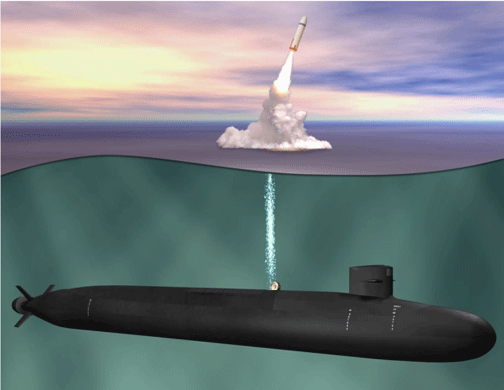 Meet the Ohio-Class: America’s Nuclear Doomsday Submarines, National Interest, by Sebastien Roblin 16 Oct 19,”………. The most deadly of the real-life kaiju prowling the oceans today are the fourteen Ohio-class ballistic-missile submarines, which carry upwards of half of the United States’ nuclear arsenal onboard. Meet the Ohio-Class: America’s Nuclear Doomsday Submarines, National Interest, by Sebastien Roblin 16 Oct 19,”………. The most deadly of the real-life kaiju prowling the oceans today are the fourteen Ohio-class ballistic-missile submarines, which carry upwards of half of the United States’ nuclear arsenal onboard.
If you do the math, the Ohio-class boats may be the most destructive weapon system created by humankind. Each of the 170-meter-long vessels can carry twenty-four Trident II submarine-launched ballistic missiles (SLBMs) which can be fired from underwater to strike at targets more than seven thousand miles away depending on the load.
As a Trident II reenters the atmosphere at speeds of up to Mach 24, it splits into up to eight independent reentry vehicles, each with a 100- or 475-kiloton nuclear warhead. In short, a full salvo from an Ohio-class submarine—which can be launched in less than one minute—could unleash up to 192 nuclear warheads to wipe twenty-four cities off the map. This is a nightmarish weapon of the apocalypse. ………. https://nationalinterest.org/blog/buzz/meet-ohio-class-americas-nuclear-doomsday-submarines-88386
|
|
Russia showcases its nuclear arsenal with huge war games
|
Russia kicks off huge war games to test its nuclear arsenal, CBS News, BY DARIA LITVINOVA, OCTOBER 15, 2019 MOSCOW — Russia kicked off a sweeping military exercise of its Strategic Missile Forces on Tuesday. The Defense Ministry said the drills would include 16 practice launches of cruise and ballistic missiles.
Dubbed “Thunder-2019,” the war games were set to last three days and involve 12,000 troops, 213 missile launchers, 105 aircraft, 15 surface warships and five nuclear submarines………
Last week, Putin announced that Russia would start developing short- and intermediate-range missiles in response to U.S. plans to deploy such weapons in Asia. They are missiles that were banned for decades under the INF. Russia formally withdrew from the Reagan-era treaty soon after the U.S., which had accused Moscow of working on new missiles that violated the terms of the accord. https://www.cbsnews.com/news/russia-war-games-thunder-2019-test-strategic-nuclear-weapons-today-after-inf-collapse-2019-10-15/ |
|
2019 Nuclear Weapons Ban Monitor report
 Nuclear Weapons Ban Monitor 2019 is here, https://banmonitor.org/news/nuclear-weapons-ban-monitor-2019-is-here The 2019 report of the Nuclear Weapons Ban Monitor was launched at a side event during the UN General Assembly in New York on 16 October. This watchdog measures progress towards a world free of nuclear weapons, by using the 2017 UN Treaty on the Prohibition of Nuclear Weapons (TPNW) as a yardstick. The report also evaluates the extent to which the policies and practices of all states comply with the prohibitions in the TPNW, regardless of whether they have joined the Treaty yet. Nuclear Weapons Ban Monitor 2019 is here, https://banmonitor.org/news/nuclear-weapons-ban-monitor-2019-is-here The 2019 report of the Nuclear Weapons Ban Monitor was launched at a side event during the UN General Assembly in New York on 16 October. This watchdog measures progress towards a world free of nuclear weapons, by using the 2017 UN Treaty on the Prohibition of Nuclear Weapons (TPNW) as a yardstick. The report also evaluates the extent to which the policies and practices of all states comply with the prohibitions in the TPNW, regardless of whether they have joined the Treaty yet.
The 2019 report of the Nuclear Weapons Ban Monitor, which is researched and published by the organization Norwegian People’s Aid (NPA), identifies 31 mostly European states – including countries like Belgium, Denmark, Italy, the Netherlands, Norway, and Spain – as “nuclear-weapon-complicit states”. These are states that do not themselves possess nuclear weapons but have outsourced their nuclear postures to one or more nuclear-armed allies through arrangements of extended nuclear deterrence, or so-called “nuclear umbrellas”. They have endorsed or acquiesced in the continued possession and potential use of nuclear weapons on their behalf.
– It is not only the nine nuclear-armed states that stand between the international community and its long-standing goal of a world free of nuclear weapons. So do the 31 nuclear-weapon-complicit states. Their role in assisting, encouraging, and inducing continued retention of nuclear weapons had not been given much attention prior to the adoption of the TPNW in the UN in 2017, says the editor of the Nuclear Weapons Ban Monitor, Grethe Lauglo Østern of NPA. The nine nuclear-armed states and the 31 nuclear-weapon-complicit states do not support the TPNW, and some of them actively oppose it. The majority of the world’s states, however, stand behind the Treaty. The Nuclear Weapons Ban Monitor categorizes a total of 135 countries as TPNW supporters.
– As of October 2019, 32 states are full states parties to the TPNW, while another 48 states have signed it, but not yet ratified it. In addition, 55 countries have voted in favour of the Treaty in the UN, but not yet taken steps to adhere to it, says Østern. Support for the TPNW is high in all regions apart from Europe, where 34 states (or 69%) today are opposed to signing it. Only 17 countries in the world are undecided on the TPNW. The TPNW will be binding, international law when 50 states have ratified it. The Nuclear Weapons Ban Monitor shows that the Treaty is moving steadily towards early entry into force, despite obstructionism from nuclear-armed states. At the time of writing, the TPNW had, by a close margin, the second fastest speed of adherence of the treaties on weapons of mass destruction, though significantly slower than the 1968 Treaty on the Non-Proliferation of Nuclear Weapons (NPT). Among the states that have ratified the TPNW already are Kazakhstan and South Africa, both of which once had nuclear weapons but subsequently disarmed; two of only four states ever to do so.
– A facts-based debate on the UN prohibition on nuclear weapons is essential if we are to achieve the goal of a world without nuclear weapons. This applies to civil society, and to politicans and diplomats. The Nuclear Weapons Ban Monitor gathers and makes available crucial data, says NPA’s secretary general Henriette Westhrin. Even though the nuclear-armed states are resisting the TPNW, Westhrin believes it is important that countries without nuclear weapons now are taking the lead and becoming the first states parties to the Treaty. In doing so they are creating a long-overdue norm that nuclear weapons are unacceptable, and an international framework for their elimination. – The first parties to the TPNW have a responsibility to use this tool to break decades of acquiescence to the nuclear threat and to encourage other states to stop justifying the “benefits” of nuclear weapons. The impact of the TPNW will be built gradually and will depend on how it is received and used by each and every UN member state, says Westhrin. Contact: Grethe Lauglo Østern, Editor of the Nuclear Weapons Ban Monitor on +41 78 717 9137 or e-mail: gretheo@npaid.org
|
|
|
Removal of highly radioactive material from 60 year old Dounreay Fast Nuclear Reactor (DFR).

BBC 15th Oct 2019, Radioactive material jammed inside a Scottish nuclear reactor since the 1970s has been removed for disposal. Remotely-operated tools were specially made to extract the breeder elements from the Dounreay Fast Reactor (DFR).
The DFR and its dome-shaped housing are to be demolished as part of the
wider decommissioning of the former nuclear power site near Thurso.
Dismantling the 60-year-old DFR is among the most challenging of the
decommissioning work.
https://www.bbc.co.uk/news/uk-scotland-highlands-islands-50055003
Distribution of highly radioactive microparticles in Fukushima revealed
Distribution and origin of highly radioactive microparticles in Fukushima revealed, Science Daily
- Date:
- October 16, 2019
- Source:
- University of Helsinki
- Summary:
- New method allows scientists to create a quantitative map of radioactive cesium-rich microparticle distribution in soils collected around the damaged Fukushima Daiichi Nuclear Power Plant Nuclear Power Plant (FDNPP). This could help inform clean-up efforts in Fuksuhima region.
A large quantity of radioactivity was released into the environment during the 2011 Fukushima Daiichi Nuclear Power Plant accident. The released radioactivity included small, poorly soluble, cesium-rich microparticles. The microparticles have a very high radioactivity per unit mass (~1011 Bq/g), but their distribution, number, source, and movement in the environment has remained poorly understood. This lack of information has made it hard to predict the potential impact of the radioactive microparticles.
However, a study just published in the scientific journal Chemosphere, involving scientists from Japan, Finland, France, and the USA, addresses these issues. The team, led by Dr. Satoshi Utsunomiya, Ryohei Ikehara, and Kazuya Morooka (Kyushu University), developed a method in 2018 that allows scientists to quantify the amount of cesium-rich microparticles in soil and sediment samples.
Radiation a top anxiety problem for Russians, survey finds
Russians’ Biggest Fears Are Police Violence and Radiation, Moscow Times, 16 Oct 19, Police violence and radiation prompted the highest levels of anxiety among Russians on social media, according to a quarterly analysis cited in Russian Forbes on Wednesday.
The findings by Russian PR firm CROS follow a summer of mass anti-government protests in Moscow, where police detained thousands of demonstrators, and two high-profile nuclear accidents that sparked fears of radiation. Drug shortages were third on the list….. https://www.themoscowtimes.com/2019/10/16/russians-biggest-fears-are-police-violence-and-radiation-a67752
Radioactive chlorine from nuclear bomb tests still present in Antarctica
|
Radioactive chlorine from nuclear bomb tests still present in Antarctica, Phys Org, by Abigail Eisenstadt, American Geophysical Union 16 Oct 19, Antarctica’s ice sheets are still releasing radioactive chlorine from marine nuclear weapons tests in the 1950s, a new study finds. This suggests regions in Antarctica store and vent the radioactive element differently than previously thought. The results also improve scientists’ ability to use chlorine to learn more about Earth’s atmosphere. Scientists commonly use the radioactive isotopes chlorine-36 and beryllium-10 to determine the ages of ice in ice cores, which are barrels of ice obtained by drilling into ice sheets. Chlorine-36 is a naturally occurring radioactive isotope, meaning it has a different atomic mass than regular chlorine. Some chlorine-36 forms naturally when argon gas reacts with cosmic rays in Earth’s atmosphere, but it can also be produced during nuclear explosions when neutrons react with chlorine in seawater. Nuclear weapons tests in the United States carried out in the Pacific Ocean during the 1950s and the 1960s caused reactions that generated high concentrations of isotopes like chlorine-36. The radioactive isotope reached the stratosphere, where it traveled around the globe. Some of the gas made it to Antarctica, where it was deposited on Antarctica’s ice and has remained ever since. Other isotopes produced by marine nuclear bomb testing have mostly returned to pre-bomb levels in recent years. Scientists expected chlorine-36 from the nuclear bomb tests to have also rebounded. But new research in AGU’s Journal of Geophysical Research: Atmospheres finds the Vostok region of Antarctica is continuing to release radioactive chlorine into the atmosphere. Since naturally produced chlorine-36 is stored permanently in layers of Antarctica’s snow, the results indicate the site surprisingly still has manmade chlorine produced by bomb tests in the 1950s and in the 1960s……… https://phys.org/news/2019-10-radioactive-chlorine-nuclear-antarctica.html |
|
Switzerland’s old Beznau nuclear power plant
|
The world’s oldest nuclear power plant, By Jack Unwin Power Technology, 16 Oct 19, A look at Beznau nuclear power plant in Switzerland, the world’s oldest nuclear power plant currently in operation…….
Construction on the plant began in 1965 and Beznau 1 began producing power on 1 September 1969, with Beznau 2 following in 1972. It has two pressurised water reactors (PWR) built by Westinghouse with a capacity of 365MW each, for a total capacity of 730MW and able to produce 6000 gigawatt-hours (GWh) of energy. The plant is owned and operated by Swiss private company Axpo Holdings.
Accidents will happenDespite its long run producing power, Beznau has been no stranger to accidents at its site. According to the Swiss Federal Nuclear Safety Inspectorate, there were 91 nuclear security incidents between 1995 and 2014. However 86 of these were at level 0 on the International Nuclear Event Scale (INES), the least severe on its scale. Four were at level 1 and one in 2009 that was level 2, when two workers at the plant were exposed to “inadmissible” levels of radiation . Following its reopening four incidents were recorded at in 2018.
Protests and closureProtestors in Switzerland have targeted Beznau in particular, and nuclear power in general. Following the Fukushima nuclear disaster in Japan in 2011, 20,000 protestors gathered in the town of Doettingen to condemn Beznau in the largest anti-nuclear protest in the country for 25 years. In 2014 100 Greenpeace activists broke into Beznau and scaled one of the buildings at the site with a banner proclaiming “the end” of nuclear power due to safety concerns for the ageing plant. These concerns appeared to be well-founded in October 2015 when Beznau 1 was found to have 1000 holes, cracks and indentations around the reactor. Beznau was closed for repairs when “anomalies” were found in its steam generators from March 2015 to March 2018. The future of nuclear power in SwitzerlandDespite still producing power and being one of five nuclear plants that form35% of Switzerland’s energy mix, Beznau and nuclear power itself is under threat. Switzerland will instead develop renewable energy from wind, solar and hydropower as part of its Energy Strategy 2050 plan. Meanwhile there will be no new general licenses for nuclear power plants, but old plants like Beznau will continue to run until they are decommissioned…..https://www.power-technology.com/features/worlds-oldest-nuclear-power-plant/ |
|
Risks of nuclear transportation
|
Safer nuke shipments? Critics split on whether tech has cut nuclear transportation risk, reno gazette journal, Scott Sonner, Associated Press Oct. 14, 2019 “…… Today, radioactive shipments are hauled in double-walled steel containers inside specialized trailers that undergo extensive testing and are tracked by GPS and real-time apps.But whether shipping technology has evolved enough to be deemed safe depends on whom you ask.
The Trump administration’s revival of a decades-old plan to move the nation’s most dangerous radioactive waste to a remote spot in the Nevada desert has reignited a long-running fight in the courts and Congress over how to safely get the hazardous remnants of decades of bomb-making and power generation to a permanent resting place. “It seems to me, that part of the gist of the government’s argument is that, ‘We’ve been doing this a long time. We know what we are doing. You have to trust us,’” noted U.S. District Judge Miranda Du who’s considering a lawsuit Nevada filed against the Energy Department over waste being sent there. For its part, the government says there are no safety concerns………. But there have been close calls, said Robert Halstead, an analyst who has studied the dangers of transporting radioactive waste for 35 years and is head of Nevada’s Agency for Nuclear Projects. A truck crash in 1971 killed a driver and propelled a cask full of nuclear waste into a ditch in Tennessee. The container was damaged, but no radioactive material leaked. More recently a Tennessee contractor revealed earlier this year it may have mislabeled low-level nuclear waste – items such as contaminated equipment or workers’ clothing – that potentially was sent to Nevada over six years without the proper safeguards. The Energy Department responded by announcing in July it will review all radioactive waste packaging and shipping. Perhaps the greatest point of disagreement is whether the “rigorous testing” is rigorous enough. It would be dangerous and expensive to run tests involving explosions, fire or other hazards on a real cask of spent nuclear fuel. So it’s never been done in the United States. “What isn’t clear is: ‘What are the conditions under which the package would fail?” said Edwin Lyman, head of the nuclear safety project at the Union of Concerned Scientists, who has studied the hazards of nuclear shipments for 25 years. There’s enough high-level nuclear waste awaiting disposal in the U.S. to fill a football field 65 feet deep. Few states want to house it within their borders. To solve the long-time problem, the Trump Administration has revived a decades-old plan to move the nation’s most dangerous radioactive waste from around the country to a site 90 miles northwest of Las Vegas, the Yucca Mountain Nuclear Waste Repository. It was proposed to hold 77,000 tons of highly radioactive spent nuclear fuel in a maze of tunnels bored into an ancient volcanic ridge. Nevada doesn’t want it. The state and its congressional delegation have been fighting the project and other attempts to store nuclear waste in Nevada for decades, and the Yucca Mountain project was shelved in 2010 under pressure from then-Senate Democratic Majority Leader Harry Reid of Nevada and President Barack Obama. U.S. Rep. Dina Titus, a Nevada Democrat who helped defeat a GOP-led effort to restore funding to Yucca Mountain last May, called it “the latest attempt to force nuclear waste down Nevada’s throats.” Meanwhile, the state has sued the federal government over the half metric ton of plutonium secretly shipped from South Carolina to the Nevada National Security Site. That site is separate from but close to the Yucca Mountain site. While U.S. leaders battle over where to ship the nuclear waste, the government says it has upgraded transportation containers and the way it hauls the material………..https://www.rgj.com/story/news/2019/10/14/critics-split-whether-tech-has-cut-nuclear-transportation-risk/3978815002/ |
|
The U.S. Supreme Court has shut down South Carolina’s attempt to complete a nuclear fuel facility
|
Supreme Court Lets US Stop Work on $8B SC Nuclear Fuel Plant
The U.S. Supreme Court has shut down South Carolina’s attempt to complete a nuclear fuel facility. https://www.usnews.com/news/us/articles/2019-10-15/supreme-court-lets-us-stop-work-on-8b-sc-nuclear-fuel-plant, Oct. 15, 2019 BY JEFFREY COLLINS, Associated Press COLUMBIA, S.C. (AP) — The federal government does not have to restart construction on a nuclear fuel facility in South Carolina that it abandoned after spending nearly $8 billion, the U.S. Supreme Court ruled Tuesday.
The justices refused without comment to hear South Carolina’s appeal of a lower court decision last October that allowed the U.S. Energy Department to stop building the Mixed Oxide Fuel Fabrication Facility at the Savannah River Site near Aiken. Work on the plant started nearly two decades ago. Its goal was to take plutonium used in nuclear weapons built during the Cold War and convert it into a fuel called MOX to run nuclear plants around the world. The facility was over budget and behind schedule nearly from the start. It was still decades away from completion when President Barack Obama’s final budget in 2016 pulled funding. Republicans in South Carolina asked President Donald Trump to restart the project, but his administration has refused. South Carolina then sued the federal government, saying the government had promised to remove the 11 metric tons (24,250 pounds) of plutonium from the state by 2021. Without the MOX plant in place, there was no guarantee the government would keep its end of the deal, state officials argued. South Carolina Attorney General Alan Wilson said he was disappointed with the Supreme Court’s refusal to hear its appeal but said state officials “will continue to do everything necessary to protect the citizens of our state and hold the federal government accountable under the law.” Federal officials said they should be free to consider any alternatives they want. The plan now appears to be to seal the plutonium and bury it in the western U.S. desert. The Energy Department first disclosed in January 2019 that it had sent a half ton of plutonium to Nevada in 2018. Two months ago, Wilson said a full ton of plutonium had been removed from South Carolina to meet a federal court-imposed deadline of Jan. 1, 2020. He didn’t say where the other half-ton went. In August, Nevada lost its own federal appeals court fight to block any more shipments of weapons-grade plutonium to a site near Las Vegas. |
|
1 This Month

of the week – Shut Down Drone Warfare!


Tell the Ukrainian Government to Drop Prosecution of Peace Activist Yurii Sheliazhenko

Petition to revoke the licensing of the Near Surface Nuclear Disposal Facility (NSDF) at Chalk River. https://www.ourcommons.ca/petitions/en/Petition/Details?Petition=e-7247
To see nuclear-related stories in greater depth and intensity – go to https://nuclearinformation.wordpress.com
-
Archives
- April 2026 (68)
- March 2026 (251)
- February 2026 (268)
- January 2026 (308)
- December 2025 (358)
- November 2025 (359)
- October 2025 (376)
- September 2025 (257)
- August 2025 (319)
- July 2025 (230)
- June 2025 (348)
- May 2025 (261)
-
Categories
- 1
- 1 NUCLEAR ISSUES
- business and costs
- climate change
- culture and arts
- ENERGY
- environment
- health
- history
- indigenous issues
- Legal
- marketing of nuclear
- media
- opposition to nuclear
- PERSONAL STORIES
- politics
- politics international
- Religion and ethics
- safety
- secrets,lies and civil liberties
- spinbuster
- technology
- Uranium
- wastes
- weapons and war
- Women
- 2 WORLD
- ACTION
- AFRICA
- Atrocities
- AUSTRALIA
- Christina's notes
- Christina's themes
- culture and arts
- Events
- Fuk 2022
- Fuk 2023
- Fukushima 2017
- Fukushima 2018
- fukushima 2019
- Fukushima 2020
- Fukushima 2021
- general
- global warming
- Humour (God we need it)
- Nuclear
- RARE EARTHS
- Reference
- resources – print
- Resources -audiovicual
- Weekly Newsletter
- World
- World Nuclear
- YouTube
-
RSS
Entries RSS
Comments RSS
 nuclear-news