To 15 October – nuclear news this week
Again – climate and nuclear news collide. In Japan, Typhoon Hagibis re-spreads nuclear contamination far and wide – nuclear workers at heightened risk. Low lying Marshall Islands, victim of nuclear testing, now declares a Climate Emergency.
Revealed by Wikileaks – facts about nuclear weapons and the nuclear industry.
Climate Scientists urge protestors to keep on going with Extinction Rebellion. Google publicly decries climate change, privately donates to climate denialism. Massive Carbon Tax is needed– International Monetary Fund. U.N. officials on how Nuclear Power is irrelevant to climate action. The woman who was first to scientifically show, in 1856, how atmospheric C02 caused global warming.
The impossibility of nuclear power solving climate change. Mainstream media fails to cover news on military carbon emissions.
Physics Nobel Laureate predicts NO Migration to Other Planets.
JAPAN.
- Typhoon Hagibis floods carry away Fukushima nuclear waste bags in their thousands. https://www.youtube.com/watch?v=7R6IrzT4gP8 Climate and nuclear threats join in Japan’s multibillion-dollar typhoon disaster. Fukushima Badly Hit By Typhoon Hagibis; TEPCO Reported “Irregular Readings” At Fukushima Daiichi Nuclear Power Station. Bags of debris from Fukushima disaster swept away in typhoon.
- A million tonnes of radioactive water and nowhere to go – Fukushima.
- Nuclear industry in Japan – as corrupt as ever? Ex-trade minister Hiroshige Seko involved in nuclear gifts scandal. Nuclear money scandal and the Tokyo Olympic Games.
FRANCE. Soaring costs of France’s Flamanville project casts a blight on the global nuclear industry. EDF’s Flamanville nuclear project – more costs, more delays. The million year problem – deep burial of nuclear wastes.
UK.
- North West Evening Mail (UK) gives a fine example of incorrect pro nuclear goobledygook.
- Is UK’s regulator of Hinkley nuclear project ignoring the seismic risks of fracking in the area?
- 35,454 Petitioners call for scrapping of UK’s “regulated asset base” (RAB) funding for Sizewell nuclear project.
- Energy Efficiency – effective, but forgotten since UK privatisation of Energy Saving Trust and the Carbon Trust.
NORTH KOREA. North Korea threatens to resume nuclear, long-range missile tests. A Partial North Korean Nuclear Agreement Is Better Than None at All.
SOUTH KOREA. Drones a threat to nuclear facilities.
INDIA. Continued strong public opposition to nuclear power in India.
RUSSIA. Putin warns on the need for a new nuclear weapons treaty. Russia and the quest for nuclear power in space.
TURKEY. USA anxiety over its nuclear weapons stashed in Turkey.
USA.
- U.S. presidential candidates should state their position on nuclear weapons.
- The truly dangerous situation of USA’s nuclear weapons. U.S. Congress ponders reckless decision to increase production of plutonium bomb cores or “pits.”
- The nuclear industry looks to Trump to bail them out. “The Columbian” jeers the U.S. Department of Energy, over nuclear wastes. EPA Announces $125 million settlement for cleanup of the Nuclear Metals Superfund Site in Concord, Massachusetts.
IRAN. Iran categorically opposes nuclear weapons – Foreign Minister Mohammad Javad Zarif. Urgent need for diplomacy with Iran.
PHILIPPINES. Senate to probe Philippine’s nuclear energy program.
UNITED ARAB EMIRATES. UAE cooperating with Russia to buy Russian nuclear fuel, minister.
SAUDI ARABIA. Russia ready to work with U.S. to build Saudi nuclear power plant – Rosatom.
ISRAEL. Submarine launched missiles in Israel’s probably 300 Nuclear Weapons.
Typhoon Hagibis floods carry away Fukushima nuclear waste bags in their thousands
Ed. note. Since we published the article below, Nuclear Hotseat has corrected the misleading information about 2667 bags of radioactive debris being washed away.
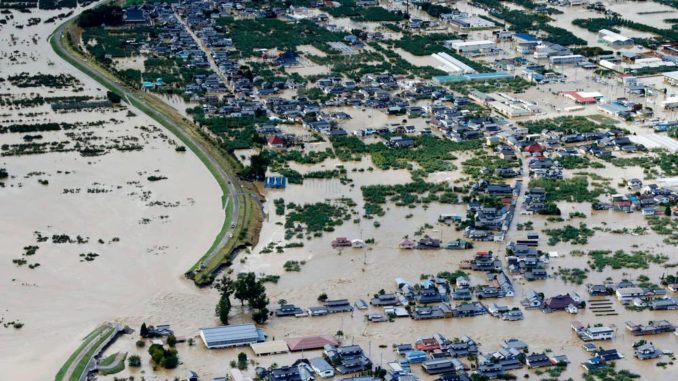
2,667 Radioactive Bags From Fukushima Swept Away By Typhoon Hagibis https://newspunch.com/1667-radioactive-bags-fukushima-swept-away-typhoon-hagibis/, October 14, 2019 Baxter Dmitry As Typhoon Hagibis hammered Japan on Saturday, thousands of bags containing radioactive waste at Fukushima were reportedly carried into a local stream by floodwaters.Experts warn the radioactive bags could have a devastating environmental impact across the entire Pacific region, reports Taiwan News.
According to Asahi Shimbun, a temporary storage facility containing 2,667 bags storing radioactive contaminants from the 2011 Fukushima nuclear disaster were “unexpectedly inundated by floodwaters brought by Typhoon Hagibis.“
Torrential rain flooded the storage facility and released the bags into a waterway 100 meters from the site.
Officials from Tamara City in Fukushima Prefecture said that each bag is approximately one cubic meter in size.
Authorities were only able to recover six of the bags by 9 p.m. on Oct. 12 and it is uncertain how many remain unrecovered while the potential environmental fallout is being assessed.
The radioactive waste swept away by Typhoon Hagibis represents the latest setback for Fukushima officials who have struggled to adequately quarantine the radiation.
StatesmanJournal reports: Seaborne radiation from Japan’s Fukushima nuclear disaster has been detected on the West Coast of the United States.
Cesium-134, the so-called fingerprint of Fukushima, was measured in seawater samples taken from Tillamook Bay and Gold Beach in Oregon, researchers from the Woods Hole Oceanographic Institution are reporting.
Because of its short half-life, cesium-134 can only have come from Fukushima.
Also for the first time, cesium-134 has been detected in a Canadian salmon, the Fukushima InFORM project, led by University of Victoria chemical oceanographer Jay Cullen, is reporting.
In both cases, levels are extremely low, the researchers said, and don’t pose a danger to humans or the environment.
Massive amounts of contaminated water were released from the crippled nuclear plant following a 9.0 magnitude earthquake and tsunami in March 2011. More radiation was released to the air, then fell to the sea.
Climate and nuclear threats join in Japan’s multibillion-dollar typhoon disaster.
|
………….As the core of the storm pulled away from Tokyo Sunday, it dumped heavy rains across Toshigi as well as Fukushima Prefecture. Floodwaters there have raised concerns about radioactive contamination following the 2011 Fukushima nuclear disaster.
Typhoon Hagibis will go down in Japanese history as a multibillion-dollar disaster. The storm’s widespread impacts and high death toll are unusual for Japan, since the country is one of the best-prepared in the world for natural disasters
Climate studies suggest that the Japanese Archipelago could see more frequent and stronger typhoons in the future, due in large part to warming seas as a result of human-caused global warming. There is evidence showing that tropical cyclones in the Northwest Pacific Ocean Basin are reaching their maximum intensities further north than they used to, a trend some scientists attribute in part to climate change. This could send more intense storms into areas that typically see weaker storms, such as Honshu and other parts of northern and northeastern Japan.
One trend that is especially clear is that damage costs from typhoons in Japan are escalating, with three of the top 10 most expensive Japanese typhoons since 1950 occurring in the past 2 years alone. Typhoon Faxai, which affected Tokyo in early September. Typhoon Hagibis is extremely likely to increase this number to four. https://www.theage.com.au/world/asia/why-typhoon-hagibis-packed-such-a-deadly-devastating-punch-in-japan-20191015-p530o7.html
|
|
|
USA’s “outrageous” claim to “universal jurisdiction over every person on earth”- plea from Australia to save Julian Assange
|
The campaign for the Morrison government to intervene gathered momentum on Monday after former deputy prime minister Barnaby Joyce lent his support to the WikiLeaks founder’s cause. Independent MP Andrew Wilkie also revealed that a multi-party parliamentary group to “agitate” for Mr Assange to be brought home to Australia would be launched in the coming weeks and would include some members of the Coalition government. In April, Mr Smith voiced concerns to Washington’s man in Canberra that Mr Assange could be charged under an “outrageous” US claim to “universal jurisdiction over every person on earth”. “Australians, like Americans, may have mixed opinions on Julian Assange, however, I believe the tide will turn if it appears an Aussie is being made a scapegoat for a security failure of the US intelligence services,” Mr Smith wrote in the letter seen by The Age and The Sydney Morning Herald. “I can assure you that many Australians will not readily accept that Mr Assange is being held responsible for such a serious security failure, as embarrassing as it may be.” He said it was “imperative to maintain the good relations” between Australia and the US, but Washington would “jeopardise” the relationship by asking its courts to “criminalise journalistic endeavours”. “I believe this will damage the reputation of the United States as an upholder of freedom of speech and a defender of human rights, and result in untold damage to the good relations between Australia and the American people.” Treasurer Josh Frydenberg said the government would not intervene in attempts by the US to have the 48-year-old Australian stand trial, where he faces a sentence of 175 years if found guilty of computer fraud and obtaining and disclosing national defence information……. Confidential government briefing notes, inadvertently released on email by the Prime Minister’s Office on Monday, gave “talking points” to MPs if they were asked about Mr Assange and his fight against extradition from Britain to the US. …. https://www.theage.com.au/politics/federal/dick-smith-lobbied-us-to-drop-julian-assange-extradition-request-20191014-p530lf.html |
|

Soaring costs of France’s Flamanville project casts a blight on the global nuclear industry
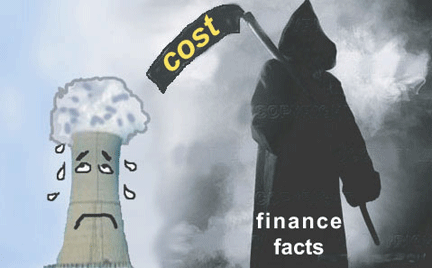
EDF said that its European pressurised reactor in Flamanville was now expected to cost €12.4 billion. This is €1.5 billion more than the previous estimate.
Initially it was supposed to cost €3.3 billion and the reactor was supposed to come on stream in 2012. The company says that under the revised plan it hopes to load fuel at Flamanville at the end of 2022, a decade late.
EDF is an electrity business with interests worldwide, including operating 58 nuclear reactors in its home country. It is majority-owned by the French state, which holds an 83.7 per cent stake…(subscribers only) https://www.thetimes.co.uk/edition/business/edf-admits-flamanville-reactor-will-cost-four-times-original-estimate-k55qjn9b5?fbclid=IwAR0-APtlBA77Q8ixdA4VPMl3YCO24A_ivA0dL9Xf_Hyo0mwKn4w0898zmjY
U.S. presidential candidates should state their position on nuclear weapons

 Candidates should state position on nuclear weapons, https://www.dispatch.com/opinion/20191014/column-candidates-should-state-position-on-nuclear-weapons David Wright, The upcoming Democratic Party presidential debate in Ohio provides an opportunity for candidates to address an issue that a majority of Ohio voters want to hear about: their plans for U.S. nuclear weapons policy.
A recent Zogby Analytics poll found that more than 80% of Ohio residents believe it is critical that the candidates state their positions on this issue.
They are right to want to hear the candidates’ views. Ohioans understand that the risk of nuclear war remains one of the greatest threats to civilization, and security experts warn that the potential for a nuclear war is greater than it has been in decades.
The good news is that the next president could make America safer by changing U.S. nuclear policy.
Under current policies, the United States could start a nuclear war by mistake. How? Let me explain the chain of events.
The Pentagon keeps its 400 land-based missiles on hair-trigger alert so they can be launched quickly upon warning of a Russian missile attack before they could be destroyed by incoming Russian missiles. If the military received such a warning, the president would have less than 10 minutes to decide whether to launch U.S. missiles. But that warning is generated by computers based on radar and satellite data, all of which are fallible. Indeed, there have been false alarms over the years due to a range of technical and human errors. This tight time span in which to make a decision increases the risk of starting a nuclear war based on a false warning. U.S. missiles cannot be recalled or destroyed in flight, even if the Pentagon belatedly realized that the warning had been false.
Keeping missiles on hair-trigger alert is not only dangerous, it is also unnecessary. Most U.S. nuclear weapons are hidden at sea on submarines where they are safe from attack, so the United States can wait to see if a nuclear attack is actually happening before it retaliates. Debate moderators should ask the candidates if they would remove U.S. missiles from hair-trigger alert and eliminate the possibility of starting a nuclear war by mistake.
The next president also could reduce the chance that the United States would deliberately start a nuclear war. Current policy permits the United States to use nuclear weapons first in a non-nuclear conflict with Russia, China or North Korea — all of which are nuclear-armed. Doing so would almost certainly provoke a devastating nuclear response against the United States.
Moderators should tackle that topic as well. They should ask the candidates whether, if elected, they would clearly state that the only purpose of U.S. nuclear weapons is to deter a nuclear attack and establish a policy that the United States will never use nuclear weapons first. Such a policy also would make America safer by making it less likely that our adversaries would attack us with nuclear weapons first out of fear that a U.S. nuclear strike was imminent.
The Zogby survey polled Ohioans about this “first use” issue, too. When asked if there were any acceptable circumstances for the United States to use nuclear weapons first, nearly two-thirds said no.
Finally, the United States has long relied on verifiable international agreements to constrain its adversaries’ nuclear forces. Today the United States and Russia still possess 92% of all nuclear weapons, yet the United States recently pulled out of a longstanding nuclear arms treaty with Russia and has threatened to walk away from the landmark treaty that limits long-range nuclear weapons. Debate moderators should ask the candidates if they are committed to maintaining such agreements, how they would reinvigorate U.S.-Russian negotiations and how they would address North Korea and Iran’s nuclear ambitions.
Voters want to know, but they will only if debate moderators ask the right questions. The presidential candidates must clarify what they would do, if elected, to reduce the nuclear threat and guarantee national — and international — security.
David Wright, co-director and senior scientist in the Global Security Program at the Union of Concerned Scientists, grew up in Lima and attended Miami University and Ohio State University.
The million year problem – deep burial of nuclear wastes
Quite apart from the technological challenges and ethical issues these solutions present, both have one major drawback: to be successful they rely on external, uncontrollable factors. How could the knowledge required to interpret these things this be guaranteed to last?
Semiotician Thomas Sebeok recommended the creation of a so-called Atomic Priesthood. Members of the priesthood would preserve information about the waste repositories and hand it on to newly initiated members, ensuring a transfer of knowledge through the generations.
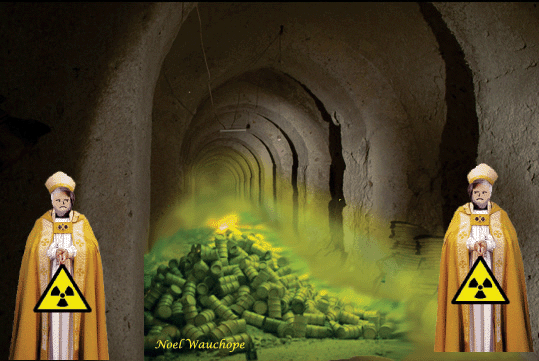
Buried nuclear waste stays dangerous for a million years — here’s how scientists plan to stop a future disaster
In thousands of years’ time, will they even understand the language written on our ‘keep out’ signs? https://inews.co.uk/news/long-reads/buried-nuclear-waste-danger-underground-future-disasters-814704
By Helen Gordon, Monday, 14th October 2019 The red metal lift takes seven juddering minutes to travel nearly 500 metres down. Down, down through creamy limestone to reach a 160-million-year-old layer of clay.
Here, deep beneath the sleepy fields and quiet woods along the border of the Meuse and Haute-Marne departments in north-east France, the French National Radioactive Waste Management Agency (Andra) has built its underground research laboratory.
The laboratory’s tunnels are brightly lit but mostly deserted, the air dry and dusty and filled with the hum of a ventilation unit.
Blue and grey metal boxes house a series of ongoing experiments – measuring, for example, the corrosion rates of steel, the durability of concrete in contact with the clay. Using this information, Andra wants to build an immense network of tunnels here.
It plans to call this place Cigéo, and to fill it with dangerous radioactive waste. It is designed to be able to hold 80,000 cubic metres of material.
Long-term risks of nuclear waste Continue reading
Bags of debris from Fukushima disaster swept away in typhoon
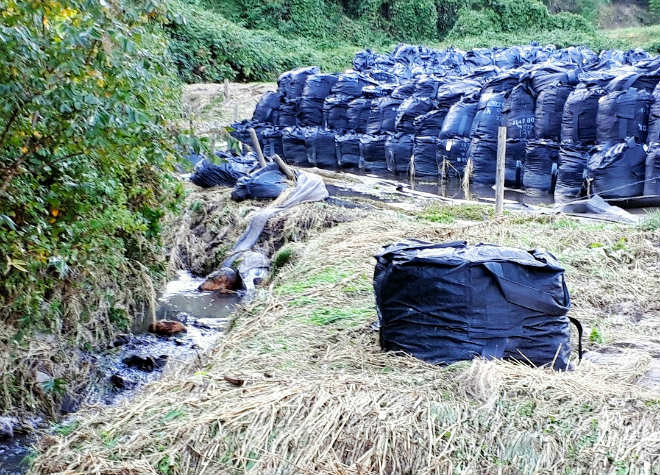
|
Bags of debris from Fukushima disaster swept away in typhoon http://www.asahi.com/ajw/articles/AJ201910140036.htmlBy TARO KOTEGAWA/ Staff Writer, October 14, 2019 Flexible bulk bags containing waste produced from decontamination work around the Fukushima No. 1 nuclear power plant were swept away in flooding during Typhoon No. 19 in Tamura, Fukushima Prefecture. (Hideyuki Miura) TAMURA, Fukushima Prefecture–Bulk bags filled with greenery collected during decontamination efforts after the nuclear disaster at the Fukushima No. 1 nuclear power plant were swept into a river during Typhoon No. 19 on Oct. 12. According to the Tamura city government, the bags were among 2,667 that have been stored temporarily at a site in the Miyakoji-machi district here. The facility was flooded after heavy rains brought by the typhoon, and the water carried an unknown number of the bags to a river about 100 meters away. A city government official received a phone call at around 9:20 p.m. on Oct. 12 from a nearby civil engineering firm, saying six of the bulk bags had been recovered from the river. Each of the bulk bags was 1 cubic meter in size. No sheets had been placed over the bags as a precaution against the rain and wind from the typhoon. A city official said consultations will be held with the Environment Ministry to determine possible effects on the environment. The decontamination effort involved removing debris, such as soil, leaves and plants, containing radioactive substances released after the 2011 triple meltdown at the Fukushima No. 1 plant. |
|
Putin warns on the need for a new nuclear weapons treaty
 PUTIN TAKES SWIPE AT TRUMP FOR WITHDRAWING FROM NUCLEAR TREATY: ‘IT WAS NOT WORTH RUINING’, Newsweek,
In an interview with Arabic-speaking journalists ahead of his visit to Saudi Arabia and the United Arab Emirates, Putin reiterated Russia’s opposition to the withdrawal in February from the INF, which had been signed in 1987 by Soviet leader Mikhail Gorbachev and President Ronald Reagan.
It banned missiles with ranges of between 310 and 3,400 miles but the U.S. and Nato had accused Russia of violating the pact by deploying a new type of cruise missile, a claim Moscow denied.
Putin said: “It think it was a mistake…and that they could have gone a different path. I do understand the U.S. concerns. While other countries are free to enhance their defences, Russia and the U.S. have tied their own hands with this treaty. However, I still believe it was not worth ruining the deal; I believe there were other ways out of the situation.”
Putin said that the U.S. must back a new START Treaty, which expires in 2021, to restrict a race to acquire strategic nuclear weapons.
“The new START Treaty is actually the only treaty that we have to prevent us from falling back into a full-scale arms race. To make sure it is extended, we need to be working on it right now. We have already submitted our proposals; they are on the table of the U.S. administration. There has been no answer so far.
“If this treaty is not extended, the world will have no means of limiting the number of offensive weapons, and this is bad news. The situation will change, globally. It will become more precarious, and the world will be less safe and a much less predictable place than today,” Putin said, according to a transcript of the interview on the Kremlin website.
Putin said that his doubt over the U.S. commitment to nuclear disarmament stretched back to 2002, when under President George W. Bush, Washington withdrew from the Anti-Ballistic Missile (ABM) Treaty, which had imposed limits on missile defence systems……… https://www.newsweek.com/putin-start-treaty-trump-arms-race-1464921
Urgent need for diplomacy with Iran
|
Both authors held high positions at the State Department in previous administrations. This month, six years ago, we were in the midst of secret talks with Iran that led to the comprehensive nuclear agreement. It was a moment when diplomacy carried considerable risk, and considerable promise. Today, the promise has faded, and the risk is accelerating. The consequences of the Trump administration’s foolish decision to abandon that nuclear deal last year, with no evidence of Iranian noncompliance, were predictable — and predicted. We are now at a very dangerous point. The story of how we got here is one of faulty expectations on both sides. Iran thought it could wait out President Trump, and the United States would simply return to the deal under a new president in 2021. But the pressure of economic sanctions, unilaterally reimposed by the United States, has been more formidable than Iran anticipated. …….. If we stay on this trajectory, we will soon go off the cliff. The policy questions debated in Washington are too often about whether or not to wear a seatbelt. Instead, we ought to put our hands back on the wheel of diplomacy and steer toward an off-ramp before it is too late. If we stay on this trajectory, we will soon go off the cliff. The policy questions debated in Washington are too often about whether or not to wear a seatbelt. Instead, we ought to put our hands back on the wheel of diplomacy and steer toward an off-ramp before it is too late. https://www.nytimes.com/2019/10/14/opinion/iran-nuclear-deal.html |
|
|

1 This Month

of the week – Shut Down Drone Warfare!


Tell the Ukrainian Government to Drop Prosecution of Peace Activist Yurii Sheliazhenko

Petition to revoke the licensing of the Near Surface Nuclear Disposal Facility (NSDF) at Chalk River. https://www.ourcommons.ca/petitions/en/Petition/Details?Petition=e-7247
To see nuclear-related stories in greater depth and intensity – go to https://nuclearinformation.wordpress.com
-
Archives
- April 2026 (74)
- March 2026 (251)
- February 2026 (268)
- January 2026 (308)
- December 2025 (358)
- November 2025 (359)
- October 2025 (376)
- September 2025 (257)
- August 2025 (319)
- July 2025 (230)
- June 2025 (348)
- May 2025 (261)
-
Categories
- 1
- 1 NUCLEAR ISSUES
- business and costs
- climate change
- culture and arts
- ENERGY
- environment
- health
- history
- indigenous issues
- Legal
- marketing of nuclear
- media
- opposition to nuclear
- PERSONAL STORIES
- politics
- politics international
- Religion and ethics
- safety
- secrets,lies and civil liberties
- spinbuster
- technology
- Uranium
- wastes
- weapons and war
- Women
- 2 WORLD
- ACTION
- AFRICA
- Atrocities
- AUSTRALIA
- Christina's notes
- Christina's themes
- culture and arts
- Events
- Fuk 2022
- Fuk 2023
- Fukushima 2017
- Fukushima 2018
- fukushima 2019
- Fukushima 2020
- Fukushima 2021
- general
- global warming
- Humour (God we need it)
- Nuclear
- RARE EARTHS
- Reference
- resources – print
- Resources -audiovicual
- Weekly Newsletter
- World
- World Nuclear
- YouTube
-
RSS
Entries RSS
Comments RSS
 nuclear-news