Massive Nuclear Explosion similar to Kyrshtym by Mayak Can Happen Happen at Hanford if the site is not Monitored and tanks not taken care of
Lane, 6 Oct 19 Mayak Explosion
Ten Thousand Gallon Tank at Mayak Exploded from Heat Decay. The Heat Deacy was from Strontium 90, Cesium 137, Cobalt 60 and Plutonium Stored in the Underground Tank. The explosion was equivalent to 100 tons of TNT. There are55 million gallons of the same Radionuclide Mix stored at Hanford, in UnderGround Tanks. If they become too concentrated and hot, the same thing will Happen there, contaminating a Great Portion of the Pacific NW USA and southe western Canada.
Medvedev, Zhores A. (4 November 1976). “Two Decades of Dissidence”. New Scientist.
Medvedev, Zhores A. (1980). Nuclear disaster in the Urals translated by George Saunders. 1st Vintage Books ed. New York: Vintage Books. ISBN 978-0-394-74445-2. (c1979)

In 1957 the cooling system in one of the tanks containing about 70–80 tons of liquid radioactive waste failed and was not repaired. The temperature in it started to rise, resulting in evaporation and a chemical explosion of the dried waste, consisting mainly of ammonium nitrate and acetates (see ammonium nitrate/fuel oil bomb). The explosion, on 29 September 1957, estimated to have a force of about 70–100 tons of TNT,[10] threw the 160-ton concrete lid into the air.[8] There were no immediate casualties as a result of the explosion, but it released an estimated 20 MCi (800 PBq) of radioactivity. Most of this contamination settled out near the site of the accident and contributed to the pollution of the Techa River, but a plume containing 2 MCi (80 PBq) of radionuclides spread out over hundreds of kilometers.[11] Previously contaminated areas within the affected area include the Techa river, which had previously received 2.75 MCi (100 PBq) of deliberately dumped waste, and Lake Karachay, which had received 120 MCi (4,000 PBq).[7]
In the next 10 to 11 hours, the radioactive cloud moved towards the north-east, reaching 300–350 km (190–220 mi) from the accident. The fallout of the cloud resulted in a long-term contamination of an area of more than 800 to 20,000 km2 (310 to 7,720 sq mi), depending on what contamination level is considered significant, primarily with caesium-137 and strontium-90.[7] This area is usually referred to as the East-Ural Radioactive Trace EURT
China buried nuclear waste in Sudan desert
 Official: China buried nuclear waste in Sudan desert, Dabanga November 12 – 2015 KHARTOUM, China has buried dozens of containers with toxic waste in the desert of Northern Sudan, according to a high-ranking official. The waste was most probably coming from nuclear plants in China.
According to the former director of the Sudan Atomic Energy Commission in Sudan, Mohamed Siddig, 60 containers have been brought to Sudan together with construction materials and machinery for the building of the Merowe Dam (Hamdab Dam) in the Northern part of Sudan. He did not mention the exact year of the import and the date the nuclear waste was disposed. China worked on the dam between 2004 and 2009.
During a conference held by the Sudanese Standards and Metrology Organisation (SSMO) in Khartoum on Tuesday, he disclosed how the Sudanese authorities allowed the import of the waste ‘without inspection’. He told the audience that 40 containers were buried in the desert not far from the Merowe Dam construction site. Another 20 containers were also disposed in the desert, though not buried. Mohamed Siddig was quoted by several local reporters, of whom some did not mention China, but ‘an Asian country’ instead. During the conference, titled ‘Raising awareness of the danger of chemicals’, Siddig said that a ‘number of Asian industrial countries’ had approached African countries to dispose their nuclear and other toxic waste…….https://www.dabangasudan.org/en/all-news/article/official-china-buried-nuclear-waste-in-sudan-s-desert?fbclid=IwAR1ScnDQ-6EcDBv2m2EhIqjnunbBnCpt5Ell_xuiNgFAhQapNqR0dF1ykMI
Russia’s manipulations in supplying Bangladesh with nuclear technology
 Derek Abbott Nuclear Fuel Cycle Watch Australia,7 Oct 19
I’m at an engineering meeting and got to meet an engineer working on the nuclear program in Bangladesh.
I asked him if Bangladesh had renewables. He said they have a lot.
I then made the point that nuclear is therefore not a good investment as his grid is now in greater need of sources that turn on and off quickly. As nuclear can’t do that, nuclear is not cost effective.
He agreed and said for that reason the Bangladeshi govt would actually never pay upfront for a nuclear station on an economic basis.
He said the nuclear program was a result of a political deal with the Russians.
He said that Pakistan and India have nuclear in the region, so the idea of Bangladesh having a nuclear station is a show of “arm flexing.”
The Russians were pushy and made a deal too hard to resist: The Russians will only charge 1% of the cost per annum for the first 30 years of operation and have agreed to remove all waste and ship it back to Russia.
I said that deal does seem too hard to resist.
I then naively asked why on earth the Russians would go to such lengths at an apparent economic loss to them.
His answer was that Bangladesh is seen as an economically strategic region. Labour costs are lower than India, and it has a very capable workforce with a GDP that is over 5 times (per head) higher than India!
I hadn’t realised that and asked how they are making money. He said that India is no longer the power house of the clothing industry. Due to lower wages, clothes are now made in Bangladesh. All your designer labels you might be wearing come from there and have been rebranded.
There are very strong trade deals between China and Bangladesh, and it his belief that Russia’s “bargain basement” nuclear deal is way of getting a foothold in the region themselves. It is a geopolitical maneuver.
What the Russians giveth with one hand, they’ll probably find a way to taketh with another.
US govt to fund study of Marshall Islands nuclear dome water
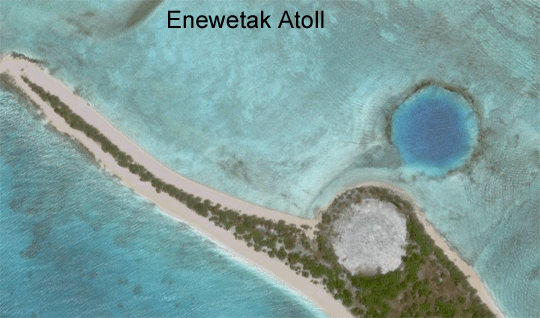
However, Marshall Islands officials say the lagoon water is already more contaminated than the dome itself, which has been leaking.
The money announced last week will fund a radiochemical analysis of the water surrounding the crater, and an engineering survey of the structure.
USA – North Korea talks broke down, but USA calls them “good discussions”
North Korea’s chief negotiator says discussions with the United States on Pyongyang’s nuclear program have broken down, but Washington says the two sides had “good discussions” that it intends to build on in two weeks. ABC News 6 Oct 17
Key points:
- North Korea said the talks broke down because negotiations had not met their expectations
- The US State Department said North Korea’s comments did “not reflect the content or the spirit” of the “good discussions” that took place
- It was the first time US and North Korea had conducted working-level negotiations since a February summit
The North Korean negotiator, Kim Miyong-Gil, said the talks in Stockholm had “not fulfilled our expectations and broke down”.
“I am very displeased about it,” he said.
Speaking outside the North Korean embassy, he read a statement in Korean that a translator next to him read in English.
Mr Kim said negotiations broke down “entirely because the US has not discarded its old stance and attitude”.
Saturday’s talks were the first between the US and North Korea since the February breakdown of the second summit between President Donald Trump and Kim Jong-un in Vietnam.
North Korea has since resumed missile tests, including an underwater-launched missile that fell inside Japan’s exclusive economic zone on Wednesday……. https://www.abc.net.au/news/2019-10-06/nuclear-talks-with-us-leave-north-korea-very-displeased/11577176
Strong environmental opposition in India, to uranium mining and nuclear power
  The Biggest Hurdle In India’s Nuclear Energy Pushm Oil Price.com By Ag Metal Miner – Oct 05, 2019, Nuclear energy is, for now, playing a minuscule role in India’s energy story, contributing to about 2 percent of the country’s electricity needs.But nuclear power generation in India is a story that is set to grow. The Biggest Hurdle In India’s Nuclear Energy Pushm Oil Price.com By Ag Metal Miner – Oct 05, 2019, Nuclear energy is, for now, playing a minuscule role in India’s energy story, contributing to about 2 percent of the country’s electricity needs.But nuclear power generation in India is a story that is set to grow.
But new nuclear plants have been opposed by the local populace in almost every part of the country where they have been proposed to be set up. Now, an in-principle approval given by the Indian government to initiate exploratory mining for more uranium across the two southern provinces of Andhra Pradesh and Telangana has locals up in arms. The location also includes a nature reserve not only rich in flora and fauna, but also with a large tiger population. The technical go-ahead was given a few months back for Uranium Corporation of India Limited (UCIL) to begin exploration for uranium, but an earlier protest led to a temporary pause in the process. Next to the mine there is a processing plant that converts the uranium ore into sodium diuranate for use in nuclear power plants. Over the years, local farmers and environmentalists have alleged that it had led to the contamination of soil and groundwater, in addition to the destruction of water bodies. A rethink by the government to go ahead with the fresh exploration has once again raised the hackles of environmentalists in India, who argue that whatever the procedure used to extract uranium, the wholesale mining for uranium would produce large amounts of radioactive waste that would pollute a major river nearby (as well as the surrounding areas). They claim even if the waste is treated before disposal, uranium mining can still lead to the contamination of water and soil, eventually harming the flora and fauna of the region………https://oilprice.com/Alternative-Energy/Nuclear-Power/The-Biggest-Hurdle-In-Indias-Nuclear-Energy-Push.html |
|
1 This Month

of the week – Shut Down Drone Warfare!


Tell the Ukrainian Government to Drop Prosecution of Peace Activist Yurii Sheliazhenko

Petition to revoke the licensing of the Near Surface Nuclear Disposal Facility (NSDF) at Chalk River. https://www.ourcommons.ca/petitions/en/Petition/Details?Petition=e-7247
To see nuclear-related stories in greater depth and intensity – go to https://nuclearinformation.wordpress.com
-
Archives
- April 2026 (68)
- March 2026 (251)
- February 2026 (268)
- January 2026 (308)
- December 2025 (358)
- November 2025 (359)
- October 2025 (376)
- September 2025 (257)
- August 2025 (319)
- July 2025 (230)
- June 2025 (348)
- May 2025 (261)
-
Categories
- 1
- 1 NUCLEAR ISSUES
- business and costs
- climate change
- culture and arts
- ENERGY
- environment
- health
- history
- indigenous issues
- Legal
- marketing of nuclear
- media
- opposition to nuclear
- PERSONAL STORIES
- politics
- politics international
- Religion and ethics
- safety
- secrets,lies and civil liberties
- spinbuster
- technology
- Uranium
- wastes
- weapons and war
- Women
- 2 WORLD
- ACTION
- AFRICA
- Atrocities
- AUSTRALIA
- Christina's notes
- Christina's themes
- culture and arts
- Events
- Fuk 2022
- Fuk 2023
- Fukushima 2017
- Fukushima 2018
- fukushima 2019
- Fukushima 2020
- Fukushima 2021
- general
- global warming
- Humour (God we need it)
- Nuclear
- RARE EARTHS
- Reference
- resources – print
- Resources -audiovicual
- Weekly Newsletter
- World
- World Nuclear
- YouTube
-
RSS
Entries RSS
Comments RSS
 nuclear-news