Hanford nuclear waste cleanup unlikely ever to be complete, and with a poor safety culture
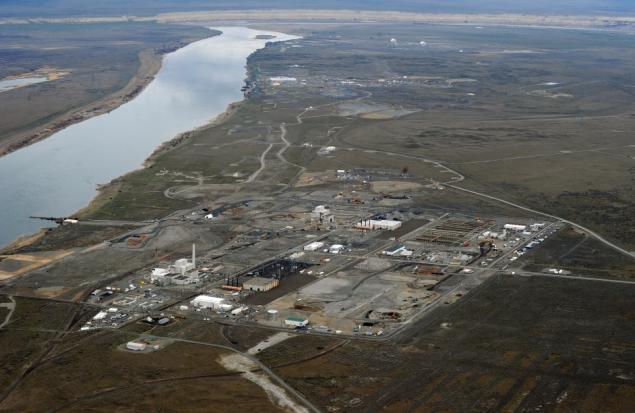
Now, a core piece of the cleanup program nears a milestone after 17 years and $17 billion of construction: startup of the first phase of a new production complex to transform much of Hanford’s 56 million gallons of long-stored radioactive waste from weapons-making into inert glass for safe disposal and future decay.

Nearly 3,000 on-site employees are attached to Hanford’s Tank Waste Treatment and Immobilization Plant, dubbed Vit Plant, including 1,500 trades workers. But as it pushes to meet court-imposed mandates, the project and its innovative technology still face big technical and funding uncertainties and stakeholder skepticism.
The project was conceived nearly two decades ago to pump the radioactive waste from 177 aging underground storage tanks, about 60 of which have leaked to the subsurface and likely into groundwater.
Using vitrification technology, the pumped waste will be heated to 2,100° F and blended with glass-forming materials. The molten mixture then will be poured into stainless steel canisters to cool and solidify, protecting humans and the environment from radioactivity as it dissipates over hundreds to thousands of years……..
the project—based on a design in a 1997 environmental impact statement—has been plagued by technical challenges and delays, and its cost now is about four times its original projection.
Project and government managers and regulators sparred regularly over scope changes, and progress and cost impacts that affected Bechtel performance incentives, most recently for 2018, says an April report in Tri-Cities-Herald, the regional newspaper that has followed the Vit Plant closely since its start. The newspaper notes improvements this year.
Even so, the current project price tag remains a moving target more than a decade from full completion, Years and billions of dollars beyond the original scope, DOE has tamped down expectations as safety and quality assurance issues emerged in the high-level waste (HLW) treatment process, some raised by whistleblowers, including one whose alarms resulted in his firing by site subcontractor URS, now part of AECOM, and a subsequent $4-million wrongful termination judgement.
Originally intending to treat all waste in a single stream, DOE in 2013 moved to create what is now called the Direct-Feed Low-Activity Waste (DFLAW) process, which will allow treatment of what the agency says is 90% of tank waste, which is considered “low-activity”, through a designated vitrification plant as engineers work out technical and design issues for high-level waste treatment.
Last month, Brian Vance, who heads DOE operations at Hanford, told the Washington state Dept. of Ecology in a “notice of serious risk” that his agency “cannot project with certainty” when the high-level waste or pretreatment plants will be completed…….
a congressionally mandated National Academies of Science draft report issued in mid-September raises concerns about the plant’s ability to treat the large amount of site low-level waste in time to meet the deadlines, based on existing design……..
Future Doubts
Tom Carpenter, executive director of leading site watchdog group Hanford Challenge, says no part of the Vit Plant should operate short of a complete and independent inspection that validates and verifies nuclear treatment quality.
“DOE seems to be doing everything in its power to simply walk away from its legal and moral obligations to deal with Hanford’s extraordinary radioactive waste inventories,” he contends, related to the proposed waste reclassification.
“I seriously doubt the HLW facility will ever operate for numerous reasons, and DOE will simply find that the waste is low-level, not high-level, dump concrete on the whole mess and call it good.”
While Carpenter supports vitrifying tank waste, he has concerns with what he calls consistent design flaws, a lack of quality control and a “poor nuclear safety culture” at the site.
Carpenter cites whistleblower lawsuits and reassignment of employees who raised safety concerns.
For DOE and Bechtel, the focus remains on the 90% of waste they say they can successfully treat via the DFLAW process.
“There have been quality issues in the past that slowed things, but those have been addressed,” McCain says. “Having legacy issues behind us was a big burden off the project.”
David Reeploeg, vice president of federal programs for local economic development group TRIDEC, is encouraged with progress made in recent years, but says funding remains the “single biggest challenge.”
Not only does the project need hundreds of millions of dollars every year to meet milestones and agreements, he says it will be “critically important for DOE and its regulators to identify ways to reduce the long-term cost and schedule for Hanford cleanup,” something that the Vit Plant’s history has already shown won’t be an easy task.https://www.enr.com/articles/47720-worst-us-nuclear-waste-dump-inches-closer-to-cleanup
1 Comment »
Leave a comment
1 This Month

of the week – Shut Down Drone Warfare!


Tell the Ukrainian Government to Drop Prosecution of Peace Activist Yurii Sheliazhenko

Petition to revoke the licensing of the Near Surface Nuclear Disposal Facility (NSDF) at Chalk River. https://www.ourcommons.ca/petitions/en/Petition/Details?Petition=e-7247
To see nuclear-related stories in greater depth and intensity – go to https://nuclearinformation.wordpress.com
-
Archives
- April 2026 (68)
- March 2026 (251)
- February 2026 (268)
- January 2026 (308)
- December 2025 (358)
- November 2025 (359)
- October 2025 (376)
- September 2025 (257)
- August 2025 (319)
- July 2025 (230)
- June 2025 (348)
- May 2025 (261)
-
Categories
- 1
- 1 NUCLEAR ISSUES
- business and costs
- climate change
- culture and arts
- ENERGY
- environment
- health
- history
- indigenous issues
- Legal
- marketing of nuclear
- media
- opposition to nuclear
- PERSONAL STORIES
- politics
- politics international
- Religion and ethics
- safety
- secrets,lies and civil liberties
- spinbuster
- technology
- Uranium
- wastes
- weapons and war
- Women
- 2 WORLD
- ACTION
- AFRICA
- Atrocities
- AUSTRALIA
- Christina's notes
- Christina's themes
- culture and arts
- Events
- Fuk 2022
- Fuk 2023
- Fukushima 2017
- Fukushima 2018
- fukushima 2019
- Fukushima 2020
- Fukushima 2021
- general
- global warming
- Humour (God we need it)
- Nuclear
- RARE EARTHS
- Reference
- resources – print
- Resources -audiovicual
- Weekly Newsletter
- World
- World Nuclear
- YouTube
-
RSS
Entries RSS
Comments RSS
 nuclear-news
Massive Nuclear Explosion similar to Kyrshtym by Mayak Can Happen Happen at Hanford if the site is not Monitored and tanks not taken care of
Mayak
Explosion
Ten Thousand Gallon Tank at Mayak Exploded from Heat Decay. The Heat Deacy was from Strontium 90, Cesium 137, Cobalt 60 and Plutonium Stored in the Underground Tank. The explosion was equivalent to 100 tons of TNT. There are55 million gallons of the same Radionuclide Mix stored at Hanford, in UnderGround Tanks. If they become too concentrated and hot, the same thing will Happen there, contaminating a Great Portion of the Pacific NW USA and southe western Canada.
Medvedev, Zhores A. (4 November 1976). “Two Decades of Dissidence”. New Scientist.
Medvedev, Zhores A. (1980). Nuclear disaster in the Urals translated by George Saunders. 1st Vintage Books ed. New York: Vintage Books. ISBN 978-0-394-74445-2. (c1979)
In 1957 the cooling system in one of the tanks containing about 70–80 tons of liquid radioactive waste failed and was not repaired. The temperature in it started to rise, resulting in evaporation and a chemical explosion of the dried waste, consisting mainly of ammonium nitrate and acetates (see ammonium nitrate/fuel oil bomb). The explosion, on 29 September 1957, estimated to have a force of about 70–100 tons of TNT,[10] threw the 160-ton concrete lid into the air.[8] There were no immediate casualties as a result of the explosion, but it released an estimated 20 MCi (800 PBq) of radioactivity. Most of this contamination settled out near the site of the accident and contributed to the pollution of the Techa River, but a plume containing 2 MCi (80 PBq) of radionuclides spread out over hundreds of kilometers.[11] Previously contaminated areas within the affected area include the Techa river, which had previously received 2.75 MCi (100 PBq) of deliberately dumped waste, and Lake Karachay, which had received 120 MCi (4,000 PBq).[7]
In the next 10 to 11 hours, the radioactive cloud moved towards the north-east, reaching 300–350 km (190–220 mi) from the accident. The fallout of the cloud resulted in a long-term contamination of an area of more than 800 to 20,000 km2 (310 to 7,720 sq mi), depending on what contamination level is considered significant, primarily with caesium-137 and strontium-90.[7] This area is usually referred to as the East-Ural Radioactive Trace EURT