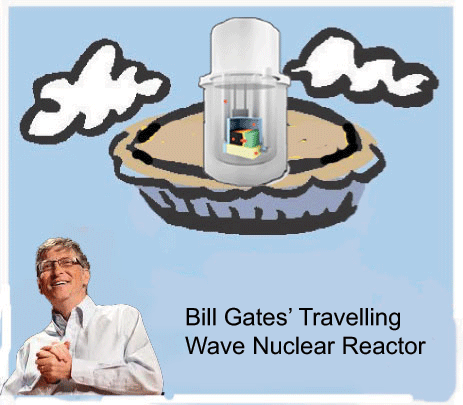
Bill Gates is wrong. Nuclear power will not save the climate.
according to the International Energy Agency (IEA), the largest share of this  [needed greenhouse gas] reduction – almost 40 percent – could come from improved energy efficiency….One third of that could be covered by renewable energies, while in this scenario, nuclear power would account for
  five percent.
..Indeed, in order to actually deliver on such a contribution, hundreds of new reactors would have to be built. “It would involve a gigantic nuclear dimension just to make a minimal contribution to the climate,”
One of the questions that has received very little attention so far is how reliable nuclear power plants will be in a warmer world……This year, reactors were again disconnected from the grid in Europe as a result of heat waves.
|
Bill Gates is wrong. Nuclear power will not save the climate. Beyond Chernobyl and Fukushima, there’s too much speaking against it, German Times, By Christoph von Eichhorn, October 2019 Nuclear power? No, thank you! “That chapter is over,” a spokesperson recently proclaimed. Nuclear power isn’t even a topic anymore, she argued. And this spokesperson wasn’t from some environmental organization or the like; she was representing RWE, one of three large corporations in Germany that still produces electricity from nuclear energy. The two other companies, EnBW and Eon, have issued similar sentiments, pointing to the fact that their priority is now the decommissioning of nuclear power plants and the switch to renewable energies.Just prior to those comments, members of Germany’s industrial community had joined up with the WerteUnion – a group of conservative parliamentarians from the CDU – to suggest longer running times for the remaining German nuclear power plants. But this suggestion was greeted with a unanimous negative response from electricity corporations: the use of nuclear energy in Germany was over, they argued. Period……..
One of the most prominent advocates of a nuclear renaissance is Bill Gates. Late last year, in an open letter to employees, the Microsoft founder wrote: “Nuclear is ideal for dealing with climate change, because it is the only carbon-free, scalable energy source that’s available 24 hours a day.” The problems associated with today’s reactors, he argued, “can be solved through innovation.” In the United States, the question of what to do with nuclear energy is particularly acute. Nuclear fission currently accounts for roughly 11 percent of global electricity, and for around 20 percent in the United States. As the Union of Concerned Scientists (UCS) points out in a recent study, one in every three of the approximately 60 nuclear power plants in the US might have to be shut down in the next few years because they are either too old or are already losing money today…… The decline in the price of renewables is seen as one of the major reasons why nuclear energy is less and less viable. Some states in the US, including Illinois, New Jersey and New York, have nonetheless subsidized unprofitable nuclear power plants in order to secure their operations. This is by all means a daring investment. The UCS estimates that it takes an average of $4 billion to make an unprofitable power plant profitable again. Equipping nuclear reactors to continue running only 20 years longer than planned usually requires expensive modernization measures designed to keep the aging technology in good condition, says Frank Peter, co-head of the think tank Agora Energiewende. “These investments often make no economic sense.” UCS researchers advise against the construction of any new power plants due to the high investment costs. “The fundamental problem is the cost,” says a recent report by the Massachusetts Institute of Technology on the future of nuclear energy. While technologies such as photovoltaics and wind power have consistently become cheaper, new nuclear power plants have become more expensive. The MIT researchers calculated the costs of nuclear energy for several regions and came up with very clear results: In terms of the cost of generating energy, wind and photovoltaics always beat nuclear power. In order to make nuclear competitive again, there would have to be massive changes in the way the technology is developed and managed. To this end, the MIT experts suggest producing components on an assembly line and testing innovative new reactor prototypes in huge “reactor parks” as quickly as possible. They even mention the idea of simplifying regulations for nuclear power plants. In the face of disasters such as those in Chernobyl and Fukushima, it is unlikely that the regimen of having lower safety standards and test sites for non-mature reactors will be able to be enforced in many countries. Even the standardization of reactors has not yet brought the savings many had hoped for. For example, European Pressurized Water Reactors are currently being built in Finland, France and the UK, and in all three cases, the costs and construction time have long since moved beyond the original scope. Construction on the third unit of the nuclear power plant in the Finnish city of Olkiluoto has already taken 10 years longer than planned. According to calculations by Greenpeace, the British plant Hinkley Point C is set to cost €108 billion in subsidies over a period of 35 years. There is one question above all that dominates the discussion, and it revolves around whether or not nuclear energy can even contribute to reducing greenhouse gas emissions. This issue has been investigated by the International Energy Agency, among others. In order to limit global warming to two degrees higher than pre-industrial levels by 2100, world emissions would have to drop from 37 billion tons today to less than five billion tons by 2050. And, according to the International Energy Agency (IEA), the largest share of this reduction – almost 40 percent – could come from improved energy efficiency. One third of that could be covered by renewable energies, while in this scenario, nuclear power would account for five percent. That would involve a reduction of more than one billion tons a year, but it would still not be enough to fundamentally shift the direction in climate policy. Indeed, in order to actually deliver on such a contribution, hundreds of new reactors would have to be built. “It would involve a gigantic nuclear dimension just to make a minimal contribution to the climate,” says Manfred Fischedick, energy expert at the Wuppertal Institute for Climate, Environment and Energy. One of the questions that has received very little attention so far is how reliable nuclear power plants will be in a warmer world. In the drought-plagued summer of 2018, several reactors in Germany and France had to be shut down because the surrounding rivers had overheated. Plant operators were no longer allowed to feed in cooling water so as not to endanger the already stressed ecosystems. This year, reactors were again disconnected from the grid in Europe as a result of heat waves. All we can do now is hope for new reactors, such as the traveling wave reactor sponsored by Bill Gates. Similar to the very slow burn of a glowing cigar, this type of reactor would produce its own fuel and consume it for decades. As it would use old fuel rods from light-water reactors and depleted uranium, this reactor type would be able to eliminate high-level nuclear waste, for which there are still no good solutions – even seven decades after the beginning of the nuclear age. If this concept were to actually work, it would certainly be a blessing. But we would be well-advised not to actually rely on this approach in our efforts to stop global warming. The concept for this type of reactor dates back to the 1950s, and the basic foundations have yet to be fully researched. For example, nuclear engineers would have to deal with enormous amounts of material that is generated in reactions involving temperatures exceeding 500 degrees Celsius. TerraPower is aiming for a prototype by the mid-2020s, and it would most likely take another 10 years to achieve a reactor that actually produces electricity. This is a very important timeframe – one in which we will have to have already shifted gears and set a course for a climate-neutral energy supply. Christoph von Eichhorn is a science editor at the Süddeutsche Zeitung. http://www.german-times.com/bill-gates-is-wrong-nuclear-power-will-not-save-the-climate-beyond-chernobyl-and-fukushima-theres-too-much-speaking-against-it/?fbclid=IwAR3CJIEaecAlk05MgeVsPCuBSCJPEDDweL9RzCxzsVRCeso5_vQPRVjiyy8 |
|
Scrutiny on Britain’s nuclear plans: small modular reactors uncompetitive

UK nuclear: a Golden Egg or Poisoned Chalice? UK nuclear power isunder  intense scrutiny as costs balloon on the controversial Hinkley Point C station in southwest England
Hanford nuclear waste cleanup unlikely ever to be complete, and with a poor safety culture
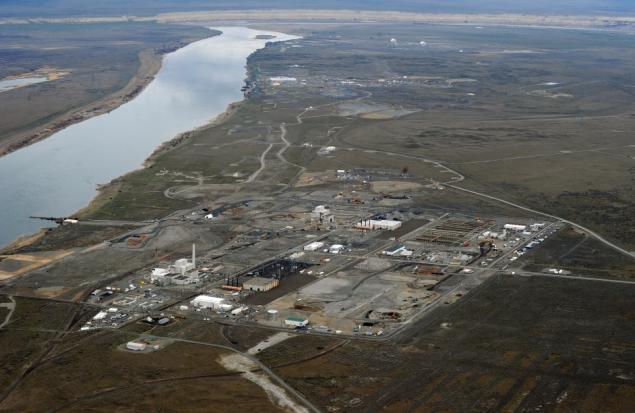
Now, a core piece of the cleanup program nears a milestone after 17 years and $17 billion of construction: startup of the first phase of a new production complex to transform much of Hanford’s 56 million gallons of long-stored radioactive waste from weapons-making into inert glass for safe disposal and future decay.

Nearly 3,000 on-site employees are attached to Hanford’s Tank Waste Treatment and Immobilization Plant, dubbed Vit Plant, including 1,500 trades workers. But as it pushes to meet court-imposed mandates, the project and its innovative technology still face big technical and funding uncertainties and stakeholder skepticism.
The project was conceived nearly two decades ago to pump the radioactive waste from 177 aging underground storage tanks, about 60 of which have leaked to the subsurface and likely into groundwater.
Using vitrification technology, the pumped waste will be heated to 2,100° F and blended with glass-forming materials. The molten mixture then will be poured into stainless steel canisters to cool and solidify, protecting humans and the environment from radioactivity as it dissipates over hundreds to thousands of years……..
the project—based on a design in a 1997 environmental impact statement—has been plagued by technical challenges and delays, and its cost now is about four times its original projection.
Project and government managers and regulators sparred regularly over scope changes, and progress and cost impacts that affected Bechtel performance incentives, most recently for 2018, says an April report in Tri-Cities-Herald, the regional newspaper that has followed the Vit Plant closely since its start. The newspaper notes improvements this year.
Even so, the current project price tag remains a moving target more than a decade from full completion, Years and billions of dollars beyond the original scope, DOE has tamped down expectations as safety and quality assurance issues emerged in the high-level waste (HLW) treatment process, some raised by whistleblowers, including one whose alarms resulted in his firing by site subcontractor URS, now part of AECOM, and a subsequent $4-million wrongful termination judgement.
Originally intending to treat all waste in a single stream, DOE in 2013 moved to create what is now called the Direct-Feed Low-Activity Waste (DFLAW) process, which will allow treatment of what the agency says is 90% of tank waste, which is considered “low-activity”, through a designated vitrification plant as engineers work out technical and design issues for high-level waste treatment.
Last month, Brian Vance, who heads DOE operations at Hanford, told the Washington state Dept. of Ecology in a “notice of serious risk” that his agency “cannot project with certainty” when the high-level waste or pretreatment plants will be completed…….
a congressionally mandated National Academies of Science draft report issued in mid-September raises concerns about the plant’s ability to treat the large amount of site low-level waste in time to meet the deadlines, based on existing design……..
Future Doubts
Tom Carpenter, executive director of leading site watchdog group Hanford Challenge, says no part of the Vit Plant should operate short of a complete and independent inspection that validates and verifies nuclear treatment quality.
“DOE seems to be doing everything in its power to simply walk away from its legal and moral obligations to deal with Hanford’s extraordinary radioactive waste inventories,” he contends, related to the proposed waste reclassification.
“I seriously doubt the HLW facility will ever operate for numerous reasons, and DOE will simply find that the waste is low-level, not high-level, dump concrete on the whole mess and call it good.”
While Carpenter supports vitrifying tank waste, he has concerns with what he calls consistent design flaws, a lack of quality control and a “poor nuclear safety culture” at the site.
Carpenter cites whistleblower lawsuits and reassignment of employees who raised safety concerns.
For DOE and Bechtel, the focus remains on the 90% of waste they say they can successfully treat via the DFLAW process.
“There have been quality issues in the past that slowed things, but those have been addressed,” McCain says. “Having legacy issues behind us was a big burden off the project.”
David Reeploeg, vice president of federal programs for local economic development group TRIDEC, is encouraged with progress made in recent years, but says funding remains the “single biggest challenge.”
Not only does the project need hundreds of millions of dollars every year to meet milestones and agreements, he says it will be “critically important for DOE and its regulators to identify ways to reduce the long-term cost and schedule for Hanford cleanup,” something that the Vit Plant’s history has already shown won’t be an easy task.https://www.enr.com/articles/47720-worst-us-nuclear-waste-dump-inches-closer-to-cleanup
Nuclear Scandal Hangs Over Japan’s Abe as Parliament Opens
 Nuclear Scandal Hangs Over Japan’s Abe as Parliament Opens, By
- Abe seeks to pass U.S. trade pact, work to revise constitution
- Opposition want to use Kansai Electric scandal to derail plans
Questions in parliament about a nuclear payoff scandal threaten to delay Japanese Prime Minister Shinzo Abe’s bid to pass a U.S. trade pact and make progress toward changing the country’s pacifist constitution.
Opposition lawmakers have pledged to hammer Abe’s ruling Liberal Democratic Party as the new session opened Friday over revelations that executives at Kansai Electric Power Co. took millions of dollars in payments, including gold coins hidden in a box of sweets, from a former local official in a town that hosts a major nuclear plant. Minority parties want to summon the executives for questioning in parliament….. (subscribers only) https://www.bloomberg.com/news/articles/2019-10-04/nuclear-scandal-hangs-over-japan-s-abe-as-parliament-opens
India and Pakistan sliding toward potential nuclear war
 Kashmir crackdown: A warning of nuclear war between India and Pakistan, Axios, Dave Lawler $ Oct 19, India and Pakistan are sliding toward potential nuclear war, according to the president of Pakistani-controlled Kashmir. The warning comes as Pakistan attempts to rally global outrage against its neighbor and rival.
Catch up quick: On Aug. 5, India revoked the constitutional autonomy of Jammu and Kashmir — the state it controls within the disputed Himalayan territory — while instituting a communications blackout and a curfew enforced by hundreds of thousands of troops.
A new process supplies medical isotope 99Mo: no need for a nuclear reactor

Nuclear fusion process could create US supply of Mo-99 https://www.dotmed.com/news/story/48759, by Lisa Chamoff, Contributing Reporter | October 04, 2019 A new nuclear fusion process may shore up supply of the rapidly-decaying, cancer-detecting radioisotope molybdenum-99 (Mo-99) without the need for reactor facilities.
Nuclear technology company Phoenix and SHINE Medical Technologies, a medical isotope production company, this week announced that in July it surpassed a record for a nuclear fusion reaction in a steady-state system.
The reaction at SHINE’s medical isotope production facility produced 46 trillion neutrons per second, surpassing the previous record set at a California facility by nearly 25 percent.
The companies say the eight Phoenix systems will help address limited accessibility to nuclear reactors for producing medical isotopes, used for cardiac stress testing and cancer detection, and meet a third of the global demand.
The companies expect to produce 20 million doses per year once the plant is up and running. SHINE has already sent Mo-99 samples produced by this method to GE Healthcare to be tested and verified.
Mo-99 is created by accelerating a particle beam into a target and generating a nuclear fusion reaction. The company developed a proprietary nuclear fusion process that uses a gaseous target instead of solid one, said Evan Sengbusch, president of Phoenix.
Nuclear waste awareness tour begins

 stories/nuclear-waste-awareness-tour-begins,586462 October 3, 2019
BRATTLEBORO — Leona Morgan isn’t in Vermont this week for leaf peeping, but for environmental justice.
 The Navajo woman from Albuquerque, N.M., is an indigenous community organizer and she wants the people of Vermont and New England what getting rid of the nuclear waste from the Vermont Yankee nuclear power plant means to her community.
Morgan, along with a group of anti-nuclear activists are touring New England this week to draw attention to what they concede is an oft-forgotten or ignored problem — where does the nuclear waste go?
Pulling a giant wooden mock cask that was built to resemble a cask used to transport — not store — high level radioactive waste, the activists are hoping the large dumbbell-looking prop will prompt discussion of the unsolved issue.
“It’s our job to wake them up,” Deb Katz, the executive director of the Citizens Awareness Network, said of residents.
Morgan said the nuclear industry — whether it is the existing 14,000-acre Waste Control Specialties (WCS) facility in west Texas, or its proposed expansion or a proposed Holtec nuclear storage facility just over the border in New Mexico — was overwhelming the communities in that region.
She said putting nuclear waste in that area, which she said is geologically unstable from a huge amount of oil and gas drilling, is dangerous and racist. The area is already home to the U.S. Department of Energy’s waste isolation pilot plant, which houses government-generated nuclear waste, including low-level plutonium. All those projects, Morgan said, are within 50 miles.
It is a largely Hispanic and Navajo area, she said, and the companies and politicians who are behind the nuclear project are “old, white men.”
“We are specifically targeted,” Morgan said.
The six-day tour has been organized by Citizens Awareness Network, a regional anti-nuclear organization based in Shelburne Falls, Mass. Katz and others made a brief stopover in Brattleboro on Wednesday with its large mock canister, as the group was making its way from the Vermont Law School to Greenfield, Mass., for a rally and concert.
“It is vital that citizens understand the issues and what’s at stake,” said Katz. “Until the criteria of sound science and environmental justice are the drivers behind any disposition, high-level nuclear waste must remain onsite,” she said.
All three members of Vermont’s congressional delegation have supported consolidated interim storage facilities, Katz said. Their support, she said, is based on the desire to get the high-level radioactive waste out of Vermont.
But she said that inherently unfair and short-sighted.
The stalled construction of a national depository at Yucca Mountain outside Las Vegas is still stalled, despite statements by President Donald Trump that he supports it. The project had been suspended during the Obama administration.
“This is an old bad idea,” said Diane D’Arrigo, the radioactive waste project director for the Nuclear Information and Resource Service in Washington, D.C.
Vermont Yankee emptied its spent fuel pool and completed the transfer of its thousands of spent fuel rods — the most dangerous of the radioactive waste — last year into a storage facility on the grounds of Vermont Yankee in Vernon. The fuel is now in large concrete and steel canisters called dry cask storage and will remain there until the federal Department of Energy builds a nuclear waste facility to store it for the thousands of years it remains dangerous. Yucca Mountain was once targeted as that facility.
But the anti-nuclear activists said a new push for interim waste storage facilities in west Texas and eastern New Mexico would be dangerous and that the nuclear fuel “should only be moved once.”
Moving the waste comes with many complications and potential dangers, Katz said, not to mention that thousands of shipments would come from dozens of nuclear power plants that have either shut down or will be shutting down.
The “Environmental Justice and Nuclear Waste Tour” started in Burlington on Tuesday, and made appearances in Montpelier, South Royalton, Brattleboro and Greenfield, Mass., on Wednesday. On Thursday, there is a legislative briefing at the Massachusetts State House, and afterwards a series of meetings in Massachusetts communities near the now-closed Pilgrim nuclear station. Then on Sunday, it’s back to western Massachusetts for an event and concert in Florence, Mass.
Contact Susan Smallheer at ssmallheer@reformer.com or at 802 254-2311, ext. 154.
International Atomic Energy Agency reports improved cooperation with Iran
|
Nuclear watchdog reports improved cooperation with Iran https://thehill.com/policy/international/464352-nuclear-watchdog-reports-improved-cooperation-with-iran
BY JOHN BOWDEN – 10/04/19, The International Atomic Energy Agency (IAEA) on Friday said Iranian officials have increased their cooperation with the United Nations agency after the organization raised questions reportedly related to traces of uranium found at an undeclared site.Reuters reported that the IAEA’s acting chief said progress being made between Iran’s government and U.N. officials was a “step in the right direction.” “Some engagement is ongoing, and this engagement is currently taking place,” acting IAEA chief Cornel Feruta said, adding, “This is an ongoing process … I cannot prejudge how this is going to end. The engagement doesn’t mean that the issues are completely addressed, but it’s a step in the right direction.” The IAEA is responsible for judging whether a facility Iran’s government claims was used for carpet-cleaning was actually a secret nuclear facility as alleged by Israel’s prime minister, Benjamin Netanyahu. Iran’s government has also been accused for weeks of stonewalling IAEA inspectors attempting to examine environmental samples of the facility. The status of Iran’s nuclear program is a controversial topic and led to the Trump administration abandoning a 2015 nuclear agreement signed by the U.S. and Iran, claiming that the Iranian government had forsaken the spirit and letter of the agreement. Iran has denied that it violated the agreement prior to the U.S.’s exit, and has refused to negotiate with the Trump administration following the president’s decision. Its government has also warned European nations still bound to the deal that Iran will abandon the agreement and ramp up uranium enrichment if Iran is not allowed access to the global economy. The U.S. and Iran, meanwhile, have seen significantly increased tensions for weeks following the destruction of a U.S. surveillance drone and other attacks in the region blamed on Iranian forces, including the destruction of oil tankers and Saudi oil facilities. |
|
AMAZING URANIUM FILM FESTIVAL IN PORTUGAL 2019
 https://uraniumfilmfestival.org/en/amazing-uranium-film-festival-in-portugal-2019, Norbert G. Suchanek and Marcia Gomes de Oliveira,
Founder and directors of the Uranium Film Festival
Those who couldn’t make it to the recent International Uranium Film Festival in Portugal have missed an amazing event at a special place where uranium mining started more than a hundred years ago. From September 13th to September 15th the festival was organised in partnership with ATMU (Former Uranium Mine Workers Association) and former uranium miners and their families in the towns Urgeiriça (Nelas), Viseu and Mangualde in the Dão region of central Portugal.
„We thank especially the former surviving uranium miners and their incredible wives for the warm welcome and their enthusiastic commitment for the festival“, said Uranium Film Festival’s executive director Márcia Gomes de Oliveira from Rio de Janeiro. And the President of ATMU added. „The Uranium Film Festival was, in fact, one of the most interesting cultural and scientific initiatives in which we had the privilege to participate. We extend our most sincere congratulations to the festival directors Márcia Gomes de Oliveira and Norbert G. Suchanek for three days of films, debates and remarkable of all, raising awareness.“
“We confess that we did not know some of the cases we were made aware of: the uncertain future of the Utah Ute people in the Grand Canyon; the scandalous case of Palomares, who lived under the shadow of lies for decades; and the living despair of Jadugoda whose inhabitants, the Adivasi, are sacrificed by uranium mining and under the hollow argument of so called development”, write the two observers Catarina Gameiro Minhoto & João Paiva in their final festival report to ATMU.
“Each case is unique, but the reality is the same. Let us quote a phrase from the Wismut movie (Yellow Cake) which said that uranium mining happened under a web of lies, propaganda and lack of information. Same in Palomares, where in 1966 two US planes crashed and four atomic bombs felt from the sky and where even today the United States and the now democratic government of Spain seem to hide the truth behind that accident and its ongoing consequences. We also mention Jadugoda where the situation is dramatic and where the authorities – like the nuclear industry in Brazil (INB) – insist on ignorance. Worse than natural ignorance, is conscious ignorance, based on the lie about the truth. The consequences of this attitude on the part of the authorities are clear: thousands of people suffering from cancer and other diseases; with terrible social conditions; the surroundings of these mines became ecological time bombs.
To our great shock, we have learned by the film that the main reason why the environmental situation is often untreated and the legacies of uranium mining are not rehabilitated is that the end point of nuclear fuel production is extremely costly. And no profit waiting. The big companies or uranium mills do not want to spend money on this last stage. The final price of this insensitivity is paid by the people of the surrounding areas, is paid by the environment, is paid by all of us.”
MOVIES LEFT A LASTING IMPRESSION ON THE AUDIENCE
Catarina Gameiro Minhoto & João Paiva’s comments show that the documentary movies screened have left a lasting impression on the audience in Portugal, especially the four films: YELLOW CAKE. THE DIRT BEHIND URANIUM(link is external) by Joachim Tschirner, BUDA CHORA EM JADUGODA (BUDDHA WEEPS IN JADUGODA)(link is external) by Shri Prakash, HALF LIFE: THE STORY OF AMERICA’S LAST URANIUM MILL (MEIA VIDA: A HISTÓRIA DO ÚLTIMO MOINHO DE URÂNIO DA AMÉRICA)(link is external) by Justin Clifton and OPERACIÓN FLECHA ROTA. ACCIDENTE NUCLEAR EN PALOMARES (BROKEN ARROW. NUCLEAR ACCIDENT IN PALOMARES) by Jose Herrera Plaza. ………https://uraniumfilmfestival.org/en/amazing-uranium-film-festival-in-portugal-2019
1 This Month

of the week – Shut Down Drone Warfare!


Tell the Ukrainian Government to Drop Prosecution of Peace Activist Yurii Sheliazhenko

Petition to revoke the licensing of the Near Surface Nuclear Disposal Facility (NSDF) at Chalk River. https://www.ourcommons.ca/petitions/en/Petition/Details?Petition=e-7247
To see nuclear-related stories in greater depth and intensity – go to https://nuclearinformation.wordpress.com
-
Archives
- April 2026 (68)
- March 2026 (251)
- February 2026 (268)
- January 2026 (308)
- December 2025 (358)
- November 2025 (359)
- October 2025 (376)
- September 2025 (257)
- August 2025 (319)
- July 2025 (230)
- June 2025 (348)
- May 2025 (261)
-
Categories
- 1
- 1 NUCLEAR ISSUES
- business and costs
- climate change
- culture and arts
- ENERGY
- environment
- health
- history
- indigenous issues
- Legal
- marketing of nuclear
- media
- opposition to nuclear
- PERSONAL STORIES
- politics
- politics international
- Religion and ethics
- safety
- secrets,lies and civil liberties
- spinbuster
- technology
- Uranium
- wastes
- weapons and war
- Women
- 2 WORLD
- ACTION
- AFRICA
- Atrocities
- AUSTRALIA
- Christina's notes
- Christina's themes
- culture and arts
- Events
- Fuk 2022
- Fuk 2023
- Fukushima 2017
- Fukushima 2018
- fukushima 2019
- Fukushima 2020
- Fukushima 2021
- general
- global warming
- Humour (God we need it)
- Nuclear
- RARE EARTHS
- Reference
- resources – print
- Resources -audiovicual
- Weekly Newsletter
- World
- World Nuclear
- YouTube
-
RSS
Entries RSS
Comments RSS
 nuclear-news