Climate change makes nuclear waste even more of a deadly threat
Can Nuclear Power’s Deadly Waste Be Contained in a Warming World? PART OF THE SERIES Covering Climate Now, Truthout. Karen Charman 23 Sept 19, ‘…………Nuclear Energy Is Not “Clean”
Ever since the nuclear industry became a global pariah following Three Mile Island and the much more severe accident at Chernobyl in 1986, it has been desperately trying to make a comeback.
In the late 1980s, then-chairman of the International Atomic Energy Agency Hans Blix began touting the idea that nuclear power should play a significant role in combating climate change because it does not release carbon while generating electricity, a position he continues to promote.
Several prominent advocates for addressing the climate crisis have taken up this call, some of the latest being Democratic presidential hopefuls Cory Booker and Andrew Yang.
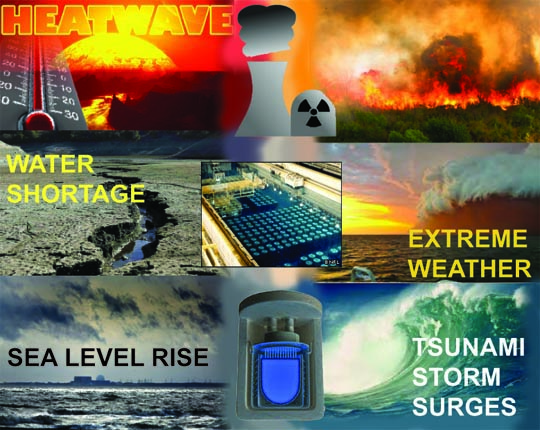
……… Because of the huge volume of deadly poisons that the nuclear fission process creates, nuclear reactors need an uninterrupted electricity supply to run the cooling systems that keep the reactors from melting down, a requirement that may be increasingly difficult to guarantee in a world of climate-fueled megastorms and other disasters.
The ongoing accident at the Fukushima Daiichi plant in Japan following the 9.0 earthquake and tsunami in March 2011 demonstrates the vulnerability of nuclear power plants to such disasters.
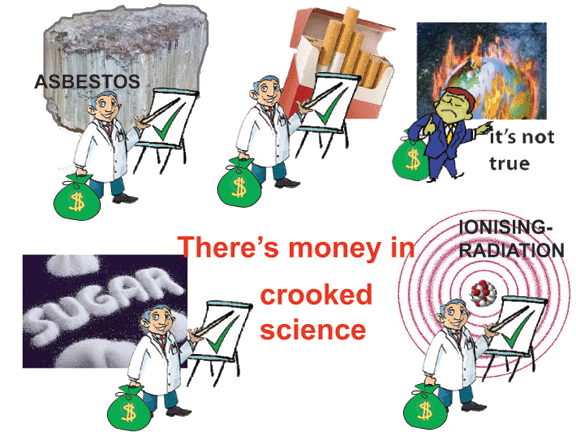 Nuclear boosters have been remarkably successful in ignoring and erasing the health effects of radiation exposure, enabling them to downplay the impacts of serious accidents. In truth, reactor meltdowns, depending on where they occur, can kill and injure enormous numbers of people and contaminate the air, water, land and food supply over thousands of miles with radiation. A 1982 study by the Sandia National Laboratory, one of the labs run by the U.S. Department of Energy, calculated deaths and injuries within a year of a core meltdown and subsequent cancer deaths at 76 different nuclear power plant sites, many of which were only proposed at that time. According to this study, the Salem nuclear plant outside Philadelphia could kill 100,000 people within a year, result in 40,000 subsequent cancer deaths and give another 70,000-75,000 people a range of radiation-related injuries. A 1997 report by Brookhaven National Laboratory on the potential consequences of a spent fuel accident also forecasted large numbers of fatalities.
Fission 101
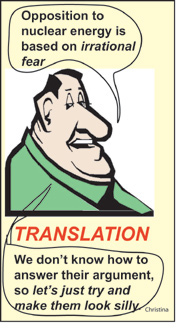 The risks of radiation exposure are downplayed and easily dismissed as “irrational fear” because the physics and chemistry of the fission process and the radioactive elements it produces are complex and not understood by the general public and also because, except in cases of acute radiation poisoning, radiation is invisible.
Radioactive fission products are “variant forms of the ordinary chemicals which are the building blocks of all material and living things,” explains Dr. Rosalie Bertell in her book, No Immediate Danger: Prognosis for a Radioactive Earth. The difference is that stable, non-radioactive atoms have an equal number of protons and electrons.
Nuclear fission creates an imbalance between protons and electrons, producing enormous quantities of hundreds of different radioactive elements — the high-level waste and activation products — all of which seek to return to a stable state. These unstable atoms become stable by knocking out the extra particles fission created, a process she says takes hundreds of thousands of years.
“Every such release of energy is an explosion on the microscopic level,” Bertell says. Radiation exposure is particularly damaging to the structure of cells, which is why it is necessary to keep these radioactive elements, known as radionuclides or radioisotopes, out of the bodies of humans, other living beings and the environment.
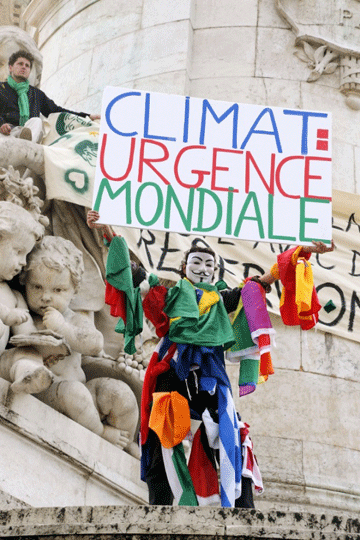 As climate models have long predicted, our warming world is now experiencing much larger and stronger storms with significantly more rainfall in the Earth’s wetter areas and more sustained and severe drought and wildfires in the drier regions. In 2019, the hottest June on record triggered an unprecedented fire season in the Arctic, with over 100 intense fires. The summer of 2019 also saw 55 billion tons of water melt off Greenland’s ice sheet in just five days, a rate scientists hadn’t expected for 50 years.
A month before the massive ice loss in Greenland, scientists predicted sea levels could rise 6.5 feet by the end of the century, submerging nearly 700,000 square miles of land.
Most nuclear power plants are located beside rivers, lakes, dams or oceans because they need a continuous source of water to cool the reactors. In August 2018, Ensia reported that at least 100 nuclear power plants built a few meters above sea level in the U.S., Europe and Asia would likely experience flooding due to sea level rise and storm surges.
Though nuclear reactors vary in generating capacity, 1,000 megawatts is common. A reactor of that size contains 100 metric tons of enriched uranium fuel, roughly a third of which needs to be replaced with fresh fuel each year. According to radioactive waste expert Dr. Marvin Resnikoff, the spent fuel, also known as high-level waste, becomes 2.5 million times more radioactive after undergoing nuclear fission in the reactor core.
 In a May 2011 report, Institute for Policy Studies (IPS) senior scholar Robert Alvarez, a top official at the U.S. Department of Energy from 1993 to 1999, described the danger of high-level waste this way: “Spent fuel rods give off about 1 million rems (10,000 sieverts) of radiation per hour at a distance of one foot — enough radiation to kill people in a matter of seconds.”
The intense radioactivity the fission process creates is why reactor cores are surrounded by five-feet thick reinforced concrete containment structures and spent fuel must be shielded by at least 20 feet of water in pools for several years after it leaves the reactor.
As of September 2019, 444 nuclear reactors are operating in the world, with 54 under construction, 111 planned and 330 more proposed.https://truthout.org/articles/can-nuclear-powers-deadly-waste-be-contained-in-a-warming-world/?eType=EmailBlastContent&eId=a5fbaf3b-857d-46f7-9571-6774775ad709
No comments yet.
1 This Month

of the week – Shut Down Drone Warfare!


Tell the Ukrainian Government to Drop Prosecution of Peace Activist Yurii Sheliazhenko

Petition to revoke the licensing of the Near Surface Nuclear Disposal Facility (NSDF) at Chalk River. https://www.ourcommons.ca/petitions/en/Petition/Details?Petition=e-7247
To see nuclear-related stories in greater depth and intensity – go to https://nuclearinformation.wordpress.com
-
Archives
- April 2026 (57)
- March 2026 (251)
- February 2026 (268)
- January 2026 (308)
- December 2025 (358)
- November 2025 (359)
- October 2025 (376)
- September 2025 (257)
- August 2025 (319)
- July 2025 (230)
- June 2025 (348)
- May 2025 (261)
-
Categories
- 1
- 1 NUCLEAR ISSUES
- business and costs
- climate change
- culture and arts
- ENERGY
- environment
- health
- history
- indigenous issues
- Legal
- marketing of nuclear
- media
- opposition to nuclear
- PERSONAL STORIES
- politics
- politics international
- Religion and ethics
- safety
- secrets,lies and civil liberties
- spinbuster
- technology
- Uranium
- wastes
- weapons and war
- Women
- 2 WORLD
- ACTION
- AFRICA
- Atrocities
- AUSTRALIA
- Christina's notes
- Christina's themes
- culture and arts
- Events
- Fuk 2022
- Fuk 2023
- Fukushima 2017
- Fukushima 2018
- fukushima 2019
- Fukushima 2020
- Fukushima 2021
- general
- global warming
- Humour (God we need it)
- Nuclear
- RARE EARTHS
- Reference
- resources – print
- Resources -audiovicual
- Weekly Newsletter
- World
- World Nuclear
- YouTube
-
RSS
Entries RSS
Comments RSS
 nuclear-news
Leave a comment