“The ashes of half a dozen unidentified laborers ended up at a Buddhist temple in a town just north of the crippled Fukushima nuclear plant. Some of the dead men had no papers; others left no emergency contacts. Their names could not be confirmed and no family members had been tracked down to claim their remains. They were simply labeled “decontamination troops”
Addressing the issue, Japan’s environmental minister Yoshiaki Harada held a news conference (September 2019). Unfortunately, he proffered the following advice: “The only option will be to drain it into the sea and dilute it.” (Source: Justin McCurry in Tokyo, Fukushima: Japan Will Have to Dump Radioactive Water Into Pacific, Minister Says, The Guardian, Sept. 10, 2019)
“The only option”… Really?
Over the past 8 years, Tokyo Electric Power (TEPCO) has scrambled like a Mad Hatter to construct emergency storage tanks (1,000) to contain upwards of one million tonnes of contaminated radioactive water, you know, the kind of stuff that, over time, destroys human cells, alters DNA, causes cancer, or produces something like the horrific disfigured creature in John Carpenter’s The Thing! That’s the upshot of a triple nuclear meltdown that necessitates constant flow of water to prevent further melting of reactor cores that have been decimated and transfigured into corium or melted blobs. It’s the closest to a full-blown “china syndrome” in all of human history. Whew! Although, the truth is it’ll be a dicey situation for decades to come.
Ever since March 11, 2011, TEPCO has scrambled to build storage tanks to prevent massive amounts of radioactive water from pouring into the ocean (still, some lesser amounts pour into the ocean every day by day). Now the government is floating a trial balloon in public that, once the tanks are full, it’ll be okay to dump the radioactive water into the ocean. Their logic is bizarre, meaning, on the one hand, the meltdown happens, and they build storage tanks to contain the radioactive water, but on the other hand, once the storage tanks run out of space, it’s okay to dump radioactive water into the ocean. Seriously?
Meantime, the Fukushima meltdown brings the world community face to face with TEPCO and the government of Japan in an unprecedented grand experiment that, so far, has failed miserably. Of course, dumping radiation into the Pacific is like dumping radiation into everybody’s back yard. But, for starters, isn’t that a non-starter?
Along the way, deceit breeds duplicity, as the aforementioned Guardian article says the Japanese government claims only one (1) death has been associated with the Fukushima meltdown but keep that number in mind. Reliable sources in Japan claim otherwise, as explained in previous articles on the subject, for example, “Fukushima Darkness, Part Two” d/d November 24, 2017, and as highlighted further on in this article.
When it comes to nuclear accidents, cover-ups reign supreme; you can count on it.
As such, it is believed the Japanese government is lying and should be held accountable for hoodwinking the world about the ravages of Fukushima, especially with the Olympics scheduled for next year.
For example, the following explains how death by radiation is shamefully hidden from the public via newspeak: Fukushima Daiichi Nuclear Power Station worker deaths “that expire at home” are not officially counted. Accordingly, how many workers on a deathbed with radiation sickness leave home to go to work (where deaths are counted) just before they die? Oh, please!
Meanwhile, the last thing the world community needs in the face of an uncontrollable nuclear meltdown, like Fukushima, is deceptiveness and irresponsibility by the host government. Too much is at stake for that kind of childish nonsense. And just to think, the 2020 Olympics are scheduled with events held in Fukushima. Scandalously, the International Olympic Committee (IOC) is A-Okay with that.
In contrast, a Greenpeace International March 8th 2019 article entitled: Japanese Government Misleading UN on Impact of Fukushima Fallout on Children, Decontamination Workers: “The Japanese government is deliberately misleading United Nations human rights bodies and experts over the ongoing nuclear crisis in areas of Fukushima… In areas where some of these decontamination workers are operating, the radiation levels would be considered an emergency if they were inside a nuclear facility.” Enough said!
“In its reporting to the United Nations, the Japanese government deliberately misrepresents the scale, complexity, and radiation risks in areas of Fukushima, the working practice and conditions for workers, and its disregard for children’s health and wellbeing. This reality should shame the government to radically change its failing policies,” said Kazue Suzuki, Energy Campaigner of Greenpeace Japan.
As such, either Greenpeace or the IOC is “dead wrong” about the conditions at Fukushima. Take your pick.
After all, the trend of misrepresentation of nuclear accidents has been established for decades. Not only Fukushima, Chernobyl (1986) is a nuclear disaster zone where the “official death count from radiation exposure” has been considerably discounted by various governmental agencies and NGOs. For inexplicable reasons (actually explicable but a long story), nuclear accidents are given Get Out Jail Free cards by the world’s press and associated governmental orgs and NGOs.
Yet, over time, the truth comes out, and when it does it’s dreadfully atrocious: A BBC special report, The True Toll of the Chernobyl Disaster d/d July 26, 2019 says: “The official, internationally recognized death toll, just 31 people died as an immediate result of Chernobyl while the UN estimates that only 50 deaths can be directly attributed to the disaster.”
That’s the official tally. Ugh! It’s so far off the mark that, if it were a baseball pitch, it’d be in the dirt, and a prime example of the public not getting the truth about the ravages of nuclear power accidents.
Of course, it is important to take note of how “wordsmiths” describe the death numbers, i.e., “died as an immediate result of Chernobyl” can only include someone standing at the site when it happened, leaving out all cases of radiation exposure that kills and cripples over subsequent days, months, and years. Or, in the case of the UN statement, “only 50 deaths can be directly attributed.” Only those standing there when it happened… ahem!
According to the BBC article, the Russian Academy of Sciences said as many as 112,000-125,000 died by 2005. That’s 2,500xs more deaths than the official reports, which also never increase in number over time as radiation takes its merry ole time blasting, destroying, and/or altering human cell structure. Ukrainian authorities claim death rates of Chernobyl cleanup workers rose from 3.5 to 17.5 deaths per 1,000 between 1988 and 2012 on a database of 651,453 cleanup workers, which equates to 11,392 deaths. Additionally, Belarus had 99,693 cleanup workers, equating to 1,732 deaths. Not only that, disability among workers shows that approximately 5% are still healthy in 2012 (only 5%, meaning 95% unhealthy) with commonality of cardiovascular and circulatory diseases and nervous system problems.
By 2008 in Belarus alone 40,049 liquidators or cleanup workers of Chernobyl were registered with cancer.
Viktor Sushko, deputy director general of the National Research Centre for Radiation Medicine (NRCRM) based in Kiev, Ukraine, describes the Chernobyl disaster as: “The largest anthropogenic disaster in the history of humankind,” Ibid.
Thus begging the most obvious of questions re Fukushima victims in the years ahead; how many cases of cancer, and how many will die? Unfortunately, radioactive isotopes don’t stop once they’re activated in a nuclear meltdown. They’re pernicious over time destroying and/or grotesquely altering human cell structure. For proof, visit second-generation Chernobyl children locked up in orphanages in Belarus.
“As of January 2018, 1.8 million people in Ukraine, including 377,589 children, carried status of victims of the disaster, according to Sushko and his colleagues. Not only that, there has been a rapid increase in the number of people with disabilities, rising from 40,106 in 1995 to 107,115 in 2018,” Ibid.
According to a USA Today article – Chernobyl’s Legacy: Kids With Bodies Ravaged by Disaster, April 17, 2016: “There are 2,397,863 people registered with Ukraine’s health ministry to receive ongoing Chernobyl-related health care. Of these, 453,391 are children — none born at the time of the accident. Their parents were children in 1986. These children have a range of illnesses: respiratory, digestive, musculoskeletal, eye diseases, blood diseases, cancer, congenital malformations, genetic abnormalities, trauma.” Many of the children are hidden away deep in the forested countryside in orphanages in Belarus.
Back to Fukushima, there are numerous instances of governmental meddling to hide the truth, starting with passage of the 2013 government secrecy act, The State Secrecy Law, aka: Act on the Protection of Specially Designated Secrets (SDS), Act No. 108, which says that civil servants or others who “leak secrets” will face up to 10 years in prison, and those who “instigate leaks,” especially journalists, will be subject to a prison term of up to 5 years. Subsequently, Japan fell below Serbia and Botswana in the Reporters Without Borders 2014 World Press Freedom Index.
Horrifically, at the end of the day, when nuclear goes bad, it takes everyone along on a daunting trip for years and years and more years, outliving life spans but continuing generation after generation, like the 453,391 Chernobyl-radiated-influence children born after the nuclear blowout in 1986. Chernobyl altered their genes before they were born…. Imagine that!
Cliodhna Russell visited children’s orphanages in Belarus in 2014: “Children rocking back and forth for hours on end, hitting their heads against walls, grinding their teeth, scraping their faces and putting their hands down their throats.” (Source: How My Trip to a Children’s Mental Asylum in Belarus Made Me Proud to be Irish, the journal.ie, March 18, 2014.)
Postscript: “It’s a real shame that the authorities hide the truth from the whole world, from the UN. We need to admit that actually many people are dying. We are not allowed to say that, but TEPCO employees also are dying. But they keep mum about it,” Katsutaka Idogawa, former mayor of Futaba (Fukushima Prefecture) Fukushima Disaster: Tokyo Hides Truth as Children Die, Become Ill from Radiation – Ex-Mayor, RT News, April 21, 2014)
Post-Postscript: “The ashes of half a dozen unidentified laborers ended up at a Buddhist temple in a town just north of the crippled Fukushima nuclear plant. Some of the dead men had no papers; others left no emergency contacts. Their names could not be confirmed and no family members had been tracked down to claim their remains. They were simply labeled “decontamination troops” — unknown soldiers in Japan’s massive cleanup campaign to make Fukushima livable again five years after radiation poisoned the fertile countryside,” (Source: Mari Yamaguchi, Fukushima ‘Decontamination Troops’ Often Exploited, Shunned, AP & ABC News, Minamisona, Japan, March 10, 2016)
September 17, 2019
Posted by Christina Macpherson |
Japan, Reference, secrets,lies and civil liberties, spinbuster |
1 Comment
 Dumping Fukushima’s Radioactive Water Into Pacific Ocean Is ‘Only Option’, Japan Says https://www.sciencealert.com/fukushima-is-running-out-of-space-to-store-contaminated-water ARIA BENDIX, BUSINESS INSIDER 12 SEP 2019 On March 11, 2011, Japan was struck by the most powerful earthquake in the nation’s history – a magnitude 9 temblor that triggered a tsunami with waves up to 133 feet (40 meters) high. The disaster set off three nuclear meltdowns and three hydrogen explosions at the Fukushima Daiichi Nuclear Power Plant.
Eight years later, Fukushima holds more than 1 million tons of contaminated water.
The water comes from two main sources. First, the tsunami caused the reactor cores to overheat and melt, so cleanup workers injected water into the cores to cool them. In the wake of the accident, groundwater also seeped in beneath the reactors and mixed with radioactive material.
To store this contaminated water, the plant currently has 1,000 sealed tanks. But the water is still accumulating. There’s enough room to keep the liquid contained through summer 2022, but after that, there will be no space left.
At a news briefing in Tokyo, Japan’s environment minister, Yoshiaki Harada, said that come 2022, “the only option will be to drain it into the sea and dilute” the contaminated water.
The Japanese government, however, is waiting on a verdict from a panel of experts before making a final decision about what to do with the water.
Meanwhile, the environmental group Greenpeace said in a statement that the “only environmentally acceptable option” would be to continue to store the water and filter it for contaminants.
But that would require more tanks and an expensive filtration process.
Dumping the water could reduce cleanup costs
Only two events have ever been designated “level 7” nuclear accidents by the International Atomic Energy Agency (IAEA): Fukushima and Chernobyl.
The majority of radiation released during the Fukushima disaster wound up in the Pacific Ocean, but the meltdown also forced the evacuation of more than 200,000 people from nearby areas – about 43,000 of whom still haven’t returned.
The Japan Centre for Economic Research has estimated that the cleanup costs of the disaster could amount to $US660 billion.
Shortly after the tsunami, Fukushima plant workers constructed storage tanks to house the contaminated water used to cool the reactor cores. But they also had to contend with the radioactive groundwater, since cracks in the downed reactors’ foundations allowed liquid to seep in from below.
This left cleanup crews with more dirty water to store and treat than they’d anticipated.
To purify all this water, plant workers at first used zeolites – volcanic materials that cling to a radioactive isotope called cesium. Then in 2013, they filtered the water for strontium, another toxic radioactive substance. But they had trouble filtering out an isotope called tritium, since it binds easily to water.
In 2016, the Japanese ministry concluded that none of the available methods for removing tritium would work on the Fukushima site.
Greenpeace later said the government had been deterred by the price tag of all the viable methods; one system from a company called Kurion would have cost around US$1 billion to set up, plus several hundred million dollars to operate each year.
‘The sea is not a garbage dump’
Water containing tritium isn’t very dangerous for humans – dumping tritium-laced water into the ocean is common practice for coastal nuclear plants. But it could endanger the local marine species, including fish, which provide a source of income for people living near the power plant.
In 2018, Fukushima’s operator, the Tokyo Electric Power Company (Tepco), also revealed that isotopes like strontium lingered in the water, which meant that about 80 percent of the plant’s treated water still had radiation levels above the government’s standard for ocean dumping.
Some tanks had radiation levels that were 20,000 times greater than the government’s safety standards.
Sending that contaminated water into the ocean could allow it to travel to nearby shores in South Korea, where it could contaminate that local seafood supply, too.
“The sea is not a garbage dump,” Jan Hakervamp, a nuclear-energy expert at Greenpeace, told Business Insider.
“The sea is a common home for all people and creatures and must be protected.” his article was originally published by Business Insider.
September 17, 2019
Posted by Christina Macpherson |
Fukushima continuing |
1 Comment
Unbeknownst to most Canadians, the Darlington nuclear power plant 70 kilometres east of Toronto has been playing a not-so-small role in the U.S. race to weaponize space
The 50th anniversary of the Apollo 11 mission added momentum to the new push to go farther into outer space than humans have ever gone before.
Ontario’s nuclear industry could receive both a reflected glow from the extraterrestrial travel hype and a new revenue stream. It could also potentially increase international nuclear-weapons proliferation.
Unbeknownst to most Canadians, the Darlington nuclear power plant 70 kilometres east of Toronto has already been playing a not-so-small role in the space race.
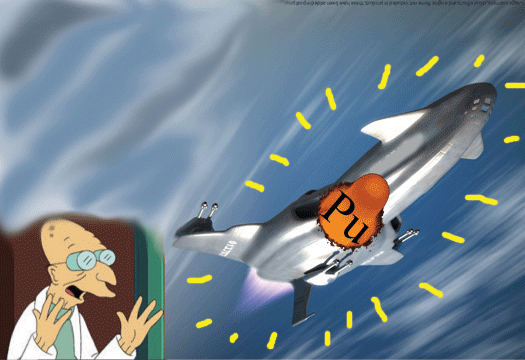
The plant has been producing radioactive plutonium-238 as fuel for spacecraft in NASA’s mushrooming space pipeline since 2017.
That’s when Ontario Power Generation (OPG) announced excitedly that it would start making plutonium-238 for space exploration. The plant produces about 10 kilograms of plutonium-238 a year.
“We are proud to have Ontario play a part, however small, in this most noble of human endeavours,” OPG’s then-president and CEO Jeff Lyash said in a news release.
Canadian Nuclear Laboratories (CNL), which runs the Chalk River facility near Ottawa, another participant in the initiative, posted a “Success Stories” article on its website seven days later. It cautioned that “this opportunity is still subject to regulatory and licensing processes.” But it quotes a CNL official as saying “staff should take a lot of pride in the fact that we are key partners.”
CNL has continued communicating with other project stakeholders. But when NOW contacted CNL for a comment it responded on September 5 that it is no longer involved in the project. OPG has removed the news release from its website and did not respond to NOW’s request for information. Turns out a company called Technical Solutions Management (TSM) is steering the initiative now.
TSM is owned by former nuclear-industry executives Billy Shipp, Pierre Tremblay and Paul Spekkens. CEO Shipp told NOW in an August 29 phone interview that NASA has yet to give its formal thumbs-up.
“For us to get out ahead of our client [NASA], in terms of anticipated need [for plutonium-238], or making statements of their need, is not that professional on our part. So we really have been very low-key on this,” Shipp says when reached for an interview aboard a boat off Vancouver Island.
But he noted that U.S. President Donald Trump’s establishment of a Space Command makes the project more likely to proceed.
Plutonium-238 has long been used to fuel flight, via conversion into electricity of the intense heat the atom pumps out. The U.S. powered military satellites with it in the 1960s. NASA also harnessed it most recently to propel Curiosity Rover to Mars in 2011.
The steps involved for the manufacture of made-in-Canada plutonium-238 to supplement the U.S.’s production involves first synthesizing neptunium-237, plutonium-238’s precursor at the Pacific Northwest National Laboratory in Richland, Washington.
From there, the material is transported to Chalk River where it is put into bundles before it’s sent to Darlington and inserted into CANDU reactors. There, the neptunium-237 catches stray neutrons, transforming it into plutonium-238. The bundles are shipped back to Chalk River where the plutonium-238 is separated from by-products and packaged into pellets. The pellets are transported to Idaho National Lab where they are readied as ‘nuclear batteries’ for spacecraft engines. The current price of plutonium-238 isn’t public, but back in 2003 one kilogram was worth about $8 million U.S.
Gordon Edwards, co-founder and president of the Canadian Coalition for Nuclear Responsibility, says the form of radioactivity emitted by plutonium (namely, alpha particles) is highly toxic when inhaled but often isn’t picked up by radiation detectors.
For example, in November 2009, hundreds of workers at OPG’s Bruce nuclear plant breathed in plutonium dust (a by-product of nuclear-energy production) but the plutonium remained undetected for weeks. Many of the workers had not been given respirators. It was the largest preventable exposure of workers to internal radioactive contamination in the history of the civilian nuclear industry.
Even worse, says Edwards, is the fact the process used to create plutonium-238 can also be used to transform depleted uranium into plutonium-239, the key explosive in nuclear bombs.
“I grant that TSM’s plutonium-238 program does not fundamentally enhance this danger, but it does provide an opportunity to tell the public and politicians that if you can produce one kind of plutonium for the space program you can just as easily produce another kind of plutonium for a nuclear-weapons program, using essentially the same CANDU technology,” Edwards tells NOW.
However, no one inside the space or nuclear industries appears be seriously addressing these well-known problems. And there is plenty of money potentially available for a new plutonium-238 venture. NASA projects its research and development budget – including developing power and propulsion systems – will be $1.5 billion next year, rising to $3.4 billion by 2024.
TSM’s other co-owners, Tremblay and Spekkens, are well-placed to move such a project forward. Tremblay was OPG’s chief nuclear operating officer and president of OPG’s subsidiary Canadian Nuclear Partners. He became AECOM Canada Nuclear Operations’ president and CEO in August 2018. The American multinational is playing key roles in the multi-billion-dollar Darlington refurbishment. Tremblay started consulting for AECOM in June 2016; an industry article about this said the firm “has recruited key expertise that will undoubtedly position the company to play a key part in the massive nuclear power projects anticipated for Ontario over the next decade.”
Spekkens retired in 2016 as OPG’s vice president of science and technology and as chair of the CANDU Owners Group, a Toronto-based private organization that promotes CANDU use around the world. He then became a consultant and director of nuclear technology at Kinectrics.
He opined on the nuclear industry’s future at a June 2017 conference. In the abstract of his lecture, Spekkens says “this future will, of course, depend heavily on technology. But also (and perhaps equally) important will be non-technical considerations such as public acceptance, a pipeline full of qualified future employees, public policy in several levels of government, and of course, finances.”
@nowtoronto
September 17, 2019
Posted by Christina Macpherson |
Reference, secrets,lies and civil liberties, space travel, weapons and war |
Leave a comment

 Broad coalition representing millions of Australians opposes nuclear power, https://www.sbs.com.au/news/broad-coalition-representing-millions-of-australians-opposes-nuclear-power 17 Sept 19, Some 40 groups have drawn up a statement calling on the federal government to embrace renewable energy rather than going down the path of nuclear.
More than 40 groups representing millions of Australians have come together to issue a clear message to the federal government that the nation’s energy future is renewable, “not radioactive”.
However, the mining industry is calling for the ban on nuclear energy to be lifted.
The coalition of groups has submitted a shared statement in response to the federal parliamentary inquiry into the prospects for nuclear power in Australia.
“The groups maintain nuclear power has no role in Australia’s energy future and is a dangerous distraction from real progress on our pressing energy and climate challenges and opportunities facing Australia,” the Australian Conversation Foundation said.
“[We call] for the federal parliament to embrace renewable energy as the cleanest, quickest, cheapest and most credible way to power Australian homes and workplaces, and re-power regional communities and the national economy.”
The ACF is joined by a broad coalition of faith, union, environmental, aboriginal and public health groups.
These include the ACTU, state and territory trade unions and councils, the Public Health Association of Australia, Uniting and Catholic church organisations, the Smart Energy Council, the Aboriginal-led Australian Nuclear Free Alliance, climate action groups and Greenpeace Australia Pacific.
Their statement raises concerns over the long-life of nuclear waste, the volume of water needed to cool a nuclear reactor, the time needed to build a reactor, the high cost of a plant, security and safety.
However, in its own submission, the Minerals Council of Australia called on the legislated ban on nuclear to be lifted and uranium mining to be mainstreamed with other minerals.
Council chief executive Tania Constable said nuclear energy should be considered as part of the energy mix if Australia is to retain its strong industrial sector with high-paying long-term jobs.
It will also encourage investment and maintain system and price stability through a stable and reliable electricity market while significantly cutting greenhouse gas emissions.
“Australia has lost its comparative advantage in energy,” Ms Constable said in a statement. “Rising prices and falling reliability are forcing businesses to invest overseas instead of Australia.”
September 17, 2019
Posted by Christina Macpherson |
AUSTRALIA, opposition to nuclear, politics |
Leave a comment








 nuclear-news
