UN warns on need for global action – treaty – as the world’s oceans are in dire trouble
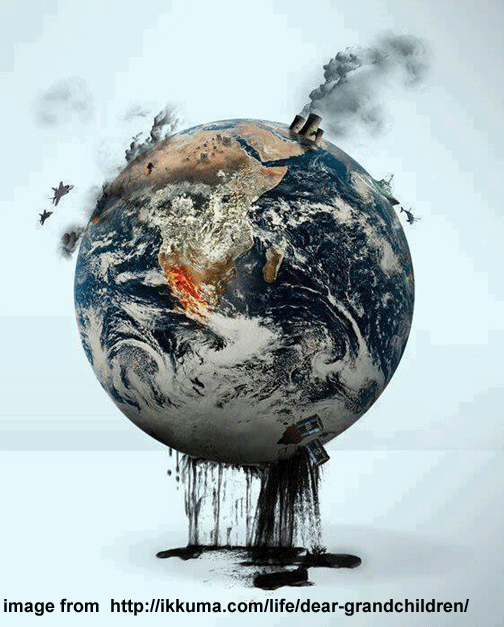 INTERVIEW-Ocean treaty needed to tackle ‘deep trouble’, says UN envoy, http://news.trust.org/item/20190831063635-oygwk/, by Adela Suliman | @adela_suliman | Thomson Reuters Foundation, Saturday, 31 August 2019 The oceans are increasingly threatened by global warming, acidification and pollution, and the impacts will affect us all, warned the U.N. oceans envoy. By Adela Suliman
STOCKHOLM, Aug 31 (Thomson Reuters Foundation) – The world’s seas are increasingly threatened by global warming, acidification and pollution, making it crucial to agree on a global treaty to protect them, the U.N. oceans envoy said.
Peter Thomson warned in an interview with the Thomson Reuters Foundation that the oceans were “in deep trouble”.
“It is worse than we think and there are no easy solutions,” he said at World Water Week in Stockholm this week, as the latest round of talks on a treaty wound up in New York.
The first global ocean treaty is due to be agreed in the first half of 2020. But on Friday environmental group Greenpeace said the negotiations were “disappointing” so far, blaming a lack of political will to secure a “progressive outcome”.
Thomson said a “comprehensive global regime” was needed to accelerate action to protect waters beyond national jurisdictions.
“It is critical in these challenging times for planetary environmental conditions that we develop a binding treaty for the conservation and sustainable use of marine biodiversity in the ocean,” he said.
A flagship scientific report warned this year that two-thirds of the ocean area was already affected by growing human impacts, primarily from stressors linked to global warming.
Climate change and the oceans were “intimately linked”, Thomson said, adding humanity was on a “totally irresponsible course” by not tackling global warming urgently enough. In 2015 nearly 200 nations signed up to the Paris Agreement that aims to keep the rise in average global temperatures to “well below” 2 degrees Celsius (3.6F) above pre-industrial times, and ideally to 1.5C.
“(Climate change) is going to have huge human impact and there will have to be a change of occupations, a change of domiciles,” Thomson warned.
Fishing communities and coastal dwellers would be worse off and needed support to adapt in a warmer world, he added.
A set of global development goals to be met by 2030 include conserving and using oceans, seas and marine resources wisely.
Much of the planet’s rainwater, drinking water, food and weather systems are provided or regulated by the sea.
“Every second breath you take comes from oxygen from the ocean,” said Thomson, a Fijian diplomat.
But seawater warming and acidification could change the chemical composition of the oceans, with profound effects for humans, he warned.
TURNING THE TIDE?
Pollution, including plastic, industrial waste, sewage and fertiliser, poses a serious threat to marine life, Thomson said.
“There are over 500 ‘dead zones’ all over the world where actually no life exists because of what’s coming down those rivers by way of pollution,” he said.
Meanwhile, irresponsible fishing practices have depleted fish stocks and are “part of the human tragedy of ending biodiversity”, he added.
Billions of people depend on oceans for their food and livelihoods, but the U.N. Food and Agriculture Organization has said nearly 90% of fish stocks are over-fished or fully exploited as global demand rises.
Thomson said, however, that pollution and over-fishing were “very fixable” with better environmental management.
Individual action had begun to make inroads – from public beach clean-ups to how people shop and vote.
Climate change, on the other hand, was a more “pernicious” threat to the Earth’s water, he said.
The U.N. climate science panel is due to publish a special report in late September on how climate change is affecting the world’s oceans and frozen water. Thomson said it would be a “guiding light” for future international protection efforts by providing scientific insight on how global warming is affecting life in the sea.
“The report will no doubt provide further support for dramatic scaling up of political ambition (to act),” he said.
“It’s no time to be sitting around philosophising … The changes have to be made now
No comments yet.
1 This Month


Tell the Ukrainian Government to Drop Prosecution of Peace Activist Yurii Sheliazhenko

Petition to revoke the licensing of the Near Surface Nuclear Disposal Facility (NSDF) at Chalk River. https://www.ourcommons.ca/petitions/en/Petition/Details?Petition=e-7247


of the week – STOP SMALL MODULAR REACTORS IN CANADA
To see nuclear-related stories in greater depth and intensity – go to https://nuclearinformation.wordpress.com
-
Archives
- March 2026 (212)
- February 2026 (268)
- January 2026 (308)
- December 2025 (358)
- November 2025 (359)
- October 2025 (376)
- September 2025 (258)
- August 2025 (319)
- July 2025 (230)
- June 2025 (348)
- May 2025 (261)
- April 2025 (305)
-
Categories
- 1
- 1 NUCLEAR ISSUES
- business and costs
- climate change
- culture and arts
- ENERGY
- environment
- health
- history
- indigenous issues
- Legal
- marketing of nuclear
- media
- opposition to nuclear
- PERSONAL STORIES
- politics
- politics international
- Religion and ethics
- safety
- secrets,lies and civil liberties
- spinbuster
- technology
- Uranium
- wastes
- weapons and war
- Women
- 2 WORLD
- ACTION
- AFRICA
- Atrocities
- AUSTRALIA
- Christina's notes
- Christina's themes
- culture and arts
- Events
- Fuk 2022
- Fuk 2023
- Fukushima 2017
- Fukushima 2018
- fukushima 2019
- Fukushima 2020
- Fukushima 2021
- general
- global warming
- Humour (God we need it)
- Nuclear
- RARE EARTHS
- Reference
- resources – print
- Resources -audiovicual
- Weekly Newsletter
- World
- World Nuclear
- YouTube
-
RSS
Entries RSS
Comments RSS
 nuclear-news
Leave a comment