The radioactive fallout from Chernobyl continues to impact lives.
 The legacy of Chernobyl: Zombie reactors and an invisible enemy ABC News, Foreign Correspondent By Europe correspondent Linton Besser, Mark Doman, Alex Palmer and Nathanael Scott, 3 Sep 2019, As the Soviet Union grappled with the scale of the disaster unfolding at Chernobyl, radioactive material spewed into the environment.
In the immediate aftermath of the 1986 explosion inside reactor number four of the nuclear power plant, dozens of first responders received fatal doses of radiation, forests surrounding the reactor were poisoned, and nearby waterways were contaminated.
Despite attempts to douse the fire in the core with sand, boron and lead, the reactor burnt for 10 days, releasing huge amounts of radioactive materials beyond the plant’s perimeter.
Three decades on from what is considered to be one of the worst nuclear accidents in history, the fallout from Chernobyl continues to impact lives.
Carried in the prevailing weather patterns, the radioactive particles pouring out of reactor four spread rapidly.
The vast majority of particulates fell over parts of Belarus, Russia and Ukraine where more than 5 million people now live in contaminated areas. But modelling by the Met Office, the UK’s national weather service, shows how, within two days of the disaster, the radioactive plume was transported more than 1,000 kilometres.
There’s also the highly contaminated Red Forest to the south and west. It got its name from the colour the trees turned as they died after the blast. Here researchers continue to uncover highly radioactive pockets of soil. Access to this area is largely restricted, but the Safecast data shows areas inside the forest reaching an average of around 30µSv/h. Then of course there’s the reactor itself. A place so irradiated it sits entombed in a giant sarcophagus made of steel and concrete. Some estimates suggest the core will remain radioactive for thousands of years.
There’s no data at the core because access to the area is heavily restricted for safety reasons. Azby Brown, the lead researcher with Safecast, said many of the hardest-hit areas, like the abandoned town of Pripyat, will remain unsafe to live “for generations”.
“If you just look at the half life of Caesium-137, it’s 30 years. So it’s been through one half life, meaning naturally half of it has decayed, so anywhere you went 30 years ago in Chernobyl was twice [as radioactive] as what it is today,” he said.
Despite the lingering risks, there are some who’ve chosen to ignore the warnings and return to live inside the exclusion zone.
Sofia Bezverhaya was living just 30 kilometres from the plant in the village of Kupovate when the plant exploded.
The breach of reactor number four occurred on a Saturday. But Sofia, the local council administrator, heard nothing of it.
“It was only on the Monday that we’ve found out there’d been an accident,” she told Foreign Correspondent. That day, she took a phone call from a Communist Party official. “There’s been an accident,” she was told. “Prepare for the evacuation.”
“They kept telling us, it’s just for three days … [but] all of us had that uneasy feeling creeping into our souls, that we might just leave our homes and never ever come back. And that’s what came to be.”
“Our grand- and great grandparents are buried here. And we also want to be buried here, in our village. It’s our dream.”
The official death toll from Chernobyl is disputed, but a UN report into the “true scale of the accident” found as many as 4,000 people could die as a result of radiation exposure.
Once Sofia returned, despite official warnings to avoid locally grown produce, she had little choice but to continue to plough her own yard for food. And more than three decades later, she’s still doing it.
From the garden bed, which runs beside the length of her blue weatherboard home, she grows tomatoes, zucchinis, pumpkins, capsicum, sorrel, potatoes and onions.
“For me, my resort is my work in the garden … where I can watch a squirrel collecting nuts, and hear the singing of nightingale.”
Kupovate is firmly within the boundaries of the exclusion zone around the reactor. But once a year, Sofia Bezverhaya said, her garden vegetables are tested, and the results are within acceptable limits.
It’s an anomaly which demonstrates the caprice of the fallout; the red lines of the exclusion zone simply do not prescribe the limits of the contamination……… https://www.abc.net.au/news/2019-09-03/chernobyls-radioactive-legacy-zombie-reactors-an-invisible-enemy/11432430
Global catastrophe ever closer as nuclear arms race revs up

New nuclear arms race brings higher risk of global catastrophe, The New Daily,
Veteran defence and security analyst Brian Toohey has warned that talk of war between the West, and China and Russia, along with brinkmanship with North Korea and Iran, has escalated the conditions that can lead to catastrophic accidents and mistakes.
Adding to the potential for disastrous nuclear consequences, Mr Toohey’s latest book – to be published this week – reveals that “many missile control systems can now be hit by a wide range of previously unknown cyber-warfare tools available to terrorists, hoaxers and governments”.
Mr Toohey’s book, Secret – The Making of Australia’s Security State, outlines a terrifying situation where nuclear  weapons continue to exist in massive numbers.
They are in the hands of governments with little or no framework to regulate their use, movement and deployment.
Russian President Vladimir Putin escalated the arms race with a 2018 declaration that Russia was developing “supposedly invulnerable delivery systems for nuclear weapons”.
President Putin later released a video of a purported prototype being tested.
“These systems are unlikely to materialise because Russia can’t afford them. However, it could afford to smuggle warheads into target countries,” Mr Toohey said.
Mr Toohey does not excuse China’s “abrasive behaviour” in the South China Sea, which is adding to tensions already exacerbated by trade “wars”.
US President Donald Trump, meanwhile, has aggravated the tense international situation with rhetoric declaring he wants America to have more nuclear weapons than anyone else.
President Trump had approved the 2018 Nuclear Posture Review, which emphasised the integration of nuclear and non-nuclear warfare in the US’s military doctrine, training and exercises.
The US abandoned the Intermediate-Range Nuclear Forces Treaty, which also allows it to put these weapons in western Europe as well as much closer to China.
Mr Toohey quoted the head of the Australian-led International Campaign to Abolish Nuclear Weapons, Beatrice Fihn, in her Nobel Prize acceptance speech: “The only rational course of action is to cease living under conditions where our mutual destruction is only one impulsive tantrum away”.
As well as government actions, Mr Toohey’s book also lists a frightening history of nuclear false alarms and accidents from the Cold War years to the present.
“Human error is ever-present. What is clear is that the risk remains of an accidental nuclear war started by missiles launched in error,” he states.
Nuclear near misses
In 2007, despite strict safety protocols, six nuclear-armed cruise missiles were mistakenly loaded onto a B-52 bomber at the US Minot Air Force Base.
“The plane sat on the tarmac unguarded overnight and then flew 2400 kilometres to another base, where it was nine hours before a maintenance crew realised the weapons were live”.
The Union of Concerned Scientists reported that nuclear war was narrowly averted in 1983 when a Soviet officer was confronted with early-warning data indicating that the US had launched five nuclear missiles.
Instead of notifying his superiors, the officer decided it was a false alarm and took no further action.
The UCS concluded: “If a different officer had been on duty, the false alarm could easily have turned into a catastrophe”.
Mr Toohey writes that nothing so starkly illustrates the “depravity of nuclear war planning” as the targeting list for the US Single Integrated Operational Plan, which anticipated deaths in the millions in targeted cities.
And “nothing so bleakly illustrates the irresponsibility of the planners as their continued refusal to install self-destruct devices that activate when missiles are launched by accident”, he said.
Australia is complicit Continue reading
UN warns on need for global action – treaty – as the world’s oceans are in dire trouble
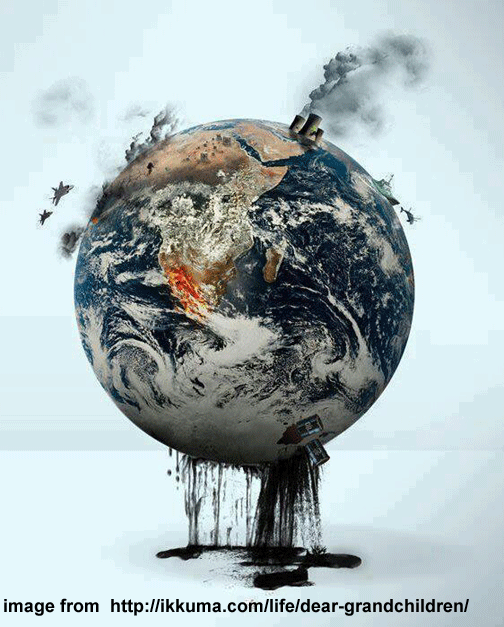 INTERVIEW-Ocean treaty needed to tackle ‘deep trouble’, says UN envoy, http://news.trust.org/item/20190831063635-oygwk/, by Adela Suliman | @adela_suliman | Thomson Reuters Foundation, Saturday, 31 August 2019 The oceans are increasingly threatened by global warming, acidification and pollution, and the impacts will affect us all, warned the U.N. oceans envoy. By Adela Suliman
STOCKHOLM, Aug 31 (Thomson Reuters Foundation) – The world’s seas are increasingly threatened by global warming, acidification and pollution, making it crucial to agree on a global treaty to protect them, the U.N. oceans envoy said.
Peter Thomson warned in an interview with the Thomson Reuters Foundation that the oceans were “in deep trouble”.
“It is worse than we think and there are no easy solutions,” he said at World Water Week in Stockholm this week, as the latest round of talks on a treaty wound up in New York.
The first global ocean treaty is due to be agreed in the first half of 2020. But on Friday environmental group Greenpeace said the negotiations were “disappointing” so far, blaming a lack of political will to secure a “progressive outcome”.
Thomson said a “comprehensive global regime” was needed to accelerate action to protect waters beyond national jurisdictions.
“It is critical in these challenging times for planetary environmental conditions that we develop a binding treaty for the conservation and sustainable use of marine biodiversity in the ocean,” he said.
A flagship scientific report warned this year that two-thirds of the ocean area was already affected by growing human impacts, primarily from stressors linked to global warming.
Climate change and the oceans were “intimately linked”, Thomson said, adding humanity was on a “totally irresponsible course” by not tackling global warming urgently enough. In 2015 nearly 200 nations signed up to the Paris Agreement that aims to keep the rise in average global temperatures to “well below” 2 degrees Celsius (3.6F) above pre-industrial times, and ideally to 1.5C.
“(Climate change) is going to have huge human impact and there will have to be a change of occupations, a change of domiciles,” Thomson warned.
Fishing communities and coastal dwellers would be worse off and needed support to adapt in a warmer world, he added.
A set of global development goals to be met by 2030 include conserving and using oceans, seas and marine resources wisely.
Much of the planet’s rainwater, drinking water, food and weather systems are provided or regulated by the sea.
“Every second breath you take comes from oxygen from the ocean,” said Thomson, a Fijian diplomat.
But seawater warming and acidification could change the chemical composition of the oceans, with profound effects for humans, he warned.
TURNING THE TIDE?
Pollution, including plastic, industrial waste, sewage and fertiliser, poses a serious threat to marine life, Thomson said.
“There are over 500 ‘dead zones’ all over the world where actually no life exists because of what’s coming down those rivers by way of pollution,” he said.
Meanwhile, irresponsible fishing practices have depleted fish stocks and are “part of the human tragedy of ending biodiversity”, he added.
Billions of people depend on oceans for their food and livelihoods, but the U.N. Food and Agriculture Organization has said nearly 90% of fish stocks are over-fished or fully exploited as global demand rises.
Thomson said, however, that pollution and over-fishing were “very fixable” with better environmental management.
Individual action had begun to make inroads – from public beach clean-ups to how people shop and vote.
Climate change, on the other hand, was a more “pernicious” threat to the Earth’s water, he said.
The U.N. climate science panel is due to publish a special report in late September on how climate change is affecting the world’s oceans and frozen water. Thomson said it would be a “guiding light” for future international protection efforts by providing scientific insight on how global warming is affecting life in the sea.
“The report will no doubt provide further support for dramatic scaling up of political ambition (to act),” he said.
“It’s no time to be sitting around philosophising … The changes have to be made now
Ukrainian victims of radioactive food
The legacy of Chernobyl: Zombie reactors and an invisible enemy ABC News, Foreign Correspondent By Europe correspondent Linton Besser, Mark Doman, Alex Palmer and Nathanael Scott, 3 Sep 2019
“…………… Victims of contaminated food
While there are areas close to the crippled reactor which are perfectly safe, throughout vast stretches of the north-west of the country, many kilometres away, Ukrainians are still grappling with the legacy of the Chernobyl eruption.
The Australian Government’s official travel advice for this region warns tourists not to eat dairy, game, fruits or vegetables “unless they are imported”.
But in a country as poor as Ukraine, where many still subsist on what they can grow themselves, that’s a luxury few can afford.A study of 14 villages in Rivne — a province 200km west of the reactor — found radioactive milk at more than 12 times the safe level for children. That study was conducted between 2011 and 2016 and published last year, 32 years after the explosion. [PITURE HERE]
The paper warned that in the absence of protective measures for the rural population, the radiation poisoning could continue until at least 2040.It’s primarily Ukraine’s youth — including the grandchildren of those who lived through the disaster — who are now paying for it.
 Nine-year-old Kristina, from the small village of Lugove to the west of Kiev, is one of them.
“Sometimes I feel sick,” she told Foreign Correspondent. “I have a headache and my stomach goes around.” In fact, Kristina has an enlarged pancreas and thyroid. She’s suffering the ill effects of consuming contaminated food.
Kristina’s condition is carefully monitored at the Institute of Specialised Radiation Protection on the outskirts of Kiev. The facility was established just months after the accident, and it is still taking on hundreds of new patients every year. All of them are children.
“[They] do not understand what Chernobyl was, the kind of catastrophe [it was],” the institute’s chief nurse, Nataliya Moshko, said. Often, the children do not believe they are sick at all.Still, it’s better than it was. When she first began in nursing, Nataliya was caring for children diagnosed with terminal cancer, “because of the consequences of the Chernobyl disaster”.
Now long dead, she insisted, “I remember every one”.
The legacy of the accident endures. As of January, of the 2.1 million people registered with Ukraine’s health authorities for treatment for Chernobyl-related illnesses, 350,000 were children.
“The problem is that the Chernobyl disaster with its consequences was not solved very quickly at that time,” Nataliya said. “And now these vast territories of Ukraine, and many, many thousands of people are contaminated.”The children spend weeks in the hospital to receive treatment, but also to be fed a clean diet. If and when their symptoms ease, and they’re discharged, they return home to the same contaminated environment which made them ill in the first place.
Food markets across the country are required to test local produce for the two isotopes which persist in the environment — Strontium-90 and Caesium-137.
Berries, mushrooms and milk contaminated by radiation are meant to be discarded, but reports abound of radioactive berries being merely discounted instead.On a visit to a testing laboratory attached to one large fresh produce hall in Kiev, officials take great care in demonstrating the rigour with which they test for Caesium-137.
But when asked how they went about checking for the Strontium isotope, they shrug their shoulders; there’s no money for the equipment needed to do so……… https://www.abc.net.au/news/2019-09-03/chernobyls-radioactive-legacy-zombie-reactors-an-invisible-enemy/11432430
Petition drive launched to reverse aid to Ohio’s nuclear plants
 https://www.ohioansagainstnukebailouts.com/petition Ohioans Against Corporate Bailouts
If the state question gets approved, it would overturn House Bill 6, which provided subsidies to keep Ohio’s two nuclear power plants open.
The petition drive must collect 265,744 valid signatures by Oct. 21 to put the issue on next year’s ballot, the group said.
Attorney General Dave Yost cleared the way for the petition drive Thursday when he announced he has approved summary language for the proposed referendum.
Yost had rejected a previous summary as inaccurate but gave a thumb’s up after a revised summary was submitted.
“Without passing on the advisability of the approval or rejection of the measure … I hereby certify that the summary is a fair and truthful statement of the measure to be referred,” Yost said.
Yost’s office said the petitioners working for Ohioans Against Corporate Bailouts must collect signatures from registered voters in each of 44 of Ohio’s 88 counties, equal to 3 percent of the total vote cast in the county for the governor’s race in the last election.
The signatures also must equal 6 percent of the total votes cast for governor.
Meanwhile, a group called Ohioans for Energy Security has launched a website and run TV ads claiming the new petition drive is a plot to put Ohio’s energy grid “in the hands of the Chinese government.”
The website warns Ohio voters not to sign the petition and “give your personal information to the Chinese government.”
To back its claims, Ohioans for Energy Security cites investments in Ohio clean energy projects by Chinese banks.
A spokesman for Ohioans Against Corporate Bailouts, Gene Pierce, said the claims are ridiculous, calling them “a new low in Ohio politics.”
“These ads are designed to intimidate and threaten our petitioners who are exercising their Constitutionally-guaranteed right to place this ridiculous bailout on the ballot,” Pierce said. “This is the kind of garbage that will get someone hurt and we will hold all parties associated with their campaign responsible for any harm that comes to our circulators.”
1 This Month


Tell the Ukrainian Government to Drop Prosecution of Peace Activist Yurii Sheliazhenko

Petition to revoke the licensing of the Near Surface Nuclear Disposal Facility (NSDF) at Chalk River. https://www.ourcommons.ca/petitions/en/Petition/Details?Petition=e-7247


of the week – STOP SMALL MODULAR REACTORS IN CANADA
To see nuclear-related stories in greater depth and intensity – go to https://nuclearinformation.wordpress.com
-
Archives
- March 2026 (212)
- February 2026 (268)
- January 2026 (308)
- December 2025 (358)
- November 2025 (359)
- October 2025 (376)
- September 2025 (258)
- August 2025 (319)
- July 2025 (230)
- June 2025 (348)
- May 2025 (261)
- April 2025 (305)
-
Categories
- 1
- 1 NUCLEAR ISSUES
- business and costs
- climate change
- culture and arts
- ENERGY
- environment
- health
- history
- indigenous issues
- Legal
- marketing of nuclear
- media
- opposition to nuclear
- PERSONAL STORIES
- politics
- politics international
- Religion and ethics
- safety
- secrets,lies and civil liberties
- spinbuster
- technology
- Uranium
- wastes
- weapons and war
- Women
- 2 WORLD
- ACTION
- AFRICA
- Atrocities
- AUSTRALIA
- Christina's notes
- Christina's themes
- culture and arts
- Events
- Fuk 2022
- Fuk 2023
- Fukushima 2017
- Fukushima 2018
- fukushima 2019
- Fukushima 2020
- Fukushima 2021
- general
- global warming
- Humour (God we need it)
- Nuclear
- RARE EARTHS
- Reference
- resources – print
- Resources -audiovicual
- Weekly Newsletter
- World
- World Nuclear
- YouTube
-
RSS
Entries RSS
Comments RSS
 nuclear-news