Refuting Australian Financial Review’s disinformation on Small Modular Nuclear Reactors (SMRs)
|
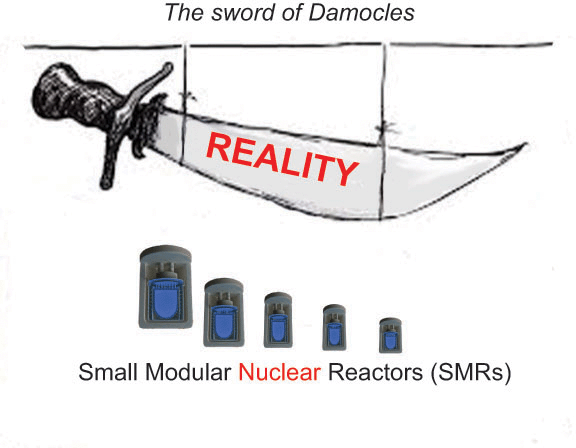
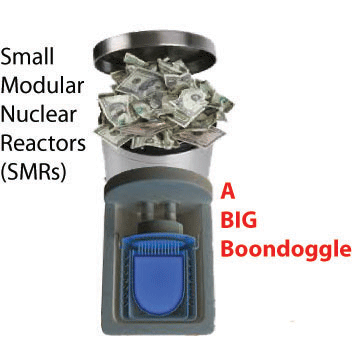
Aaron Patrick, senior correspondent with the Australian Financial Review (AFR), is the latest journalist to enter the nuclear culture wars with some propaganda that’s indistinguishable from that served up in the Murdoch tabloids. There’s lots of misinformation in Patrick’s articles. For example he uncritically promotes a dopey Industry Super Australia report, described by RenewEconomy editor Giles Parkinson as “one of the most inept analyses of the energy industry that has been produced in Australia”. (I’ve asked the authors of the Industry Super report if they intend to withdraw or amend it. No response.) The focus here ‒ and the focus of Patrick’s recent articles ‒ is on small modular reactors (SMRs), which he describes as new, small, safe, cheap and exciting (and he continues to make such claims even as I continue to feed him with evidence suggesting alternative SMR adjectives … non-existent, overhyped, obscenely expensive). Some history is useful in assessing Patrick’s claims. There’s a long history of small reactors being used for naval propulsion, but every effort to develop land-based SMRs has ended in tears. Academic M.V. Ramana concludes an analysis of the history of SMRs thus: “Sadly, the nuclear industry continues to practice selective remembrance and to push ideas that haven’t worked. Once again, we see history repeating itself in today’s claims for small reactors ‒ that the demand will be large, that they will be cheap and quick to construct. “But nothing in the history of small nuclear reactors suggests that they would be more economical than full-size ones. In fact, the record is pretty clear: Without exception, small reactors cost too much for the little electricity they produced, the result of both their low output and their poor performance. … “Worse, attempts to make them cheaper might end up exacerbating nuclear power’s other problems: production of long-lived radioactive waste, linkage with nuclear weapons, and the occasional catastrophic accident.” Patrick quotes an SMR company representative saying that SMRs have been “researched and developed for the best part of 50 years”. Fine … but surely AFR readers ought to be informed that every single attempt to commercialise SMRs over the past 50 years has failed. According to the Coalition’s energy spokesperson (p.34), “new-generation reactors with maximum safety features are now coming into use”. That was 30 years ago, and the spokesperson was Peter McGauran. A wave of enthusiasm for SMRs came and went without a single SMR being built anywhere in the world, and there’s no reason to believe the current wave of enthusiasm will be more fruitful. Diseconomies of scaleInterest in SMRs derives primarily from what they are not: large reactor projects which have been prone to catastrophic cost overruns and delays. Cost estimates for all reactors under construction in western Europe and north America range from A$17.5 billion to A$24 billion, and the twin-reactor V.C. Summer project in South Carolina was abandoned in 2017 after the expenditure of at least A$13 billion, forcing Westinghouse into bankruptcy and almost bankrupting its parent company Toshiba. But SMRs will cost more (per megawatt and megawatt-hour) because of diseconomies of scale: a 250MW SMR will generate 25 per cent as much power as a 1,000MW reactor, but it will require more than 25 per cent of the material inputs and staffing, and a number of other costs including waste management and decommissioning will be proportionally higher. So the nuclear industry’s solution to its wildly expensive and hopelessly uncompetitive large reactors is to offer up even-more-expensive reactors. Brilliant. Small wonder that nuclear lobbyists are lamenting the industry’s crisis and pondering what if anything might be salvaged from the “ashes of today’s dying industry“. Aaron Patrick claims in the AFR that SMRs are “likely” to be installed in North America and Europe. No, they aren’t. William Von Hoene, senior vice-president at Exelon ‒ the largest operator of nuclear power plants in the US ‒ said last year: “Right now, the costs on the SMRs, in part because of the size and in part because of the security that’s associated with any nuclear plant, are prohibitive.” The prevailing scepticism is evident in a 2017 Lloyd’s Register report based on the insights of almost 600 professionals and experts from utilities, distributors, operators and equipment manufacturers. They predict that SMRs have a “low likelihood of eventual take-up, and will have a minimal impact when they do arrive”. Likewise, American Nuclear Society consultant Will Davis said in 2014 that the SMR “universe [is] rife with press releases, but devoid of new concrete.” And a 2014 report produced by Nuclear Energy Insider, drawing on interviews with more than 50 “leading specialists and decision makers”, noted a “pervasive sense of pessimism” resulting from abandoned and scaled-back SMR programs. Independent economic assessmentsSMRs are “leading the way in cost” according to Tania Constable from the Minerals Council of Australia. NSW Deputy Premier John Barilaro claims that SMRs “are becoming very affordable”. But every independent economic assessment finds that electricity from SMRs will be more expensive than that from large reactors. A study by WSP / Parsons Brinckerhoff prepared for the 2015/16 South Australian Nuclear Fuel Cycle Royal Commission estimated costs of US$127‒130 per megawatt-hour (MWh) for large reactors, compared to US$140‒159 for SMRs. The Royal Commission’s final report identified numerous hurdles and uncertainties facing SMRs. A December 2018 report by CSIRO and the Australian Energy Market Operator concluded that “solar and wind generation technologies are currently the lowest-cost ways to generate electricity for Australia, compared to any other new-build technology.” It found that electricity from SMRs would be more than twice as expensive as that from wind or solar power with storage costs included (two hours of battery storage or six hours of pumped hydro storage). A report by the consultancy firm Atkins for the UK Department for Business, Energy and Industrial Strategy found that electricity from the first SMR in the UK would be 30 percent more expensive than that from large reactors, because of diseconomies of scale and the costs of deploying first-of-a-kind technology. A 2015 report by the International Energy Agency and the OECD Nuclear Energy Agency predicted that electricity from SMRs will be 50−100 percent more expensive than that from large reactors, although it holds out some hope that large-volume factory production could reduce costs. An article by four pro-nuclear researchers from Carnegie Mellon University’s Department of Engineering and Public Policy, published in 2018 in the Proceedings of the National Academy of Science, considered options for the development of an SMR industry in the US. They concluded that it would not be viable unless the industry received “several hundred billion dollars of direct and indirect subsidies” over the next several decades. That’s billion with a ‘b’: several hundred billion dollars.
|
|

No comments yet.
1 This Month

18 March Webinar @ 1 PM EST: An Assessment of SMR Projects: The Case of Canada
register for the zoom:
https://us02web.zoom.us/webinar/register/WN_o8BIIOUvQ2ONJR1nta65DQ#/registration

of the week – STOP SMALL MODULAR REACTORS IN CANADA
To see nuclear-related stories in greater depth and intensity – go to https://nuclearinformation.wordpress.com
-
Archives
- February 2026 (256)
- January 2026 (308)
- December 2025 (358)
- November 2025 (359)
- October 2025 (376)
- September 2025 (258)
- August 2025 (319)
- July 2025 (230)
- June 2025 (348)
- May 2025 (261)
- April 2025 (305)
- March 2025 (319)
-
Categories
- 1
- 1 NUCLEAR ISSUES
- business and costs
- climate change
- culture and arts
- ENERGY
- environment
- health
- history
- indigenous issues
- Legal
- marketing of nuclear
- media
- opposition to nuclear
- PERSONAL STORIES
- politics
- politics international
- Religion and ethics
- safety
- secrets,lies and civil liberties
- spinbuster
- technology
- Uranium
- wastes
- weapons and war
- Women
- 2 WORLD
- ACTION
- AFRICA
- Atrocities
- AUSTRALIA
- Christina's notes
- Christina's themes
- culture and arts
- Events
- Fuk 2022
- Fuk 2023
- Fukushima 2017
- Fukushima 2018
- fukushima 2019
- Fukushima 2020
- Fukushima 2021
- general
- global warming
- Humour (God we need it)
- Nuclear
- RARE EARTHS
- Reference
- resources – print
- Resources -audiovicual
- Weekly Newsletter
- World
- World Nuclear
- YouTube
-
RSS
Entries RSS
Comments RSS
 nuclear-news
Leave a comment