Refuting Australian Financial Review’s disinformation on Small Modular Nuclear Reactors (SMRs)
|
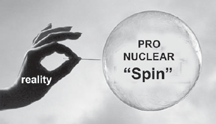
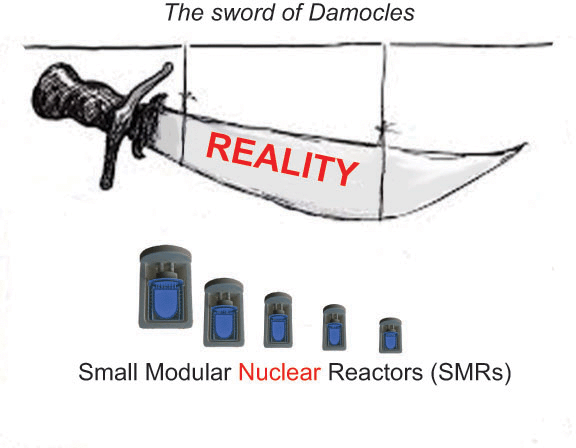
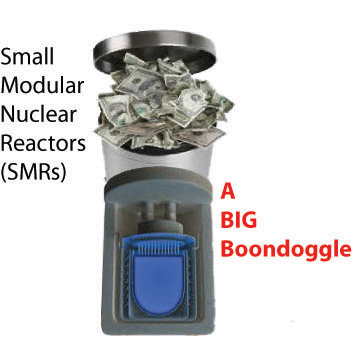
Aaron Patrick, senior correspondent with the Australian Financial Review (AFR), is the latest journalist to enter the nuclear culture wars with some propaganda that’s indistinguishable from that served up in the Murdoch tabloids. There’s lots of misinformation in Patrick’s articles. For example he uncritically promotes a dopey Industry Super Australia report, described by RenewEconomy editor Giles Parkinson as “one of the most inept analyses of the energy industry that has been produced in Australia”. (I’ve asked the authors of the Industry Super report if they intend to withdraw or amend it. No response.) The focus here ‒ and the focus of Patrick’s recent articles ‒ is on small modular reactors (SMRs), which he describes as new, small, safe, cheap and exciting (and he continues to make such claims even as I continue to feed him with evidence suggesting alternative SMR adjectives … non-existent, overhyped, obscenely expensive). Some history is useful in assessing Patrick’s claims. There’s a long history of small reactors being used for naval propulsion, but every effort to develop land-based SMRs has ended in tears. Academic M.V. Ramana concludes an analysis of the history of SMRs thus: “Sadly, the nuclear industry continues to practice selective remembrance and to push ideas that haven’t worked. Once again, we see history repeating itself in today’s claims for small reactors ‒ that the demand will be large, that they will be cheap and quick to construct. “But nothing in the history of small nuclear reactors suggests that they would be more economical than full-size ones. In fact, the record is pretty clear: Without exception, small reactors cost too much for the little electricity they produced, the result of both their low output and their poor performance. … “Worse, attempts to make them cheaper might end up exacerbating nuclear power’s other problems: production of long-lived radioactive waste, linkage with nuclear weapons, and the occasional catastrophic accident.” Patrick quotes an SMR company representative saying that SMRs have been “researched and developed for the best part of 50 years”. Fine … but surely AFR readers ought to be informed that every single attempt to commercialise SMRs over the past 50 years has failed. According to the Coalition’s energy spokesperson (p.34), “new-generation reactors with maximum safety features are now coming into use”. That was 30 years ago, and the spokesperson was Peter McGauran. A wave of enthusiasm for SMRs came and went without a single SMR being built anywhere in the world, and there’s no reason to believe the current wave of enthusiasm will be more fruitful. Diseconomies of scaleInterest in SMRs derives primarily from what they are not: large reactor projects which have been prone to catastrophic cost overruns and delays. Cost estimates for all reactors under construction in western Europe and north America range from A$17.5 billion to A$24 billion, and the twin-reactor V.C. Summer project in South Carolina was abandoned in 2017 after the expenditure of at least A$13 billion, forcing Westinghouse into bankruptcy and almost bankrupting its parent company Toshiba. But SMRs will cost more (per megawatt and megawatt-hour) because of diseconomies of scale: a 250MW SMR will generate 25 per cent as much power as a 1,000MW reactor, but it will require more than 25 per cent of the material inputs and staffing, and a number of other costs including waste management and decommissioning will be proportionally higher. So the nuclear industry’s solution to its wildly expensive and hopelessly uncompetitive large reactors is to offer up even-more-expensive reactors. Brilliant. Small wonder that nuclear lobbyists are lamenting the industry’s crisis and pondering what if anything might be salvaged from the “ashes of today’s dying industry“. Aaron Patrick claims in the AFR that SMRs are “likely” to be installed in North America and Europe. No, they aren’t. William Von Hoene, senior vice-president at Exelon ‒ the largest operator of nuclear power plants in the US ‒ said last year: “Right now, the costs on the SMRs, in part because of the size and in part because of the security that’s associated with any nuclear plant, are prohibitive.” The prevailing scepticism is evident in a 2017 Lloyd’s Register report based on the insights of almost 600 professionals and experts from utilities, distributors, operators and equipment manufacturers. They predict that SMRs have a “low likelihood of eventual take-up, and will have a minimal impact when they do arrive”. Likewise, American Nuclear Society consultant Will Davis said in 2014 that the SMR “universe [is] rife with press releases, but devoid of new concrete.” And a 2014 report produced by Nuclear Energy Insider, drawing on interviews with more than 50 “leading specialists and decision makers”, noted a “pervasive sense of pessimism” resulting from abandoned and scaled-back SMR programs. Independent economic assessmentsSMRs are “leading the way in cost” according to Tania Constable from the Minerals Council of Australia. NSW Deputy Premier John Barilaro claims that SMRs “are becoming very affordable”. But every independent economic assessment finds that electricity from SMRs will be more expensive than that from large reactors. A study by WSP / Parsons Brinckerhoff prepared for the 2015/16 South Australian Nuclear Fuel Cycle Royal Commission estimated costs of US$127‒130 per megawatt-hour (MWh) for large reactors, compared to US$140‒159 for SMRs. The Royal Commission’s final report identified numerous hurdles and uncertainties facing SMRs. A December 2018 report by CSIRO and the Australian Energy Market Operator concluded that “solar and wind generation technologies are currently the lowest-cost ways to generate electricity for Australia, compared to any other new-build technology.” It found that electricity from SMRs would be more than twice as expensive as that from wind or solar power with storage costs included (two hours of battery storage or six hours of pumped hydro storage). A report by the consultancy firm Atkins for the UK Department for Business, Energy and Industrial Strategy found that electricity from the first SMR in the UK would be 30 percent more expensive than that from large reactors, because of diseconomies of scale and the costs of deploying first-of-a-kind technology. A 2015 report by the International Energy Agency and the OECD Nuclear Energy Agency predicted that electricity from SMRs will be 50−100 percent more expensive than that from large reactors, although it holds out some hope that large-volume factory production could reduce costs. An article by four pro-nuclear researchers from Carnegie Mellon University’s Department of Engineering and Public Policy, published in 2018 in the Proceedings of the National Academy of Science, considered options for the development of an SMR industry in the US. They concluded that it would not be viable unless the industry received “several hundred billion dollars of direct and indirect subsidies” over the next several decades. That’s billion with a ‘b’: several hundred billion dollars.
|
|
Nuclear winter – the global threat to life

Nuclear winter would threaten nearly everyone on Earth https://www.sciencedaily.com/releases/2019/08/190828080543.htm
Second study of its kind confirms extreme impacts from US vs. Russia nuclear war
- Date:
- August 28, 2019
- Source:
- Rutgers University
- Summary:
- If the United States and Russia waged an all-out nuclear war, much of the land in the Northern Hemisphere would be below freezing in the summertime, with the growing season slashed by nearly 90 percent in some areas, according to a new study. Indeed, death by famine would threaten nearly all of the Earth’s 7.7 billion people, according to the research.
-
If the United States and Russia waged an all-out nuclear war, much of the land in the Northern Hemisphere would be below freezing in the summertime, with the growing season slashed by nearly 90 percent in some areas, according to a Rutgers-led study.
Indeed, death by famine would threaten nearly all of the Earth’s 7.7 billion people, said co-author Alan Robock, a Distinguished Professor in the Department of Environmental Sciences at Rutgers University-New Brunswick.
The study in the Journal of Geophysical Research-Atmospheresprovides more evidence to support The Treaty on the Prohibition of Nuclear Weapons passed by the United Nations two years ago, Robock said. Twenty-five nations have ratified the treaty so far, not including the United States, and it would take effect when the number hits 50.
- Lead author Joshua Coupe, a Rutgers doctoral student, and other scientists used a modern climate model to simulate the climatic effects of an all-out nuclear war between the United States and Russia. Such a war could send 150 million tons of black smoke from fires in cities and industrial areas into the lower and upper atmosphere, where it could linger for months to years and block sunlight. The scientists used a new climate model from the National Center for Atmospheric Research with higher resolution and improved simulations compared with a NASA model used by a Robock-led team 12 years ago.
The new model represents the Earth at many more locations and includes simulations of the growth of the smoke particles and ozone destruction from the heating of the atmosphere. Still, the climate response to a nuclear war from the new model was nearly identical to that from the NASA model.
“This means that we have much more confidence in the climate response to a large-scale nuclear war,” Coupe said. “There really would be a nuclear winter with catastrophic consequences.”
- In both the new and old models, a nuclear winter occurs as soot (black carbon) in the upper atmosphere blocks sunlight and causes global average surface temperatures to plummet by more than 15 degrees Fahrenheit.
Because a major nuclear war could erupt by accident or as a result of hacking, computer failure or an unstable world leader, the only safe action that the world can take is to eliminate nuclear weapons, said Robock, who works in the School of Environmental and Biological Sciences.
’12 Years to Act on Climate Change’ – what does this really mean?

What Does ’12 Years to Act on Climate Change’ (Now 11 Years) Really Mean? https://insideclimatenews.org/news/27082019/12-years-climate-change-explained-ipcc-science-solutionsIt doesn’t mean the world can wait until 2030 to cut greenhouse gas emissions, or that chaos will erupt in 2030. Here’s what the science shows., BY BOB BERWYN, INSIDE CLIMATE NEWS, AUG 27,2019We’ve been hearing variations of the phrase “the world only has 12 years to deal with climate change” a lot lately.Sen. Bernie Sanders put a version of it front and center of his presidential campaign last week, saying we now have “less than 11 years left to transform our energy system away from fossil fuels to energy efficiency and sustainable energy, if we are going to leave this planet healthy and habitable.”
But where does the idea of having 11 or 12 years come from, and what does it actually mean?
The number began drawing attention in 2018, when the United Nations’ Intergovernmental Panel on Climate Change released a report describing what it would take to keep global temperatures from rising more than 1.5 degrees Celsius, a goal of the Paris climate agreement. The report explained that countries would have to cut their anthropogenic carbon dioxide emissions, such as from power plants and vehicles, to net zero by around 2050. To reach that goal, it said, CO2 emissions would have to start dropping “well before 2030” and be on a path to fall by about 45 percent by around 2030 (12 years away at that time).
Mid-century is actually the more significant target date in the report, but acting now is crucial to being able to meet that goal, said Duke University climate researcher Drew Shindell, a lead author on the mitigation chapter of the IPCC report.
We need to get the world on a path to net zero CO2 emissions by mid-century,” Shindell said. “That’s a huge transformation, so that if we don’t make a good start on it during the 2020s, we won’t be able to get there at a reasonable cost.”
How Do Scientists Know?
Basics physics and climate science allow scientists to calculate how much CO2 it takes to raise the global temperature—and how much CO2 can still be emitted before global warming exceeds 1.5°C (2.7°F) compared to pre-industrial times.
Scientists worked backward from that basic knowledge to come up with timelines for what would have to happen to stay under 1.5°C warming, said Scott Denning, who studies the warming atmosphere at Colorado State University.
“They figured out how much extra heat we can stand. They calculated how much CO2 would produce that much heat, then how much total fuel would produce that much CO2. Then they considered ‘glide paths’ for getting emissions to zero before we burn too much carbon to avoid catastrophe,” he said.
“All this work gets summarized as ‘in order to avoid really bad outcomes, we have to be on a realistic glide path toward a carbon-free global economy by 2030.’ And that gets translated to something like ’emissions have to fall by half in a decade,’ and that gets oversimplified to ’12 years left.’
“There’s certainly a grain of truth in the phrase, but it’s so oversimplified that it leads to comically bad misconceptions about how to get there, conjuring up ridiculous cartoon imagery suggesting we just go on with life normally for the next 11 years and then the world ends,” Denning said.
That’s not what the IPCC writers envisioned, he said.
The science on the 2030 date is clear, said Michael Mann, a climate scientist at Pennsylvania State University. The controversy stems from people mischaracterizing the carbon reduction timeline as a threshold for climate disaster. He noted that people promoting climate science denial and delay have also latched on to the phrase “to intentionally try to caricature the concern about climate change.”
What Would Success Look Like?
It would be helpful if people looked at the 2030 target in terms of what success looks like rather than what failure means, Denning said.
“Solving the problem by 2030, 2040 or 2050 requires a new global energy infrastructure, which is arguably easier and less expensive than past infrastructure shifts like indoor plumbing, rural electrification, the automobile and paved roads, telecommunications, computers, mobile phones or the internet.
“All of these past changes cost tens of trillions of dollars, adjusted for inflation. All of them were hugely disruptive. All of them took a decade or more, completely changed the industrial and economic and social landscape, and created bursts of growth and productivity and jobs. And arguably, all of them made life better for huge numbers of people.”
This time, the shift is from heavy reliance on carbon-emitting fossil fuels to carbon-free energy sources, like wind power. And even with a speedy energy transition, the IPCC says keeping temperatures from warming more than 1.5°C will also likely require removing CO2 from the atmosphere on a large scale.
Missing the target doesn’t imply the onset of cataclysmic climate change in 2030, Denning said.
“Things just keep getting worse and worse until we stop making them worse, and then they never get better,” he said. “But no matter what, the world has to move on from fossil fuels just as we moved on from tallow candles and outhouses and land lines.”
What Would Exceeding 1.5°C Warming Mean?
The IPCC report described how increasing greenhouse gas emissions will result in more dangerous and costly disruptions to global societies and ecosystems, including longer, hotter heat waves and more frequent crop-killing droughts.
Mountain glaciers will melt faster as the planet warms, creating new risks for settlements in the valleys below. The meltdown of polar ice sheets is also projected to accelerate, intensifying flooding and speeding up sea level rise to a rate that will be hard to adapt to. More Arctic permafrost will thaw, releasing more greenhouse gases to the atmosphere.
Despite the rising risks, it’s important to understand that, “in the physical climate system, there are no scientists claiming that there is a magical threshold that we breach or don’t breach that determines whether we have a habitable climate system,” said Daniel Swain, a climate scientist at UCLA and the National Center for Atmospheric Research’s Center for Climate and Weather Extremes.
The 2030 target is useful because it shows how the “next decade is incredibly consequential for what we do.” Swain said. “But I think the emphasis that’s being placed on this specific 12-year window as a differentiator between existential crisis or not is problematic.
“First of all, it negates some of the risks that already exist and that will continue to build no matter what. And it also potentially suggests that anything short of complete victory in the next 12 years is pointless, which is exactly the opposite of the truth. At any point along the spectrum, more progress is always going to be better than less progress, less warming is always going to be better than more warming.”
Have We Passed Tipping Points Already?
In some ways, the “12 years” narrative may set up a deadline that’s too lenient, because some key part of the climate system may already be at or past tipping points, Swain said.
It creates the false illusion that there is some sort of guardrail moving forward, that if we just get in under the deadline we’ll be OK, he said. But “twelve years from now, it could be too late for some of these things, like the ice sheets.”
Research in the past few years reinforces the idea that some climate tipping points have already been breached. Studies show some parts of the Greenland Ice Sheet are unlikely to recover, and parts of the West Antarctic Ice Sheet may also be at or very near a tipping point to rapid disintegration.
A study published in June suggested that the rate of permafrost thawing is progressing much faster than climate models projected. And scientists studying the link between global warming and European heat waves said those recent extremes are also outside the scope of what they expected at current levels of warming.
The world will still exist if we breach 1.5°C and 2°C, but “the climate impacts and risks will be higher and the temperature will be higher,” said Glen Peters, research director at the CICERO climate research center in Oslo. That all seems to be sinking in to public awareness, he said.
“But in terms of deadlines, we have already missed the deadline,” he said. “We should have started mitigating decades ago, then we would have the problem solved.”
Narrow escapes from nuclear war
|
A few small goofs nearly threw the world into nuclear war Popular Science , Excerpt: End Times, By Bryan Walsh
If there’s an important post in America’s national defense establishment, chances are that William Perry has held it. He worked as a civilian expert in electronic intelligence in the 1960s, served as undersecretary of defense for research and engineering, and ended his career in government service as President Bill Clinton’s defense secretary from 1994 to 1997. He served on the University of California’s board of governors for the laboratory at Los Alamos—where the first nuclear bomb was developed—and is currently the head of the board at the Bulletin of the Atomic Scientists. Even at 91 years old his voice still exudes authority, and his words demand attention in capitals around the world. What makes Perry special, however, is that he is one of the last living American statesmen who saw with his own eyes just how close we came to nuclear annihilation. And what he came to understand was that the real threat of nuclear war wasn’t from military competition, but from the way that simple misunderstandings and technical errors could spiral out into planetary catastrophe. It wasn’t the war in nuclear war that was so dangerous—it was the nuclear, the fact that thousands of megatons of explosive power kept on a hair trigger made any mistake irrevocable…… Perry got involved in what would become known as the Cuban Missile Crisis. ….. The stage was set for the single moment in the modern age when the human race may have come closer to extinction than it ever has before or since. On October 27, 1962, as part of the U.S. naval quarantine of Cuba, American destroyers and the aircraft carrier USS Randolph managed to corner the Soviet submarine B-59. The U.S. ships began dropping small depth charges—underwater explosive devices—around the sub. The American commanders weren’t trying to sink the sub but rather to force it to the surface, an intention they had made clear to Soviet military leaders in Moscow. What the Americans didn’t know was that the sub had been out of touch with Moscow for days. When depth charges began exploding around the sub, the crew had every reason to believe that World War III had begun. An exhausted Captain Valentin Savitsky gave the orders to prepare the sub’s nuclear torpedo for firing. A successful hit on the Randolph would have vaporized the aircraft carrier, which in turn would have put the U.S. nuclear war plan for total retaliation into play. Thousands of American warheads would have been on their way to targets in the Soviet Union, China, and other nations. The Soviets would have responded, and the worst would have come true. The decision to launch a nuclear weapon on board the Soviet sub had to be authorized by three officers. Ivan Maslennikov, the deputy political officer, said yes. But Vasili Arkhipov, Savitsky’s second in command, refused. He convinced Savitsky to instead bring the sub to the surface, where a U.S. destroyer ultimately allowed the ship to return to Russia. …….. The Cuban Missile Crisis is only the best known of many, many times when World War III was almost triggered by accident. William Perry himself lived through one when he was serving in the Department of Defense in 1979 and was awakened in the middle of the night by a watch officer at NORAD who said his monitors were showing two hundred Soviet intercontinental ballistic missiles (ICBMs) en route to the United States. It turned out to be a computer error. Less than a year later, on June 3, 1980, military computers showed thousands of Soviet missiles headed toward the States. Then–national security adviser Zbigniew Brzezinski was about to recommend a counterattack until he was told at the last minute that the alarm had been generated by a faulty computer chip—one that cost all of 46 cents. Perhaps the closest the world came to nuclear war after the Cuban Missile Crisis was on September 26, 1983, with the reported launch of several ICBMs from the United States. Lieutenant Colonel Stanislav Petrov was on duty that night, and his job was straightforward: register the missile launch and report it to Soviet military and political command. An ICBM takes half an hour to reach its target, which meant Petrov had only minutes to authenticate the apparent attack in time for the Soviets to launch a counterattack. Yet Petrov judged that the United States would not launch a first strike with only a handful of missiles, so he instead reported a system malfunction. And then he waited. “Twenty-three minutes later I realized that nothing had happened,” Petrov told the BBC in 2013. “If there had been a real strike, then I would already know about it. It was such a relief.” ………… But the side effect of nuclear-enforced peace was the creation of existential risk for the entire species. Every year, every day, every moment, global catastrophe could strike at the push of a button. “Today, every inhabitant of this planet must contemplate the day when this planet may no longer be habitable,” President Kennedy told the United Nations in 1961. “Every man, woman, and child lives under a nuclear sword of Damocles, hanging by the slenderest of threads, capable of being cut at any moment by accident or miscalculation or by madness.” And we live under that sword still. Excerpted from End Times by Bryan Walsh. https://www.popsci.com/end-times-nuclear-war-accidents/ |
|
|
Parliamentary Inquiry told that renewable energy, not nuclear power, is Australia’s best option
 Nuclear inquiry told “firmed renewables” cheapest and best option for future https://reneweconomy.com.au/nuclear-inquiry-told-firmed-renewables-cheapest-and-best-option-for-future-58109/ , 29 August 2019 A mix of distributed renewable energy generation and firming technologies including battery storage and pumped hydro remains the best path forward for Australia’s future grid, experts have told the federal government’s inquiry into nuclear power.A panel including representatives from Australia’s energy market regulator (AER), rule maker (AEMC) and operator (AEMO) faced questions on Thursday from the House of Representatives Standing Committee on the prerequisites for nuclear energy in Australia. Established by the federal Coalition and chaired by Queensland LNP MP Ted O’Brien, the Committee aims – according to O’Brien – to answer the three main questions of whether nuclear is “feasible, suitable and palatable” in the Australian context.
Physical and psychological abuse of Julian Assange
Clinical psychologist Lissa Johnson: They are trying to break Assange “physically and psychologically” WSWS, By Oscar Grenfell , 28 August 2019Australian clinical psychologist Lissa Johnson has been an outspoken defender of Julian Assange, writing extensively on the grave implications of his persecution for democratic rights and freedom of speech.
Johnson explained to the WSWS that she “writes about the psychology of politics and social issues.” She has a background in media studies and sociology, and a PhD in the psychology of manipulating reality-perception.
Earlier this year, Johnson wrote an extensive five–partinvestigative series titled “The Psychology of Getting Julian Assange,” published on the New Matilda website. Johnson provided the following responses to a series of questions from the World Socialist Web Site earlier this week.
WSWS: John Shipton and John Pilger have recently detailed the punitive conditions of Assange’s detention in Belmarsh Prison. Could you speak about the way in which his isolation, and the denial of his right to access computers/legal documents is aimed at stymieing his defence against the US extradition request and increasing the psychological pressures upon him?
Lissa Johnson: If anyone takes a moment to imagine what it must be like to face the prospect of 175 years in a US prison, having already been subjected to nearly a decade of arbitrary detention and judicial harassment, knowing that you have no chance of a fair trial in the US, having been smeared in the media and branded a “terrorist” and enemy of the state, then that gives you an inkling of what Julian Assange was dealing with even before being placed under lockdown in Belmarsh prison. If you add to that having read hundreds of documents from Guantanamo Bay and knowing, in intimate detail, what the United States does to those it brands terrorists and enemies of the state, then Julian Assange’s reality becomes even clearer.
Now, with the full force of the US national security state bearing down on him, Julian Assange has been stripped of his most basic abilities to protect himself. Continue reading
Double standards in UK prison, as Julian Assange is deprived of justice
Julian Assange: Deprivation of Justice and Double Standards in Belmarsh Prison, 21st Century Wire , AUGUST 28, 2019 BY
Alfred de Zayas, former UN Rapporteur, has described the actions of the British authorities in pursuit of Assange as “… contrary to the rule of law and contrary to the spirit of the law.” What we see on the surface is an illusion of British justice, masking a political agenda behind it.
Britain’s notorious Belmarsh Prison is now being presented as beacon of good governance, indicative of a fair and just society which equitable but firm with perpetrators. After carefully reviewing the case of Julian Assange though, there can be little doubt that placing the award-winning journalist in such a facility is nothing but the latest vehicle for his rendition to the US.
So far, Belmarsh has been fulfilling that state agenda.
Belmarsh as the state’s next weapon of choice
Judge Deborah Taylor sent Assange to category A Belmarsh prison for a bail-skipping offense, even though he’d demonstrated that he had good reason to skip bail. It is difficult not to conclude that the category A assignment was done so that he would be weak and vulnerable. In essence, Assange was sent to Belmarsh for 50 weeks for failing to turn up at a police station. There was no ongoing court case; he had no prior offenses; there were no charges; the Swedish investigation had been dropped. So skipping police bail was all the British government had. It should also be pointed out that Judge Taylor made a series of mistakes during the sentencing on 1st May, referring to rape charges in Sweden, which Assange corrected and which she then acknowledged were wrong. This indicates that Judge Taylor went into court at least uninformed, set in her mind that Assange had somewhere, somehow been charged with rape. This would seem to explain some of the reasoning behind Judge Taylor’s cruel sentencing, described by the United Nations Working Group on Arbitrary Detention as ‘disproportionate’ but also as furthering the arbitrary deprivation of Assange’s liberty. What’s more, it has been pointed out how several thousand people in the UK skip bail each year and are in now way subject to such harsh punishment.
Clearly, Judge Taylor had used narratives provided by the state in order to send Assange to a category A penitentiary, even though these narratives have been thoroughly debunked. …….
Following his assessment of Assange in May inside Belmarsh prison, Nils Melzer issued a statement detailing the conditions of dentention. Melzer was accompanied by two medical experts who specialize in the examination of possible victims of torture as well as the documentation of symptoms, both physical and psychological. On examining Assange Melzer observed the following:
“Most importantly, in addition to physical ailments, Mr. Assange showed all symptoms typical for prolonged exposure to psychological torture, including extreme stress, chronic anxiety and intense psychological trauma.“
In addition to these concerns, reports also indicate Assange is being medicated. Continue reading
“Lipstick on a Pig” – Pro nuclear groups again trying to classify nuclear power as “Renewable”
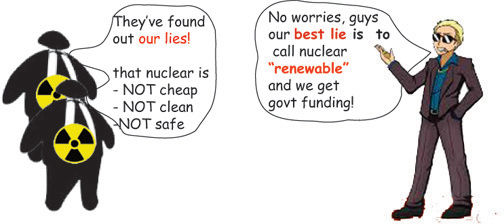
To keep Diablo Canyon open, SLO assemblyman wants to classify nuclear power as renewable, BY MATT FOUNTAIN The Tribune, AUGUST 28, 2019 A Central Coast legislator and two pro-nuclear groups are taking an unusual step to keep Diablo Canyon nuclear power plant operating: They want an amendment to the state Constitution classifying nuclear power as a renewable energy source.
Then, with the plant’s production able to count toward California’s target for renewables, the hope is that someone would acquire it through PG&E’s bankruptcy proceedings and continue to run it for another 20 years.
The effort’s a long shot, however, in a state controlled by Democrats more interested in investing in solar, wind, and geothermal energy, and with the plant facing significant relicensing hurdles.
Assemblyman Jordan Cunningham, R-San Luis Obispo, announced Wednesday that he filed a proposed constitutional amendment to prohibit the Legislature from discriminating against any form of renewable or zero-carbon energy as part of California’s Renewables Portfolio Standard, qualifying nuclear as a source of renewable energy.
The operating licenses for Diablo Canyon’s two reactors expire in 2024 and 2025 respectfully, and the plant is slated for closure in 2026.
Logistical issues aside, Cunningham says qualifying the plant as a generator of renewable energy could allow the plant to operate up to 2045.
In June 2016, PG&E abandoned its efforts to relicense the plant’s reactors, citing among other factors the state’s renewable energy policy…….
The proposed amendment is supported by the pro-nuclear nonprofit groups Environmental Progress and Californians for Green Nuclear Power.
‘LIPSTICK ON A PIG’
But David Weisman, spokesman for the Alliance for Nuclear Responsibility, which has called for the early closure of Diablo Canyon, likened the proposed amendment to a recent taxpayer bailout of Ohio’s two remaining nuclear reactors.
Saying that PG&E customers already pay among the highest rates in the country, Weisman said subsidies placed on the nuclear industry in other states have passed on extra costs to ratepayers.
“Ratepayers are already on the hook for a portion of billions of dollars in losses caused by PG&E’s negligence in Northern California,” Weisman said, referring to the utility’s liability for allegedly causing recent wildfires. “PG&E doesn’t want this plant.”
John Geesman, attorney for the Alliance, said the Diablo Canyon proposal will likely draw attention to the magnitude of Diablo’s above-market costs.
“This is an obvious attempt to put lipstick on a pig in hopes of attracting a purchaser of the asset in bankruptcy,” Geesman wrote in an email…… https://www.sanluisobispo.com/news/local/article234470352.html
“Chernobyl on the Seine” – Marie curie’s radioactive legacy
France Is Still Cleaning Up Marie Curie’s Nuclear Waste, Her lab outside Paris, dubbed Chernobyl on the Seine, is still radioactive nearly a century after her death. Bloomberg Business Week , By Tara Patel, 28 Aug 19,
In 1933 nuclear physicist Marie Curie had outgrown her lab in the Latin Quarter in central Paris. To give her the space needed for the messy task of extracting radioactive elements such as radium from truckloads of ore, the University of Paris built a research center in Arcueil, a village south of the city. Today it’s grown into a crowded working-class suburb. And the dilapidated lab, set in an overgrown garden near a 17th century aqueduct, is sometimes called Chernobyl on the Seine. No major accidents occurred at the lab, which closed in 1978. But it’s brimming with radioactivity that will be a health threat for millennia, and France’s nuclear watchdog has barred access to anyone not wearing protective clothing. The lab is surrounded by a concrete wall topped by barbed wire and surveillance cameras. Monitors constantly assess radiation, and local officials regularly test the river. “We’re proof that France has a serious nuclear waste problem,” says Arcueil Mayor Christian Métairie. “Our situation raises questions about whether the country is really equipped to handle it……. (subscribers only) https://www.bloomberg.com/news/articles/2019-08-28/france-is-still-cleaning-up-marie-curie-s-nuclear-wastePhysicist Ed Lyman on new safety threats to US nuclear reactors
BO’s Chernobyl Sparks Questions About US Nuclear Power Safety, UCS, AUGUST 27, 2019
Physicist Ed Lyman discusses new safety threats to US nuclear reactors and why risks here are different than in Russia.
If you’re gonna have nuclear power, you should make sure that there’s a sufficient region around every plant that’s low population density. So that if evacuation or other emergency measures are needed, they can be carried out effectively. And by simply suburbanization and development, a lot of plants around the country that were originally sited in rural areas now find themselves in suburbs and the population’s increasing.
The idea is that it doesn’t really matter too much how old the plant is, as long as you can inspect and maintain those systems, structures, and components that are aging so that they stay within an acceptable range. Now there are certain things that can’t be changed. For instance, the concrete and steel containment buildings around most plants, it’s not something that’s going to be replaced.
There’s buried piping in a lot of plants, this piping was never intended to be replaced, but some of it is corroding. So, there may be an issue with how do you manage those structures that can’t be replaced. And finally, the reactor vessels, these are the steel vessels that hold the nuclear fuel in reactors, they become brittled over time as they’re bombarded with neutrons. And there is a risk that they could shatter like glass if they are sufficiently brittle and they undergo rapid cooling.
So that’s one of the…what is called a time limiting aspects of a nuclear plant because those reactor vessels would be way too expensive to ever replace……..
Colleen: Ed, is it true that the next generation of nuclear power plants will be so safe that they can’t meltdown?
Ed: It is not true. Any nuclear plant has vulnerabilities that could result in a serious accident or could be exploited. It is true that you can design greater safety into nuclear power, there are ways to reduce that risk. But by and large, you’re always going to have these vulnerabilities and you can’t depend on the design to save the day. It’s always going to be a good design plus a well-run plant, plus well-trained operators, plus robust inspections and maintenance, and also robust security to prevent against sabotage attacks.
Colleen: How far-fetched is the idea that terrorists could attack a nuclear power plant? What would they be trying to do or to get?
Ed: For a commercial nuclear power plant in this country, the greatest concern is radiological sabotage. And that is a deliberate act that could destroy or disable enough of the safety systems and the backup safety systems that the reactor would meltdown and there would be very little that the plant operators could do about that. And it’s a very real threat.
Because if there were a well-trained, paramilitary type terrorist attack at a nuclear reactor, without a robust security response, the attackers could essentially destroy enough equipment to cause a meltdown within minutes. So there is a very short time window for trying to respond if you have this type of event. The best thing to do is to prevent the attack from taking place…..
it’s a fallacy to think that Chernobyl was an event that was only due to Soviet incompetence and corruption and that that kind of thing couldn’t happen here. Chernobyl couldn’t happen here, but Fukushima could or something worse than Fukushima. https://ucsusa.org/ep66-lyman
1 This Month

of the week – Shut Down Drone Warfare!


Tell the Ukrainian Government to Drop Prosecution of Peace Activist Yurii Sheliazhenko

Petition to revoke the licensing of the Near Surface Nuclear Disposal Facility (NSDF) at Chalk River. https://www.ourcommons.ca/petitions/en/Petition/Details?Petition=e-7247
To see nuclear-related stories in greater depth and intensity – go to https://nuclearinformation.wordpress.com
-
Archives
- March 2026 (230)
- February 2026 (268)
- January 2026 (308)
- December 2025 (358)
- November 2025 (359)
- October 2025 (376)
- September 2025 (257)
- August 2025 (319)
- July 2025 (230)
- June 2025 (348)
- May 2025 (261)
- April 2025 (305)
-
Categories
- 1
- 1 NUCLEAR ISSUES
- business and costs
- climate change
- culture and arts
- ENERGY
- environment
- health
- history
- indigenous issues
- Legal
- marketing of nuclear
- media
- opposition to nuclear
- PERSONAL STORIES
- politics
- politics international
- Religion and ethics
- safety
- secrets,lies and civil liberties
- spinbuster
- technology
- Uranium
- wastes
- weapons and war
- Women
- 2 WORLD
- ACTION
- AFRICA
- Atrocities
- AUSTRALIA
- Christina's notes
- Christina's themes
- culture and arts
- Events
- Fuk 2022
- Fuk 2023
- Fukushima 2017
- Fukushima 2018
- fukushima 2019
- Fukushima 2020
- Fukushima 2021
- general
- global warming
- Humour (God we need it)
- Nuclear
- RARE EARTHS
- Reference
- resources – print
- Resources -audiovicual
- Weekly Newsletter
- World
- World Nuclear
- YouTube
-
RSS
Entries RSS
Comments RSS
 nuclear-news