Losing the climate war: the unholy alliance between the Pentagon and the fossil fuel industries
We Can’t Confront Climate Change While Lavishly Funding the Pentagon, BY JP Sottile, Truthout. August 18, 2019
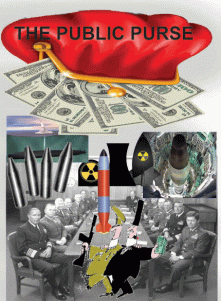 The Pentagon is staring down the barrel of what could become the longest, hottest war in U.S. history. This titanic clash pits the largest military the world has ever seen against an omnipresent opponent that can marshal resources like no enemy it has ever encountered.
That opponent is climate change, and according to a
joint investigationby
NBC News and
InsideClimate News, the extreme heat it brings is already generating military casualties. But soldiers like
Sgt. Sylvester Cline are not dying where you might expect, such as scorching, oil-rich targets like Iraq, where Cline served during a lie-tainted war. Unlike the overwhelming majority of Uncle Sam’s
long list of military conflicts, this war is also being waged on U.S. soil. Sadly, the Arkansas-based sergeant was just one of “at least 17 troops to die of heat exposure during training exercises at U.S. military bases since 2008.”
In fact, the total number of heat-strokes and cases of heat exhaustion suffered by active-duty service members rose by 60 percent between 2008 and 2018 (from 1,766 to 2,792). Forty percent of these incidents occurred in the Southeastern United States in places like Fort Benning (Georgia), Camp Lejeune (North Carolina) and Fort Polk (Louisiana). Over that same period, the Southeast region has experienced average summer temperatures that were the nation’s hottest on record, and a staggering 61 percent of major Southeast cities show the effects of these worsening heat waves, according to the
Fourth National Climate Assessmentreleased in 2018.
As Brown University’s Costs of War research project
recently pointed out, the Defense Department “remains the world’s
single largest consumer of oil – and as a result, one of the world’s top greenhouse gas emitters.” British researchers at Durham University and Lancaster University
published a corroborating report detailing the profuse use of hydrocarbons to fuel U.S. military adventurism. They astutely pointed out the dilemma of attempting to confront “the effects of climate change while remaining the largest single institutional consumer of hydrocarbons in the world.” …….
every year the U.S. political system reflexively funds a
world-dominating defense budget that directly benefits the oil industry, client states and the entire hydrocarbon-based economy. Basically, it’s a global protection racket that generates
huge profits for defense companies that sell weapons to the Pentagon.
And the
U.S. governmentalso
pushes arms sales abroad, particularly to
oil-rich clients like those in the Middle East. All of those arms sales sustain
thousands of jobs in states and congressional districts around the U.S. That, in turn, creates constituencies for members of Congress who collect millions in campaign contributions from both the
defense and
oil industries to make sure they can maintain
de facto subsides for their weapons and their oil. Taxpayers and consumers complete the circuit through their “contributions” to the empire’s public-private partnership: They get to keep on buying oil, gas and plastic, while paying taxes for the military. It’s a perpetual ATM fueled by oil.
Meanwhile, U.S. citizens fill the ranks of the military services that guarantee the continuation of a hydrocarbon system that’s now cooking them alive as they train on U.S. soil. It’s the ghoulish internal logic of the oil-driven imperium, one that generates its rationale for being through its continued existence.
Funding the Pentagon, Fueling the Fallout
Now this self-perpetuating system threatens to engulf the thawing Arctic, which is becoming a
new frontier for untapped oil and gas. Of course, there’d be no scramble for the Arctic’s once-impenetrable hydrocarbon resources without the unprecedented melting caused by our hydrocarbon-driven climate crisis. But that sad irony was purposefully ignored by Secretary of State Mike Pompeo at a recent meeting of the eight-nation
Arctic Council in Finland. Unsurprisingly, the
Rapture-ready Pompeo
refused to sign the meeting’s
joint accord because it mentioned the climate crisis now devastating the Arctic’s ecosystems. Instead, Secretary Pompeo
extolled the
supposed benefits of the big melt that’s rapidly altering the pristine landscape of the ever-less frozen frontier:
The Arctic is at the forefront of opportunity and abundance. It houses 13 percent of the world’s undiscovered oil, 30 percent of its undiscovered gas, an abundance of uranium, rare earth minerals, gold, diamonds, and millions of square miles of untapped resources, fisheries galore.
It’s a predictable statement from an
oil-obsessed administration that salivates at the prospect of
drilling, baby, drilling in the Arctic. At the same time, Secretary Pompeo put the world on notice,
stating that the region has become an “arena of global power and competition.” Without irony, he
warned Russia and “
non-Arctic” nations like China against “
aggressive” behavior. Actually, China is
already there and
drilling in cooperation with Russia in
a de facto alliance around the issue of the opening Arctic, a fact that is likely to become
budgetary catnip for U.S. empire. Competition for this new frontier is quickly becoming the latest oily justification to pour money into yet another theatre of operations. In other words, the climate crisis is not only a byproduct of empire, but it’s becoming a rationale for even more empire.
Actually, it’s already started
The troops sent to the border to “assist” U.S. Customs and Border Patrol and to “build” Trump’s wall are, like Sergeant Cline’s heat-related death, a harbinger of things to come. They are not only seeing firsthand the desperation of people willing to walk up to 2,000 milesto flee the fallout from decades of U.S. interventionism in Central America, they are witnessing the start of a widely predicted climate migration crisis. A brutal mix of prolonged drought, water scarcity and deforestation is exacerbating the suffering in El Salvador, Guatemala and Honduras. As InsideClimate News noted, Honduras typifies the unfair paradox of the climate crisis because “like so many developing countries” it “has contributed relatively little to the greenhouse gas emissions,” but “projections suggest it is especially imperiled by climate change.”
Low-emission countries like
Bangladesh,
Mozambique and
Fiji are already feeling the heat of the climate crisis. And, as U.S. troops suffer from heat waves in the Southeast, the impact of climate crisis is also being felt acutely in the U.S. in places like the
Alaskan village of Newtok, which requested and was
finally granted Federal Emergency Management Agency money to flee the relentless march of climate-caused erosion. Obviously, the crisis is not 50-75 years away, as Environmental Protection Agency Administrator and former hydrocarbon lobbyist Andrew Wheeler
smugly proclaimed — and
the Pentagon knows it.
Unfortunately, the longer the U.S. continues to garishly fund the Pentagon and its oil-based protection racket, the harder it will be to deal with the massive ecological and human fallout caused by the hydrocarbon economy. Ultimately, it might be impossible to halt or even mitigate the climate crisis without also ending empire. And if we are not careful, the same forever war mentality that has continually shifted from one enemy to another will find yet another reason to exist — this time as a bulwark against the escalating impacts of a climate crisis it helped to create in the first place.
August 19, 2019 -
Posted by Christina Macpherson |
climate change, USA, weapons and war
No comments yet.
 The Pentagon is staring down the barrel of what could become the longest, hottest war in U.S. history. This titanic clash pits the largest military the world has ever seen against an omnipresent opponent that can marshal resources like no enemy it has ever encountered.




 nuclear-news
Leave a comment