Boris Johnson enthusiastic for a new ‘nuclear renaissance’ in UK
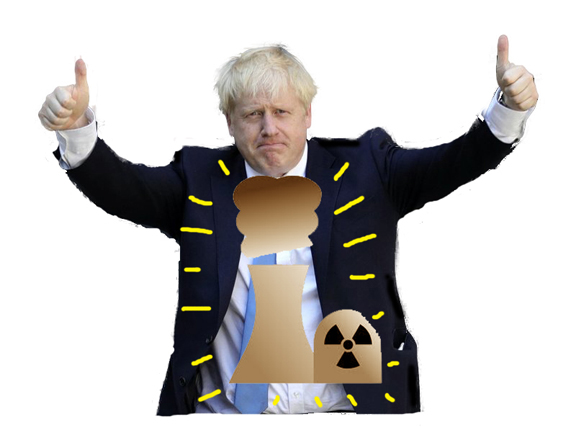 UK’s new premier promises boost for nuclear power, WNN. 26 July 2019 Boris Johnson expressed his “passionate” support for nuclear power when he addressed the House of Commons for the first time as UK prime minister yesterday. Seven of the country’s eight existing nuclear plants are set to be retired by 2030, while new-build projects have faced financial uncertainty over the last two year………On 22 July, the day that Johnson was elected leader of the Conservative Party and two days before he officially replaced Theresa May as prime minister, the government launched a consultation into funding large-scale nuclear power plants and a proposed GBP18 million (USD22 million) investment into small modular reactors.
Greg Clark, secretary of state for the Department for Business, Energy and Industrial Strategy (BEIS) – who Johnson replaced this week with Andrea Leadsom – announced in June 2018 that the government would review the viability of a Regulated Asset Base (RAB) model for new nuclear projects. The consultation states that, as the cost of renewable technologies continues to fall, they are likely to provide the majority of the country’s low-carbon generating capacity in 2050. It adds however there will still be a crucial role for low-carbon ‘firm’ – always available – power in 2050.
The RAB model would not apply to Hinkley Point C (HPC), which is currently under construction by EDF Energy in Somerset, England, but would apply to future plants. As many as five more new-build projects had been planned – by EDF Energy together with China General Nuclear (CGN); NuGeneration (NuGen); and Horizon Nuclear Power……… http://world-nuclear-news.org/Articles/UKs-new-premier-promises-boost-for-nuclear-power
Self-regulation of nuclear power plants? What could possibly go wrong?
The industry insists that self-policing can work and that operators of the 90-plus nuclear plants across the country don’t need the kind of rigorous federal inspections that have been required annually or once every two years under previous administrations. Under plans now being contemplated, inspections would be reduced to as little as once every three years.
A Nuclear Regulatory Commission staff report, recently made public, recommends cutting back on nuclear reactor inspections to improve efficiency and save money. Competition in the energy-generating industry has grown much stiffer with the increased use of cheaper natural gas and renewable sources…….
Rare is the industry that welcomes heavy regulation and rigorous federal inspections. But history is rife with examples of how badly things can go wrong when the government steps back and allows companies in high-risk industries to police themselves.
Boeing faces billions of dollars in losses after two of its 737 Max 8 jetliners crashed. The Federal Aviation Administration’s acting administrator, Daniel Elwell, acknowledged before Congress in May that the agency had cut back on staff inspections and relied on manufacturers like Boeing to conduct their own inspections.
After the 2010 Deepwater Horizon disaster in the Gulf of Mexico, Congress imposed heavy regulations on the offshore oil industry to prevent any repeat of the explosion that killed 11 and sent millions of barrels of oil spewing into the Gulf of Mexico. The Trump administration is working to cut those regulations back so the industry can return to policing itself.
Likewise, the administration worked with Republicans in Congress to reverse banking-industry regulations imposed after the 2007-2008 financial-industry meltdown that prompted the Great Recession — again on the premise that the industry is better off self-regulating.
The record on self-policing doesn’t bode well. But as the saying goes, those who do not learn from history are doomed to repeat it. https://www.stltoday.com/opinion/editorial/editorial-self-regulation-of-nuclear-power-plants-what-could-go/article_98f37d34-a229-5aac-a54b-0a36e75cdc9a.html
Nevadans say no to nuclear waste
Brian Greenspun hit the nail on the head in his July 14 column “Why Yucca Mountain rattles us should be no surprise.”
The Trump administration and the president’s many enablers may not understand the meaning of the word no, but hopefully they hear this loud and clear: The families of Las Vegas do not want to store nuclear waste less than 100 miles from their homes.
The families of Nevada have been lied to repeatedly by people like Energy Secretary Rick Perry, whose department recently shipped nuclear waste into the state. This sort of ineptitude is inexcusable at any level of the federal government, but especially so when hazardous nuclear waste is being mishandled.
I urge Nevadans to thank Sens. Catherine Cortez Masto and Jacky Rosen, as well as Gov. Steve Sisolak, for opposing the shipments and attempts to reopen Yucca Mountain. We should also support Rep. Steven Horsford’s call for Perry’s resignation.
India’s Govt prohibits mining of thorium and other atomic minerals by private entities
Govt prohibits mining of atomic minerals by private entities https://www.thehindubusinessline.com/economy/govt-prohibits-mining-of-atomic-minerals-by-private-entities/article28732945.ece July 27, 2019
Atomic minerals zirconium, monazite and thorium are found in abundance along several beaches of the country
The government has prohibited mining of atomic minerals by private entities and will grant operating rights to only state-run companies to “safeguard” strategic interest of the country, according to a gazette notification issued on Saturday.
Atomic minerals zirconium, monazite and thorium are found in abundance along several beaches of the country.
Zircon have potential applications in the strategic, defence and hi-tech sectors as it contains an important strategic element, called hafnium, which is used in the field of atomic energy.
Monazite is a mineral of thorium, uranium and rare earths and it has a high percentage of neodymium which has several hi-tech applications.
Zirconium, hafnium and thorium are very important strategic elements used in different stages of the country’s nuclear power programme, and since monazite and zircon occur in beach sand minerals, any loss or pilferage of these minerals at any stage of mineral handling or processing “shall affect the larger national interest”, the notification said.
“In offshore areas and their strategic importance, it is imperative that the mineral concessions in offshore areas be brought at par with the onshore areas in their treatment and therefore, in order to safeguard the strategic interest of the nation, it is expedient in larger national interest to prohibit the grant of operating rights in terms of any reconnaissance permit, exploration license or production lease of atomic minerals” in any offshore areas to anyone, except a government owned or controlled company, it stated.
“The central government hereby prohibits grant of operating rights in respect of atomic minerals in any offshore areas in the country…to any person, except the government or a government company or a corporation owned or controlled by the government, under the Offshore Areas Mineral (Development and Regulation) Act, 2002,” it said.
The government also “rescinded” any action taken by it earlier in this regard.
Boris Johnson government could reach net zero, without nuclear power
Utility Week 26th July 2019 , Boris may not need the nuclear option to reach net zero. The proposal to use the regulated asset base model to fund new nuclear projects this week
was given a mixed reaction. SSE chief executive Alistair Phillips-Davies
writes exclusively for Utility Week about why he believes the government
should now be showing the same level of support for renewable electricity
if it is serious about reaching net-zero emissions by 2050.
https://utilityweek.co.uk/boris-may-not-need-nuclear-option-reach-net-zero/
Yet more delay at Flamanville nuclear debacle – doesn’t bode well for UK’s Hinkley Point C project
Times 27th July 2019 As French existential jokes go, little beats building a nuclear power plant
at a place called Flammable. OK, it’s actually Flamanville. But who cares
about that sort of nicety – not least when the project’s proving so
incendiary?
It was due to be up and running in 2012 at a cost of €3.3
billion. Not only that. Flaming Ville was to be the showcase for the
European Pressurised Reactor, the wizzy new tech developed by the
state-backed EDF. True, it’s living up to the pressurised bit, at least for
EDF boss Jean-Bernard Lévy.
He’s just been forced to announce another
delay: a howitzer, even by usual standards, of “more than three years”. The
end of 2022 is now the earliest start date; a delay bound to jack up
project costs that have already exploded to €10.9 billion
The reason?
France’s spoilsport nuclear safety authority has ordered EDF to repair
eight bits of dodgy welding: who’d have thought nukes had to be welded
together properly? And, yes, the whole thing is turning into a nice French
farce. Except for one thing, of course: the joke’s on us.
Flamanville is the prototype for our very own nuclear disaster: the £20 billion Hinkley
Point C. It’s being built by EDF and the Chinese in return for the
contractual right to fleece UK consumers for 35 years: an index-linked,
guaranteed £92.50 per megawatt hour that’s twice the wholesale price. Even
better, the 3,200MW Hinkley is the planned forerunner for a fleet of new
nukes.
Indeed, so thrilling is the prospect that Greg Clark spent his dying
days as business secretary agonising over whether it might actually be
better to fleece consumers upfront instead, via his “regulated asset base”
funding model, before the plant was built. His verdict? A “consultation”,
the sort of non-decision-making for which he was deservedly sacked. Surely
someone in government can see the big picture here.
It’s not just
Flamanville that’s proving new nuclear so radioactive; a heady mix of
last-century tech, uncontrollable costs, endless delays and a dirty great
clean-up bill. EDF’s sister project, at Olkiluoto in Finland, has proved a
similar disaster. And didn’t ministers notice while their mooted plant at
Moorside was imploding that the project’s promoter, Japan’s Toshiba, was
blowing itself in the US with subsidiary Westinghouse?
No bribe was big enough, either, for Hitachi at Wylfa: no big shock when the group’s from
Fukushima-land. True, nuclear accounts for a fifth of Britain’s energy
needs. But its costs keep going up, while those of wind, solar, battery
power and carbon capture are falling. And they don’t require dangerous
clean-ups. Yes, maybe it’s too late to stop Hinkley. But someone in Boris’s
new team must see that new nuclear’s a route to torching money. Flammable
is all the evidence they need.
https://www.thetimes.co.uk/article/5268801e-afd9-11e9-84cf-31ddba0e0fae
Trump might like this: they originally wanted to explode nuclear bombs on the moon.
It’s just as well that Donald Trump doesn’t read books and so is unlikely to find out about this moon-bruising idea, an idea that would surely appeal to his teeny-weeny mind.
There was active planning of the moon bombing (it was called “Project A119”) so that, visible to the whole world, it would have been a demonstration of US military might to send a chill up the spine of the USSR.
In the end, the bombing didn’t go ahead because the White House was worried that the American people, perhaps with affectionate feelings towards the moon (as reflected in popular sentimental love songs like By the Light of the Silvery Moon) would be upset by an act of cruelty towards our cuddly, faithful, silvery celestial neighbour.
One wonders if today’s American people, brutalised and the balances of their minds disturbed by the Trump presidency, would oppose a new Project A119, perhaps designed to remind those pesky Iranians of US military might.
One can just hear a rally of thousands of Trump’s patriotic “core” admirers, revved up by him, chanting “Nuke the moon! Nuke the moon!”. https://www.canberratimes.com.au/story/6293989/should-we-nuke-the-moon-yes-the-moon-where-men-grown-on-trees/?cs=14246
Huge Arctic fires have now emitted a record-breaking amount of CO2
Temperatures have been well above average in the region, and fires erupted in boreal peatlands across Siberia around 9 June. Normally the fires would last a few days, but this year some vegetation and peatland has been ablaze for a month and a half.
The result is the rapid release … (subscribers only) https://www.newscientist.com/article/2211013-huge-arctic-fires-have-now-emitted-a-record-breaking-amount-of-co2/#ixzz5v1ZsBrij
July 28 Energy News — geoharvey

Opinion: ¶ “The Best Trees To Plant For Global Warming Have Three Blades And Generate Electricity” • What is better, a forest or a wind farm? Calculations show a wind farm is about eight times more effective at reducing CO₂e annually than a forest. Also, it eliminates a bunch of other air and water pollution, […]
1 This Month


10 March A LIVE WEBINAR THE REAL EFFECTS OF NUCLEAR POWER
What the Industry Isn’t Telling Us
1:00 PM Mountain, 2 pm Central, 3 pm Eastern. Live on the Keepers of the Water Facebook page

18 March Webinar @ 1 PM EST: An Assessment of SMR Projects: The Case of Canada
register for the zoom:
https://us02web.zoom.us/webinar/register/WN_o8BIIOUvQ2ONJR1nta65DQ#/registration


of the week – STOP SMALL MODULAR REACTORS IN CANADA
To see nuclear-related stories in greater depth and intensity – go to https://nuclearinformation.wordpress.com
-
Archives
- March 2026 (62)
- February 2026 (268)
- January 2026 (308)
- December 2025 (358)
- November 2025 (359)
- October 2025 (376)
- September 2025 (258)
- August 2025 (319)
- July 2025 (230)
- June 2025 (348)
- May 2025 (261)
- April 2025 (305)
-
Categories
- 1
- 1 NUCLEAR ISSUES
- business and costs
- climate change
- culture and arts
- ENERGY
- environment
- health
- history
- indigenous issues
- Legal
- marketing of nuclear
- media
- opposition to nuclear
- PERSONAL STORIES
- politics
- politics international
- Religion and ethics
- safety
- secrets,lies and civil liberties
- spinbuster
- technology
- Uranium
- wastes
- weapons and war
- Women
- 2 WORLD
- ACTION
- AFRICA
- Atrocities
- AUSTRALIA
- Christina's notes
- Christina's themes
- culture and arts
- Events
- Fuk 2022
- Fuk 2023
- Fukushima 2017
- Fukushima 2018
- fukushima 2019
- Fukushima 2020
- Fukushima 2021
- general
- global warming
- Humour (God we need it)
- Nuclear
- RARE EARTHS
- Reference
- resources – print
- Resources -audiovicual
- Weekly Newsletter
- World
- World Nuclear
- YouTube
-
RSS
Entries RSS
Comments RSS
 nuclear-news