Churches aim for joint church action to end nuclear energy
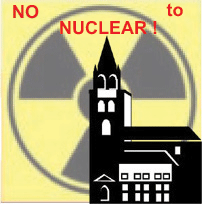 International forum calls for joint church action to end nuclear energy development https://www.anglicannews.org/news/2019/07/international-forum-calls-for-joint-church-action-to-end-nuclear-energy-development.aspx: July 26, 2019 [ACNS, by Rachel Farmer] An international forum set up by the Nippon Sei Ko Kai (NSKK) – the Anglican Communion in Japan – has issued a statement this week calling for denuclearisation and for churches to join in the campaign for natural energy.
The statement, following a gathering in May, says: “the Tokyo Electric Power Company Fukushima Daiichi Nuclear Power Station disaster and subsequent damage which occurred as a result of the March 11, 2011 Great East Japan Earthquake completely shattered the myth of safety and made us aware of the extreme danger of nuclear power generation.”
It states that as long as nuclear power generation is operative, it continues to create dangerous radioactive waste and there is a risk that the technology can at any time be diverted to nuclear weapons and threaten the right to live in peace.
It continues: “no longer should we continue as a society with the economic priority of reliance upon nuclear power generation; we should take a new path, of course practicing power saving and energy conservation, and we should make policy changes to renewable energy . . . Also, we have recognised that, when a nuclear power plant accident occurs, it is irreparable, and is more hazardous than with any other energy source. While on the one hand, grave effects remain now, after eight years have passed, with the passage of time we have become forgetful of the pain and suffering of those afflicted by the disaster.”
The Anglican Communion in Japan has clearly expressed its position on the issue of nuclear power generation, which led to the International Forum for a Nuclear-Free World at Sendai Christ Church and Moniwa-so, Sendai in May 2019. Some 68 participants from around the world joined the event including, including lay and clergy representatives from the UK, the USA, Korea, Taiwan, and the Philippines as well as members of the National Christian Council in Japan Peace and Nuclear Issues Committee and members of the NSKK Justice and Peace Committee.
One participant, Asia and the Pacific Partnership Officer for the US-based Episcopal Church, Bruce Woodcock, said: “the realisation that contamination on such a large scale (50 kilometre plus, and potentially worse events) might happen anywhere nuclear material is being stored, transported and used, can and should be a wake-up call. One need only see field after field full of huge bags of radioactive soil – because there are no other places to put them for the next 30-plus years – to appreciate the dangers of the contamination of the earth resulting from a nuclear disaster.”
He said the NSKK had taken on a critical mission to call upon the Anglican Communion to create and support networks committed to protect the environment by seeking a worldwide ban on the use of nuclear energy and weapons.
“Congregations are asked to support developing safer ways to satisfy a seemingly ever-growing global need for energy production by promoting the use of renewable resources,” he said. “May our prayers and political action abound to help preserve God’s creation.
The statement issued an appeal, as “those who bear witness to the events at Fukushima”, and asked for support in a range of ways. It called for people to continue to bear witness to all the effects of the Great East Japan Earthquake and be aware that, when a nuclear accident occurs, the resulting situation cannot be undone.
It asks for a “Fukushima Week” within NSKK, to listen to what “that incident” speaks to us and continue to walk in ways that will bring about a society living in peace.
Calling for the strengthening of domestic and international denuclearisation, it also says there should be no further increase of nuclear power plants and that each diocese should build a model church which is dependent on natural energy, with financial support for those who switch.
The statement is underpinned by the Communion’s Fifth Mark of Mission, “To strive to safeguard the integrity of creation, and sustain and renew the life of the earth”.
The Statement also included the following prayer for the International Forum for a Nuclear-Free World.
O God,
We have disobeyed your command
to govern your creation which you entrusted to us,
we have misused natural resources,
and through nuclear accidents we have destroyed nature and people’s livelihoods.
Forgive us these sins, we pray.
Please grant us the wisdom and strength to return to your love,
to remember those in the midst of suffering,
and to create a world without nuclear power plants in which we may coexist with all life.
No comments yet.
1 This Month
10 March A LIVE WEBINAR THE REAL EFFECTS OF NUCLEAR POWER
What the Industry Isn’t Telling Us
1:00 PM Mountain, 2 pm Central, 3 pm Eastern. Live on the Keepers of the Water Facebook page



18 March Webinar @ 1 PM EST: An Assessment of SMR Projects: The Case of Canada
register for the zoom:
https://us02web.zoom.us/webinar/register/WN_o8BIIOUvQ2ONJR1nta65DQ#/registration


of the week – STOP SMALL MODULAR REACTORS IN CANADA
To see nuclear-related stories in greater depth and intensity – go to https://nuclearinformation.wordpress.com
-
Archives
- March 2026 (119)
- February 2026 (268)
- January 2026 (308)
- December 2025 (358)
- November 2025 (359)
- October 2025 (376)
- September 2025 (258)
- August 2025 (319)
- July 2025 (230)
- June 2025 (348)
- May 2025 (261)
- April 2025 (305)
-
Categories
- 1
- 1 NUCLEAR ISSUES
- business and costs
- climate change
- culture and arts
- ENERGY
- environment
- health
- history
- indigenous issues
- Legal
- marketing of nuclear
- media
- opposition to nuclear
- PERSONAL STORIES
- politics
- politics international
- Religion and ethics
- safety
- secrets,lies and civil liberties
- spinbuster
- technology
- Uranium
- wastes
- weapons and war
- Women
- 2 WORLD
- ACTION
- AFRICA
- Atrocities
- AUSTRALIA
- Christina's notes
- Christina's themes
- culture and arts
- Events
- Fuk 2022
- Fuk 2023
- Fukushima 2017
- Fukushima 2018
- fukushima 2019
- Fukushima 2020
- Fukushima 2021
- general
- global warming
- Humour (God we need it)
- Nuclear
- RARE EARTHS
- Reference
- resources – print
- Resources -audiovicual
- Weekly Newsletter
- World
- World Nuclear
- YouTube
-
RSS
Entries RSS
Comments RSS
 nuclear-news
Leave a comment