World security needs nuclear New Start agreement – USA-Russia, not a distraction about China
|
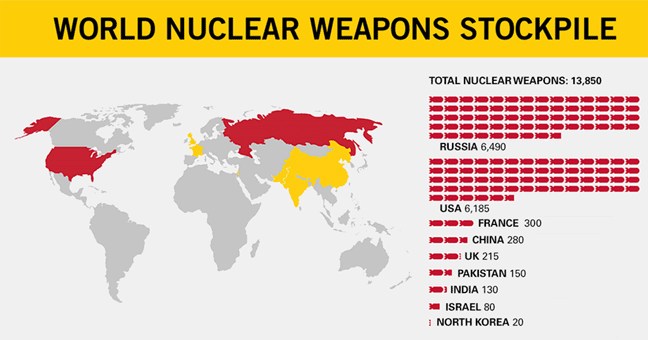
Nobody wins a nuclear war — especially not two nuclear behemoths. https://thehill.com/opinion/international/453576-nobody-wins-a-nuclear-war-especially-not-two-nuclear-behemoths BY DANIEL R. DEPETRIS,— 07/17/19 U.S. and Russian officials met this week in Geneva for what one hopes will be new strategic arms reduction talks. Trump administration officials are cautiously optimistic the discussions could lead to a more substantive negotiation about capping — and perhaps even decreasing — the number of nuclear weapons both countries have in their stockpiles. This matters for U.S. and global security because these two nations possess more than 90 percent of all nuclear weapons. President Trump, however, wants to go further than a simple extension of the 2010 The New Strategic Arms Reduction Treaty (START) agreement or a new bilateral treaty with the Russians. Instead, he is prodding China to join a trivariate arrangement. But in prefacing or linking an extension of New START to a fresh accord that includes the Chinese, the administration is increasing the possibility of ending up with neither. For one, pushing Beijing to into a three-way deal is like pushing on a locked door. The Chinese have shown no interest in a three-way deal, in large measure because their nuclear arsenal is a fraction (roughly 2 percent) of the globe’s entire inventory. At roughly 290 warheads, Beijing’s nuclear weapons program is minuscule when compared to the thousands of combined warheads Washington and Moscow have stockpiled. Indeed, China stockpile is less than 1/20th the size of the United States and about 1/22th the size of Russia’s. To expect the Chinese to participate in a new arms control negotiation with two nuclear superpowers when the numbers are so steadily stacked against them is a fool’s errand. Beijing’s no-first use nuclear policy, in place since its first ever nuclear explosive test in 1964, was recently reaffirmed just last year. An offensive nuclear strike is not something U.S. officials in Washington have to worry about. To focus on a U.S.-Russia-China nuclear agreement at the expense of keeping an already existing New START accord alive is the wrong priority. New START, signed in April 2010, was a win-win, pragmatic arms control agreement for both sides. The pact cut the U.S. and Russian stockpiles byaround one-third; capped the amount of nuclear warheads on deployed intercontinental ballistic missiles at 1,550; limited the number of deployed and non-deployed ICBM launchers to 800; and allowed each country to verify compliance with the treaty, including on-site inspections, information exchanges and advanced notices. Unlike the Intermediate Range Nuclear Forces Treaty, inspectors have verified Moscow’s compliance with the letter of the deal. For two countries that possess a combined 12,675 nuclear weapons, New START is a critical enforcing mechanism for nuclear parity and a stable balance of power. It is now the only functional arms control accord preventing the U.S. and Russia from entering another costly, risky arms race. The deal expires in February 2021 but could be extended for another five years if both Presidents Trump and Putin agree to do so. Putin has already expressed his interest. Trump, someone who considers himself a transactional pragmatist, shouldn’t waste any more time before doing the same. An extension of New START, however, is not only important for strategic stability between the two nuclear superpowers (without New START, there is nothing stopping either the United States or Russia from building and deploying more and better nuclear warheads). but also valuable for stabilizing the entire U.S.-Russia relationship in desperate need of improvement. For this reason, a constructive relationship with Moscow is unquestionably a good thing for U.S. security. Extending New START is a no-brainer and indeed could very well be an opportunity to mend relations. It’s not hyperbole to describe U.S.-Russia relations as being at their lowest since the land-based missile build-up in Europe in the early 1980s. From Syria and Ukraine to NATO and cybersecurity, Washington and Moscow are often on opposite sides of the issue. Even though both nations share some interests, including arms control and countering terrorism, Washington has become the epicenter of anti-Russia sentiment, where condemning Putin and advocating for sanctions is sport. Good politics, however, doesn’t necessarily correspond with good statecraft or foreign policy. Talking with adversaries, rivals, or competitors is a critically important component of effective foreign policy. We must engage with the world as it is, not as we wish it to be. Simply ignoring the Russians, pretending they don’t exist, or believing that using the stick unreservedly against Moscow will force it to cry uncle and change its policies to our liking makes conflict between nuclear superpowers more likely. Giving New START another five years of life is perhaps the only issue Washington and Moscow can agree on in today’s political climate. It’s perhaps the most important reason the U.S. and Russia must find a way to co-exist. Ensuring New START survives should be pursued aggressively for the sake of U.S. and global security Nobody wins a nuclear war — especially especially not two nuclear behemoths with thousands of warheads apiece. Daniel R. DePetris is a fellow at Defense Priorities, a foreign policy think tank focused on promoting security, stability and peace. |
|
|
New research shows how low dose ionising radiation promotes cancer
 Low doses of radiation promote cancer-capable cells, Science Daily
New research in mice helps to understand the risks around exposure to low doses of radiation, such as CT scans and X-rays
- Date
- July 18, 2019
- Source:
- Wellcome Trust Sanger Institute
- Summary:
- New research finds that low doses of radiation equivalent to three CT scans, which are considered safe, give cancer-capable cells a competitive advantage over normal cells.
-
Low doses of radiation equivalent to three CT scans, which are considered safe, give cancer-capable cells a competitive advantage over normal cells in healthy tissue, scientists have discovered. Researchers at the Wellcome Sanger Institute and the University of Cambridge studied the effects of low doses of radiation in the esophagus of mice.
The team found that low doses of radiation increase the number of cells with mutations in p53, a well-known genetic change associated with cancer. However, giving the mice an antioxidant before radiation promoted the growth of healthy cells, which outcompeted and replaced the p53 mutant cells.
The results, published today (18 July) in Cell Stem Cell show that low doses of radiation promote the spread of cancer-capable cells in healthy tissue. Researchers recommend that this risk should be considered in assessing radiation safety. The study also offers the possibility of developing non-toxic preventative measures to cut the risk of developing cancer by bolstering our healthy cells to outcompete and eradicate cancer-capable cells……..
-
Low doses of radiation equivalent to three CT scans, which are considered safe, give cancer-capable cells a competitive advantage over normal cells in healthy tissue, scientists have discovered. Researchers at the Wellcome Sanger Institute and the University of Cambridge studied the effects of low doses of radiation in the esophagus of mice.
The team found that low doses of radiation increase the number of cells with mutations in p53, a well-known genetic change associated with cancer. However, giving the mice an antioxidant before radiation promoted the growth of healthy cells, which outcompeted and replaced the p53 mutant cells.
The results, published today (18 July) in Cell Stem Cell show that low doses of radiation promote the spread of cancer-capable cells in healthy tissue. Researchers recommend that this risk should be considered in assessing radiation safety. The study also offers the possibility of developing non-toxic preventative measures to cut the risk of developing cancer by bolstering our healthy cells to outcompete and eradicate cancer-capable cells…….
- Dr Kasumi Murai, an author from the Wellcome Sanger Institute, said: “Giving mice an antioxidant before exposing them to low doses of radiation gave healthy cells the extra boost needed to fight against the mutant cells in the esophagus and make them disappear. However, we don’t know the effect this therapy would have in other tissues — it could help cancer-capable cells elsewhere become stronger. What we do know is that long term use of antioxidants alone is not effective in preventing cancer in people, according to other studies.” … https://www.sciencedaily.com/releases/2019/07/190718150933.htm
Doubts on the safety of Ukraine’s nuclear reactors

experts are still studying the cancerous, continent-spanning impact of the 1986 meltdown, which took place just outside the small town of Prypyat, some 150 kilometers north of Kyiv, and belched billions of radioactive particles into the wind.
In Ukraine alone, nearly two million people are estimated to have been victims in some way of the disaster, caused by cost-cutting and negligence. The Ukrainian government pays the price today: in compensation to the families of at least 35,000 people who died of Chornobyl related cancers. Across Ukraine, Belarus and Russia, fatality estimates reach into the hundreds of thousands
A major complaint is that Energoatom’s environmental impact assessments are unconvincing. Safety and security are insufficiently addressed, waste disposal is barely mentioned and plans to mitigate risks are severely lacking in detail..
Ukraine’s nuclear power disasters may not be over, experts warn, Kyiv Post, By Jack Laurenson. July 19 2019
After more than three decades in the shadow of the Chornobyl catastrophe — the world’s worst nuclear energy-related disaster — Ukrainians continue to live with nuclear power plants as part of their country’s landscape. A whopping 15 reactors power their towns and cities, while Ukraine’s total installed capacity makes it the seventh-largest nuclear nation in the world today.
At the same time, experts are still studying the cancerous, continent-spanning impact of the 1986 meltdown, which took place just outside the small town of Prypyat, some 150 kilometers north of Kyiv, and belched billions of radioactive particles into the wind.
In Ukraine alone, nearly two million people are estimated to have been victims in some way of the disaster, caused by cost-cutting and negligence. The Ukrainian government pays the price today: in compensation to the families of at least 35,000 people who died of Chornobyl related cancers. Across Ukraine, Belarus and Russia, fatality estimates reach into the hundreds of thousands.
Only two nuclear energy-related disasters have been rated at the maximum severity available on the International Nuclear Event Scale: the Chornobyl explosion, and the meltdowns that shook Japan and the world during the 2011 Fukushima disaster. There, some 170,000 evacuees still cannot return to their irradiated homes in the exclusion zone.
Today in Ukraine, difficult questions linger. Have the painful lessons of Chornobyl and Fukushima been learned, and can a country struggling with war, corruption and political turmoil guarantee the safety of its nuclear infrastructure?
Safety, security lacking
These days, at least 55 percent of all Ukrainian electricity comes from its 15 fission reactors, operating at four different nuclear power plants, or NPPs, around the country. They are all operated by the state-owned National Nuclear Energy Generating Company of Ukraine, widely known as Energoatom.
These nuclear reactors in Ukraine are still not as safe and secure as they could be. They are vulnerable to external shocks, internal sabotage, cybersecurity threats and terrorism, according to shortcomings identified in expert assessments.
Ukraine scored poorly in a 2018 security index published by the Nuclear Threat Initiative organization, scoring 70 out of 100 points, ranking it 30th out of the 45 countries indexed.
The most recent overall safety assessment of all Ukrainian NPPs, completed in 2010 by the International Atomic Energy Agency, or IAEA, and the European Commission, found that Ukrainian plants were non-compliant with 22 out of 194 vital safety requirements. Weak areas included the “consideration of severe accidents, NPP seismic resistance, completeness of deterministic safety analysis, and post-accident monitoring.”
The National Ecological Center of Ukraine, or NECU, and other nongovernmental organizations here warn that nine Ukrainian nuclear reactors are currently operating beyond their safe lifespan, on the basis of 10-year lifetime extension permits granted following an assessment they have labelled as “deeply flawed.”
And now, in Khmelnytsky Oblast, scientists, experts and campaigners are starting to raise their voices in protest at the latest and perhaps most serious concern.
Experts say that two new reactors which are planned to go into operation there have serious, known safety flaws and do not meet modern safety standards, widely adopted following lessons learned from the Fukushima disaster in Japan eight years ago………..
Khmelnytsky expansion
On May 16, a senior official with an Austrian government ministry taking part in talks on the Khmelnytsky project, contacted the Kyiv Post to express concern over its feasibility and safety. The official asked not to be named for fear of jeopardizing talks with Ukrainian counterparts, but shared an official report with the Kyiv Post that makes for alarming reading.
The 87-page report from Austria’s environment agency was commissioned by the country’s Federal Ministry of Sustainability and Tourism. Its lead authors are two Austrian scientists — Oda Becker, a physicist specializing in nuclear safety, and Gabriele Mraz, an expert on nuclear policy.
A major complaint is that Energoatom’s environmental impact assessments are unconvincing. Safety and security are insufficiently addressed, waste disposal is barely mentioned and plans to mitigate risks are severely lacking in detail.
And Energoatom’s plan to simply “continue” construction of facilities that would house KhNPP 3&4 is unthinkable, because the partially-finished constructions have been largely abandoned for nearly three decades and are no longer suitable, the report’s authors said.
“I was surprised that (KhNPP 3&4) was restarted…the site is in ruins… nothing has been done to protect the construction and the conditions there,” the official said.
The official asked how anyone can “think of using this ruin to build a nuclear power plant,” considering that the site and components had been exposed to ice, snow and rain over the years.
The experts also voiced concerns over the shady choice of supplier for the two new reactors.
Energoatom has selected a type of Russian-built reactor from the Czech-based (but ultimately Russian-owned) company Škoda JS. The reactor is cheap and fits within the existing, partially abandoned buildings, but features a number of known safety deficiencies, according to experts.
“They wanted a cheaper reactor — but this reactor is not considered good enough and it lacks safety features that have become required after what we learned since Fukushima,” the official said.
The Kyiv Post repeatedly tried to speak with Energoatom about its plans for the Khmelnytsky NPP, but the agency was uncooperative. Ultimately, Energoatom did not provide information or answer questions by deadline.Unanswered questions
In the report from Vienna seen by the Kyiv Post, the Austrian environment agency poses at least 89 separate questions to Energoatom which it said had so far gone unanswered. Some questions are highly technical, while others address issues of basic safety and security. The authors state that the Ukrainian side has not responded to many questions, or have provided materials that are insufficient and do not address their concerns.
Questions relating to the proposed choice of a reactor, a VVER‑1000/V‑320, and its safety deficiencies, are raised repeatedly. It states that the Ukrainian side has not sufficiently demonstrated how it will cope with any of the “known safety issues” of the reactors……… https://www.kyivpost.com/business/ukraines-nuclear-power-disasters-may-not-be-over-experts-warn.html?cn-reloaded=1
Secret Locations of U.S. nuclear weapons in Europe revealed

Leaked NATO report reveals where USA is hiding SIX nuclear weapons – and they’re in EUROPE https://www.express.co.uk/news/world/1155277/us-nuclear-weapons-map-secret-locations-nukes-europe-nato-news
THE SECRET locations of US nuclear weapons in Europe were been accidentally revealed in a NATO-affiliated report. By KATE WHITFIELD, , Jul 19, 2019 The document was titled “A new era for nuclear deterrence? Modernisation, arms control and allied nuclear forces”. It was first published in April and written by a Canadian senator for the Defense and Security Committee of the NATO Parliamentary Assembly. The document, which has now been deleted, seems to confirm long-held suspicions that US nuclear weapons are being stored in Europe.
The document referred to the sites of roughly 150 American nuclear weapons.
Locations in Belgium, Germany, Italy, the Netherlands and Turkey were identified.
The report was seen by Belgian newspaper De Morgen, which said: “These bombs are stored at six US and European bases — Kleine Brogel in Belgium, Büchel in Germany, Aviano and Ghedi-Torre in Italy, Volkel in The Netherlands, and Incirlik in Turkey.”
The document did not attribute this information to any source.
In the final version of the document, published last week, the reference was removed.
The latest version of the report instead makes reference to aircraft capable of carrying nuclear weapons.
The report says: “The European Allies often cited as operating such aircraft are Belgium, Germany, Italy, The Netherlands, and Turkey.”
A NATO official told The Washington Post the report was “not an official Nato document” and pointed out that it was written by the alliance’s parliamentary assembly.
The official added: “We do not comment on the details of Nato’s nuclear posture.”
While the storage of US nuclear weapons has long been suspected, many are viewing this as confirmation.
De Morgen’s report was headlined: “Finally in black and white: There are American nuclear weapons in Belgium.”
And Dutch broadcaster RTL News said: “NATO reveals the Netherlands’ worst-kept secret.”
Kingston Reif, director for disarmament and threat-reduction policy at the Arms Control Association, said the presence of US nuclear weapons in Europe was “no surprise”.
He added: “This has long been fairly open knowledge.”
The presence of the weapons resulted from an agreement reached in the 1960s and is thought to be a relic of the Cold War era.
But in recent years, fears have grown over whether parts of the continent, such as Turkey, are the best place to store them in the wake of terrorist extremism in the region.
How many nuclear weapons does the USA have?
The US was the first country to manufacture nuclear weapons and, to date, is the only country to have used them in combat – in the Hiroshima and Nagasaki bombings in World War II.
Since 1945, the United States produced more than 70,000 nuclear warheads – more than all other nuclear states combined.
At its peak in 1967, the US military had a stockpile of 31,255 warheads.
Now, the most recent figures suggest the US has an estimated 4,018 nuclear weapons in either deployment or storage.
Tokyo Electric Power Company to close down Fukushima Daini nuclear plant
The decommissioning of all four nuclear reactors at Daini will likely require more than 40 years and some 280 billion yen ($2.6 billion) in costs, the source said. If realized, all 10 nuclear reactors in Fukushima Prefecture will be scrapped.
Closure of the Daiichi plant, which suffered core meltdowns at three of its six reactors, has already been decided.
After telling Fukushima Gov. Masao Uchibori about the policy, it may be formally approved at a TEPCO board meeting, scheduled at the end of this month, the source said.
The Daini complex was also hit by tsunami waves in the 2011 disaster and temporarily lost reactor cooling functions. But unlike the Daiichi plant, it escaped meltdowns.
Since the disaster, the decommissioning in Japan of 21 nuclear reactors, including those at Daini, has been decided.
For the Tokyo-headquartered power company, the Kashiwazaki-Kariwa plant in Niigata Prefecture will be its only nuclear complex.
In June last year, TEPCO President Tomoaki Kobayakawa told the governor that the company is leaning toward scrapping all four reactors at the Daini plant. A project team was later formed at the utility and looked into whether that is possible, according to the source.
The prefecture has demanded the utility scrap the reactors, saying their existence would hamper its reconstruction efforts.
Strong rejection of nuclear power for Indonesia
 Idea to develop nuclear energy receives strong opposition in Indonesia, The Jakarta Post
Jakarta / Fri, July 19, 2019 A lawmaker’s revival of an idea to build a nuclear power plant in Indonesia has triggered public debate over the pros and cons of the technology, particularly about its safety and efficiency.The proposal came from Kurtubi, a member of House of Representatives Commission VII for energy affairs, among others, who demanded the government include that type of energy generation in the 2019 to 2038 National Electricity General Plan (RUKN)……..
In response, Jonan said the government would be very cautious when considering the idea, while there were still many other energy resources in the country that had lower development costs than a nuclear power plant. “The prices of electricity from nuclear energy is less competitive,” he added. …….
Greenpeace Asia Tenggara’s climate change and energy head Tata Mustafa expressed his rejection of the idea, stressing that the country needed to focus on the development of other renewable energy resources.
“The potential of solar energy is 207 gigawatts (GW), while the potential of wind farm energy reached 66 GW,” he said as quoted by kontan.co.id, adding that he doubted the safety of nuclear energy, particularly because of the country’s position on the Ring of Fire that was frequently hit by earthquakes.
Institute for Essential Services Reform executive director Fabby Tumiwa also opposed the plan. He said he was particularly concerned about the management of radioactive waste. “The life span of a nuclear power plant is only 50 years, but radioactive waste will exist for thousands of years. Who will be responsible?” he asked. (bbn) https://www.thejakartapost.com/news/2019/07/18/idea-to-develop-nuclear-energy-receives-strong-opposition-in-indonesia.html
High temperatures may force EDF to shut down production at Golfech nuclear power plant

 Hot weather could force EDF to halt output at Golfech nuclear plant, https://www.reuters.com/article/us-france-electricity-heatwave/hot-weather-could-force-edf-to-halt-output-at-golfech-nuclear-plant-idUSKCN1UE0PW 19 July 19
PARIS (Reuters) – French utility EDF may have to shut down electricity generation at its 2,600 megawatt (MW) Golfech nuclear power plant in the south of France from Tuesday July 23 because of high temperatures forecast on the Garonne river.
The power utility uses water from the river to cool the two reactors at the plant, but French meteorological services have forecast hot and dry weather next week, with a risk of a heatwave in the southeastern parts of the country.
“Due to the temperature forecasts on the Garonne, production restrictions are likely to affect EDF’s nuclear power plant at Golfech from Tuesday July 23,” the company said, adding that both reactors could be unavailable.
EDF operates France’s 58 nuclear reactors, which account for more than 75 percent of the country’s electricity needs. Its use of water from rivers as a reactor coolant is regulated by law to protect plant and animal life.
The company is obliged to reduce output from its reactors when water temperatures rise or when river levels and the flow rate are low.
Low flow rate for the Rhone river because of drought conditions has also curtailed power generation in recent weeks at EDF’s St. Alban, Bugey, Cruas and Tricastin nuclear power plants. St Alban has capacity of 2,600 MW while the other three each have 3,600 MW of capacity.
In a separate note on its website on Friday EDF said that power generation could be reduced by about 30 percent at its 1,300 MW St. Alban 1 nuclear reactor on Saturday.
Reporting by Bate Felix; Editing by David Goodman
Repeated earthquakes all too close to proposed U.S. nuclear waste dump site
 Earthquakes repeatedly striking proposed US nuclear waste site
Officials fear deadly radioactivity could seep into earth if another high-magnitude quake strikes Nevada desert, Independent, Emma Snaith, 19 July 19
Repeated earthquakes could risk releasing deadly radioactivity into the earth if plans for a nuclear waste site in go ahead in Nevada’s desert, the state’s governor has warned.
Tens of thousands of tons of highly radioactive used nuclear reactor fuel are due to be transferred from 35 US states to a new facility in the Mojave Desert.
The Yuka Mountain nuclear waste repository is set to store this material deep within the earth.
But a series of recent earthquakes in the Mojave Desert has raised concerns about the safety of storing radioactive waste at the facility.
On 4 July, a 7.1 magnitude earthquake ruptured the earth in the desert, which stretches across the California-Nevada border.
The force of the quake cracked buildings, sparked fires, damaged roads and caused several injuries in southern California. It was followed by a 6.4-magnitude temblor two days later.
In the wake of the earthquakes, the governor of Nevada Steve Sisolak said he was committed to “fighting any continued federal effort to use Nevada as the nation’s nuclear dumping ground”.
“These significant recent earthquakes so near to Yucca Mountain show one of the many geologic problems with the site as a nuclear waste repository,” he said.
Mr Sisolak sent a letter to the energy secretary, Rick Perry, urging him to reconsider the location of the facility.
………. In governor of Nevada’s letter to Mr Perry, he included the opinions of James Faulds at the Nevada Bureau of Mines and Geology and Graham Kent at the seismological laboratory at the University of Nevada.
They urged for more research to be conducted into the seismic activity at the Yuka Mountain site. “The Ridgecrest earthquake sequence, which began July 4 and has yet to subside, clearly highlights the importance of such studies,” Mr Faulds and Mr Kent said.
A recent ranking compiled by the US Geological Survey found Nevada was the US state with the fourth highest level of seismic activity after Alaska, Wyoming and Oklahoma.
Additional reporting by AP https://www.independent.co.uk/news/world/americas/earthquake-nuclear-waste-radioactive-mojave-desert-nevada-yuka-mountain-a9011051.html
For the second time in a week, take-down of Russian nuclear reactors, due to malfunction
|
Second Russian Nuclear Plant Taken Down After Malfunction, July 18, 2019 https://www.themoscowtimes.com/2019/07/18/second-russian-nuclear-plant-taken-down-after-malfunction-a66464 Three units have been unplugged at a nuclear power plant in Russia after a short circuit, less than a week after another nuclear plant unit was briefly taken down in the country over an unspecified malfunction. Russia operates 10 nuclear power plants, including the four-reactor Kalinin plant 350 kilometers northwest of Moscow, according to the London-based World Nuclear Association. Second Russian Nuclear Plant Taken Down After Malfunction Kalinin’s first, second and fourth reactors were taken offline, Russia’s state-run TASS news agency reported, citing emergency services in the town of Udomlya on Thursday. The Tver region branch of Russia’s Emergency Situations Ministry told the agency the three reactors were taken down due to a short-circuit. “The radiation level at the station and surrounding territory remains without change and is in line with normal background levels,” said Rosenergoatom, a subsidiary of state nuclear corporation Rosatom, in a statement. Last Friday, a nuclear power plant reactor in Beloyarsk was knocked out, triggered by a safety mechanism. It resumed operations on Tuesday. |
|
Iran makes ‘substantial’ nuclear offer in return for US lifting sanctions
|
Plan would allow enhanced, permanent nuclear inspections Iran has offered a deal with the US in which it would formally and permanently accept enhanced inspections of its nuclear programme, in return for the permanent lifting of US sanctions. The offer was made by the Iranian foreign minister, Mohammad Javad Zarif, on a visit to New York. But it is unlikely to be warmly received by the Trump administration, which is currently demanding Iran make a range of sweeping concessions, including cessation of uranium enrichment and support for proxies and allies in the region…… https://www.theguardian.com/world/2019/jul/18/iran-nuclear-deal-trump-mohammad-javad-zarif-sanctions |
|

Ohio Senate passes bill to save state’s two nuclear power plants
Ohio Senate passes bill to save state’s two nuclear power plantshttps://www.reuters.com/article/us-ohio-nuclear/ohio-senate-to-vote-on-bill-to-save-states-nuclear-power-plants-idUSKCN1UC1Y2 18 July 19
(Reuters) – The Ohio Senate passed a bill on Wednesday that will create financial subsidies to stop the state’s two nuclear power reactors from retiring early, according to market analysts tracking the legislation.
The two reactors in Ohio, Davis-Besse and Perry, are owned by FirstEnergy Solutions, which has said it would shut the money-losing plants in 2020 and 2021 unless the state provides some financial assistance to keep them operating.
FirstEnergy Solutions is a bankrupt unit of Ohio power company FirstEnergy Corp.
The Senate version of the nuclear bill, House Bill 6 (HB6), is expected to go to the state House of Representatives for a concurrence vote on Wednesday night, one of the analysts said. The House has an “if needed” session scheduled for Thursday if members need more time to debate the Senate changes to the bill. HB6 passed the House in May.
The senate passed the bill after an amendment which postpones nuclear subsidies by one year, according to an analyst.
The earlier version of the bill was designed to reduce consumer power rates by weakening the state’s renewable and energy efficiency goals even though FirstEnergy Solutions would receive an estimated $150 million a year from 2020-2026 to keep its reactors in service.
“We expect the legislature will hit this deadline and send the bill to Governor Mike DeWine’s desk this week,” Josh Price, senior analyst at Height Capital Markets in Washington, said earlier on Wednesday.
Officials at FirstEnergy Solutions had no comment earlier Wednesday. The company has said it needed the bill to pass by July 17 to avoid shutting the Davis-Besse reactor next spring.
FirstEnergy Solutions has warned that shutting the reactors could result in the loss of 4,300 jobs.
On Monday, U.S. electric generator LS Power warned it would be forced to terminate development of an expansion of its Troy natural gas-fired power plant in Ohio if the state passes legislation to subsidize nuclear energy.
LS Power said the expansion of the Troy plant would create hundreds of jobs during construction and about 20 permanent positions. Analysts, however, said that was likely not enough to offset legislators’ concerns about the potential loss of thousands of jobs if the reactors shut.
Gas-fired plants would likely make more money if the reactors shut because they would operate more often.
Reporting by Scott DiSavino and Sumita Layek; Editing by Susan Thomas and Grant McCool
Ohio Delays Bill to Bail Out Nuclear and Coal Plants, Gut Renewable Spending
A setback for House Bill 6, with House and Senate versions at odds. But FirstEnergy’s threat to shutter plants without state support could force final passage next month. GreenTech Media, JULY 18, 2019 Ohio lawmakers have delayed a critical vote on a controversial energy bill that would charge the state’s utility customers hundreds of millions of dollars to subsidize two nuclear power plants that their owner, bankrupt utility FirstEnergy Solutions, has threatened to close without financial support.On Wednesday, the Ohio House of Representatives failed to bring to a vote House Bill 6, forcing the legislature to put off consideration of the bill until it reconvenes in August. House Speaker Larry Householder said the late-night decision was due to the absence of four representatives who planned to vote yes on the bill, adding that the House would “tentatively” take it up again on Aug. 1. ……
Other states, including New York, Illinois and New Jersey, have given financially struggling nuclear power plants incentives to keep their carbon-free generation capacity running, as part of a broader policy push toward decarbonizing their energy sectors.
An outlier among state nuclear bailout plans
But Ohio’s bill is different, opponents say, because it also guts the state’s energy efficiency spending and renewable energy mandates — something that Ohio’s Republican legislators have been trying to do for years.
HB 6 would also shift the costs of some of the country’s oldest coal-fired power plants from utilities to ratepayers for a decade to come. The result, opponents say, will be higher electric bills, more pollution and reduced investment and innovation in modern energy infrastructure for the state.
The bill would replace today’s monthly surcharges on utility customers’ bills, which now pay for the state’s energy efficiency and renewable energy mandates, with a new set of lower surcharges. These will pay for FirstEnergy’s two nuclear power plants, as well as two coal-fired power plants operated by Ohio Valley Electric Corp. (OVEC) and jointly owned by the state’s investor-owned utilities. …….
as opponents including the Union of Concerned Scientists, The Sierra Club and the Natural Resources Defense Council have pointed out, monthly payments for energy efficiency and renewable energy represent investments in lower bills and cleaner energy for Ohio ratepayers. HB 6 ends those investments, in exchange for monthly payments that at their best support out-of-market payments for nuclear power plants, and at their worst help keep some of the state’s worst-performing and polluting coal plants running far past their logical retirement date.
Efficiency, renewables, natural gas and consumers groups are opposed
The Senate version of HB 6 differs from the original House bill’s approach to moving utility funding away from efficiency and renewable energy and toward nuclear and coal subsidies, Neil Waggoner, Ohio campaign representative for the Sierra Club, said in a Tuesday interview.
For example, the House version of the bill would have entirely eliminated Ohio’s current 12.5-percent-by-2026 RPS and cut all the monthly surcharges paying for energy efficiency and demand-reduction programs, which have saved Ohio customers $5.1 billion from 2009 to 2017, according to the Midwest Energy Efficiency Alliance.
But the version passed by the Senate opts for changing the targets for both programs in ways that will effectively end further investment, he said. For the efficiency standard, the bill will reduce today’s top energy-efficiency targets for utilities from 22.2 percent to 17.2 percent — a measure that many of the state’s utilities have likely already achieved — while expanding options for large industrial customers to opt out of paying. …..
HB 6 is being opposed by groups representing residential ratepayers and commercial-industrial energy users that worry it will increase energy prices and undermine free-market energy competition. Competing natural-gas-fired power plant owners are also crying foul, with one, LS Power, threatening this week to end a planned 500-megawatt expansion of its Troy, Ohio facility if HB 6 is passed.
HB 6 does provide $20 million a year, amounting to a total of $140 million through 2026, to support utility-scale solar development, including six solar farms already being built that might have lost funding under previous versions of the bill. And the Senate stripped a House amendment that would have allowed county residents to block wind farm projects on unincorporated land via referendum, even if construction had already begun.
As for the argument that HB 6 was necessary to keep FirstEnergy’s carbon-free nuclear plants up and running, “if we want to have a conversation about keeping carbon emissions in Ohio low, we need to talk about how we replace these nuclear plants with clean energy,” Waggoner said. “The legislature isn’t asking that question. They have never had that question in mind. Their only concern from day one has been how…[to] increase these customer bills to bail out these plants.”
Rains noted that another amendment to HB 6 added this week would weaken the Public Utilities Commission of Ohio’s oversight of how FirstEnergy, as the company to receive the “clean air credits” to be created by HB 6, spends its money.
“Language supporting annual audits for recipients from the clean air credits program was dropped in favor of much more flexible disclosures by qualifying firms to the commission on an annual basis,” he wrote. https://www.greentechmedia.com/articles/read/ohio-delays-bill-to-bail-out-nuclear-and-coal-plants-gut-efficiency-and-ren#gs.qa5wl6
What are the NRC staff recommendations for scaling back nuclear reactor inspections
https://www.powermag.com/nrc-staff-recommends-scaling-back-reactor-inspections/?pagenum=1 07/18/2019 | Sonal Patel For an in-depth analysis – read this article:
Next Steps and Pushback
The recommendations will need approval by the NRC’s commissioners. Three of the four confirmed commissioners are President Trump appointees—Chair Kristine Svinicki, Annie Caputo, David A. Wright. Only one is an Obama appointee—Jeff Baran. One seat in the five-member commission remains vacant.
However, as the Associated Press reported on July 17, and as notes in the document show, the recommendations were reached after considerable disagreement. The Associated Press quoted Baran as saying, “NRC shouldn’t perform fewer inspections or weaken its safety oversight to save money.” Baran urged the NRC to give the public an opportunity to discuss before it decides on whether to approve the changes.
—Sonal Patel is a senior associate editor at POWER (@sonalcpatel, @POWERmagazine)
Reduced U.S. nuclear safety oversight will save money for the industry
The nuclear power industry says the safety culture at the U.S. nuclear industry — 40 years after partial meltdown of a nuclear reactor at Three Mile Island — is “exceptional” and merits the easing of government inspections. ,,,,,
Opponents say the changes are bringing the administration’s business-friendly, rule-cutting mission to an industry — nuclear reactors — where the stakes are too high to cut corners.
This week, the NRC released staff recommendations for rollbacks in safety inspections for the 90-plus U.S. nuclear power plants and for less flagging of plant problems for the public. Democratic lawmakers and one NRC commissioner expressed concern about the safety risks and urged the commission to seek broader public comment before proceeding.
Svinicki and two other NRC commissioners did not respond Wednesday to requests for comment made through the agency’s public affairs staff. NRC public affairs director David Castelveter said the NRC would respond directly to lawmakers on Pallone’s letter.
A fourth commissioner, Jeff Baran, spoke out Tuesday, saying he opposed cutting inspections and reducing oversight. Baran called for more public input on proposed rollbacks.
Nuclear regulators post notices of meetings on proposed rollbacks on oversight of nuclear power plants on the NRC website. Lawmakers complained there’s been scant notice to the public at large about the meetings or proposals.
Commissioners have been moving more assertively to cut regulation requirements for the nuclear industry under the Trump administration, which has now nominated or renominated all four current members of the five-member board.
Edwin Lyman, a nuclear safety expert with the Union of Concerned Scientists non-profit group, pointed to a board move last fall, when the NRC cut the frequency of commission-run mock commando raids at nuclear power plants.
The drills are meant to test whether attackers would be able to reach the heart of a nuclear reactor.
In January, in one of the comparatively few widely reported changes, commissioners rejected staff recommendations for making nuclear power plants harden themselves against Fukushima-scale natural disasters.
New recommendations by staff made public Tuesday would cut the time and scope of annual plant inspections. They also would change how the NRC flags safety issues at plants for the public and for local state officials.
Iran’s diplomatic offer on nuclear inspections meets with USA scepticism
|
Iran floats offer on nuclear inspections; U.S. skeptical Arshad Mohammed, Steve Holland, WASHINGTON (Reuters) 18 Jul 19- Iran on Thursday signaled a willingness to engage in diplomacy to defuse tensions with the United States with a modest offer on its nuclear program that met immediate skepticism in Washington. Iran’s foreign minister told reporters in New York that Iran could immediately ratify a document prescribing more intrusive inspections of its nuclear program if the United States abandoned its economic sanctions, media organizations reported. The document, known as the Additional Protocol, gives U.N. inspectors from the International Atomic Energy Agency (IAEA) more tools to verify that a nuclear program is peaceful. While U.S. officials suggested they viewed the idea as a non-starter, analysts said it could provide an opening for U.S. President Donald Trump’s administration to pursue diplomacy. …….. ‘A CREATIVE OPENING’? Former U.S. officials saw a diplomatic opening. “If the foreign minister has suggested that the Majlis (the Iranian parliament) would ratify the additional protocol now, that is a serious step,” said Wendy Sherman, a former Obama administration official who negotiated the 2015 nuclear deal. “Of course, Iran will want something serious in return. Nonetheless, a creative opening,” she added. ……… Trump on Thursday said a U.S. Navy ship had “destroyed” an Iranian drone in the Strait of Hormuz after the aircraft threatened the ship. But Zarif told reporters at the United Nations he was not aware of any Iranian drone being downed.https://www.reuters.com/article/us-mideast-iran-usa-zarif/iran-floats-offer-on-nuclear-inspections-us-skeptical-idUSKCN1UD310 |
1 This Month


Tell the Ukrainian Government to Drop Prosecution of Peace Activist Yurii Sheliazhenko

Petition to revoke the licensing of the Near Surface Nuclear Disposal Facility (NSDF) at Chalk River. https://www.ourcommons.ca/petitions/en/Petition/Details?Petition=e-7247


of the week – STOP SMALL MODULAR REACTORS IN CANADA
To see nuclear-related stories in greater depth and intensity – go to https://nuclearinformation.wordpress.com
-
Archives
- March 2026 (204)
- February 2026 (268)
- January 2026 (308)
- December 2025 (358)
- November 2025 (359)
- October 2025 (376)
- September 2025 (258)
- August 2025 (319)
- July 2025 (230)
- June 2025 (348)
- May 2025 (261)
- April 2025 (305)
-
Categories
- 1
- 1 NUCLEAR ISSUES
- business and costs
- climate change
- culture and arts
- ENERGY
- environment
- health
- history
- indigenous issues
- Legal
- marketing of nuclear
- media
- opposition to nuclear
- PERSONAL STORIES
- politics
- politics international
- Religion and ethics
- safety
- secrets,lies and civil liberties
- spinbuster
- technology
- Uranium
- wastes
- weapons and war
- Women
- 2 WORLD
- ACTION
- AFRICA
- Atrocities
- AUSTRALIA
- Christina's notes
- Christina's themes
- culture and arts
- Events
- Fuk 2022
- Fuk 2023
- Fukushima 2017
- Fukushima 2018
- fukushima 2019
- Fukushima 2020
- Fukushima 2021
- general
- global warming
- Humour (God we need it)
- Nuclear
- RARE EARTHS
- Reference
- resources – print
- Resources -audiovicual
- Weekly Newsletter
- World
- World Nuclear
- YouTube
-
RSS
Entries RSS
Comments RSS
 nuclear-news