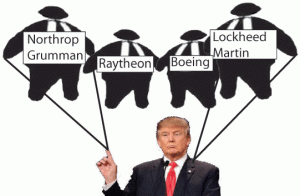
 WASHINGTON ,WATCH: IS TRUMP HELPING THE SAUDIS GO NUCLEAR? https://www.jpost.com/Opinion/Washington-Watch-Is-Trump-helping-the-Saudis-go-nuclear-592310,BY DOUGLAS BLOOMFIELD, JUNE 12, 2019
US President Donald Trump recently took another step toward bringing Saudi Arabia into the nuclear club. While Israeli-Saudi ties have warmed in recent years, helping the desert kingdom go nuclear – with its ongoing support for the most extreme Islamic radicals in the world – can hardly be good for the Jewish state.
Secret negotiations with the US Energy Department over many months have led Washington to “transfer highly sensitive US nuclear technology, a potential violation of federal law,” to Saudi Arabia, according to House Oversight Committee sources cited by The Washington Post.
Sen. Tim Kaine (D-Virginia) revealed last week that at least two transfers were approved since the assassination of Washington Post journalist Jamal Khashoggi.
The Saudis say they want to begin building their own nuclear power plants with their own enriched uranium, even though it could be purchased elsewhere more cheaply. That raises suspicions that their real goal isn’t producing electricity. By enriching their own uranium, they could begin diverting it to highly enriched weapons grade, especially if they bar international inspectors, as they’ve insisted.
Given its record of obeisance to Saudi demands for top technology and weapons, it is unlikely the Trump administration would object, but instead continue helping to conceal the kingdom’s plans. Crown Prince Muhammad bin Salman, the de facto ruler, has said that the kingdom would build nuclear weapons if the Iranians did. He may have taken encouragement from a speech in the UAE last month by Trump’s national security adviser, John Bolton.
The Iranians are threatening to leave the nuclear pact with the major powers – the Joint Comprehensive Plan of Action (JCPOA) – in the wake of the Trump administration’s unilateral exit last year and imposition of sanctions to tighten the economic screws on Tehran.
There’s “no reason” for Iran to walk away from JCPOA, “unless it is to reduce the breakout time to nuclear weapons,” said Bolton, a decades-long advocate of regime change in Iran. Bolton offered no evidence to back his claim.
That should give MBS the rationale he seeks to develop his version of the bomb.
When he turns to Trump for help, he will remind the president that if America won’t sell it to him, there are others who will. Trump is a sucker for that pitch.
North Korea would be a good place to go shopping, since they tried helping Syria build nukes until the Israeli Air Force stopped the plan, something it had done earlier in Iraq. Then there’s Pakistan, which is believed to have built its own nuclear weapons stockpile with Saudi financial help.
THERE MIGHT BE some resistance on Capitol Hill, where Saudi support is low and sinking, but Trump has shown himself more responsive to the wishes of the Saudis than the US Congress.
Republicans like Sen. Lindsey Graham of South Carolina may moan and groan and make threatening sounds toward Riyadh, but he and majority leader Mitch McConnell are Trump’s poodles, and will make sure the president gets what he wants.
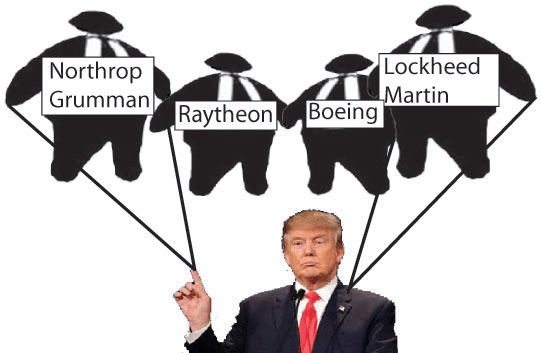
All US administrations – Republican and Democratic – have indulged the Saudi appetite for top technology and weapons. They’ve been driven by pressure from industry and its friends in the Pentagon to sell, sell, sell – and an inexplicable attitude that we need the Saudis far more than they need us. Trump has just raised this to a new level.
Trump’s latest selling spree includes 120,000 conversion kits to produce smart bombs. It is part of an $8.1 billion package that Trump labeled “emergency” to bypass Congressional review.
Most alarming is the Trump administration’s approval for the transfer of highly sensitive weapons technology and equipment to Saudi Arabia so the kingdom can produce electronic guidance systems for Paveway precision-guided bombs, according to congressional sources cited by The New York Times.
The administration assured Congress that it is confident in the Saudi ability to protect the technology, that the need is urgent and that it won’t alter the balance of power in the region – which is exactly what it is intended to do.
Look for Trump to justify massive sales to the Saudis and the UAE as also helping protect Israel from Iran. Historically, all administrations have justified arms sales around the Middle East as harmless to Israel’s qualitative military edge. But they aren’t. Especially when the US is selling the Arabs the same planes, missiles and technology it sells Israel. Trump values his oil-rich customer so much that he has rejected the findings of his own CIA that the crown prince was complicit in Khashoggi’s murder.
Saudi Arabia is the Pentagon’s favorite cash cow. Arms sales are a lucrative business for the US Defense Department, which charges commissions and other fees, and gets economies of scale for its own purchases while selling off old inventory to help pay for replacements. Military attachés around the world are top salesmen for defense contractors as they lay the groundwork for post-uniform careers. Then there are the former – and possibly future – defense industry executives at the highest levels of the Pentagon, starting with the Secretary of Defense.
Sen. Chris Murphy (D-Connecticut) said the administration “has effectively given a blank check to the Saudis – turning a blind eye to the brutal murder of Jamal Khashoggi and allowing their ballistic missile program to expand.”
The United States is not allowed to sell ballistic missiles, so the Saudis have turned to China. CNN reported last week that American intelligence believes Beijing is helping enhance the kingdom’s strategic missile program. In the 1980s, it secretly bought Chinese DF-3 missiles and based them within range of Israel. It bought more advanced missiles in 2007 with the approval of then-president George W. Bush. Unconfirmed published reports suggest they also bought other missiles from Pakistan, which produces a version of the North Korean Nodong missile.
If the Saudis decide to pursue nuclear weapons, they can turn to Trump’s dear friend Kim Jong Un, whose cash-strapped regime has developed its own and the missiles to deliver them.
With Trump looking for business that will create jobs he can claim credit for – and with John Bolton rattling sabers and B-52s, and calling for regime change in Iran – can Saudi Arabia be knocking on an open door to the nuclear club?
June 13, 2019
Posted by Christina Macpherson |
business and costs, politics, politics international, Saudi Arabia, USA |
Leave a comment
Nuclear Disarmament’s Lessons for Climate Change. https://foreignpolicy.com/2019/06/12/nuclear-disarmaments-lessons-for-climate-change/ If we can ban nukes, we can ban carbon emissions. Here’s how. BY CHARLI CARPENTER, RONALD MITCHELL, JUNE 12, 2019 T hroughout the Cold War, nuclear weapons were the main existential threat to the planet. But they were also considered vital to powerful nations. With no chance of getting those players to give them up, possession and use of the weapons was simply regulated at the margins. But thanks to the concerted work of a coalition of activists, nuclear weapons were banned outright in a 2017 treaty that has been signed by 70 countries and ratified by 23.
Although the treaty is not yet in force, if it ever becomes international law, it will represent a major step forward toward nuclear disarmament. And even states that have not signed the nuclear ban treaty can already feel its stigmatizing effects: British banks and U.S. cities are divesting from the nuclear weapons industry, and nuclear powers are increasingly forced to defend their nuclear stance against social and ethical demands for disarmament.
If nations can come together to ban something as precious to great powers as nuclear weapons, why can’t they at least try to do the same for carbon emissions? Unlike a nuclear war, which represents a terrible but highly unlikely future threat, carbon-induced climate change is a human catastrophe already in motion.
A 2012 report of experts published by the aid organization DARA International calculated that 400,000 people die every year as a direct result of carbon-induced climate change. According to the journalist David Wallace-Wells, writing in New York magazine, scientists project that catastrophic heat waves, food shortages, and warming-induced plagues will hit the earth in only a few decades. The latest—and inherently conservative—report from the United Nations’ Intergovernmental Panel on Climate Change warns of extreme weather and the displacement of millions of people.
Like nuclear disarmament, the key problem in global climate governance is not our scientific understanding of the problem. Rather, it is creating the political will to solve it. Political incentives work against action. The states most responsible for the problem are the least likely to feel its immediate effects and are therefore the least willing to make drastic changes.
Meanwhile, because the rest of the global community is so desperate to get the veto players on board, they have reduced climate governance efforts to the lowest common denominator. This is why the Kyoto Protocol and Paris agreement didn’t ban the use of carbon or require switching to carbon-free energy sources (like nuclear power). Rather, such treaties have focused on incremental changes. Yet even if all states met their commitments, it would be too little, too late.
What has a chance of working is to shake the carbon villains out of their cost-benefit thinking by adopting a moral shaming approach. Climate change is an existential threat to vulnerable populations—and, eventually, we will all be vulnerable. Shaming people into sacrificing for the common good is what wins wars, fuels wartime economies, and generally helps populations accept and enforce austerity measures in times of conflict. The same approach will help the global community address climate change, but only if laggard nations are first shamed into cooperating with those who are already feeling the heat.
In this, climate change activists could take a page from nuclear disarmament activists’ playbook. They should stop treating climate change as an economic problem that can be solved through carbon trading, or an environmental issue that requires collective action by the worst offenders on behalf of the planet. Instead, eliminating carbon emissions must be seen as a moral and humanitarian imperative requiring decisive action regardless of whether the United States and China agree. To do so, they will need to build a strong set of global norms prohibiting carbon emissions.
This approach has worked well in solving other global problems, especially in the area of weapons regulation, where the worst offenders are also least interested in change. Research shows that to replace patchwork global governance approaches with solid global prohibition norms, activists must ask states to adopt ambitious goals rather than move in incremental steps. To avoid incrementalism, the activists marginalize the veto players by creating invite-only forums for like-minded powers to solve jointly understood problems. To encourage cooperation among the non-like-minded, they valorize norm leaders and shame (rather than appease) norm laggards. Perhaps most importantly, they articulate issues through a humanitarian and moral lens. This shift in rhetoric has the power to change the entire conversation around an issue—and it can lead to rapid policy innovation.
Consider the case of nuclear weapons. Like climate change, nuclear weapons represent an existential security threat to nations, human beings, and the planet. And like with climate change, in the nuclear arena, a majority coalition of weak states, middle powers, and nonstate actors favored strong action, while a few powerful veto players hobbled progress. The veto players pushed for incremental reforms: better safeguards, gradual reduction of nuclear stockpiles, and bans on testing and technology transfer but not on the weapons themselves.
After decades working unsuccessfully through the Non-Proliferation Treaty conference forum, ban advocates finally changed strategies in 2006. They began to talk about nuclear weapons not as a threat to state security but as a global humanitarian issue. They began calling on states to abandon the Non-Proliferation Treaty and ban the weapons altogether. They started organizing their own, separate conferences, inviting states to sign the “Humanitarian Pledge.” Ultimately, 122 nations did so, and the document has already started to influence how nuclear nations justify their arsenals. As political scientists know, this is the first step in global normative and political change.
June 13, 2019
Posted by Christina Macpherson |
general |
Leave a comment






 nuclear-news