Town of Pilgrim now faces long lasting problem of dangerous nuclear wastes
What to do with nuclear waste remains a national problem with no solution, despite a promise by the federal government to have a facility ready to permanently store it ready by 1998.
About 80,000 tons of spent fuel is currently sitting on nuclear plant properties across the country. To give the number perspective, if existing radioactive fuel assemblies were stacked end-to-end and side-by-side, they would stand over two stories high and cover a football field.
And like those other communities that have hosted nuclear plants during the last 50 years, residents and officials in Plymouth are crying foul. “The Department of Energy has absolutely dropped the ball on this for our communities and all the others, which are becoming de facto nuclear waste repositories,” said Kevin O’Reilly, former executive director of the Plymouth Area Chamber of Commerce and current vice chairman of the Nuclear Decommissioning Citizens Advisory Panel. “The federal government needs to step up to the plate and fulfill their promise.”
“Spent fuel” is nuclear fuel that has been used and removed from the reactor core. The Government Accountability Office calls the hot and highly radioactive stuff one of the most hazardous substances created by humans. Some components stay radioactive for tens of thousands of years.
“If not properly contained or shielded, the intense radioactivity of spent fuel can cause immediate deaths and environmental contamination, and in lower doses can cause long-term health hazards such as cancer,” according to a GAO study done at the request of Congress in 2012……….
Holtec International and Waste Control Services have submitted applications to operate interim storage facilities in New Mexico and West Texas that are under review by the Nuclear Regulatory Commission. But the review process hasn’t been smooth, as both proposed locations have drawn opposition.
Meanwhile, a small startup group in California is working on yet another alternative, which the company says would provide permanent storage right on current plant sites or close by.
The proposal from Deep Isolation calls for drilling a vertical access channel up to a mile or more down, then gradually running the hole horizontally along the line of the rock formation, where company officials say the nuclear waste would remain unaffected by surface impacts such as sea level rise.
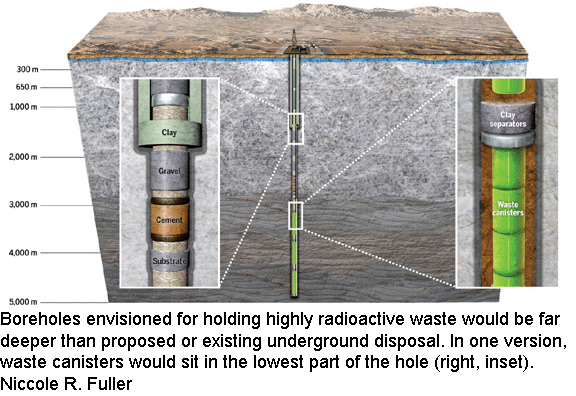
While the debate over where to put spent fuel continues, owners of commercial plants are suing the federal government to recoup money they’ve spent on storing fuel. To date, the Department of Energy has paid out $6.1 billion in damages.
All payouts so far have gone to nuclear power companies. Towns that store the spent fuel have lobbied to be paid for being de facto waste sites. While no such bill has been filed during the current session, legislators in states hosting spent fuel have filed legislation during the past three years called Nuclear Waste Accountability Act. Its provisions require the Department of Energy to provide payments to host communities equal to $15 per kilogram of spent fuel stored there.
FUEL DANGERS
Spent fuel stored in pools has historically caused worry. A zirconium fire could release radiation over hundreds of miles if the water in them is drained away through a seismic event, operator error or act of malice.
Much of the fuel will still be in the pool when Plymouth celebrates its 400th anniversary in 2020, with events throughout the year that will attract crowds of tourists and dignitaries from around the world.
“Spent fuel is a misnomer,” said Mary Lampert, president of the citizens group Pilgrim Watch. “It will be highly toxic as far into the future as dinosaurs were in the past.”
Fuel pool storage is particularly dangerous, she said. “The pool is vulnerable to water loss resulting in a fire that could contaminate an area larger than Massachusetts and force the evacuation of millions.”
The casks, once loaded, will ultimately be situated on a spent fuel pad about 75 feet above sea level………
Holtec International, the company looking to buy Pilgrim and decommission it, has long been involved in the manufacture of dry casks. Entergy has used Holtec’s Hi-Storm 100 casks and plans to continue with that model.
Watchdogs like Lampert worry over what will happen if those casks give out over time. They could crack or corrode from the coastal salt air. “We will only know after the fact that a cask has leaked radiation,” she said…… https://www.capecodtimes.com/news/20190601/radioactive-waste-big-concern-for-now-closed-pilgrim-plant
No comments yet.
1 This Month

of the week – Shut Down Drone Warfare!


Tell the Ukrainian Government to Drop Prosecution of Peace Activist Yurii Sheliazhenko

Petition to revoke the licensing of the Near Surface Nuclear Disposal Facility (NSDF) at Chalk River. https://www.ourcommons.ca/petitions/en/Petition/Details?Petition=e-7247
To see nuclear-related stories in greater depth and intensity – go to https://nuclearinformation.wordpress.com
-
Archives
- April 2026 (103)
- March 2026 (251)
- February 2026 (268)
- January 2026 (308)
- December 2025 (358)
- November 2025 (359)
- October 2025 (376)
- September 2025 (257)
- August 2025 (319)
- July 2025 (230)
- June 2025 (348)
- May 2025 (261)
-
Categories
- 1
- 1 NUCLEAR ISSUES
- business and costs
- climate change
- culture and arts
- ENERGY
- environment
- health
- history
- indigenous issues
- Legal
- marketing of nuclear
- media
- opposition to nuclear
- PERSONAL STORIES
- politics
- politics international
- Religion and ethics
- safety
- secrets,lies and civil liberties
- spinbuster
- technology
- Uranium
- wastes
- weapons and war
- Women
- 2 WORLD
- ACTION
- AFRICA
- Atrocities
- AUSTRALIA
- Christina's notes
- Christina's themes
- culture and arts
- Events
- Fuk 2022
- Fuk 2023
- Fukushima 2017
- Fukushima 2018
- fukushima 2019
- Fukushima 2020
- Fukushima 2021
- general
- global warming
- Humour (God we need it)
- Nuclear
- RARE EARTHS
- Reference
- resources – print
- Resources -audiovicual
- Weekly Newsletter
- World
- World Nuclear
- YouTube
-
RSS
Entries RSS
Comments RSS
 nuclear-news
Leave a comment