Voices of Fukushima power plant disaster victims strengthens call to ban nuclear energy, ACNS Anglican News Service June 6, 2019 by Rachel Farmer Japanese parish priests shared stories of suffering from victims of the Fukushima nuclear disaster at an International Forum for a Nuclear-Free World held in Sendai, Japan, last week. A joint statement from the forum, due out next month, is expected to strengthen the call for a worldwide ban on nuclear energy and encourage churches to join in the campaign.
The forum, organised by the Nippon Sei Ko Kai (NSKK) – the Anglican Communion in Japan – follows the NSKKs General Synod resolution in 2012 calling for an end to nuclear power plants and activities to help the world go nuclear free.
The disaster in 2011 followed a massive earthquake and tsunami which caused a number of explosions in the town’s coastal nuclear power station and led to widespread radioactive contamination and serious health and environmental effects. The Chair of the forum’s organising committee, Kiyosumi Hasegawa, said: “We have yet to see an end to the damage done to the people and natural environment by the meltdown of TEPCO’s Fukushima Daiichi Nuclear Power Plant. I do think this man-made disaster will haunt countless people for years to come. We still see numerous people who wish to go back to their hometowns but are unable to. We also have people who have given up on ever going home.”
One pastor, Dr Naoya Kawakami, whose church was affected by the tsunami and is the General Secretary of the Sendai Christian Alliance Disaster Relief Network, Touhoku HELP, explained how he had supported sufferers in the aftermath and heard from priests supporting the survivors. He said: “I have been more than 700 times to meet with more than 180 mothers and about 20 fathers, all of whom have seen abnormalities in their children since 2011. . . Thyroid cancer has been found in more than 273 children and many mothers are in deep anxiety.
“The more the situation worsens, the more pastors become aware of their important role. The role is to witness . . . pastors who have stayed in Fukushima with the ‘voiceless survivors’ are showing us the church as the body of Jesus’s resurrection, with wounds and weakness . . . sufferers are usually in voiceless agony and most people never hear them.”
The forum was attended by bishops, clergy and lay representatives from each diocese, together with representatives from the US-based Episcopal Church, USPG, the Episcopal Church of the Philippines, the Diocese of Taiwan, the Anglican Church of Korea, and also ecumenical guests. International experts took part, along with local clergy who shared individual stories from those directly affected by the disaster……….https://www.anglicannews.org/news/2019/06/voices-of-fukushima-power-plant-explosion-victims-strengthens-call-to-ban-nuclear-energy.aspx
June 8, 2019
Posted by Christina Macpherson |
Japan, Religion and ethics |
Leave a comment
 Giant clams are a delicacy of the Marshall Islands but illnesses fuel fears of nuclear contamination, ABC
Key points:
- The Marshallese bore the brunt of US nuclear bomb tests between 1946–58
- Tests released large amounts of radioactivity that the US was supposed to clean up
- Local leaders say that people remain fearful of eating contaminated local produce
“You see a nice-looking edible clam in the lagoon — it’s just like giving a kid a lovely lollipop,” nuclear commissioner Alson Kelen told the ABC, maintaining that eating clams will always be part of Marshall Islands life.
From 1946–1958, the US detonated 67 nuclear bombs in the Marshall Islands — some of the largest atomic weapons tests in history — and the area near the test site was evacuated, with locals receiving settlement payouts.
In the aftermath, with widespread radiation sickness being reported across the Marshall Islands, radioactive soil, debris, and wreckage was dumped into a nuclear crater on Enewetak Atoll.
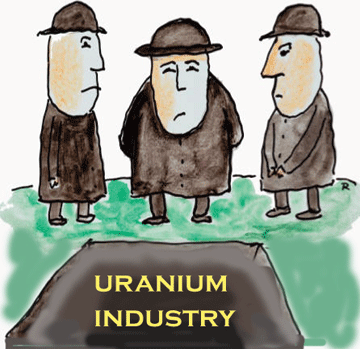
The crater was capped with cement in 1980 and is officially called the Runit Dome — but locals have nicknamed it The Tomb.
The Enewatak people eventually began returning to the islands in the early 1980s following highly controversial talks between the United States and leaders of the Marshall Islands.
Amid reports of ongoing aftereffects and illness, a 2012 United Nations report found that the effects of the nuclear tests were long-lasting, which was followed by a 2013 US Department of Energy report which found radioactive materials were leeching out of the Dome, threatening the already tenuous existence of Enewetak locals. ………..https://www.abc.net.au/news/2019-06-08/illness-on-enewetak-atoll-reignites-nuclear-contamination-fears/11181940
June 8, 2019
Posted by Christina Macpherson |
environment, OCEANIA |
Leave a comment
Nuclear Energy Regulators Need to Bring on More Cyber Experts, Watchdog Says Defense One, 7 June 19, Cyberattacks on nuclear power stations on the rise, and an aging workforce may soon leave the government struggling to defend plants against the latest threats.
The Nuclear Regulatory Commission is facing a mass exodus of cybersecurity experts in the years ahead, which could limit its ability to ensure the nation’s nuclear power plants are safe from digital attacks, an internal watchdog found……….
As of March 31, NRC officials had inspected 24 of the 57 power plants under its jurisdiction. While assessments “generally provide reasonable assurance that nuclear power plant licensees adequately protect digital computers, communications systems and networks,” auditors said, the agency could be hindered if the NRC doesn’t ramp up its recruitment and training efforts. …….
The situation at NRC is a symptom of the government’s broader struggle to recruit tech and cyber talent amid an aging workforce.
The IG advised NRC to improve its process for addressing skill gaps and managing its workforce, leaning on practices laid out in its existing Strategic Workforce Planning initiative.
Auditors also urged the agency to include more performance testing in its cybersecurity inspections. While today’s inspections focus largely on compliance, collecting data on vulnerability assessments, patching frequency and software management could make the process more efficient and effective, auditors wrote.https://www.defenseone.com/technology/2019/06/nuclear-energy-regulators-need-bring-more-cyber-experts-watchdog-says/157559/
June 8, 2019
Posted by Christina Macpherson |
safety, USA |
Leave a comment
Someday the U.S. Will Have to Actually Deal With Its Nuclear Waste Problem, The Department of Energy has made a move in that direction. Slate, By JANE C. HU 7 June 19, “………… the Department of Energy announced Wednesday that they are reclassifying the definition of “high-level,” or highly radioactive, waste stored in underground tanks at Hanford Nuclear Reservation in Washington state, the Savannah River Plant in South Carolina, and the Idaho National Laboratory in Idaho Falls. The DOE hopes that the redefinition will expedite cleanup of the waste. Currently, the high-level waste stored at these sites is waiting for the government to open a secure waste repository (like Yucca Mountain in Nevada, which has been in limbo for decades). But if some of the less radioactive waste qualifies under the new definition, it might instead be shipped off to other sites, like one in Texas, where it could be
mixed with “concrete-like grout.” The cleanup at Hanford has already cost the country billions of dollars and is projected to cost billions more as we continue the search for the waste’s final home. (Adding some urgency to developing a new plan is the risk that containers could leak and contaminate the environment, especially if there’s an earthquake in Washington.)JUNE 07,
The DOE’s new plan could be cost-effective, sure, but the question is whether it’s safe. When the agency first announced reclassification plans in October 2018 and solicited public comment, the proposal received thousands of responses. And Washington state officials are not happy; Gov. Jay Inslee and Department of Ecology Director Maia Bellon have both sent letters of concern to the DOE. “I am gravely concerned with DOE forging ahead with a new interpretation of HLW that does not comport with federal law, despite objections from Washington state,” wrote Bellon.
In addition to the waste we already have sitting around at Hanford and other old nuclear weapons facilities (charmingly called “legacy waste”), nearly 100 commercial nuclear reactors at 60 facilities around the U.S. are creating new waste every day. The type of waste produced by those two types of facility contains different radioactive materials with varying half-lives, but the same storage issues remain: What will we eventually do with all this radioactive stuff?
The lack of solution is not from lack of discussion. There have been all sorts of wacky ideas floated about where to store nuclear waste. Some have proposed we shoot it all into space, maybe have it orbit Venus. But given how spacecraft are prone to explosions, which would effectively mean showering the world with bits of radioactive waste, that idea stalled. In the ’90s, the idea of burying waste in deep ocean seabeds seemed promising, but it never really got off the ground. And some countries tried storing barrels of waste in ice sheets, which turns out to be less than ideal given that ice both moves and melts. As the earth thaws out, old waste becomes uncovered.
Here in the U.S., we’re running out of space, and experts are concerned about the lack of long-term solutions. “Instead of a planned, coherent system, we have the confusion of an unplanned, less than optimal system,” nuclear experts wrote in a 2018 report on nuclear waste management strategy and policy, calling the U.S. program “an ever-tightening Gordian Knot” subject to technical, scientific, logistical, regulatory, legal, financial, social, and political challenges. “This is not a situation that builds public confidence.”……..https://slate.com/technology/2019/06/department-of-energy-nuclear-waste-reclassification-yucca.html
June 8, 2019
Posted by Christina Macpherson |
USA, wastes |
Leave a comment
 Top Uranium Producer Is Gloomy About Nuclear Power, for Now, Bloomberg, By Will Wade, June 7, 2019, Don’t expect an upswing in the global uranium market anytime soon.
“In our models, we don’t get excited on the demand side,” said Galymzhan Pirmatov, chief executive officer of Kazatomprom, Kazakhstan’s state-owned mining company that’s the world’s biggest supplier.
With construction of nuclear power plants at a 10-year low, uranium demand remains weak. That’s holding prices so low that mining companies have been wary of increasing production. Kazatomprom’s output will increase about 5% this year, to as much as 22,800 tons, and then will be flat in 2020, Pirmatov said Wednesday in an interview in New York. While he hasn’t yet made a decision on 2021, he doesn’t see much to get excited about, at least in the short term.
“I do believe prices are too low,” he said. Uranium has slumped 15% this year to $24.35 a pound as of Wednesday. Kazakhstan controls about 40% of the world’s supply of the metal, and Kazatomprom accounts for half of that, making it the biggest producer………
U.S. Closings
In the U.S., flush with abundant and cheap natural gas, utilities are closing nuclear plants. The U.S. is also considering whether to impose tariffs on uranium, after two small domestic mining companies filed a trade case last year, arguing that imports are a threat to national security. The Commerce Department concluded its investigation in April, but the results haven’t been made public……..https://www.bloomberg.com/news/articles/2019-06-05/top-uranium-producer-is-gloomy-about-nuclear-power-for-now
June 8, 2019
Posted by Christina Macpherson |
2 WORLD, business and costs, Uranium |
Leave a comment
“Top National Security Democrats Call on Pres. Trump to Extend New START Nuclear Treaty with Russia June 5, 2019 WASHINGTON—Representative Eliot L. Engel (D-N.Y.), Chairman of the House Foreign Affairs Committee, Senator Bob Menendez (D-N.J.), Ranking Member of the Senate Foreign Relations Committee, and six other Democratic leaders on national security issues, today raised concerns […]
via Top National Security Democrats Call on Trump to Extend New START Nuclear Treaty with Russia — Mining Awareness +
June 8, 2019
Posted by Christina Macpherson |
Uncategorized |
Leave a comment

Iranian Foreign Minister Mohammad Javad Zarif Press TV – June 7, 2019 Iranian Foreign Minister Mohammad Javad Zarif has categorically rejected a claim by US Secretary of State Mike Pompeo about Iran’s missile program, saying Tehran does not seek to develop nuclear weapons. “Our missiles are not ‘designed’ for nukes, which we’re not developing,” Zarif […]
via Unlike Pompeo’s claim, Iran’s missiles not for developing nukes: FM Zarif — Aletho News
June 8, 2019
Posted by Christina Macpherson |
Uncategorized |
Leave a comment

Even a small chunk of the desert could indeed power much of the world, in theory. But how would this be achieved? The post Solar panels all over the Sahara desert? appeared first on RenewEconomy.
via Solar panels all over the Sahara desert? — RenewEconomy
June 8, 2019
Posted by Christina Macpherson |
Uncategorized |
Leave a comment

“JUNE 04, 2019 Kaine Statement On Transfers Of Nuclear Technical Expertise To Saudi Arabia WASHINGTON, D.C. – U.S. Senator Tim Kaine, a member of the Senate Foreign Relations and Armed Services Committees, has repeatedly requested information from the Trump Administration about the approval of seven nuclear technical expertise transfers to Saudi Arabia, including whether any […]
via Trump Admin Approved Seven Transfers of Nuclear Tech to Saudi; Two After Jamal Khashoggi Murder — Mining Awareness +
June 8, 2019
Posted by Christina Macpherson |
Uncategorized |
Leave a comment





 nuclear-news