Church should oppose nuclear waste in Utah
|
https://www.sltrib.com/opinion/letters/2019/05/29/letter-church-should/ By Leslie and Gail Ellison | The Public Forum, Dear Russell M. Nelson, Dallin H. Oaks and Henry B. Eyring,
On May 5, 1981, the First Presidency of The Church of Jesus Christ of Latter-day Saints issued a bold and important statement opposing the placing of the MX missile train system in Utah and Nevada. Our state is confronted with a similar situation today that simply cannot be ignored. Our legislators in the last session passedHB220 potentially allowing Class B and Class C nuclear wastes (including depleted uranium) to be transported to and stored at the Envirocare Skull Valley repository. These long-lived wastes increase in toxicity over hundreds of thousands of years. Every legislator that voted in favor of this legislation received donations from Envirocare. Imagine the thousands of trains and trucks transporting these nuclear poisons, sloshing in their holds … forever. Insane! There is so much wrong here, not only the dangers of transportation through population centers and the Envirocare site itself (open pit, shallow aquifer, etc.), but so many unknowns. This is a Utah state issue. Other states and the U.S. Department of Energy (DOE) cannot believe our state will actually welcome these toxic wastes. This should not be a political issue. It is an extremely serious health concern for our families, our children and our children’s children. We call upon the First Presidency and the Quorum of the Twelve Apostles to take a stand in reversing this bill, similar to the brave and righteous position they took against the MX missile system in 1981. |
|
Young voters supported Europe’s Greens – big winners in European elections
 Guardian 28th May 2019 Europe’s Greens, big winners in Sunday’s European elections, will use
their newfound leverage in a fractured parliament to push an agenda of urgent climate action, social justice and civil liberties, the movement’s leaders say. “This was a great outcome for us – but we now also have a great responsibility, because voters have given us their trust,” Bas Eickhout, a Dutch MEP and the Greens’ co-lead candidate for commission president, told the Guardian.
concerned about the climate crisis, and they are pro-European – but they feel the EU is not delivering. They want us to change the course of Europe.”https://www.theguardian.com/environment/2019/may/28/greens-eu-election-mandate-leverage-climate-policy
Scotland the first country to set legally binding annual emission reduction targets
Scotsman 29th May 2019 , Scotland is leading way by being first country to set legally binding annual emission reduction targets, writes Jamie Livingstone, head of Oxfam Scotland. Earlier this month, Environment Secretary Roseanna Cunningham reaffirmed in the Scottish Parliament the First Minister’s declaration that we are facing a “climate emergency”.
It’s a phrase that’s suddenly in vogue among political leaders from Edinburgh to Cardiff, London, Dublin and
beyond. It’s not hard to see why. Politicians are feeling the climate heat after schoolchildren went on strike and campaigners brought prominent locations, including in Edinburgh, to a standstill.
A recent poll by Stop Climate Chaos Scotland shows 70 per cent of people in Scotland support further action on climate change. It follows dire warnings by climate scientists that we have until 2030 to avert a climate catastrophe.
Political language is, it seems, catching up with reality. And not before time. When I hear the words “climate emergency”, I picture Jenipher, a young woman from the Mulanje district of southern Malawi. When I met her in 2016, Malawi was suffering from the worst drought the country had experienced in over 30 years, one made worse by climate change. Jenipher’s crops had withered; her family was starving; her life depended on the rain
coming next season.
Robot boats, drones, artificial intelligence to repair Britain’s repair offshore wind farms
Britain’s seas to repair offshore wind farms within two years, a coalition
of arms makers, space scientists and green energy experts said yesterday. A
£4 million project funded by the government will develop an autonomous
mothership that will transport a fleet of self-piloting drones, which will
carry a swarm of six-legged, insect-like robots known as Bladebugs. These
will use suction pads to cling to the blades of wind turbines and assess
them for wear and tear. They should also be able to carry out basic repairs
such as sanding and repainting damaged areas. The system will also make use
of artificial intelligence techniques pioneered by Nasa to run unmanned
space missions. It will be tested at Levenmouth in Fife using a wind
turbine owned by a renewable energy research facility funded by the
government.
https://www.thetimes.co.uk/article/182d58a8-817f-11e9-bb89-165499dc1684
World’s second EPR nuclear reactor starts work in China
The first nuclear fuel was loaded into the Taishan 2 reactor in early May in the southern Chinese province of Guangdong……….
EDF has faced serious problems rolling out the technology and has managed to sell just a handful of the reactors as construction problems piled up.
EDF has been building an EPR reactor at Flamanville along the Atlantic coast of northwest France. It was originally set to go online in 2012 but the project has been plagued by technical problems and budget overruns.
Levy acknowledged that the “difficulty” of the Flamanville project had been “underestimated.”
French President Emmanuel Macron has asked EDF to study the feasibility of building more next-generation EPR nuclear reactors in the country, but will wait until 2021 before deciding whether to proceed with construction. https://phys.org/news/2019-05-world-epr-nuclear-reactor-china.html
May 29 Energy News — geoharvey

Science and Technology: ¶ “A Warming Arctic Produces Weather Extremes In Our Latitudes” • Atmospheric researchers have shown that rising temperatures in the stratosphere are causing the jet stream to falter and follow a wave-like course. And the weakening of the jet stream is spreading downward from the stratosphere, producing weather extremes in lower latitudes. […]
1 This Month
To see nuclear-related stories in greater depth and intensity – go to https://nuclearinformation.wordpress.com/
12 February – Webinar The Big Push: New Nuclear Projects in Canada
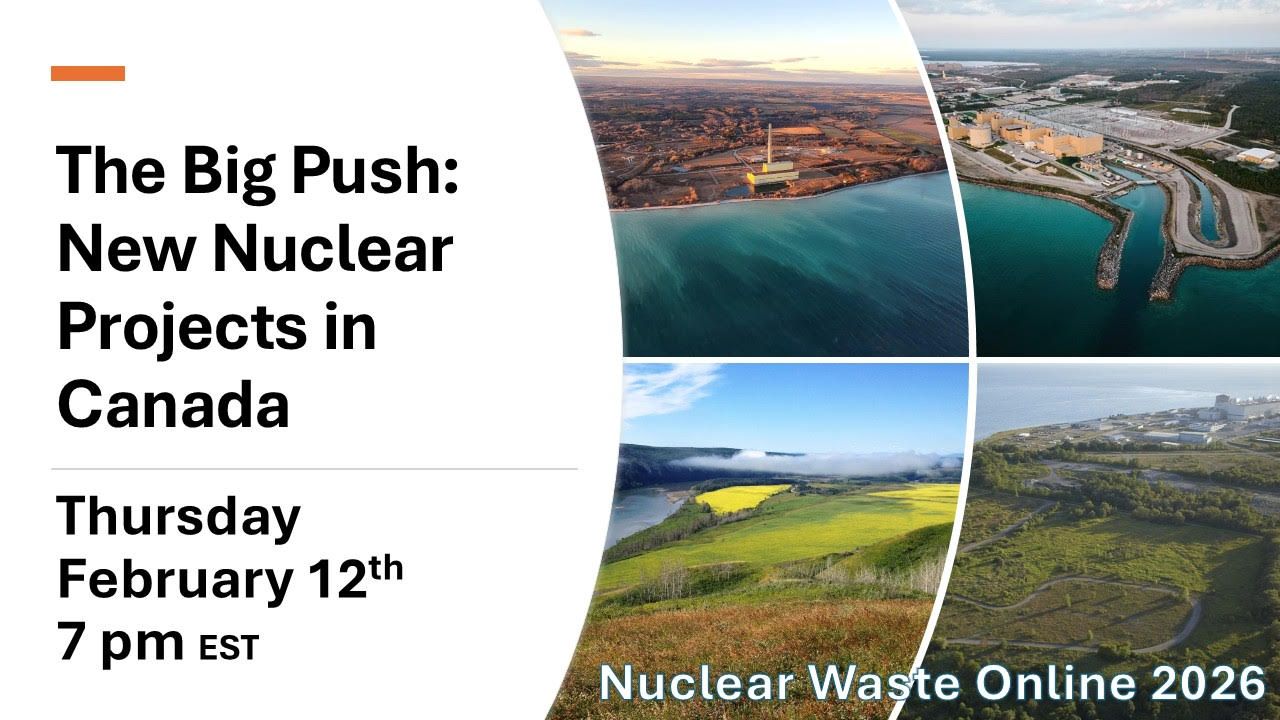
Thursday, February 12, 7 pm Eastern | 2nd of 4 sessions in the 2026 Nuclear Waste Online webinar series
Join a webinar on the push for new nuclear generation in Canada. Go to Northwatch.org to register or use the registration link https://us02web.zoom.us/webinar/register/WN_ZfWOf1GITqSRIZX8CB-A9w

-
Archives
- February 2026 (127)
- January 2026 (308)
- December 2025 (358)
- November 2025 (359)
- October 2025 (376)
- September 2025 (258)
- August 2025 (319)
- July 2025 (230)
- June 2025 (348)
- May 2025 (261)
- April 2025 (305)
- March 2025 (319)
-
Categories
- 1
- 1 NUCLEAR ISSUES
- business and costs
- climate change
- culture and arts
- ENERGY
- environment
- health
- history
- indigenous issues
- Legal
- marketing of nuclear
- media
- opposition to nuclear
- PERSONAL STORIES
- politics
- politics international
- Religion and ethics
- safety
- secrets,lies and civil liberties
- spinbuster
- technology
- Uranium
- wastes
- weapons and war
- Women
- 2 WORLD
- ACTION
- AFRICA
- Atrocities
- AUSTRALIA
- Christina's notes
- Christina's themes
- culture and arts
- Events
- Fuk 2022
- Fuk 2023
- Fukushima 2017
- Fukushima 2018
- fukushima 2019
- Fukushima 2020
- Fukushima 2021
- general
- global warming
- Humour (God we need it)
- Nuclear
- RARE EARTHS
- Reference
- resources – print
- Resources -audiovicual
- Weekly Newsletter
- World
- World Nuclear
- YouTube
-
RSS
Entries RSS
Comments RSS
 nuclear-news