Erica Cirino is a science photojournalist, covers stories about wildlife and the environment, most often related to biology, conservation and policy. She is based in New York and Copenhagen.
Nuclear power, useless against climate change, is itself threatened by climate change’s weather extremes
|
Nuclear power is not the answer in a time of climate change, https://aeon.co/ideas/nuclear-power-is-not-the-answer-in-a-time-of-climate-change Heidi Hutner, Erica Cirino-November 2018, In the Woolsey Fire scorched nearly 100,000 acres of Los Angeles and Ventura counties, destroying forests, fields and more than 1,500 structures, and forcing the evacuation of nearly 300,000 people over 14 days. It burned so viciously that it seared a scar into the land that’s visible from space. Investigators determined that the Woolsey Fire began at the Santa Susana Field Laboratory, a nuclear research property contaminated by a partial meltdown in 1959 of its failed Sodium Reactor Experiment, as well as rocket tests and regular releases of radiation. The State of California’s Department of Toxic Substances Control (DTSC) reports that its air, ash and soil tests conducted on the property after the fire show no release of radiation beyond baseline for the contaminated site. But the DTSC report lacks sufficient information, according to the Bulletin of Atomic Scientists. It includes ‘few actual measurements’ of the smoke from the fire, and the data raises alarms. Research on Chernobyl in Ukraine following wildfires in 2015 shows clear release of radiation from the old nuclear power plant, calling into question the quality of DTSC’s tests. What’s more, scientists such as Nikolaos Evangeliou, who studies radiation releases from wildfires at the Norwegian Institute for Air Research, point out that the same hot, dry and windy conditions exacerbating the Woolsey Fire (all related to human-caused global warming) are a precursor to future climate-related radioactive releases.
With our climate-impacted world now highly prone to fires, extreme storms and sea-level rise, nuclear energy is touted as a possible replacement for the burning of fossil fuels for energy – the leading cause of climate change. Nuclear power can demonstrably reduce carbon dioxide emissions. Yet scientific evidence and recent catastrophes call into question whether nuclear power could function safely in our warming world. Wild weather, fires, rising sea levels, earthquakes and warming water temperatures all increase the risk of nuclear accidents, while the lack of safe, long-term storage for radioactive waste remains a persistent danger.
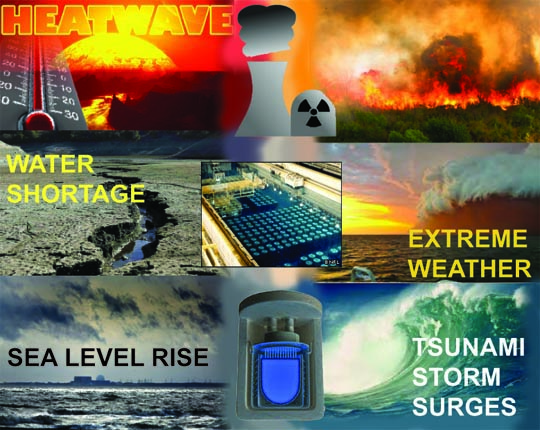 The Santa Susana Field Laboratory property has had a long history of contaminated soil and groundwater. Indeed, a 2006 advisory panel compiled a report suggesting that workers at the lab, as well as residents living nearby, had unusually high exposure to radiation and industrial chemicals that are linked to an increased incidence of some cancers. Discovery of the pollution prompted California’s DTSC in 2010 to order a cleanup of the site by its current owner – Boeing – with assistance from the US Department of Energy and NASA. But the required cleanup has been hampered by Boeing’s legal fight to perform a less rigorous cleaning. Like the Santa Susana Field Lab, Chernobyl remains largely unremediated since its meltdown in 1986. With each passing year, dead plant material accumulates and temperatures rise, making it especially prone to fires in the era of climate change. Radiation releases from contaminated soils and forests can be carried thousands of kilometres away to human population centres, according to Evangeliou. Kate Brown, a historian at the Massachusetts Institute of Technology and the author of Manual for Survival: A Chernobyl Guide to the Future (2019), and Tim Mousseau, an evolutionary biologist at the University of South Carolina, also have grave concerns about forest fires. ‘Records show that there have been fires in the Chernobyl zone that raised the radiation levels by seven to 10 times since 1990,’ Brown says. Further north, melting glaciers contain ‘radioactive fallout from global nuclear testing and nuclear accidents at levels 10 times higher than elsewhere’. As ice melts, radioactive runoff flows into the ocean, is absorbed into the atmosphere, and falls as acid rain. ‘With fires and melting ice, we are basically paying back a debt of radioactive debris incurred during the frenzied production of nuclear byproducts during the 20th century,’ Brown concludes. Flooding is another symptom of our warming world that could lead to nuclear disaster. Many nuclear plants are built on coastlines where seawater is easily used as a coolant. Sea-level rise, shoreline erosion, coastal storms and heat waves – all potentially catastrophic phenomena associated with climate change – are expected to get more frequent as the Earth continues to warm, threatening greater damage to coastal nuclear power plants. ‘Mere absence of greenhouse gas emissions is not sufficient to assess nuclear power as a mitigation for climate change,’ conclude Natalie Kopytko and John Perkins in their paper ‘Climate Change, Nuclear Power, and the Adaptation-Mitigation Dilemma’ (2011) in Energy Policy. Proponents of nuclear power say that the reactors’ relative reliability and capacity make this a much clearer choice than other non-fossil-fuel sources of energy, such as wind and solar, which are sometimes brought offline by fluctuations in natural resource availability. Yet no one denies that older nuclear plants, with an aged infrastructure often surpassing expected lifetimes, are extremely inefficient and run a higher risk of disaster. ‘The primary source of nuclear power going forward will be the current nuclear fleet of old plants,’ said Joseph Lassiter, an energy expert and nuclear proponent who is retired from Harvard University. But ‘even where public support exists for [building new] nuclear plants, it remains to be seen if these new-build nuclear plants will make a significant contribution to fossil-emissions reductions given the cost and schedule overruns that have plagued the industry.’ Lassiter and several other energy experts advocate for the new, Generation IV nuclear power plants that are supposedly designed to deliver high levels of nuclear power at the lowest cost and with the lowest safety risks. But other experts say that the benefits even here remain unclear. The biggest critique of the Generation IV nuclear reactors is that they are in the design phase, and we don’t have time to wait for their implementation. Climate abatement action is needed immediately. ‘New nuclear power seemingly represents an opportunity for solving global warming, air pollution, and energy security,’ says Mark Jacobson, director of Stanford University’s Atmosphere and Energy Programme. But it makes no economic or energy sense. ‘Every dollar spent on nuclear results in one-fifth the energy one would gain with wind or solar [at the same cost], and nuclear energy takes five to 17 years longer before it becomes available. As such, it is impossible for nuclear to help with climate goals of reducing 80 per cent of emissions by 2030. Also, while we’re waiting around for nuclear, coal, gas and oil are being burned and polluting the air. In addition, nuclear has energy security risks other technologies don’t have: weapons proliferation, meltdown, waste and uranium-worker lung-cancer risks.’ Around the world, 31 countries have nuclear power plants that are currently online, according to the International Atomic Energy Agency. By contrast, four countries have made moves to phase out nuclear power following the 2011 Fukushima disaster, and 15 countries have remained opposed and have no functional power plants. With almost all countries’ carbon dioxide emissions increasing – and China, India and the US leading the pack – the small Scandinavian country of Denmark is an outlier. Its carbon dioxide emissions are decreasing despite it not producing any nuclear power. Denmark does import some nuclear power produced by its neighbours Sweden and Germany, but in February, the country’s most Left-leaning political party, Enhedslisten, published a new climate plan that outlines a path for the country to start relying on its own 100 per cent renewable, non-nuclear energy for power and heat production by 2030. The plan would require investments in renewables such as solar and wind, a smart grid and electric vehicles that double as mobile batteries and can recharge the grid during peak hours. Gregory Jaczko, former chairman of the US Nuclear Regulatory Commission and the author of Confessions of a Rogue Nuclear Regulator (2019), believes the technology is no longer a viable method for dealing with climate change: ‘It is dangerous, costly and unreliable, and abandoning it will not bring on a climate crisis.’ Edited by Pam Weintraub |
–
|
Panicky nuclear lobby produces a propaganda book, desperate to win public support

U.S., Canada Energy Leaders Announce New Book on Nuclear Innovation in Clean Energy USA Dept of Energy
MAY 28, 2019, VANCOUVER, CANADA – Today, leaders from the United States and Canada are unveiling a new book, Breakthroughs: Nuclear Innovation in A Clean Energy System, at the Tenth Clean Energy Ministerial (CEM10), a forum including ministers from 25 nations, occurring this year in Vancouver, Canada from May 27-29. MAY 28, 20
“The combination of vision and innovation is having a profound impact on our energy landscape, and nowhere is that more true than nuclear energy,” said U.S. Under Secretary of Energy Mark W. Menezes. “Nuclear energy is one of our most reliable and cleanest sources of energy, and we are determined to revive and revitalize the nuclear energy industry with advanced and smart designs. This book highlights some of the incredible transformative opportunities nuclear innovation can bring to society and the clean energy future of our planet.”
Canada’s Minister of Natural Resources Amarjeet Sohi said, “The Clean Energy Ministerial is part of building the world’s clean energy future. Canada is proud to host the 10th Clean Energy Ministerial in Vancouver at this historic moment in time. We are pleased to be working with the United States, Japan, and other countries under the nuclear innovation initiative. We also welcome the release of Breakthroughs – a collection a real stories about nuclear innovations and how they can contribute to our climate change goals.” ………
The Breakthroughs book is a product of the CEM Nuclear Innovation: Clean Energy Future (NICE Future) initiative that was launched at the May 2018 Ninth CEM in Copenhagen, Denmark. The NICE Future initiative envisions nuclear energy’s many uses in contributing to clean, reliable energy systems of the future. …….. https://www.energy.gov/articles/us-canada-energy-leaders-announce-new-book-nuclear-innovation-clean-energy
France’s many nuclear waste locations revealed in an interactive map

Nuclear waste map of France published by Greenpeace, https://www.connexionfrance.com/French-news/Nuclear-waste-map-of-France-published-by-environmental-activists-Greenpeace-on-issue 29 May, 19, Nuclear waste is becoming a hot topic of discussion, as Greenpeace publishes a map of waste across France
A new interactive map showing the locations of nuclear waste across France has been published by environmental group Greenpeace, as part of its forthcoming campaign on the issue.
The map was published online this week, with the NGO aiming to “compile in a single place” all of the information it has on the location of radioactive material, to let people know how close they may be living to the waste.
The map categories include storage centres (at which the waste will be stored for 300 years minimum); nuclear centres that generate all forms of nuclear waste; more than 200 old uranium mines, operational up to 2001; factories and other plants; and radioactive waste from more than 70 military sites.
The data was collected from records of radioactive waste agency l’Agence Nationale pour la Gestion des Déchets Radioactifs (Andra).
The map does not include waste from medical use or research.
The map allows you to search by post code (Greenpeace.fr / Screenshot)Greenpeace is hoping to raise awareness and prompt debate over the extent of nuclear waste, and ask questions on the potential impact it may have. This also includes the impact of transporting nuclear waste by road or rail.
The group is also seeking to gather signatures and support for its national campaign on the issue, which it will later address to French ecology minister François de Rugy.
The map features a button saying “Agir! (Act!)”, allowing members of the public to add their support.
A public debate is set to be held on September 25 on this exact question – the issue of nuclear waste in France. It will be held on a platform via which the public will be able to ask for further information and have their say.
Nuclear waste disposal is also expected to be on the agenda at the G20 summit being held in Japan next month.
Breathtaking series on Chernobyl nuclear catastrophe
(Foxtel Showcase 12 June 8.30 pm and 10.30 pm)
Chernobyl: horrifying, masterly television that sears on to your brain. This breathtaking series throws us right into the hellish chaos of the nuclear disaster – and its terrors are unflinching and unforgettable, Guardian, Rebecca Nicholson, 29 May 2019 After three of its five episodes aired, the miniseries Chernobyl found its way to the top of IMDB’s top 250 TV shows in history list. While the fan-voted chart might seem hyperbolic, given that the drama had only just crossed the halfway point, it is not undeserving of the honour. Chernobyl is masterful television, as stunning as it is gripping, and it is relentless in its awful tension, refusing to let go even for a second. That old ‘don’t spoil the ending’ joke about Titanic will inevitably be rebooted here, but it is confident enough to withstand any familiarity with the story.
Chernobyl’s “liquidators” suffered acute, and long-term health effects
|
How Did Radiation Affect the ‘Liquidators’ of the Chernobyl Nuclear Meltdown? https://www.livescience.com/65563-chernobyl-radiation-effects-body.html These liquidators, who worked between 1987 and 1990, were exposed to high levels of radiation, on average around 120 millisievert (mSv), according to the World Health Organization. That’s over a thousand times more powerful than a typical chest X-ray, which delivers 0.1 mSv of radiation. And some of the very first responders were exposed to levels astronomically higher than that. So, what happens to the human body when exposed to such high levels of radiation? [5 Weird Things You Didn’t Know About Chernobyl] It’s like walking into a giant, powerful X-ray machine shooting radiation everywhere, said Dr. Lewis Nelson, chairman of emergency medicine at Rutgers New Jersey Medical School. Except, in this case, most of the radiation consisted of an even more damaging type of radiation than X-rays, called gamma-rays. This radiation, as it passes through the body, is ionizing. This means that it removes electrons from atoms in the body’s molecules, breaking chemical bonds and damaging tissues. Very high levels of ionizing radiation cause “radiation sickness.” At Chernobyl, 134 liquidators quickly developed radiation sickness, and 28 of them died from it. These people were exposed to radiation levels as high as 8,000 to 16,000 mSv, or the equivalent of 80,000 to 160,000 chest X-rays, according to the World Health Organization. Radiation sickness mostly manifests in the gastrointestinal tract and the bone marrow, Nelson said. Those areas have rapidly dividing cells, which means that instead of being tightly coiled and a little more protected, the DNA is unraveled so that it can be copied. That makes it more susceptible to the radiation (this is also why radiation therapy works to target cancer cells, which also rapidly divide). Within a couple of hours of the exposure, people with radiation sickness develop symptoms such as diarrhea and vomiting, Nelson said. When cells cannot properly divide, the mucosa or tissue lining of the GI tract also break downs, releasing cells and the bacteria that live in the gut (including in the stool) into the bloodstream. This would make even a healthy person sick, Nelson said. But because the radiation is also stopping the bone marrow from producing infection-fighting white blood cells, the body can’t fight those infections. People who have radiation sickness therefore have a weakened immune systemand frequently die of blood poisoning, or sepsis, within a couple of days, he said. High levels of radiation can also cause burns and blisters on the skin, which show up minutes to a few hours after the exposure and look just like a sunburn, Nelson said. While the GI-tract symptoms and burns happen almost immediately to a couple of hours after exposure to the radiation, the bone marrow survives for a couple of days. This means there is a latency period, when the person might even seem to improve, before showing symptoms of sepsis. The people who survived radiation sickness from Chernobyl took years to recover, and many of them developed cataracts because the radiation damaged the eye lenses, according to the World Health Organization. Lower exposuresBut much of the health focus around Chernobyl survivors has focused on the long-term consequences of the radiation exposure in these areas. The main consequence, for them, is an elevated risk of cancer. “But remember, the cancer risk is something you see 10 years down the road, so you have to live for 10 more years in order to see [that],” Nelson said. So the cancer risk is generally more of a concern for those who survived Chernobyl but were exposed to lower levels of radiation. The data on this risk is murky, with very approximate numbers, but it is estimated that 270,000 people in the Ukraine, Russia and Belarus who wouldn’t have otherwise developed cancers did develop these illnesses. This mainly manifested as thyroid cancer, directly caused by radioactive particles of iodine-131 released by the explosion. The thyroid needs iodine in order to produce hormones that regulate our metabolism. But if it doesn’t have enough of the healthy, nonradioactive iodine found in many foods, it absorbs the radioactive iodine, and this can eventually lead to thyroid cancer. This is why in the HBO series “Chernobyl,” people take iodine pills; filling those stores of iodine in the thyroid prevents it from absorbing the radioactive iodine. These radioactive particles, which also include others such as cesium-137 enter the body through contact with the skin or through the mouth and nose. In Chernobyl, these particles were thrown into the air, carried by winds and later fell back down in surrounding areas, contaminated crops and water, and the people who ate them. |
|
Radioactive shellfish – giant clams in Marshall Islands near USA nuclear dump
High radiation levels found in giant clams near U.S. nuclear dump in Marshall Islands, By SUSANNE RUST and CAROLYN COLE,
Researchers have found high levels of radiation in giant clams near the Central Pacific site where the United States entombed waste from nuclear testing almost four decades ago, raising concerns the contamination is spreading from the dump site’s tainted groundwater into the ocean and the food chain.

The findings from the Marshall Islands suggest that radiation is either leaking from the waste site — which U.S. officials reject — or that authorities did not adequately clean up radiation left behind from past weapons testing, as some in the Marshall Islands claim.
The radioactive shellfish were found near Runit Dome — a concrete-capped waste site known by locals as “The Tomb” — according to a presentation made by a U.S. Department of Energy scientist this month in Majuro, the island nation’s capital. The clams are a popular delicacy in the Marshall Islands and in other nations, including China, which has aggressively harvested them from vast swaths of the Pacific.
According to Terry Hamilton, a veteran nuclear physicist at the Energy Department’s Lawrence Livermore National Laboratory, Runit Dome is vulnerable to leakage by storm surge and sea level rise, and its groundwater, which is leaking into the lagoon and ocean, is severely contaminated.
But the radiation in the shellfish and surrounding lagoon is not coming from the 40-year-old dome, said Hamilton in a slide he presented May 15 to an audience assembled in a hotel conference room in Majuro.
He said isotopic analyses indicated the lagoon contamination was from residue from the initial nuclear weapons testing.
The Los Angeles Times was not at Hamilton’s presentation, and the Energy Department did not make him available to comment. But the following day, residents and officials informed The Times about the findings, which were later confirmed with others.
Between 1946 and 1958, the United States tested 67 nuclear devices in the Marshall Islands, including 44 in Enewetak Atoll, one of the nation’s 29 coral atolls. Although the Marshall Islands were home to only 6% of the total number of tests conducted by the United States, it bore the brunt of more than half the total energy yield of all U.S. nuclear weapons testing.
Much of the fallout from those events is now entombed within Runit Dome. According to a photograph taken of Hamilton’s presentation slides, the 377-foot-wide crater in Enewetak Atoll contains groundwater samples with radiation levels 1,000 to 6,000 times higher than those found in the open ocean.
Some Marshallese who attended the presentation are skeptical about the agency’s conclusion that the dome is not leaking into the lagoon.
“What they’re saying is, here is the dome. And here, in the lagoon area, there is radiation. … But as far as leaking from the dome, we don’t think that’s the case?” said James Matayoshi, mayor of Rongelap Atoll, one of the atolls contaminated by fallout from the nuclear testing program. “That doesn’t make any sense.”
Extending the incredulity further, Matayoshi and others noted that Hamilton presented a short animation of the dome, showing it rise and fall with the tide — suggesting seawater
is freely flowing in and out of the containment zone.
Between 1977 and 1980, the United States enlisted roughly 4,000 U.S. soldiers and subcontractors to clean the site. Many said they were inadequately protected. They excavated soils from Enewetak and elsewhere and turned the soil into a concrete slurry, which they poured into an unlined crater on Runit Island, left behind by the Cactus bomb. They sealed it with a clean concrete top 18 inches thick, creating what is now called the Tomb.
In 1980, the people of Enewetak were told by the U.S. government it was safe to return home.
But there have been lingering worries about the atoll’s safety. The U.S. government told the Marshallese the dome was a temporary fix. It’s now been nearly 40 years. This latest news didn’t alleviate any of those concerns, said Holly Barker, a professor of anthropology at the University of Washington in Seattle. Barker is a member of the Marshall Islands’ three-person National Nuclear Commission — a government-mandated committee charged with seeking justice for nuclear-related injuries and damage.
The basic takeaway from the presentation, said Barker, is the lagoon is so contaminated, any leakage from the dome is negligible.
Which raises the question, “in what way was Runit a cleanup?” Barker said………
Lucinda Anitok, 35, from Sedro-Woolley, Wash., is a descendant of Runit landowners. She said the U.S. testing program in Enewetak had devastated her family. Her grandmother, who was raised on Enewetak, had thyroid cancer. Her mother, who was born there, had cervical cancer. And her sister had leukemia.
“What happened there was wrong,” she said. “It ruined, and is still harming, many people’s lives.”…….https://www.latimes.com/science/environment/la-me-marshall-islands-dome-is-leaking-radiation-20190528-story.htm
Canada’s plans for nuclear waste disposal
Canada’s nuclear waste to be buried in deep underground repository, By Eric Sorensen, Global News, 29 May 19, “……..While the nuclear creating heat and electricity has been well contained in reactors, ceramic pellets and fuel bundles, we have been left with big a problem that everyone saw coming: the hazard posed by nuclear waste.
At the Bruce plant, low and intermediate level wastes are accumulating. Low-level includes worker clothing and tools. Typically, they could be radioactive for 100 years. Intermediate-level waste is described as resins, filters and used reactor components that could be a hazard for 100,000 years.
Ontario Power Generation has slowly made headway for a plan to bury this waste in a deep underground repository next to the Bruce plant. Much of it now sits in large tanks with row upon row of cement lids poking above the surface.of the ground.
Fred Kuntz, wearing an OPG hard hat, gazed over the containers: “This is all safe storage for now, but it’s not really the solution for thousands of years. The lasting solution is disposal in a deep geologic repository.”
He pointed to a stand of trees. “The DGR would be built here.”
Some think that’s a terrible idea. The repository could leak, it could be attacked, and the location on the Bruce site is barely a kilometer from Lake Huron, which has opponents on both sides of the Great Lakes up in arms.
“There isn’t a magic bullet. It’s not like we can put it out of sight and we’ve solved the problem.” said Theresa McClenaghan of the Canadian Environamental Law Association.
She suggests humans have little concept of how long 100,000 years is. She questions whether the facility would last and whether we can be sure we’ll be able to communicate the dangers to some future civilization.
………..The deep geological repository was approved by an environmental review panel in 2015, but both the Harper and Trudeau governments have put off giving the final go ahead. It now appears to hinge on the approval by indigenous people in the region.
For the Saugeen Ojibway Nation, it’s about time they were consulted. Fifty years ago, the concerns of indigenous people were an afterthought when it came to major public policy decisions.
The nuclear plant was built on the traditional land of the Saugeen Ojibway. OPG says it has come to recognize the “historic wrongs of the past” and is negotiating compensation for those wrongs. And moving forward, OPG has given its assurance that the repository will only be built if the Saugeen Ojibway approve – from an afterthought to the power of veto over a multibillion-dollar enterprise……….
Remarkably, this is the relatively easy stuff to deal with: low- and intermediate-level nuclear waste. An even bigger problem is high-level radioactive used fuel. It too is piling up, primarily at the three big Ontario plants. It may be toxic for a million years. ……..
Ultimately they need to find one particular community to be a “willing host” for what amounts to 57,000 tonnes of used nuclear fuel……..
The plan is to pack the bundles into carbon steel tubes coated in copper – 48 bundles per container. They look like a big torpedoes. Each one will be packed snugly into what look like coffins made of a special clay called bentonite.

Thousands of bentonite boxes will be moved by robotic machines into hundreds of long placement rooms deep underground. Dried slightly, the clay will expand and plug every last space, ultimately sealing the repository. ……
Picking a host community, getting regulatory approval, building the repository, and transferring high-level waste will take the next 50 years.
It is separate from the OPG plan for low- and intermediate-level waste, which could have an answer from the Saugeen Ojibway Nation by the end of this year, and federal approval in 2020.
As it turns out, two of the NWMO sites for high-level waste – South Bruce and Huron-Kinloss – are also on Saugeen Ojibway land, so they may ultimately have to decide on separate nuclear waste projects on their land………https://globalnews.ca/news/5329835/canadas-nuclear-waste-to-be-buried-in-deep-underground-repository/
USA National Security Adviser John Bolton Accuses Iran of Seeking Nuclear Weapons,
National Security Adviser John Bolton Accuses Iran of Seeking Nuclear Weapons, TIME BY JON GAMBRELL / AP , MAY 29, 2019 (ABU DHABI, United Arab Emirates) — President Donald Trump’s national security adviser warned Iran on Wednesday that any attacks in the Persian Gulf will draw a “very strong response” from the U.S., taking a hard-line approach with Tehran after his boss only two days earlier said America wasn’t “looking to hurt Iran at all.”
John Bolton’s comments are the latest amid heightened tensions between Washington and Tehran that have been playing out in the Middle East.
Bolton spoke to journalists in Abu Dhabi, the capital of the United Arab Emirates, which only days earlier saw former Defense Secretary Jim Mattis warn there that “unilateralism will not work” in confronting the Islamic Republic……..
A longtime Iran hawk, Bolton blamed Tehran for the recent incidents, at one point saying it was “almost certainly” Iran that planted explosives on the four oil tankers off the UAE coast. He declined to offer any evidence for his claims.
…….Iran’s Foreign Minister Mohammad Javad Zarif has repeatedly criticized Bolton as a warmonger. Abbas Mousavi, a spokesman for Iran’s Foreign Ministry, said later Wednesday Bolton’s remarks were a “ridiculous accusation.”
Separately in Tehran, President Hassan Rouhani said that the “road is not closed” when it comes to talks with the U.S. — if America returns to the nuclear deal. However, the relatively moderate Rouhani faces increasing criticism from hard-liners and Supreme Leader Ayatollah Ali Khamenei over the collapsing accord…….
Bolton also said the U.S. would boost American military installations and those of its allies in the region. …..
Bolton’s trip to the UAE comes just days after Trump in Tokyo appeared to welcome negotiations with Iran. http://time.com/5597424/john-bolton-iran-nuclear-weapons/
As Pilgrim nuclear plant closes, Holtec moves in to make a tidy profit
 Closure of Pilgrim nuclear plant is part of a shifting energy industry, Boston Globe, By David Abel Globe Staff,May 28, 2019, “…….. If all goes right, the last of 145 crucifix-shaped control rods will be inserted into the reactor, shutting down operations for good.
“For many of us, it’s the end of an era,” said Joe Frattasio, 56, a control room shift manager who has been working for Pilgrim for 19 years and expects to remain at the plant until March. “Unfortunately, this is the reality of the industry.”
When Pilgrim shuts down, there will be 97 nuclear reactors left in the United States, down from a peak of 112 in 1990. Another 10 reactors are slated to close by 2025.
Concerns about the safety of nuclear power — especially after the disasters at plants in the former Soviet Union and Japan — have contributed to the industry’s decline. The Nuclear Regulatory Commission in recent years had designated Pilgrim one of the nation’s three least-safe reactors, forcing the plant to spend tens of millions of dollars on upgrades and inspections.
……. But the changing nature of the larger energy industry, and the resulting economics, has played an even larger role.
…… By next April, when Entergy expects to complete the first phase of the decommissioning process, only about half as many workers will remain.
“It’s a sad time, but also a time of reflection,” said Patrick O’Brien, a spokesman for Pilgrim, before a simulation of the shutdown on Tuesday at a testing facility near the plant.
As part of the process, the company will reduce the evacuation zone to the perimeter around the plant.
….. The future of the property may be left to Holtec International, a New Jersey company that’s seeking to buy Pilgrim. Although it has never owned or decommissioned a nuclear plant, Holtec has promised to complete the process in just eight years, well ahead of the 60 years allowed by federal rules. https://www.bostonglobe.com/metro/2019/05/28/pilgrim/p00dL7Ju623l3VZDiUvMJO/story.html
$125 million to NASA to develop nuclear rockets
 NASA JUST GOT $125 MILLION TO DEVELOP NUCLEAR ROCKETS, https://futurism.com/the-byte/nasa-develop-nuclear-rockets DAN ROBITZSKI_ 29 May 19, For the first time since the 1970s, NASA is developing nuclear propulsion systems for its spacecraft.NASA didn’t request any money for a nuclear propulsion program, but it will get $125 million for the research as part of the space agency’s $22.3 billion budget that Congress approved last week, Space.comreports. If the program succeeds, nuclear propulsion could significantly cut down on travel time during missions to Mars and beyond.
Test Launch
Republican leadership sees nuclear propulsion as an important step along the way to deep space missions and the 2024 Moon landing with which Congress has tasked NASA, per Space.com. Alabama Representative Robert Aderholt described nuclear propulsion as “critical” for the 2024 launch in a budget meeting last week.
“As we continue to push farther into our solar system, we’ll need innovative new propulsion systems to get us there, including nuclear power,” Vice President Mike Pence told the National Space Council in March.
Sorting It Out
But before NASA can embrace nuclear-powered technology, there’s the matter of navigating regulations that govern the use of nuclear energy.
For the time being, the space agency hasn’t announced any plans to use nuclear propulsion for any of its planned missions, according to Space.com, but that may change as the technology develops.
U.S, official claims that Russia is ‘probably’ conducting banned nuclear tests
|
Russia ‘probably’ conducting banned nuclear tests, US official says, https://www.bbc.com/news/world-us-canada-48454680 29 May 19, Russia may be violating a ban on the testing of low-yield nuclear weapons capabilities at a site in the Arctic, a top US intelligence official said.Lt Gen Robert Ashley, the director of the US Defense Intelligence Agency, said Moscow was “probably not adhering to” the rules of a recognised treaty.
He was referring to the Comprehensive Test Ban Treaty (CTBT), a multilateral agreement prohibiting nuclear testing. Russia, which ratified the treaty in 2008, says it complies with the CTBT. The US has signed but has not yet ratified the treaty. Our understanding of nuclear weapon development leads us to believe that Russia’s testing activities would help it improve its nuclear weapons capabilities,” Lt Gen Ashley said on Wednesday. He added that the US expected Russia, which he said was likely testing weapons in the Novaya Zemlya islands, to increase its nuclear arsenal “significantly” over the next decade. But analysts received the statement with scepticism. The Comprehensive Nuclear Test Ban Treaty Organization (CTBTO) said in a statement that it had not detected any unusual activity. “The CTBTO has full confidence in the ability of the IMS [its monitoring system] to detect nuclear test explosions,”, the organisation said in a statement. The CTBT, which bans nuclear weapons testing anywhere in the world, was adopted by the UN General Assembly in 1996. It sets out nuclear disarmament as a principle but diplomatically avoids the politics of the issue. |
|
Continuing glum lookout for the uranium market

Uranium Week: Buyers’ Market. https://www.fnarena.com/index.php/2019/05/28/uranium-week-buyers-market, By Greg Peel, May 28 2019
Sellers continue to chase down ever more empowered buyers in an ongoing weak uranium market.
-Uranium spot price continues to fall
-Rio Tinto may shut down Rossing
-US production falls dramatically
It was Groundhog Week last week in the uranium market. With utilities largely out of the market pending a section 232 decision, sellers continue to lower prices in order to flush out buying interest.
And the buyers are not making it easy. Having the upper hand, they are not simply insisting on lower prices, industry consultant TradeTech reports, but on specific origins, delivery locations and other restrictive terms and conditions.
Four transactions totalling 500,000lbs U3O8 equivalent were recorded in the spot market last week. TradeTech’s weekly spot price indicator has fallen -US20c to US$24.30/lb.
The spot price has now fallen -16% in 2019, whittling a 12-month gain down to 6%.
There were no transactions reported in uranium term markets. TradeTech’s term price indicators remain at US$28.50/lb (mid) and US$32.00/lb (long).
Supply Response
Australian-listed diversified miner Rio Tinto ((RIO)) has announced it will advance the closure of its 69% owned Rossing uranium mine in Namibia to June 2020 if the Namibian competition regulator blocks the US$104m sale of the mine to China National Uranium Corp.
Rio cannot continue to operate the loss-making business and would rather cease operations ahead of a forecast 2025 mine life if the sale is rejected.
The Namibian government owns a 3% stake in Rossing but 51% of the voting rights. The Iranian Foreign Investment Co holds 15% and the Industrial Development Corp of South Africa owns 10%.
Persistently low uranium prices continue to impact on global supply. Last week the US Energy Information Agency reported US uranium mines produced 700,000lbs U3O8 in 2018, down -37% from 2017.
Total shipment of uranium concentrate from US mills fell -35%. US producers sold 1.5mlbs of concentrate at an average price of US$32.51/lb.
San Onofre Task Force Questions Edison About Nuclear Waste Canisters
https://www.kpbs.org/news/2019/may/29/san-onofre-task-force-questions-edison-about-nucle/ May 29, 2019, By Alison St John Members of a San Onofre Task Force convened by San Diego Congressman Mike Levin are meeting Wednesday with officials from Southern California Edison, which owns and operates the shuttered nuclear power plant in North San Diego County.
The Task Force was created to increase public involvement in the decommissioning of the plant, which shut down in 2012 after a small radioactive leak was discovered in the steam generators.
Levin said several Task Force members are concerned about burying spent nuclear fuel in stainless steel canisters encased in concrete, next to the beach.
“Our task force members had specific questions about those canisters,“ Levin said, “their safety, their design and the wear and tear that the coastal environment takes on them. Those questions were not answered sufficiently. Edison said, ‘We’ll have to have another meeting to discuss that,’ so we took them up on that, and we’re having another meeting.”
Levin said he has introduced legislation to put San Onofre’s nuclear waste at the top of the list to be moved if Congress decides on a location to store the nation’s spent fuel longer term.
His bill to earmark $25 million to identify and develop what’s called consolidated interim storage site recently passed the House Appropriations Committee.
The long-lasting impact on North Wales agriculture, from Chernobyl nuclear disaster
Daily Post 28th May 2019 ,Despite being over 2,000 miles apart, North Wales was directly affected by the huge blast of radioactive particles which were released into the air
following the Chernobyl disaster. The most significant way this impacted on
the region was the effect it had on livestock, primarily in north western
areas.
following the Chernobyl disaster. The most significant way this impacted on
the region was the effect it had on livestock, primarily in north western
areas.
Radiation plumes that blew across Europe in the days after the April
1986 catastrophe reached upland farms of over 53,000 hectares – with the
impact lasting for more than 20 years. Just days after the Ukrainian
disaster, the UK Government announced a ban on the sale of sheep across
parts of the region as well as in Cumbria and Scotland – as the enormity of
the problem for farmers became apparent. The protocol was motivated by
heavy rain following the explosion, which washed radioactive decay – mostly
caesium 137 – out of clouds and on to fields all across the continent.
1986 catastrophe reached upland farms of over 53,000 hectares – with the
impact lasting for more than 20 years. Just days after the Ukrainian
disaster, the UK Government announced a ban on the sale of sheep across
parts of the region as well as in Cumbria and Scotland – as the enormity of
the problem for farmers became apparent. The protocol was motivated by
heavy rain following the explosion, which washed radioactive decay – mostly
caesium 137 – out of clouds and on to fields all across the continent.
And because of the nature of soil in North Wales, the radioactive particles
were absorbed by plants – rather than being locked up in the soil itself.
Local sheep grazing on the land then became contaminated by eating the
radioactive grass, with restrictions affecting 180,000 sheep. The
restrictions in Snowdonia and beyond – which remained in some areas until
2012 – were imposed on more than 300 Welsh farms following concern for the
caesium in soil and vegetation in upland areas.
were absorbed by plants – rather than being locked up in the soil itself.
Local sheep grazing on the land then became contaminated by eating the
radioactive grass, with restrictions affecting 180,000 sheep. The
restrictions in Snowdonia and beyond – which remained in some areas until
2012 – were imposed on more than 300 Welsh farms following concern for the
caesium in soil and vegetation in upland areas.
https://www.dailypost.co.uk/news/north-wales-news/chernobyl-disaster-how-north-wales-16340587
73 years ago today – radiation-caused death of nuclear physicist Louis Slotin, in the Manhattan Project
Paul Waldon Fight To Stop Nuclear Waste Dump In Flinders Ranges SA, 30 May 19
Today the 30th of May 2019 marks the 73rd anniversary of the death of nuclear physicist Louis Slotin who was the second worker to succumb to acute radiation poisoning attributed to the Demon Core while working on the Manhattan Project.
The nuclear coterie has continued to orate its safety record as one to be proud of in an industry that continues to have shortcomings to the abandonment of the radioactive material it produces. “You can not throw out waste when there is no out.” more https://www.facebook.com/groups/941313402573199/
1 This Month

18 March Webinar @ 1 PM EST: An Assessment of SMR Projects: The Case of Canada
register for the zoom:
https://us02web.zoom.us/webinar/register/WN_o8BIIOUvQ2ONJR1nta65DQ#/registration

of the week – STOP SMALL MODULAR REACTORS IN CANADA
To see nuclear-related stories in greater depth and intensity – go to https://nuclearinformation.wordpress.com
-
Archives
- February 2026 (256)
- January 2026 (308)
- December 2025 (358)
- November 2025 (359)
- October 2025 (376)
- September 2025 (258)
- August 2025 (319)
- July 2025 (230)
- June 2025 (348)
- May 2025 (261)
- April 2025 (305)
- March 2025 (319)
-
Categories
- 1
- 1 NUCLEAR ISSUES
- business and costs
- climate change
- culture and arts
- ENERGY
- environment
- health
- history
- indigenous issues
- Legal
- marketing of nuclear
- media
- opposition to nuclear
- PERSONAL STORIES
- politics
- politics international
- Religion and ethics
- safety
- secrets,lies and civil liberties
- spinbuster
- technology
- Uranium
- wastes
- weapons and war
- Women
- 2 WORLD
- ACTION
- AFRICA
- Atrocities
- AUSTRALIA
- Christina's notes
- Christina's themes
- culture and arts
- Events
- Fuk 2022
- Fuk 2023
- Fukushima 2017
- Fukushima 2018
- fukushima 2019
- Fukushima 2020
- Fukushima 2021
- general
- global warming
- Humour (God we need it)
- Nuclear
- RARE EARTHS
- Reference
- resources – print
- Resources -audiovicual
- Weekly Newsletter
- World
- World Nuclear
- YouTube
-
RSS
Entries RSS
Comments RSS
 nuclear-news