Vancouver’s ‘Clean Energy Summit’ – Clean Energy Ministerial in the grip of the nuclear lobby
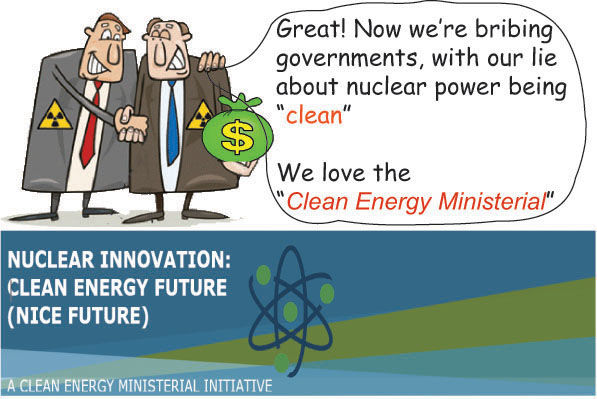
At Vancouver’s Clean Energy Summit, Nuclear Is Making a Play Note to ministers from 25 nations: Prepare to be dangerously greenwashed. By Tanya Glafenhein and M.V. RamanaTanya Glafenhein is an undergraduate political science major at UBC focused on ecological sustainability, and environmental and social justice.
M.V. Ramana is the Simons Chair in Disarmament, Global and Human Security at the School of Public Policy and Global Affairs at UBC, and the author of The Power of Promise: Examining Nuclear Energy in India, Penguin Books, New Delhi (2012).
This week Vancouver is host to a summit of ministers from over 25 countries gathered “to accelerate progress toward a clean energy future.
Created in 2010, the Clean Energy Ministerial describes itself as a “high-level global forum to promote policies that advance clean energy technology” and “to encourage the transition towards a global clean energy economy.”
As we face massive environmental challenges, a transition is clearly needed. The problem is that one significant focus of the CEM is to find ways of preserving the existing energy infrastructure while greenwashing it.
Case in point: the cleverly termed NICE Future, which stands for Nuclear Innovation: Clean Energy Future, that was set up in 2018 by the CEM initiative. Its stated aim is “to initiate a dialogue on the role that clean and reliable nuclear energy can play in bolstering economic growth, energy security and access, and environmental stewardship.”
But nuclear energy is not clean except in some narrow definition, and our experience over the decades with this technology has shown that it cannot “bolster” any of the other goals.
Dirty truths about ‘clean energy’
Before going further, it would help to beVanctter understand the term clean energy. For years now, there is an open and growing preference for renewable energy among the public around the world.
This was a problem for the large private and public sector organizations that owned other forms of electricity generation technologies, particularly coal, nuclear, or natural gas. One of the strategies that these large organizations, and supportive politicians and government officials, have been undertaking is to sweep these, or slight variants thereof, under the term clean energy.
The key word is clean, and its use has been promoted by multiple fossil fuel and other industry groups. In the mid-2000s, dozens of coal and utility companies formed something called the American Coalition for Clean Coal Electricity. It then spent tens of millions of dollars on advertisement campaigns about “clean coal” being a solution to global warming.
The Clean Energy Ministerial buys into a similar narrative by promoting what it calls the “Carbon Capture, Utilisation, and Storage Initiative.”
This branding strategy continues to pay off. Utilities and friendly politicians have promoted existing but uneconomical power plants as clean energy options and sought subsidies, for example in the state of New Jersey in the United States.
Last week, Republicans in Ohio proposed legislation known as the “clean energy” subsidy bill. What does this legislation do? Bail out old and uneconomical coal and nuclear power plants in the state, and endmandates that utilities use more renewable and efficient energy.
Of course, neither coal nor nuclear power plants are clean by any reasonable definition. Unless you focus entirely on carbon dioxide and ignore all the other potential pollutants.
Radioactive waste
In the case of nuclear energy, the most difficult environmental legacy is the radioactive waste produced by all nuclear reactors. Radioactive waste is inextricably linked to nuclear energy production, because each nucleus of uranium or plutonium gives rise to radioactive fission products as they break apart. Other radioactive “transuranic elements” are produced when uranium-238 in the fuel absorbs a neutron, again an inevitable occurrence in nuclear reactors.
The problem is that it takes hundreds of thousands of years before the radioactive materials decay to levels that could be considered relatively safe. For those long periods of time, this waste will have to be kept away from human contact — an unprecedented challenge for which there is still no demonstrated solution.
But nuclear plants are not the only source of radioactive wastes. At the very start of the nuclear fuel chain, the mines that produce uranium ore and the mills that process the ore into uranium that is used to fuel nuclear power plants generate radioactive materials that are harmful to the environment and human health.
Around the world, uranium mining and processing has been primarily carried out on Indigenous lands and Indigenous peoples have been significantly affected. Impacted communities include the Navajos in the United States, the Dene people in the Northwest Territories, and the Santhal, Munda, and Ho people in India. Proposed sites for the deep geological repository in Canada are almost all on traditional First Nations land, in a practice that has been termed nuclear colonialism.
Accidents
Nuclear energy is unique among all electricity generating technologies in its propensity for catastrophic accidents such as Chernobyl and Fukushima that create radioactive contamination on a potentially global scale. In those locations near the site of the accident where contamination levels are high, the hazards to health will last for decades if not centuries.
The “exclusion zone” with radiation levels deemed too high for human habitation encompassed 4,300 square kilometres in the case of Chernobyl; at least 116,000 people were evacuated from the area.
The contaminated area is smaller in the case of Fukushima because most of the atmospherically released radionuclides were deposited into the Pacific Ocean due to the prevalent wind direction during the first few days of the accidents.
Many proponents of nuclear energy argue, despite this history of disastrous accidents, that reactors can be operated safely. Critics respond: “The key question is not whether it can be safe, but whether it will be safe.”
The simple answer is no. Not when this has to be done across countries, across many facilities, according to multiple priorities including cost cutting and profit making, and using multiple technologies, each with its own vulnerabilities.
Weapons
Though the nuclear industry is loath to admit it, there is a very close relationship between nuclear power and weapons. In the words of the late Ted Taylor, a former weapons designer turned nuclear abolition advocate, “the connections between nuclear technology for constructive use and for destructive use are so closely tied together that the benefits of the one are not accessible without greatly increasing the hazards of the other.” Nuclear war would be the ultimate environmental catastrophe.
This connection is particularly important to emphasize given that many of the members of the Clean Energy Ministerial are either nuclear weapon states or members of military alliances with nuclear weapon states. Members include the U.S., China, France, Russia, India, United Kingdom, Canada, and Japan to name a few.
But isn’t nuclear the cheap way to fight climate change?
Despite all these problems with nuclear energy, some might argue that this technology remains the only way to reduce carbon dioxide emissions.
The problem with this argument is that nuclear energy is fading in importance globally. Nuclear power’s share of global electricity generation was 17.5 per cent in 1996. Since then, this fraction has steadily declined, reaching 10.3 per cent in 2017. For a variety of reasons, the downward trend is expected to continue.
What is behind this trend? The primary reason is that nuclear plants are no longer financially viable. Because they are hugely expensive, it has been known for a while that building new nuclear plants makes little economic sense. What has changed in the last decade is that it is not just constructing new reactors, but just operating one, even one that is old and has its capital costs paid off, that has ceased to make economic sense in many cases.
This is because alternatives to nuclear energy, in particular renewable sources of electricity like wind and solar energy, have become drastically cheaper. In contrast, just about every nuclear plant that was constructed in the last decade has proven more expensive than initially projected.
The Wall Street consulting company, Lazard, publishes annual cost figures for different energy technologies. In 2018, the Lazard estimate for the construction cost of a new nuclear plant in the United States was over $9,000 per kilowatt and each megawatt-hour of electricity produced would have cost around $150.
In comparison, a new wind energy plant cost $1,350 per kilowatt to construct; it cost $1,110 per kilowatt for solar energy. The generation costs for wind and solar energy are around $40 per megawatt-hour. The comparison has only been becoming more favourable to renewable technologies over the years.
These economic trends suggest that to expect nuclear energy to play an important role in climate change mitigation is wishful or delusional at best. The Clean Energy Ministerial should drop its support for technologies like nuclear power and coal. Or it can change its name to Unclean Energy Ministerial. https://thetyee.ca/Opinion/2019/05/27/Nuclear-Making-Play-Clean-Energy-Summit/
Wide swathe of USA affected by major tornadoes -to the alarm of climate scientists
 Tornadoes Cut Across Unusually Wide Swaths of US, Raising Alarm for Climate Scientistshttps://www.commondreams.org/news/2019/05/27/tornadoes-cut-across-unusually-wide-swaths-us-raising-alarm-climate-scientists “There’s reason to believe major outbreak days are getting worse.” by Julia Conley, staff writer,
As the death toll in Oklahoma rose to six Monday amid an outbreak of nearly 200 tornadoes across the Midwest in recent days—as well as in areas far less accustomed to them—climate scientists said such patterns may carry warnings about the climate crisis and its many implications for extreme weather events.
In Oklahoma, tornadoes touched down in at least two cities, including El Reno and Sapulpa, over the weekend, injuring dozens and leveling a number of homes. The tornado that hit El Reno, a suburb of Oklahoma City, was given an EF3 rating, with wind speeds up to 165 miles per hour. Only about five percent of tornadoes are given an EF3 rating or higher.
Outside the Midwest, at least one twister touched down near Washington, D.C., with reports of tornadoes in Texas and Colorado, and Chicago facing a tornado watch on Monday.
While tornadoes have long been a fixture in the Midwest, meteorologist Eric Holthaus tweeted last week that there is “reason to believe major outbreak days…are getting worse,” while climate scientists are examining links between the storms and the climate crisis.
The so-called “Tornado Alley,” which covers parts of Texas and Kansas as well as Oklahoma, appears to be growing, according to a study published in Nature last year—making tornadoes more frequent in states that rarely saw them previously including Arkansas, Mississippi, and eastern Missouri.
“What all the studies have shown is that this particular part of the U.S. has been having more tornado activity and more tornado outbreaks than it has had in decades before,” Mike Tippett, a mathematician who studies the climate at Columbia University told PBS Newshour earlier this year.
As the Kansas City Star reported on Sunday, scientists believe the warming of the globe—fueled by human activities like fossil fuel extraction—is contributing to higher amounts of water vapor in the atmosphere, causing heavier rainfalls which can spawn tornadoes.
The increase in destructive tornadoes across wider swaths of the country than in previous decades “may be suggestive of climate change effects,” Purdue University researcher Ernest Agee told the Star. And the unusual occurrence of tornadoes in far more densely-populated areas than those that frequently see such weather events has led to concerns that tornadoes will become more deadly and destructive than they’ve been in the past
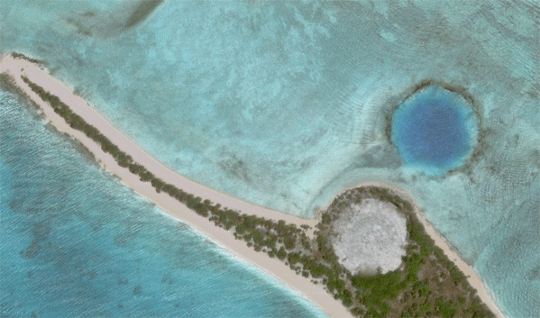
Temporary dome over radioactive trash on Runit Island – now leaking waste to the Pacific
|
Fears Grow That ‘Nuclear Coffin’ Is Leaking Waste Into The Pacific https://www.forbes.com/sites/trevornace/2019/05/27/fears-grow-that-nuclear-coffin-is-leaking-waste-into-the-pacific/#653322537073, Trevor Nace The tropical blue skies over the southern Pacific Ocean were enveloped by towering mushroom clouds lingering over the Marshall Islands in 1954 as the United States continued its testing of nuclear weapons. The United States conducted 67 nuclear weapon tests from 1946 to 1958 on the pristine Marshall Islands. The most powerful test was the “Bravo” hydrogen bomb in 1954, which was about 1,000 times more powerful than the bomb dropped on Hiroshima, Japan. The extensive nuclear bomb testing blanketed the islands in radioactive ash, covering it in the fine, white, powder-like substance. Children, unaware of what the radioactive ash was, played in the “snow” and ate it according to the Atomic Heritage Foundation. Today, there are growing concerns that the temporary containment of the nuclear waste resulting from those tests is leaking into the Pacific Ocean and could be cracked wide open from the next storm that rolls by. Specifically, the site is believed to be leaking one of the most toxic substances in the world, the radioactive isotope plutonium-239, a byproduct of nuclear bombs that decays with a half-life of 24,100 years. In 1977 the United States worked to clean up the radioactive waste left strewn across the Marshall Islands. In total, an estimated 73,000 cubic meters of radioactive soil was collected across the Marshall Islands. The US used a crater from an especially large nuclear bomb test on Runit Island to stash away the radioactive soil. The 328-foot crater from a May 1958 test was designated the dumping ground. As this was considered a temporary solution, the crater bottom was not lined with impervious material, which would have prevented radioactive waste from entering the below aquifers and Pacific Ocean. After the material was piled into the crater, an 18-inch thick concrete dome was positioned on top of it as a temporary containment. Plans for permanent radioactive waste storage were never finalized and thus the temporary solution has sat as-is for nearly 40 years. Shortly afterward, in 1983 the Marshall Islands agreed on their severity from the United States and with it, the islands released the United States of any responsibility for past nuclear testing. Rising sea level, soil shifting, and storms have all caused new concern over the integrity of the “nuclear coffin” and its ability to contain radioactive waste. The dome is reportedly cracking and the local government fears the next big storm may split the concrete dome apart. In addition, groundwater models suggest that seawater is almost certainly accessing the crater. However, it is unclear how much nuclear waste is seeping from the unlined crater bottom into the Pacific Ocean and groundwater aquifers. Despite recent awareness around the issue, the Marshallese government does not have the money or expertise to properly clean up and isolate the nuclear waste. Thus, the Marshallese are left helpless as their tropical islands continue to leak deadly radioactive waste across its coral reefs. Trevor Nace is a PhD geologist, founder of Science Trends, Forbes contributor, and explorer. Follow his journey @trevornace. |
|
Ohio’s “Clean Air Program” – a ruse to prop up nuclear power, diminish solar and wind

Now, the veil is off.
Changes made to House Bill 6 last week would direct most of the $197.6 million collected from new fees on Ohioans’ electric bills to Akron-based FirstEnergy Solutions, which operates two nuclear plants outside Toledo and Cleveland.
Renewable energy companies from wind to solar would not get a cut of this “Ohio Clean Air Program.”
In a double blow, lawmakers also axed current programs that encourage electricity providers to purchase renewable energy and help customers become more energy efficient.
And lawmakers ensured utilities could charge customers a fee for two coal plants operated by Piketon-based Ohio Valley Electric Corporation through 2030. The plants are located in Gallipolis and Madison, Indiana. Wednesday’s changes likely jettisoned any hope of widespread Democratic support.
“It’s now just straight-up corporate welfare,” said Rep. Kristin Boggs, the Ohio House’s No. 2 Democrat. “I don’t know how else to describe it.”
That means Speaker Larry Householder, R-Glenford in Perry County, must rely on fellow Republicans to pass the energy bill – a divergence from his recent bipartisan strategy. And it’s not clear he has the votes yet. ……
opponents of the bill argue that investing in energy efficiency has saved the state $5.1 billion since 2009. No energy efficiency requirements will lead to higher electrical bills, environmental groups say. …….
Should Ohio bail out FirstEnergy?
At the heart of the debate is whether Ohio taxpayers should save FirstEnergy Solutions.
The company, which was spun off from parent FirstEnergy Corp., filed for bankruptcy in March 2018 with more than $2.8 billion in debt.
Without help from taxpayers, FirstEnergy Solutions says the company will close its two nuclear plants in Ohio: Davis-Besse, east of Toledo, in May 2020 and Perry, east of Cleveland, in May 2021……..
opponents of the bailout say FirstEnergy made poor business decisions by investing in coal and nuclear plants rather than diversifying its energy portfolio. The company’s financial situation is not Ohio ratepayers’ problem.
Nuclear energy is costly compared to natural gas, coal and some renewable energy. Nuclear plants require security, disaster plans and maintenance that other plants do not. That has made nuclear energy dependent on subsidies to survive nationwide………
FirstEnergy and pro-FirstEnergy groups have spent millions on campaign contributions, Facebook advertisements and television spots to encourage a deal that saves the plants.
Since 2015, FirstEnergy’s political action committee has given more than $1.74 million to Ohio political candidates and parties, according to an Enquirer analysis of campaign finance data.
Recipients of those contributions include Householder, Senate President Larry Obhof and Gov. Mike DeWine – the three politicians with the power to make a FirstEnergy bailout happen. https://www.cincinnati.com/story/news/politics/2019/05/27/ohio-energy-no-money-wind-solar-just-nuclear-plants/3739552002/
Armenia’s aging nuclear reactor, vulnerable in an earthquake zone
|
The city in the shadow of an aging nuclear reactor
This model Soviet city, or atomograd, was purpose-built in the 1970s to entice skilled workers to work in the nuclear power plant… BBC, By Daryl Mersom, 27 May 2019
Metsamor has been described as one of the world’s most dangerous nuclear power plants because of its location in an earthquake zone. It sits just 35km (22 miles) from Armenia’s bustling capital, Yerevan, with distant views of snowy Mount Ararat across the border in Turkey. The plant was constructed around the same time as Chernobyl in the 1970s. At the time the Metsamor reactor provided energy for the growing needs of a vast Soviet Union, which once had ambitious plans to generate 60% of its electricity from nuclear power by 2000. But in 1988 everything changed; the 6.8 magnitude Spitak earthquake devastated Armenia, killing around 25,000 people. The nuclear power plant was swiftly closed down because of safety concerns over an unreliable electricity supply to power the plant’s systems. Many of the plant’s workers returned home to Poland, Ukraine and Russia. Thirty years on, Metsamor plant and its future remain a divisive topic in Armenia. One of its reactors was restarted in 1995 and now generates 40% of Armenia’s energy needs. Its critics argue the site remains extremely vulnerable to earthquakes due to its location in an area of seismic activity. Its supporters, however, including government officials, argue it was deliberately originally built on a stable basalt block and insist further modifications, such as improved fire doors, have been made to make it even safe…….. http://www.bbc.com/capital/story/20190527-the-city-in-the-shadow-of-an-ageing-nuclear-reactor |
|
Serious doubts about Holtec’s lucrative fast decommissioning of nuclear reactors

|
Nuclear waste: A hot business? https://thebulletin.org/2019/05/nuclear-waste-a-hot-business/, By Thomas Gaulkin, May 24, 2019 It usually takes decades for defunct nuclear plants in the United States to be taken apart and cleaned up so the land can be developed for other purposes. Long after the main facilities are dismantled and their sites remediated, spent fuel remains radioactive and takes years to cool off in pools before it can be safely placed in concrete cylinders—dry casks, in industry lingo—for interim storage that could last years or even decades. Utility companies stuck with these useless sites often delay the costly cleanups as long as they possibly can.
But Bob Salsberg reports for the Associated Press that a profit-hungry industry is emerging to rescue electric utilities that have little enthusiasm for dismantling their own aging nuclear power plants. Behind a promise of dramatically reduced decommissioning times, in some cases by as much as 50 years, a group of companies wants to buy the retired plants, take on the work of demolishing them, and manage storage of the spent fuel rods that will likely be stuck on the plants’ grounds for a very long time. Companies like Holtec International (which Salsberg reports has deals for several plants that are being retired up and down the east coast and in Michigan) will take on the nuclear facilities, their multibillion-dollar funds set aside for the decommissioning process, and the prospect of lucrative government compensation. (Since there’s no national long-term disposal site for high-level civilian nuclear waste, the concrete cylinders have to stay where they are until a long-term repository is created.) Holtec claims it can safely store spent fuel in its specialized cylinders after only two years of cooling, instead of the five to 10 years of cooling now required. But opponents and some officials worry that encouraging commercialization of nuclear waste storage will jeopardize safety, and that the speedier decommissioning projects will hit more snags than they already do. Salsberg notes that Holtec International has “never managed a decommissioning start to finish.” It’s also not clear that moving spent fuel from cooling pools into storage canisters a few years more quickly than it otherwise might be moved will make the former sites of nuclear power plants—still burdened with dry casks full of nuclear waste—all that attractive as developments sites. |
|
May 27 Energy News — geoharvey

Opinion: ¶ “At Vancouver’s Clean Energy Summit, Nuclear Is Making a Play” • As we face massive environmental challenges, a transition is clearly needed. The problem is that one significant focus of the global forum “Clean Energy Ministerial” is to find ways of preserving the existing energy infrastructure while greenwashing it. [TheTyee.ca] ¶ “Turbines Arrive […]
1 This Month
10 March A LIVE WEBINAR THE REAL EFFECTS OF NUCLEAR POWER
What the Industry Isn’t Telling Us
1:00 PM Mountain, 2 pm Central, 3 pm Eastern. Live on the Keepers of the Water Facebook page



18 March Webinar @ 1 PM EST: An Assessment of SMR Projects: The Case of Canada
register for the zoom:
https://us02web.zoom.us/webinar/register/WN_o8BIIOUvQ2ONJR1nta65DQ#/registration


of the week – STOP SMALL MODULAR REACTORS IN CANADA
To see nuclear-related stories in greater depth and intensity – go to https://nuclearinformation.wordpress.com
-
Archives
- March 2026 (109)
- February 2026 (268)
- January 2026 (308)
- December 2025 (358)
- November 2025 (359)
- October 2025 (376)
- September 2025 (258)
- August 2025 (319)
- July 2025 (230)
- June 2025 (348)
- May 2025 (261)
- April 2025 (305)
-
Categories
- 1
- 1 NUCLEAR ISSUES
- business and costs
- climate change
- culture and arts
- ENERGY
- environment
- health
- history
- indigenous issues
- Legal
- marketing of nuclear
- media
- opposition to nuclear
- PERSONAL STORIES
- politics
- politics international
- Religion and ethics
- safety
- secrets,lies and civil liberties
- spinbuster
- technology
- Uranium
- wastes
- weapons and war
- Women
- 2 WORLD
- ACTION
- AFRICA
- Atrocities
- AUSTRALIA
- Christina's notes
- Christina's themes
- culture and arts
- Events
- Fuk 2022
- Fuk 2023
- Fukushima 2017
- Fukushima 2018
- fukushima 2019
- Fukushima 2020
- Fukushima 2021
- general
- global warming
- Humour (God we need it)
- Nuclear
- RARE EARTHS
- Reference
- resources – print
- Resources -audiovicual
- Weekly Newsletter
- World
- World Nuclear
- YouTube
-
RSS
Entries RSS
Comments RSS
 nuclear-news