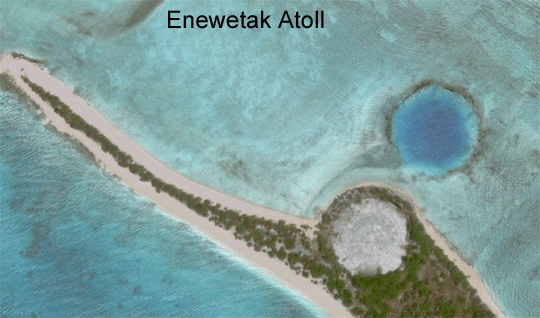
According to Phys.org, the structure in question is on Enewetak atoll in the Marshall Islands — where the US conducted 67 nuclear weapons tests between 1946 and 1958. The tests included the Castle Bravo hydrogen bomb, which was reportedly about 1,000 times bigger than the atomic bomb dropped on Hiroshima. In the late 70s, waste from those tests was dumped into a crater and capped with a concrete dome 18 inches thick. That was intended to be a temporary solution, so the bottom of the crater was never lined.
Now, UN Secretary General António Guterres and Marshall Islands President Hilda Heine fear nuclear waste could be leaking from the pit. They’re also concerned about cracks in the concrete, which they worry could break apart if hit by a tropical cyclone. Guterres says the Pacific’s
nuclear history needs to be addressed — hopefully he’ll be taken more seriously than Shin Godzilla‘s Goro Maki, who warned of impending trouble but went unheard.
May 18, 2019
Posted by Christina Macpherson |
OCEANIA, wastes |
Leave a comment

picture is from Financial Times https://www.ft.com/content/d35f0566-787b-11e9-be7d-6d846537acab
John Bolton Has Wanted War With Iran Since Before You Were Born
“I actually temper John,” Trump said, “which is pretty amazing.” Mother Jones, DAN SPINELLI, 18 May 19, Fourteen months into his tenure as national security adviser, John Bolton has become a central figure in the run-up to what could be the most extensive American military offensive since the invasion of Iraq. Tensions between Iran and the United States have been high for weeks, beginning with a menacing video Bolton released in February targeting the Iranian supreme leader and reached a boil last week when, according the New York Times, he ordered the Pentagon to prepare to send as many as 120,000 troops to the Middle East to counter Iran. ……
May 18, 2019
Posted by Christina Macpherson |
politics international, USA, weapons and war |
Leave a comment
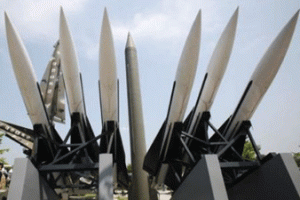 Nuclear Weapons Are Getting Less Predictable, and More Dangerous Defense One, BY PATRICK TUCKER, TECHNOLOGY EDITOR MAY 16, 2019 Facing steerable ICBMs and smaller warheads, the Pentagon seeks better tracking as the White House pursues an unlikely arms-control treaty.
On Tuesday, U.S. Secretary of State Mike Pompeo met his counterpart, Russian Foreign Minister Sergey Lavrov, to discuss, among many things, the prospect of a new, comprehensive nuclear-weapons treaty with Russia and China. At the same time, the Pentagon is developing a new generation of nuclear weapons to keep up with cutting-edge missiles and warheads coming out of Moscow. If the administration fails in its ambitious renegotiation, the world is headed toward a new era of heightened nuclear tension not seen in decades.
That’s because these new weapons are eroding the idea of nuclear predictability.
Since the dawn of the nuclear era, the concept of the nuclear triad — bombers, submarines, and intercontinental ballistic missiles — created a shared set of expectations around what the start of a nuclear war would look like. If you were in NORAD’s Cheyenne Mountain Complex in Colorado and you saw ICBMs headed toward the United States, you knew that a nuclear first strike was underway. The Soviets had a similar set of expectations, and this shared understanding created the delicate balance of deterrence — a balance that is becoming unsettled.
Start with Russia’s plans for new, more-maneuverable ICBMs. Such weapons have loosely been dubbed “hypersonic weapons” — something of a misnomer because all intercontinental ballistic missiles travel at hypersonic speeds of five or more times the speed of sound — and they create new problems for America’s defenders. …….
The United States is starting to build a new generation of smaller nukes of its own. The reasoning was laid out in the 2018 Nuclear Posture Review, and the weapons have been rolling off the assembly line since January……
But Selva also noted that low-yield weapons present the same sort of ambiguity as hypersonic weapons.
“We don’t know what they launched at us until it explodes,” he said.
The U.S. military has responded to Russian weapons development with several other key moves: building a next-generation air-launched cruise missile, hiring Northrop Grumman to build a new penetrating bomber, lowering the nuclear yield on some sub-launched ballistic missiles, and exploring bringing back a sea-launched cruise missile, or SLCM, that could have a nuclear tip……
Lynn Rusten, vice president of the Global Nuclear Policy Program at the Nuclear Threat Initiative, said that the ambiguity problem would apply to the SLCMs effort as well. “We use conventional SLCMs a lot in our normal warfare. If you start having nuclear SLCMs deployed as well, there will be a real discrimination in terms of when one of those things is launched, what is that thing coming at you? Where is it going?”……..
Many arms control experts say the first and most important step that the U.S. could take in navigating this far more unpredictable future is to extend New START. Even Selva, who declined to offer a public recommendation about such an extension, said that the United States benefits in multiple ways from the treaty’s mechanisms for keeping track of the parties’ strategic arsenals. ……
A collapse of New START might also cause China to embrace a more aggressive nuclear stance to hedge against rising unpredictability…….
As uncertainty increases, misperceptions become more dangerous. And there is reason to believe the United States is already looking at the situation through various imperfect lenses. One is the belief that China has any interest in trilateral arms control. Another is “escalate to de-escalate.” Some Russia experts, such as Olga Oliker, the Europe and Central Asia director at the International Crisis Group, call it a fiction dreamed up in the West after a misreading of a Russia’s 2017 Naval Doctrine.
“Moscow continues to believe, and Russian generals in private conversations emphasize, that any conventional conflict with NATO risks rapid escalation without ‘de-escalation’ — into all-destroying nuclear war. It must therefore be avoided at all costs,” she wrote in February.
“If anything, U.S. emphasis on new lower-yield capabilities — effectively an ‘escalate to de-escalate’ strategy of the sort many attribute to Russia — would undermine the deterrent balance, potentially triggering the very sorts of crises low-yield proponents hope to avert.”
Michael Kofman, a senior research scientist at CNA, says the “escalate to de-escalate” debate obscures a more fundamental truth about Russian strategic doctrine. “Russia has never accepted the proposition that a war with the United States could be conventional only. Hence, Russian nuclear strategy has a firm place for scalable employment of nuclear weapons, for demonstration, escalation management, warfighting, and war termination if need be,” he told Defense One. “The gist of the problem is that the Pentagon believes that nuclear weapons are some kind of gimmick that can be deterred in conventional war, but actually the prospect for conventional-only war with Russia is somewhat limited from the outset.”
Bottom line: the U.S., Russia, and China, may be entering into a high-stakes discussion on nuclear arms with each suffering from severe misconceptions about the others’ intent. The price of failure of the new negotiation effort, if New START is not re-affirmed, would be a new period of heightened nuclear tensions and less predictability.
Rusten believes the arms race has already begun.
“We don’t want to be where that trajectory will take us five years from now,” she said. https://www.defenseone.com/technology/2019/05/everyones-nuclear-weapons-are-getting-less-predictable-and-more-dangerous/157052/
May 18, 2019
Posted by Christina Macpherson |
politics international, Russia, USA, weapons and war |
Leave a comment


Vote Delayed On Bill To Prop Up Ohio Nuclear Plants WOSU Public Media, By JO INGLES 18 May 19, Lawmakers in the Ohio House continue to debate a bill that would bail out the state’s two financially struggling nuclear power plants. Earlier this week, some Democrats walked out of a committee hearing, saying their concerns were not being heard……
Democrats on the committee say they need more assurances that the changes being made will not hurt air quality or do away with clean energy…..
FirstEnergy gave more than $150,000 to House Republicans in 2018 leading up to the November election, but Householder denies a connection between the bill and FirstEnergy’s political support
https://radio.wosu.org/post/vote-delayed-bill-prop-ohio-nuclear-plants#stream/0
|
|
|
May 18, 2019
Posted by Christina Macpherson |
politics, USA |
Leave a comment
 With Bolton whispering in Trump’s ear, war with Iran is no longer unthinkable, Guardian, Owen Jones 16 May 19, Antiwar activists must do everything they can to prevent it, and that includes pressuring US allies
It was a deception that would lead to millions of civilian deaths, and the deaths of nearly 60,000 US soldiers. In August 1964 President Lyndon B Johnson solemnly declared that, after two apparent North Vietnamese attacks on US navy destroyers in the Gulf of Tonkin, military action would take place.
Four years later, Senator Albert Gore – father of Bill Clinton’s future vice-president – warned in a closed Foreign Relations Committee session that, “If this country has been misled … the consequences are very great.” His suspicions were correct. The second Gulf of Tonkin attack might never have happened – and perhaps neither did. Communications to make it look like the attack occurred had been falsified. But US policy was already set on a dramatic escalation of the Vietnam war: and here was the perfect pretext.
This week it emerged that the US government is discussing sending up to 120,000 troops to the Middle East for possible military action against Iran. “We’ll see what happens with Iran,” declared President Trump. “If they do anything, it will be a bad mistake.” The principal driving force behind this is Trump’s national security adviser, John Bolton, a man who thinks there is no problem to which the answer isn’t war: in the Bush era, his militarism was too much for the commander-in-chief who laid waste to Iraq. You can see them scrabbling for excuses already: the Trump administration says Iran-backed proxy groups are preparing attacks on US forces in Iraq and Syria, a claim forcefully denied this week by British major-general Christopher Ghika, the deputy commander of counter-terror operations in both countries. The US has blamed Iran, without evidence, for damage to Saudi oil tankers in the Gulf of Oman. Could an Iranian Gulf of Tonkin be looming?
It is easy to dismiss these fears as alarmist. Is Trump not the man who confounded his critics by seeking peace on the Korean peninsula? Trump boasts that he “actually tempers” Bolton; Iran’s supreme leader, Ayatollah Ali Khamenei, states: “There won’t be any war.” As Sanam Vakil, a research fellow at Chatham House, tells me: “Both sides are posturing, sending [threats] back and forth, and I don’t think heading for any direct military interventions.” Bolton, she reassures me, is just one of many voices in the room, and US secretary of state Mike Pompeo himself says that the US is not seeking war……..
A senior Senate aide tells me that the triumph of Bolton’s plans is all too conceivable: Bolton could exploit Trump’s ignorance of policy, an area in which he excels. While any war would not be popular with Trump’s base he could be convinced by Bolton that it is possible to escalate up to a point, then pull back at the brink: but by then it may be impossible to do so. Rightwing thinktanks and broadcasters are already hyping up links between Iran and al-Qaida.
The consequences of an Iranian conflagration should horrify us. Dan Plesch – a specialist at Soas University of London’s Centre for International Studies and Diplomacy – details the US air and naval power potentially ranged against Iran: it’s what one of his colleagues describes as “a tsunami of precision-guided molten metal”. The “lethality of US force”, says Plesch, “to very rapidly destroy military, civil, political and economic infrastructure is hugely underestimated” – and is far greater than in 2003. The US would seek to impose a government-in-exile with no roots in the country; a bloody balkanisation could follow. Iran would mobilise its regional influence – dramatically increased by the Iraq catastrophe – raising the prospect of wider regional conflict.
The risk is already too real for us to wait and see before acting. Pressure must be exerted by the public on US allies to declare their total opposition to any war with Iran, including not permitting their military bases to be used. The mass protests that will greet Trump’s visit in three weeks’ time must include demands that no British support for such a bloody adventure be offered. Feeling blasé about the danger? Well, consider this: all that stands between Bolton’s violent fantasy being executed is Donald Trump himself. https://www.theguardian.com/commentisfree/2019/may/15/war-with-iran-john-bolton-donald-trump-usa?CMP=share_btn_tw
May 18, 2019
Posted by Christina Macpherson |
politics, politics international, USA, weapons and war |
Leave a comment
|
Chelsea Manning Is Going Back To Jail, Saying She’d Rather “Starve To Death” Than Testify About WikiLeaks, BuzzFeed News,
Manning was released for a week after the grand jury she had been subpoenaed to testify before expired. A judge ordered her detained again on Thursday.
Zoe Tillman, BuzzFeed News Reporter, May 16, 2019, ALEXANDRIA, Virginia — After a week of freedom, former Army intelligence officer Chelsea Manning was ordered back to jail on Thursday for once again refusing to testify before a federal grand jury.
Manning had been jailed for two months starting on March 8 after she refused to answer questions before a grand jury in Alexandria, Virginia, about WikiLeaks and the group’s founder Julian Assange — specifically, about the cache of classified military documents that she gave to WikiLeaks in 2010. She was released on May 9 because the term of the grand jury expired.
US District Judge Anthony Trenga ordered Manning jailed on Thursday following a two-hour hearing, half of which was sealed. During the second, public portion of the hearing, Trenga announced that he had once again found Manning in civil contempt, and decided that notwithstanding her pledge not to cooperate, he thought there was still a chance that more jail time could convince her otherwise. The government had argued that because Manning had an appeal pending during part of the previous two months she served, she spent part of her earlier jail time with some hope of release. …..
Manning, wearing a black jacket, shirt, pants, and boots, told the judge she would rather “starve to death” than change her opinion, and added that she meant that “literally.”
“The government cannot build a prison bad enough, cannot create a system worse than the idea that I would ever change my principles,” she said.
The judge has the power to keep Manning in jail until she testifies or until the term of the grand jury expires again. Trenga also imposed a fine — after 30 days in jail, a daily fine of $500 will kick in, and that amount will go up to $1,000 per day after 60 days. …….
After the previous grand jury expired earlier this month and Manning was released, prosecutors convened a new grand jury in the US District Court for the Eastern District of Virginia and issued a new subpoena to Manning, requiring her to come back and testify. Speaking to reporters before she went into the courthouse, Manning again vowed not to answer any questions.
“I will not cooperate with this or any other grand jury,” Manning said.
Grand jury proceedings are normally secret, but Manning and her support team confirmed that prosecutors want to ask her about WikiLeaks. A military court found Manning guilty of violating the Espionage Act in 2013, among other crimes, for leaking hundreds of thousands of military documents to WikiLeaks. She was sentenced to 35 years in prison. But in January 2017, in the final days of the Obama administration, former president Barack Obama commuted Manning’s sentence, and she was released in May of that year.
Assange is facing an indictment in the Alexandria court charging him with conspiring with Manning to hack into US Defense Department computer systems in 2010. Assange is in London — he was arrested on April 11 after spending years in the Ecuadorian Embassy as an asylum-seeker — and is contesting efforts by the US government to extradite him to the United States. It could be years before the extradition fight is resolved, however.
The Justice Department has 60 days after seeking a “provisional arrest” of Assange through UK authorities in mid-April to submit a final extradition package. Once that happens, prosecutors can’t add any more charges against him. It’s unclear if prosecutors want Manning to testify before the grand jury specifically about matters that could lead to more charges against Assange, or as part of a broader investigation with other subjects.
Manning has repeatedly challenged the lawfulness of the government’s effort to force her to testify, and said she believes she may have been under surveillance. The US Court of Appeals for the 4th Circuit summarily rejected her challenges to the subpoena and her incarceration the first time she was jailed. …….https://www.buzzfeednews.com/article/zoetillman/chelsea-manning-back-jail-wikileaks-assange
|
|
May 18, 2019
Posted by Christina Macpherson |
civil liberties, USA |
Leave a comment
 This Town Didn’t Want to Be a Radioactive Waste Dump. The Government Is Giving Them No Choice. Earther, Yessenia Funes , 17 May 19,PIKETON, OHIO
—David and Pam Mills have grown tomatoes, peppers, cucumbers, and okra on their secluded Appalachian property for about 18 years now. This will be the first year the retired couple doesn’t. They just can’t trust their soil anymore. Not with what’s being built barely a five-minute walk away.
Past the shed and through the gray, bare trees that grow in the backyard, bulldozers and dump trucks are busy scooping tan-colored dirt atop an overlooking hill on a brisk January afternoon. They’re constructing a 100-acre landfill for radioactive waste. …..On a short metal fence marking where the Mills property ends, a sign reads, “U.S. PROPERTY, NO TRESPASSING,” in big, bold letters with red, white, and blue borders.
The Department of Energy (DOE) owns what sits on the other side: the Portsmouth Gaseous Diffusion Plant. The DOE built the 1,200-acre facility, located just outside town of Piketon about an hour’s drive south of Columbus in southcentral Ohio, in 1954, as
one of three plants it was using to enrich uranium and develop the country’s nuclear weapons arsenal. Now, the agency is trying to clean it up.
The landfill—or “on-site waste disposal cell,” as the department calls it—would extend about 60-feet down and house 2 million tons of low-level radioactive waste comprised of soil, asbestos, concrete, and debris. It’ll be outfitted with a clay liner, a plastic cover layer, and a treatment system for any water that leaches through it. When finished, it will be one of the largest nuclear waste dumps east of the Mississippi.
Waste could begin entering it as soon as this fall…….
“It’s gonna contaminate everything,” David says, after he shows me how close the landfill sits to his property. “It’s just a matter of time.”
The couple is far from alone in their fears. The 2,000-strong Village of Piketon passed a
resolution in August 2017 opposing the landfill. So did the
local school district and the
Pike County General Health District, where Piketon resides. The rural, low income, and largely white county is home to more than 28,000 people across a number of small towns and cities, some of which have passed their own resolutions against this project. Driving through neighborhoods behind Piketon’s main highway, lawn signs covered in red stating “NO RADIOACTIVE WASTE DUMP in Pike County” can be seen everywhere……
The Zahn’s Corner Middle School, which sits barely a 10-minute drive away from the plant,
closed on May 13 after university researchers detected enriched uranium inside the building, and traces of neptunium appeared in readings from an air quality monitor right outside the school. While the DOE believes everything’s fine, the Pike County General Health District
has been calling for the department to halt work while it investigates the matter. Townspeople worry this contamination is a direct result of recent activity at the plant.
All of this highlights deep public distrust over the nuclear facility’s cleanup plan. And after reviewing thousands of pages of documents—including independent studies, the project’s record of decision, and the remedial investigation and feasibility studies that went into writing it—to understand the risks, it’s clear the public isn’t worried for nothing.
Here’s the thing: Nothing is technically illegal about the landfill. The DOE, though the polluter, is taking the lead on cleaning up the facility, and the Ohio EPA supports its plan. Whether their decision is morally right given local opposition is another matter. But this is what often happens when a corporation or governmental entity needs to dispose of toxic waste: It gets left in an overlooked town no one’s heard of……..
What they, and everyone really, didn’t understand at the outset of the Cold War was the lasting impacts uranium enrichment could have. Sure, scientists understood radioactive material could cause cancer, but they thought that it’d take
a lot of radiation, explained Edwin Lyman, a senior scientist and acting director of the Union of Concerned Scientists’ Nuclear Safety Project. Now, we know
any exposure poses a risk……
Now, the DOE is left with the task of cleaning up the more than 2 million tons of low-level radioactive waste and thousands more tons of hazardous waste the plant’s operations left behind. Completing the landfill is estimated to take another 10 to 12 years, with the entire clean-up projected to go on
until 2035. ……
Money aside, shipping radioactive waste off-site has other benefits. Some 24 wetlands and 38 streams sit near the landfill. To bury the waste on-site, the DOE must waive a requirement that prevents it from constructing the landfill within 200 feet of these kinds of water bodies. The department can do so because even though it’s not technically a Superfund, it’s being regulated as one, a common practice for such DOE facilities. ……
the local hydrology is a key point of concern among community members. The region has a rainy climate, and it’s been seeing
above-average levels of precipitation in recent years. More than anything, it’s the idea of rainfall causing the landfill’s contents to leak into the groundwater that makes people so nervous…….
Despite the fancy cut-outs put together by DOE contractor Fluor-BWXT, Chillicothe city council members passed a resolution that day against the waste cell. And it wouldn’t be the last: at least 11 counties, townships, city councils, and school boards in southcentral Ohio have come out against the project. Unfortunately, the plan was set by the time these resolutions passed.
Here’s the thing: Many residents didn’t even know about the landfill until after the DOE had already decided on it. The public had between November 2014 and March 2015 to comment on the project. The department published its record of decision in favor of the landfill on June 30, 2015. Then, the backlash hit……..
A lot of community members worry that the town will continue to be impoverished and devoid of business opportunities so long as it’s home to the landfill. Who’s going to want to invest in a place that’s a nuclear dumpsite?
And Piketon officials don’t trust the DOE at all. Neither does the plant’s former chief scientist, David Manuta, who worked there for nearly 11 years and has seen firsthand the operations that went on.
“DOE has a history in this community of not listening,” Manuta told Earther. “DOE is not a popular government agency in this community.”……
As the Ferguson Group points out in its analysis, fractures deeper than 20 feet exist throughout the entirety of where the landfill will be built, with some reaching as deep as 70 feet.
“This is the craziness of it all. They go out there and investigate this what we call ‘ideal site,’ right?” Karl Kalbacher, the Ferguson Group consultant Piketon hired for this analysis, told me. “There’s groundwater just oozing out of the ground, which tells you there’s a very shallow water table. They document that there are streams that are flowing through the proposed site area.”……..
To opponents of the landfill, all these fractures and discrepancies raise concerns about the DOE’s commitment to keeping the region contaminant-free. So does the recent independent analysis from
Northern Arizona University that prompted the closure of Piketon’s Zahn’s Corner Middle School this week. That analysis found that the Scioto River and village creeks, as well as dust and soils from the school and private homes, are currently contaminated with enriched uranium, neptunium, and plutonium—all radioactive carcinogens. While the analysis did not measure concentrations, it found that much of this contamination could, indeed, be traced back to the plant……..
Regardless of whether the DOE is concerned, the evidence suggests demolition of the plant and construction of the landfill may already be spreading some contaminants via the air. Add in the threat of the landfill impacting groundwater, and opponents see several additional health risks in a regional already overburdened by cancer.
Jeanie Williams, a 63-year-old who’s lived in a spacious trailer home since 1972 right alongside the plant—not far from where the Mills live—knows that statistic all too personally. Cancer took Williams’ brother in 1999. Her dad worked at the plant and died of lung disease about 10 years ago. Her stepfather worked there and died last year from cancer. Her daughter is battling colon cancer. https://earther.gizmodo.com/this-town-didnt-want-to-be-a-radioactive-waste-dump-th-1834789264?IR=T
May 18, 2019
Posted by Christina Macpherson |
USA, wastes |
Leave a comment

Unusual secrecy around 1950s nuclear testing , The Saturday Paper, Martin McKenzie-Murray 18 May 19 Between 1952 and 1957, Britain tested 12 nuclear weapons in Australia – on the Montebello Islands off the Pilbara coast, and at Maralinga and Emu Fields in the South Australian outback. The tests were hurried, incautious and showed extraordinary disregard for Australian assistance and the local Indigenous people who had been forcibly but imperfectly evacuated from their land.
It was a clusterfuck,” says Elizabeth Tynan, an Australian historian, and the award-winning author of Atomic Thunder: The Maralinga Story. “The disregard was partly driven by the fact they were in a rush. They cut corners. They did it on the cheap – and it showed. They had very little regard for safety. Cavalier. They knew about the risks. There were international protocols. Many were disregarded. I met one man, he was a technician with the British effort in Australia, and he said of Indigenous Australians that they were ‘nothing to do with us – it was the Australian government’s responsibility’.”
For Susanne Roff growing up in Melbourne in the 1950s was uneventful. But later, living in Scotland with her husband, William Roff, an eminent historian, she developed a dogged, almost obsessive interest in this chapter of British history that remains cloaked in secrecy.
Once a month, Roff takes the train south from her home in a Scottish fishing village – to archives in London, Birmingham and Cambridge. She’s still looking for answers. “Why was the purportedly Australia-controlled Atomic Weapons Tests Safety Committee so ineffective?” she asks. “Why was the UK able to continue testing at Maralinga until barely six weeks before opening of the 1956 Olympics despite the known hazards to east coast populations? Why didn’t [Sir Mark] Oliphant ever speak out against the tests and contamination, including when he was governor of South Australia?”
Late last year, Roff had another question: Why, more than 60 years after the last nuclear test in Australia, had the British government suddenly vanished previously declassified documents about the tests from its national archives? Roff wasn’t alone in her surprise. The Campaign for Freedom of Information, a British not-for-profit organisation, described it as worrying.
All that was certain was that the files had been removed on the order of the Nuclear Decommissioning Authority.
“WE CAN BUT WONDER WHY THE WORLD’S THIRD ATOMIC AND THERMONUCLEAR POWER HAS SUDDENLY BECOME SO NERVOUS ABOUT EVENTS THAT HAPPENED DECADES AGO.”“The secrecy is arguably even worse today,” Tynan tells me. She is working on a second book about the British tests. “British service personnel have run into brick walls at every turn [in seeking compensation and acknowledgement]. One of the clues to the attitude of the British government is that it has not really ever properly acknowledged what they did. They were nuclear colonialists and they buggered up a part of our country. One former British personnel I met burst into tears when he thought about how Britain had never said sorry. The secrecy … seems incomprehensible. They continue to be secretive.”
But not all documents are closeted. Susanne Roff has some, which she shared with me – British intelligence files on Dr Eric Burhop, an Australian physicist who had worked on the Manhattan Project, which ran from 1939 to 1946. …….
Robert Menzies agreed to the testing immediately, without bothering to consult cabinet. For a time, only three people in the country knew of the agreement: the prime minister, treasurer and defence minister. He asked few questions of the British. “But it wasn’t pure patriotic sycophancy,” Tynan says of Menzies’ decision. “The pragmatic response was: vast reserves of uranium in Australia. It’s central to weaponry and power. It was completely valueless until the Manhattan Project. Then it became a valuable commodity. Australia had a lot of it. That was a very significant part of his reasoning. The other thing that would’ve informed Menzies’ thinking was that he was anxious to ensure Britain and America would protect Australia.”
They were also without the counsel of the Australians who had worked on the American tests – notably, Mark Oliphant and Eric Burhop. Both Susanne Roff and Elizabeth Tynan agree Oliphant would have been a strong head of the safety authority, which was otherwise feckless.
Both men were long suspected of being Communist spies, and may have been excluded to mollify US doubts about British security. The files on Burhop that I’ve seen are voluminous. The FBI, MI5 and ASIO all had records on him. In England and America, he was aggressively surveilled. His phone was tapped. Even Joseph Rotblat had his doubts about his former colleague. The British intelligence historian Andrew Brown has written: “Rotblat remained convinced that Burhop and other left-wing scientists … opposed the [proposed nuclear] moratorium not for their stated reasons but because it would perpetuate the USA’s monopoly and place the USSR at a dangerous disadvantage.”……
In 1984, Australia held a royal commission into the British tests. It found a litany of negligence and cover-ups. “Britain had to be dragged, kicking and screaming, to it,” Elizabeth Tynan says. Today, their attitude is much the same. In 2015, Fiji – frustrated by Britain’s refusal to compensate its people who suffered radiation poisoning during the Pacific tests – declared it would compensate citizens itself. “We are bringing justice to a brave and proud group of Fijians to whom a great injustice was done,” Fiji’s prime minister said. “Fiji is not prepared to wait for Britain to do the right thing.”
Meanwhile, in Britain’s national archives, the nuclear files are still gone. “The UK government has always [downplayed] risks to the servicemen who took part in the tests, the Aboriginal community in the immediate vicinity of them, and the general population downwind … as well as possible genetic effects on subsequent generations,” Susanne Roff says. “We see similar responses in relation to Fukushima in Japan. All the operational and scientific documents relating to the Australian tests that have been on open access in the National Archives have suddenly gone walkabout. We can but wonder why the world’s third atomic and thermonuclear power has suddenly become so nervous about events that happened decades ago.” https://www.thesaturdaypaper.com.au/news/law-crime/2019/05/18/unusual-secrecy-around-1950s-nuclear-testing/15581016008158
|
|
May 18, 2019
Posted by Christina Macpherson |
AUSTRALIA, history, OCEANIA, politics international, secrets,lies and civil liberties, UK, weapons and war |
Leave a comment
“Get Your Endangered Species Off My Bombing Range!” Counter Punch by JOAN  ROELOFS MAY 17, 2019,
 “The Department of Defense’s ability to conduct realistic live-fire training, weapons system testing, and essential operations is vital to preparing a more lethal and resilient force for combat. . . . Starting in the late 1990s, the Department became increasingly concerned about “encroachment” pressures adversely affecting the military’s use of training and testing lands. Specifically, military installations saw
two main threats to their ability to test, train, and operate: nearby incompatible land uses and environmental restrictions to protect imperiled species and their habitats.”
Such problems are to be resolved by the DoD Readiness and Environmental Protection Integration
(REPI) Program.
The program employs “buffer partnerships” that include the DoD, private conservation groups, universities, and state and local governments. Also involved, often as additional funders, are other federal departments: Homeland Security, Energy, Interior, Agriculture, Commerce; and agencies, for example, the Agency for International Development (USAID) and the National Oceanic and Atmospheric Administration (NOAA). REPI regards these as “win-win partnerships,” as they share the cost of land or acquire easements to preserve compatible uses and natural habitats, without interfering with bombing or other essential training exercises. In addition to the helpful funding, the military can muster impressive influence over local development authorities, town councils, and adjacent landowners…….
At Fort Benning, Georgia, home of the “Maneuver School of Excellence,” (as well as the notorious School of the Americas, now renamed the Western Hemisphere Institute for Security Cooperation), live-fire and other training was threatened by threatened species and their habitats. Now the base and its partners are restoring habitat and offering contiguous land for buyers who would use the land for recreation. Among the partners are the Georgia Land Trust, The Conservation Fund, the Alabama Land Trust, and the Nature Conservancy (TNC).
Nationwide, TNC is likely the conservation organization with the greatest amount of funding from the DoD. The TNC grants for Fort Benning alone included (but were not limited to) one for $11,115,000, and another for $55,517,470. Both were described as: “Assist State and local governments to mitigate or prevent incompatible civilian land use/activity that is likely to impair the continued operational utility of a Department of Defense (DoD) military installation.”
Washington State, very receptive to military activities, despite the Hanford nuclear disaster area, has several REPI projects. One of them, at Joint Base Lewis-McChord, on Puget Sound, is to eliminate the “threat” to live-fire exercises and other missions coming from imperiled species and incompatible development. The extensive area beyond its 91,000 acres became a designated “Sentinel Landscape,” a partnership headed by Departments of Agriculture, Defense, and Interior to “align resources” to protect military testing “while benefiting ALL partners and landowners.” ……
The Defense Department has several other programs designed to prevent interference with live ammunition, bombing ranges, and other military activities. One is the Legacy Resource Management Program, which seeks civilian partners to help protect endangered species and “to promote stewardship of our nation’s. . . cultural heritage.” Already “The Department of Defense manages thousands of National Register of Historic Places-listed properties. . .” Also working with REPI is the DoD’s Office of Economic Adjustment; its Joint Land Use Studies Program helps local communities to avoid interfering with military operations by their civilian activities.
The military has a poor reputation as regards the environment—we think about the Marshall Islands, the Hanford Nuclear Reservation, poisoned aquifers, toxic waste burns, underwater sonar, and much more. It has paid attention to the criticisms. It still engages in its former ways, including the world record of oil consumption and extensive toxic emissions, but now there is a soft cop.
The DoD now emphasizes its need for natural landscapes for realistic training, its wish to avoid displacing or accidently bombing locals, and its help in protecting endangered species. However it does not want any environmental restrictions to poke into its activities. The military wants more land, airspace, and ocean clearance, and will make concessions. It uses the carrot, and the commanding influence of military power. The REPI Program supplies funds and also leverages contributions from state and local governments and conservation organizations, which are henceforth partners…..
there are serious concerns about the REPI project, and similar ones that partner with civilian governments and nongovernmental environmental organizations. First of all, by publicizing its protection of red-cockaded woodpeckers, gopher tortoises and others, their habitats, working farmlands, forests, and wetlands, the DoD emits a dust cloud over the intense environmental destruction of land, sea, and air resulting from military operations and their preparations. Militarization is worldwide and beyond, into space. In addition to the contribution of the US, other nations’ militaries are increasing in size, activities, and lethality. Many have been armed by us, or against the threat of us; some in response to other perceived threats. ……
Toxic wastes are produced (and not sequestered) at many US domestic bases; our military has granted us the bulk of superfund sites. As Joshua Frankhas stated:
US military sites, which total more than 50 million acres, are among the most insidious and dangerous Pentagon legacies. They are strewn with toxic bomb fragments, unexploded munitions, buried hazardous waste, fuel dumps, open pits filled with debris, burn piles and yes, rocket fuel…….
Another major concern about REPI and other military “partnerships” with civilian institutions and terrain is that it erodes the boundaries, however weak these days, between civil and military. Might the US be turning into a banana republic or a military dictatorship? Penetration is not new; the US Army Corps of Engineers have been developing and maintaining recreational lakes and flood control projects for a long time. However, the military is slowly expanding into every nook and cranny of civilian life. …..
https://www.counterpunch.org/2019/05/17/get-your-endangered-species-off-my-bombing-range/
May 18, 2019
Posted by Christina Macpherson |
environment, Reference, USA, weapons and war |
Leave a comment
|
 Some in rural Nevada see benefits in nuclear repository plan, WRAL.com MIRANDA WILLSON, Las Vegas Sun 17 May 19, LAS VEGAS Some in rural Nevada see benefits in nuclear repository plan, WRAL.com MIRANDA WILLSON, Las Vegas Sun 17 May 19, LAS VEGAS — Elected officials in rural Nye County say they support moving forward with a long-studied but mothballed national nuclear waste repository in Nevada, unlike their counterparts in urban Las Vegas, approximately 90 miles away.
But the Las Vegas Sun reports that residents who live close to Yucca Mountain are split on whether storing approximately 70,000 tons of nuclear waste there is a good idea.
Spanning more than 18,000 square miles, Nye County is the largest county by area in Nevada, with a population of 44,200 people.
Some see the proposed repository as a potential bringer of economic development and jobs to a county where nearly 19% of residents live below the poverty line.
Others say the environmental and human health risks of transporting and storing the nation’s most radioactive material are too high, and unjust, considering that Nevada doesn’t produce nuclear energy.
Nevada’s U.S. senators, Jacky Rosen and Catherine Cortez Masto, Gov. Steve Sisolak, Democrats, and most of the state’s congressional representatives and officials in Clark County surrounding Las Vegas share similar concerns.
Nonetheless, Nye County commissioners are urging lawmakers in Congress to support the Nuclear Waste Policy Amendments Act of 2019, sponsored by Sen. John Barrasso, R-Wyoming, chairman of the Committee on Environment and Public Works.
The bill has a name recalling a measure that Congress passed in 1982 and amended in 1987. It would restart the licensing process for establishing Yucca Mountain as the primary storage site for the country’s spent nuclear fuel.
Progress toward licensing stopped in 2009 under President Barack Obama. President Donald Trump has signaled support for moving forward again.
In a letter to Barrasso and Sen. Tom Carper, D-Delaware, a ranking member of the Committee on Environment and Public Works, Nye County commissioners asked lawmakers to allow the Nuclear Regulatory Commission to renew its review of the Yucca Mountain proposal.
Eight other rural counties in Nevada also support resuming the Yucca Mountain licensing process……..
The county’s National Resources and Federal Facilities chief, Daryl Lacy, said many residents are convinced that nuclear waste isn’t inherently dangerous.
He says Yucca Mountain could bring several thousand highly paid jobs to Nye County, where the former Nevada Test Site, renamed the Nevada National Security Site, remains the largest employer in Nye County.
Lacy said officials support resuming discussions about how waste could be transported and stored safely, as well as financial benefits the county and the state would get in return.
“Many of the people here understand that yes, there’s risks, yes, it’s a nasty material, but it can be handled appropriately. And it’s not necessarily any worse than other things that have been done here in the past,” Lacy said, referring to nuclear detonations from 1951 to 1992……..
Ninety-eight nuclear reactors operating in 30 U.S. states have so far produced approximately 90,000 tons of radioactive waste. Most is stored at reactor sites using dry cask storage, intended to be a temporary solution……
Susan Sorrells, owner and manager of Shoshone Village just over the California state line, says Yucca Mountain could devastate an area that relies on tourism to Death Valley National Park, which draws more than 1 million people a year.
A fourth-generation resident of the town of fewer than 30 people, Sorrells said Yucca Mountain would negatively impact ecotourism that she spearheads. She also worries about impacts on the area water supply, which she says is affected by nuclear testing decades ago.
Patrick Donnelly, Nevada director for the Center for Biological Diversity and a former Shoshone resident, said he believes environmental and safety risks outweigh potential economic benefits.
Joe Kennedy, former Timbisha Shoshone chairman, says nuclear waste could affect the environment and water supply in Indian Village and Furnace Creek, California, close to Death Valley.
Ian Zabarte, principal man for the larger Western Shoshone Nation that includes the Timbisha, questions whether the Timbisha would reap any financial benefits if Yucca Mountain moves forward……. https://www.wral.com/some-in-rural-nevada-see-benefits-in-nuclear-repository-plan/18393722/
|
|
May 18, 2019
Posted by Christina Macpherson |
opposition to nuclear, USA |
Leave a comment
Morning Star 16th May 2019, Alan Simpson: The unthinkable is happening. Parliament, public institutions and the press are waking to the fact that climate change can only be
constrained by systems change. This recognition is still in its infancy,
but it is already unstoppable.
Since the 2017 general election, there have
been ample opportunities for MPs to show real political leadership on the
climate crisis. They never did. Instead, Parliament has preferred to play
Trivial Pursuit with Brexit absurdities. Social movements had to step into
the vacuum; addressing the big picture issues politicians had been choosing
to ignore.
Britain’s Climate Change Committee (CCC) would not have had
the political space to bring forward their own “pull your finger out”
report without the occupations that brought London streets to a halt. Nor
would they have been listened to.
The latest UN report on species extinctions now gets treated as evidence, not argument. Politicians of all shades queue up, calling for a programme to deliver the CCC rescue plan.
Few grasp the upheavals involved (or that, in itself, this will still not
be enough). Over 60 per cent of what the CCC calls for involves behaviour
change; all of which is doable. What they duck is that you won’t get
behaviour change without systems change.
How can Labour deliver climate stability if large parts of the party are still locked into airport
expansions, fossil fuel subsidies, expanding road programmes and the
illusion of a new era of global free-trade deals? Physics tells us there
are no “slow track’ survival options left.
A better starting point lies
somewhere between Extinction Rebellion and the CCC. To join in, Labour may
need to tear up whatever has been its draft manifesto for the next
election, replacing it with a new “climate emergency” one. Former
Labour leader Ed Miliband was right in telling Radio 4 that the British
economy must be “put on a war footing to tackle climate change.”
The answer isn’t to go building more runways, motorways or shopping malls.
What we need is to replant forests, green our cities, and give pollinators
places to feed, breed and shelter in. And for the public, we need a
national programme to green the nation’s habitat too; delivering warm
homes that also produce more energy than they consume.
https://morningstaronline.co.uk/article/f/climate-jesus-versus-pharisees
May 18, 2019
Posted by Christina Macpherson |
general |
Leave a comment
Solar Power Portal 16th May 2019 The Labour Party has announced plans to install solar one 1.75 million homes as part of a huge energy sector shake-up. The plans would see solar
installed on 1 million social homes in a bid to tackle fuel poverty, while
a series of interest free loans, grants and regulatory changes will help
enable an additional 750,000 domestic installs. Full details of the plans
are to be announced by Labour Party leader Jeremy Corbyn later today. The
party said the policies stood to create nearly 17,000 jobs, while raising
as much as £66 million for local authorities through the export of surplus
generation. Corbyn said that the party’s self-styled Green Industrial
Revolution would benefit homeowners and revive parts of the country through
the creation of new industries.
https://www.solarpowerportal.co.uk/news/labour_party_unveils_new_solar_commitment_in_push_to_install_pv_on_1.75_mil
May 18, 2019
Posted by Christina Macpherson |
renewable, UK |
Leave a comment
 New Jersey’s $300 Million Nuclear Power Bailout Is Facing a Court Challenge. Does It Have a Chance?
 The state’s utility advocate said regulators should not have approved the subsidies for the energy company PSEG.by
Talia Buford , May 16,
But some of the board members who voted for subsidies had openly questioned the need for them, echoing concerns expressed by the board’s staff and objections raised by utility watchdogs.
Now, the unusual circumstances around the vote are the basis of a legal challenge by the state-appointed utility advocate, who says the subsidies — and the surcharge financing them — should be cut off.
In an appeal filed on Wednesday in state court, Stefanie Brand, the state’s rate counsel, said that by ignoring its own staff experts and providing little basis for the amount of the surcharge, the board had violated the law.
“It’s very unusual and inconsistent with the statute,” Brand said.
But will that argument persuade a court?
“It’s hard, in general, to beat regulators at their own game,” said Ari Peskoe, a lawyer and director of the Electricity Law Initiative at the Harvard Law School. ……..
“The significant thing about this filing is the rate counsel was given this on a silver platter on why these subsidies are unwarranted,” said Doug O’Malley, director of Environment New Jersey. “It’s not a surprise that she’d be filing an appeal. I think the surprise is the ratepayer has such a strong case.”
The appeal focuses on four issues: the staff findings that PSEG didn’t meet the criteria for the subsidy; the board’s dismissal of those findings; the lack of reasoning for setting the subsidy rate at $0.004 per kilowatt hour, which was calculated to provide a total subsidy of $300 milion; and whether the amount of the subsidy represented clean-energy benefits as legislators claimed.
PSEG’s Hope Creek and Salem plants in Salem County make up the second-largest nuclear facility in the United States, and they serve as an economic anchor for the area, which is represented by New Jersey’s most powerful legislator, Senate President Stephen Sweeney. New Jersey passed its nuclear subsidy last year after intense lobbying by PSEG, which spent nearly $4 million in 2017 and 2018 on the effort.
Similar measures that offer incentives for nuclear plants to stay open after the companies have threatened to close them survived challenges in federal court. This month, Pennsylvania legislators said they didn’t have the support to bring the proposed subsidy bill to a vote, prompting Exelon to announce plans to close Three Mile Island nuclear plant in September.
Since the debate over the New Jersey measure began in 2017, Brand has questioned how legislators came up with the amount of the subsidy…….
At the board meeting last month, BPU staff and an independent consultant reported that PSEG was including some ineligible costs and inflating others in an attempt to satisfy the statute’s requirements, but they said that the facilities were not actually in danger of closing. …….
While the run-up to the BPU vote was marked by full-page newspaper ads and stories in local media, the only indication that customers were subsidizing PSEG’s nuclear plants was, for some, a note on the top corner of their latest bills. https://www.propublica.org/article/new-jerseys-300-million-nuclear-power-bailout-is-facing-a-court-challenge-does-it-have-a-chance#
May 18, 2019
Posted by Christina Macpherson |
Legal, USA |
Leave a comment
Nuclear weapons are archaic weapons that promote an outdated global order rooted in inequality and oppressive patriarchy. Which is another way of saying: our world isn’t that dissimilar to the world of Game of Thrones. The destruction that happened in King’s Landing could happen here, too. My hope is that the fictional blaze witnessed by the Game of Thrones viewership (43 million people!) will serve as a warning, and will spark denuclearization action.
|
What ‘Game of Thrones’ Taught Us About Nuclear Devastation https://www.thedailybeast.com/what-game-of-thrones-taught-us-about-nuclear-devastation?ref=scroll
The destruction that happened in King’s Landing can happen in our world, too, writes Beatrice Fihn, winner of the Nobel Peace Prize in 2017.
Beatrice Fihn, 05.17.19 “Atomic bombs are primarily a means for the ruthless annihilation of cities.”
Famed physicist Leo Szilard wrote those words in 1945, entreating President Harry Truman to give Japan a chance to surrender before using the nuclear weapons Szilard had been instrumental in developing. His words rang in my head as Tyrion tried and failed to convince Daenerys to spare the surrendering King’s Landing from her dragon’s fire in the latest Game of Thrones episode, “The Bells.”
There is a significant difference between weapons of war and nuclear weapons. The former target their opponent’s military force. The latter yield absolute and indiscriminate power to kill civilians. Harry Truman admitted that nuclear weapons were created for the destruction of cities when he said, “You have got to understand that this isn’t a military weapon. It is used to wipe out women and children and unarmed people, and not for military uses.”
In the first seven seasons of Game of Thrones, Daenerys’s dragons have been a veiled threat. They were a plot device; their purpose was to transform Daenerys from meek girl to strong queen. But that changed Sunday night. On Sunday night, viewers around the country saw the full power of a dragon’s destructive force as it breathed fire onto a city.
A modern nuclear weapon would also, essentially, breathe fire: it would cause a fireball burning 10,000 times stronger than the surface of the sun, incinerating everyone and everything within nearly a mile. That heat would cause third-degree burns in a radius of 50 square miles and the shock wave would flatten most buildings within 10 miles of ground zero. In Nagasaki, ground temperatures reached 7,000°F and radioactive rain poured down. 70 percent of all buildings were razed in Hiroshima including 42 out of the city’s 45 hospitals. These facts have led the UN and ICRC to state that in the event of a nuclear bombing, no help is coming.
It’s worth noting that although Trump has been criticized for spending large sums on new nuclear weapons, the Nuclear Modernization Program was actually started by the Obama administration, with support from both secretaries of state, John Kerry and Hillary Clinton and it’s unlikely a Hillary Clinton presidency would look much different on the issue of nuclear weapons than a Trump one.
Although she is a (fictional) woman, Daenerys could burn a city to the ground. Although she is a woman, Hillary Clinton could support the Nuclear Modernization Program. Women aren’t inherently pacifist; more women in power will not be enough. It is important to get rid of the corrupting power of nuclear weapons instead of relying on our leaders to use them responsibly.
And yet, ironically, abolishing nuclear weapons is a feminist issue, because nuclear fallout disproportionately affects women. Women in Hiroshima and Nagasaki had nearly double the risk of developing and dying from solid cancer due to ionizing radiation exposure. Girls are considerably more likely than boys to develop thyroid cancer from nuclear fallout. Pregnant women exposed to nuclear radiation face a greater likelihood of delivering children with physical malformations and stillbirths, leading to increased maternal mortality. And the list goes on.
Nuclear weapons are archaic weapons that promote an outdated global order rooted in inequality and oppressive patriarchy. Which is another way of saying: our world isn’t that dissimilar to the world of Game of Thrones. The destruction that happened in King’s Landing could happen here, too. My hope is that the fictional blaze witnessed by the Game of Thrones viewership (43 million people!) will serve as a warning, and will spark denuclearization action.
I am reminded of another TV event: the 1983 TV Movie The Day After. Over 100 million people in nearly 40 million households tuned in for the 2-hour film, and most stuck around for a 90-minute conversation about the film hosted by Ted Koppel. The movie’s unflinching account of the horrific aftermath of nuclear war was the topic of conversation around the water cooler for every American and even found its way into President Reagan’s diary.
TV has the power to move the world—for good or ill. Ronald Reagan sent a telegram to Nicholas Meyer, the director of The Day After, as he signed the 1987 INF Treaty with the Soviet Union. The telegram read: “Don’t think your movie didn’t have any part of this because it did.”
It can feel insensitive or even flippant to compare the real deaths and destruction of nuclear war with a fictional dragon razing a fictional city. However, like The Day After, Game of Thrones has transcended TV to become a cultural touchstone—a world we all gather in once a week and debate endlessly after. “The Bells” was a gift to those of us who work for disarmament and give all our energy to avoiding war. Millions saw a glimpse of the horror of war in a way they could understand and were primed to receive.
Let’s hope our leaders were watching. Let’s hope they saw Arya Stark walking through the crumbled buildings and charred bodies. Let’s hope they saw the look on her face. That look wasn’t feigned; the actress Maisie Williams described shooting the painfully long sequence as “sickening even to the strongest person.” The horror Williams felt would be familiar to anyone exposed to the reality of the atomic bombings of Hiroshima and Nagasaki, or the suffering of those at nuclear test sites.
We cannot wait until nuclear weapons are used again to eliminate them; by then it will be too late. We need creative voices to remind us of the hidden humanitarian disaster of nuclear weapons so we can act now.
As Daenerys and Drogon transformed into the “destroyer of worlds,” I recalled something I often say to those who argue that there are good and bad nuclear-armed states: the weapons are the problem, not the leaders. Like dragons, they are destructive power that no one person should hold over humanity. If Daenerys wasn’t able to use her dragons responsibly, then nobody can. It was not the Targaryen bloodline that was cursed, it was the dragons that corroded their humanity. Luckily, unlike dragons, nuclear weapons are not magical, they are just weapons and we can dismantle them. We must.
We already have a plan to eliminate our dragons. 122 states voted in favor of the Treaty on the Prohibition of Nuclear Weapons at the UN in 2017. 23 states have already ratified the treaty and it will become international law once 50 do. When asked why they supported the treaty, the diplomats and leaders all said the same thing: they were compelled to sign after learning about the ruthless devastation that nuclear weapons cause. A real hero doesn’t unleash a dragon. A real hero picks up a pen. The truly radical action is just that: a signature.
In our world and in the world of Game of Thrones, there are characters in the shadows, negotiating behind the scenes for a peace that will save innocent lives. That’s what bravery looks like. Those are the heroes we need. Rest in Peace, Lord Varys.
Beatrice Fihn is the Executive Director of the International Campaign to Abolish Nuclear Weapons, winner of the Nobel Peace Prize 2017.
|
|
May 18, 2019
Posted by Christina Macpherson |
culture and arts, media |
Leave a comment











 nuclear-news