Another nail in the coffin of the ‘integral fast nuclear reactors’ championed by nuclear lobby shills
Jim Green.Nuclear Fuel Cycle Watch South Australia https://www.facebook.com/groups/1021186047913052/– 9 May 19
 Another nail in the coffin of the ‘integral fast reactors’
  championed by Ben Heard, Barry Brook et al.
A decision on the fate of UK’s Plutonium stockpile remains years away. http://corecumbria.co.uk/briefings/a-decision-on-the-fate-of-uks-plutonium-stockpile-remains-years-away/?fbclid=IwAR2yPVluaq70YaoxikF_paOTbJ9BwleBhtGQb6kF0vI2sT4Ae-0M7HIItrE, 6th May 2019 The much delayed update from the Nuclear Decommissioning Authority (NDA) on its plans for dealing with Sellafield’s burgeoning plutonium stockpile was quietly published at the end March 2019 under the title ‘Progress on plutonium consolidation, storage and disposition’. The lack of fanfare for its publication may be attributable to the absence of any major breakthrough in progress since the NDA’s 2014 Position Paper and the subsequent warning given to a Sellafield Stakeholder Group in 2016. Continue reading
Trump announces new sanctions on Iran. Iran warns it will step away from nuclear deal
U.S. Issues New Sanctions as Iran Warns It Will Step Back From Nuclear Deal, NYT, By David E. Sanger, Edward Wong, Steven Erlanger and Eric Schmitt, May 8, 2019
WASHINGTON — Iran’s president declared on Wednesday that he would begin to walk away from the restrictions of a 2015 nuclear deal, and the Trump administration responded with a new round of sanctions against Tehran, reviving a crisis that had been contained for the past four years.
The escalation of threats caught the United States’ allies in Europe in the crossfire between Washington and Tehran. And while the announcement by President Hassan Rouhani of Iran did not terminate the landmark nuclear accord that was negotiated by world powers, it put it on life support.
Britain, France and Germany all opposed President Trump’s move a year ago to withdraw the United States from the accord that limited Iran’s capacity to produce nuclear fuel for 15 years. Ever since, the Trump administration has ramped up a pressure campaign against Iran’s military and clerical leaders, including blocking global oil exports and expediting warships and B-52 bombers to the Persian Gulf this week to face down what officials described, without evidence, as a new threat by Tehran against American troops in the Middle East.
European officials had promised to set up a bartering system to evade American sanctions imposed against Iranian oil. But that effort has largely failed, even as Iran complied with its obligations under the agreement, from production limits to inspections.
On Wednesday morning in Tehran, Mr. Rouhani declared he had run out of patience.
“The path we have chosen today is not the path of war, it is the path of diplomacy,” he said in a nationally broadcast speech. “But diplomacy with a new language and a new logic.”
Rather than exit the deal entirely, Mr. Rouhani announced a series of small steps to resume the production of nuclear centrifuges and to begin accumulating nuclear material.
-
Mr. Rouhani also set a series of carefully calibrated deadlines for European leaders — essentially forcing them to either join the United States in isolating Iran or uphold the nuclear deal that world powers spent years negotiating with Tehran.
He said the Europeans had 60 days to assure that Iran could “reap our benefits” under the nuclear accord, by making up for lost oil revenues and allowing the country back into the international financial system.
If the Europeans agree, they will be subject to sanctions by the United States. If they dismiss Mr. Rouhani’s claims, he says Iran will take more dramatic steps.
Hours later, the White House announced that it was taking additional measures to squeeze Iran’s economy by imposing sanctions on its steel, aluminum, iron and copper sectors. Iran’s industrial metals industries account for about 10 percent of its exports, according to a Trump administration estimate.
Mr. Trump said in a statement that the move “puts other nations on notice that allowing Iranian steel and other metals into your ports will no longer be tolerated.”
Under John R. Bolton, the national security adviser who has long advocated pressing for regime change in Iran, the White House has been urging ever-escalating sanctions…….Hours later, the White House announced that it was taking additional measures to squeeze Iran’s economy by imposing sanctions on its steel, aluminum, iron and copper sectors. Iran’s industrial metals industries account for about 10 percent of its exports, according to a Trump administration estimate.
Mr. Trump said in a statement that the move “puts other nations on notice that allowing Iranian steel and other metals into your ports will no longer be tolerated.”
Under John R. Bolton, the national security adviser who has long advocated pressing for regime change in Iran, the White House has been urging ever-escalating santions……Hours later, the White House announced that it was taking additional measures to squeeze Iran’s economy by imposing sanctions on its steel, aluminum, iron and copper sectors. Iran’s industrial metals industries account for about 10 percent of its exports, according to a Trump administration estimate.
Mr. Trump said in a statement that the move “puts other nations on notice that allowing Iranian steel and other metals into your ports will no longer be tolerated.”
Under John R. Bolton, the national security adviser who has long advocated pressing for regime change in Iran, the White House has been urging ever-escalating sanctions…….https://www.nytimes.com/2019/05/08/us/politics/iran-nuclear-deal.html
Long delay before Savannah River Plutonium Disposal can start
 NNSA Won’t Start Savannah River Plutonium Disposal Until 2028 https://www.exchangemonitor.com/mfff-alternative-wont-running-2028-nnsa-says/?printmode=1BY EXCHANGEMONITOR 8 May 19 The National Nuclear Security Administration (NNSA) indicated Monday it will not start disposal of 34 metric tons of surplus weapon-usable plutonium in South Carolina until 2028 — a date by which the agency could accrue more than $1 billion in financial penalties for failing to remove the material from the South Carolina facility.The semiautonomous Department of Energy cited the schedule for startup of the Surplus Plutonium Disposition Project in a chart in the “NNSA Strategic Integrated Roadmap 2020-2044.” NNSA Won’t Start Savannah River Plutonium Disposal Until 2028 https://www.exchangemonitor.com/mfff-alternative-wont-running-2028-nnsa-says/?printmode=1BY EXCHANGEMONITOR 8 May 19 The National Nuclear Security Administration (NNSA) indicated Monday it will not start disposal of 34 metric tons of surplus weapon-usable plutonium in South Carolina until 2028 — a date by which the agency could accrue more than $1 billion in financial penalties for failing to remove the material from the South Carolina facility.The semiautonomous Department of Energy cited the schedule for startup of the Surplus Plutonium Disposition Project in a chart in the “NNSA Strategic Integrated Roadmap 2020-2044.”
The unfunded, unauthorized Surplus Plutonium Disposition Project, also sometimes called dilute-and-dispose, is the NNSA’s new method of getting rid of the plutonium under an arms-reduction pact signed with Russia in 2000. The NNSA once planned to dispose of the plutonium by turning it into commercial reactor fuel in Savannah River’s now-canceled Mixed Oxide Fuel Fabrication Facility (MFFF) — a partially built structure the agency now wants to turn into a factory for fissile nuclear warhead cores called pits. Under federal law, the NNSA must pay the state of South Carolina a maximum of $100 million annually for every year after Jan. 1, 2016, that the agency fails to remove 1 metric ton of surplus weapon-usable plutonium from the Savannah River Site. South Carolina in 2016 sued DOE in federal court to collect after the agency ditched the MFFF in favor of dilute-and-dispose — chemically weakening the plutonium, suspending it in an inert material known as stardust, and burying it deep underground at DOE’s Waste Isolation Pilot Plant near Carlsbad, N.M. In a separate lawsuit in 2017, a U.S. District Court judge in South Carolina ordered the NNSA to remove 1 metric ton of the formerly MFFF-bound plutonium from Savannah River. The NNSA folded that metric ton of material back into its weapon-production pipeline and, some time last year, shipped half of that amount to the Nevada National Security Site over Nevada’s loud objections. |
|
America’s accumulating nuclear trash: new Bill threatens Nevada
 Nevada Warns of Impacts of Rad Waste Disposal Bill https://www.exchangemonitor.com/nevada-warns-impacts-rad-waste-disposal-bill/ BY EXCHANGEMONITOR, 8 May 19, The proposed nuclear waste repository at Yucca Mountain in Nevada could conceivably end up receiving 150,000 metric tons of radioactive waste by the second half of this century, according to a Nevada state government analysis of a proposed U.S. Senate bill to speed up that project.The April 29 memo from Bob Halstead, executive director of the Nevada Agency for Nuclear Projects, is another salvo in the state’s decades-long fight against the planned Department of Energy disposal site. In this case, the target is legislation pending from Sen. John Barrasso (R-Wy.). Nevada Warns of Impacts of Rad Waste Disposal Bill https://www.exchangemonitor.com/nevada-warns-impacts-rad-waste-disposal-bill/ BY EXCHANGEMONITOR, 8 May 19, The proposed nuclear waste repository at Yucca Mountain in Nevada could conceivably end up receiving 150,000 metric tons of radioactive waste by the second half of this century, according to a Nevada state government analysis of a proposed U.S. Senate bill to speed up that project.The April 29 memo from Bob Halstead, executive director of the Nevada Agency for Nuclear Projects, is another salvo in the state’s decades-long fight against the planned Department of Energy disposal site. In this case, the target is legislation pending from Sen. John Barrasso (R-Wy.).
The discussion draft of the Nuclear Waste Policy Amendments Act of 2019 also, according to Halstead: would allow a mobile retrievable storage facility in Nevada; does not guarantee the nation’s nuclear wastes would avoid Las Vegas while being sent to Yucca Mountain; and ignores adverse economic impacts if something goes wrong with the transportation and storage of the wastes. Barrasso’s draft is effectively identical to 2017 legislation from Rep. John Shimkus (R-Ill.) that died in the Senate. It contains a set of measures to advance both temporary storage of the nation’s nuclear waste in a small number of locations and the final repository in Nevada. The proposed bill would increase the limit of wastes at the proposed Yucca Mountain repository from 70,000 metric tons to 110,000 metric tons. “If this change is permitted, Congress will almost certainly further revise upward or eliminate the capacity limit,” Halstead wrote in his memo to the state’s congressional delegation and Gov. Steve Sisolak (D).
The analysis estimated that the United States will create 150,000 metric tons of high-level radioactive waste and spent fuel by 2050. While a second repository closer to the East Coast had at one been considered in the disposal plan, Congress in 1987 limited the disposal approach to Yucca Mountain. |
|

Three Mile Island nuclear station has licence for 15 more years, but now to close
 Three Mile Island Nuclear Plant To Close, Latest Symbol Of Struggling Industry, NPR, May 8, 2019, 40 years after the nation’s worst commercial nuclear accident, the remaining reactor still operating at Three Mile Island in South-central Pennsylvania is closing.
Exelon announced Wednesday that Three Mile Island Generating Station Unit 1 will shut down by September 30th.
The company says the plant has been losing money for years. The nuclear industry generally has struggled to compete with less expensive electricity generated from natural gas and renewable energy.
Exelon first announced it would close two years ago unless lawmakers stepped in to keep it open. It then campaigned to save the plant by seeking a subsidy from Pennsylvania’s legislature. The company argued that, in light of climate change and efforts to address it, the plant deserves compensation for the [supposedly] carbon-free electricity it produces.
When it became clear the subsidy legislation wouldn’t pass within the next month Exelon decided to retire the plant, which was licensed to operate for 15 more years. …….. https://www.npr.org/2019/05/08/721514875/three-mile-island-nuclear-plant-to-close-latest-symbol-of-struggling-industry
Mike Pompeo enthuses over the ‘benefits ‘ of climate change
 Mike Pompeo dismisses climate change, calls melting Arctic ice caps ‘new opportunities for trade’ Marissa Higgins, Daily Kos Staff ·Another day, another horrifying dismissal of climate change by one of our government representatives. In this case, Secretary of State Mike Pompeo decided to describe the Arctic’s melting ice caps as “new opportunities for trade,” which is possibly the worst climate-related take of the day. Pompeo uttered this out-of-touch assertion when he appeared at the Arctic Council Ministerial Meeting in Finland. This probably doesn’t come as a major surprise, but the bulk of Pompeo’s speech centered on China and Russia. Russia, for what it’s worth, has long held a serious reach in the Arctic, but China is rapidly getting closer. Mike Pompeo dismisses climate change, calls melting Arctic ice caps ‘new opportunities for trade’ Marissa Higgins, Daily Kos Staff ·Another day, another horrifying dismissal of climate change by one of our government representatives. In this case, Secretary of State Mike Pompeo decided to describe the Arctic’s melting ice caps as “new opportunities for trade,” which is possibly the worst climate-related take of the day. Pompeo uttered this out-of-touch assertion when he appeared at the Arctic Council Ministerial Meeting in Finland. This probably doesn’t come as a major surprise, but the bulk of Pompeo’s speech centered on China and Russia. Russia, for what it’s worth, has long held a serious reach in the Arctic, but China is rapidly getting closer.
But you know, why not throw in an asinine statement on climate change while you’re at it? “Steady reductions in sea ice are opening new passageways and new opportunities for trade,” Pompeo told the audience……. its centerpiece, the Arctic Ocean, is rapidly taking on new strategic significance,” he continued. “Offshore resources, which are helping the respective coastal states, are the subject of renewed competition.” While this is terrible, it isn’t really surprising given Pompeo’s past comments on climate change. For example, he was asked by ABC News over the weekend how he would rank climate change among other national security threats. …… Just last week, the Trump administration tried to remove references to climate change from the Arctic Council’s declaration. The declaration is a big deal, and all eight countries involved expect to sign it. The eight countries include Canada, Denmark (which includes Greenland), Finland, Iceland, Norway, Russia, Sweden, and the U.S. “There are different tones with which different countries want to approach climate change,” Aleksi Harkonen, the Arctic Ambassador of Finland, said, as reported by CNBC. “It’s not about whether climate change can be mentioned or not. It will be there in the final declaration.” And while everyone (hopefully) agrees that climate change is a serious issue, it’s worth noting that it’s particularly dire in the Arctic. Why? In short, the Arctic is warming at more than double the rate that the rest of the globe is. This means that the region is changing at a rapid rate, which can be impossibly dangerous for wildlife and indigenous populations. Pompeo sees all of this as just a security issue, but it’s a humanitarian one, too……https://www.dailykos.com/stories/2019/5/6/1855803/-Mike-Pompeo-dismisses-climate-change-calls-melting-Arctic-ice-caps-new-opportunities-for-trade |
|
|
Nuclear industry not really prepared for climate change’s impacts on nuclear reactors
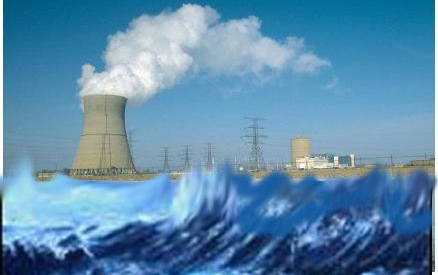 Sohn: Climate clouds gather over U.S. nukes – Part 1, Times Free Press, May 5th, 2019, Sohn: Climate clouds gather over U.S. nukes – Part 1, Times Free Press, May 5th, 2019,
U.S. nuclear power plants weren’t built for climate change. So says the headline in April 18 Bloomberg News special online expose. The lead example, of course, is Japan’s Fukushima-Daiichi reactor meltdowns after a 9.0 earthquake and consequent tsunami. The earthquake itself, almost 81 miles offshore, did no damage. The two tsunami waves that followed were a different story. And no, earthquakes have nothing to do — that we know of — with climate change. Nor do tsunamis. But flooding certainly does, and that’s why Fukushima’s story illustrates this point. When the quake hit the Fukushima plant — a near twin of TVA’s Brown’s Ferry plant in North Alabama, the reactors went into automatic shutdown mode, as all nuclear plants are designed to do. It’s a safety feature — like a fuse blowing when your circuits are overloaded. But not even shutdown could prevent catastrophe when less than an hour later two enormous ocean waves swamped the back-up diesel generators, the seawater pumps, the back-up electrical switchgear and a series of batteries in the plant’s basement. With no power, the pumped flow of cooling water to surround the hot radioactive cores ceased. From there, the dominoes fell fast, and within three days, three of six reactor cores had melted. Explosions ripped away parts of the containment structures. Within hours, mandatory evacuations began in a radius at 1.2 miles and gradually expanded to 12.4 miles. A voluntary evacuation was requested in the 12.4-to-18.6-mile area, and 10 days later, the Japanese government set a 12.4-mile-radius “no-go” area. Some 160,000 people were evacuated from their homes. Years later, 81,000 evacuees remained displaced, as much of the nearby land is still uninhabitable. …… the nuclear industry, on the whole, fought Jaczko’s recommendation of redesigning the plants. Nuclear people instead thought it would be enough to focus mainly on storing emergency generators, pumps, and other equipment in on-site concrete bunkers — a system they dubbed Flex, for Flexible Mitigation Capability. Flex was the process TVA adopted. Spokesman Jim Hopson says TVA was the first nuclear utility in the U.S. to implement and certify its FLEX facilities at Watts Bar, and among the first to certify its entire nuclear fleet. In a sad way, we’re lucky that TVA took that early approach, because in January, NRC’s new majority — three commissioners appointed by President Trump — ruled that nuclear plants wouldn’t have to update equipment to deal with new, higher levels of expected flooding. The commission even eliminated a requirement that plants run Flex drills. Jaczko and others told Bloomberg the NRC already hadn’t done enough to require owners of nuclear power plants to take preventative measures — and that the risks will only increase as climate change worsens. Jaczko said the new ruling nullified the work done following Fukushima. “It’s like studying the safety of seat belts and then not making automakers put them in a car.” Using data from the Union of Concerned Scientists, Bloomberg mapped the plants expected to flood an average of at least twice a month by 2060. Some 90% of the current 59 operating plants were shown as having a minimum of one to four flood risks for which the facilities were not designed. TVA’s Brown’s Ferry in North Alabama, Watts Bar in Spring City, Tennessee, and Sequoyah in Soddy-Daisy all made that risk list. Should we worry? We’ll take a deeper look Monday.https://www.timesfreepress.com/news/opinion/times/story/2019/may/05/sohn-climate-clouds-nukes/493926/ |
|
|
Unease at China’s grip on Britain’s nuclear future.
 Times 8th May 2019 Unease at China’s grip on Britain’s nuclear future. China is still investing in big British infrastructure projects despite concerns over the Huawei deal and fears among the UK’s intelligence partners of exposure to foreign influence.
 controversy around security implications of involving Huawei, yet plans for China General Nuclear Power Corporation to build nuclear reactors on UK soil are progressing almost unnoticed.
https://www.thetimes.co.uk/article/4f281efe-710a-11e9-a116-49ac88679a93

Donald Trump and John Bolton conniving to avoid any effective nuclear arms deal?
|
Trump wants to negotiate nuclear deals. He should start with the one he already has. WP, By Editorial Board, May 8 2019 PRESIDENT TRUMP has been suggesting recently that he’s interested in negotiating a reduction of nuclear weapons stockpiles. After speaking Friday with President Vladimir Putin of Russia, Mr. Trump said they discussed “a nuclear agreement” in which “we get rid of some of the tremendous firepower that we have right now.” On April 4, meeting with China’s vice premier, Liu He, Mr. Trump said, “Between Russia and China and us, we’re all making hundreds of billions of dollars’ worth of weapons, including nuclear, which is ridiculous.” If he’s serious, it is important that Mr. Trump focus on practical measures to reduce the nuclear danger, not negotiating feints. The Post reported April 25 that Mr. Trump has “ordered his administration to prepare a push for new arms-control agreements with Russia and China.” The exact nature of his order isn’t known, but Mr. Trump is right to be concerned that many areas of nuclear weapons and systems to deliver them are not covered by treaties and agreements. Soon, the 1987 Intermediate-Range Nuclear Forces Treaty between the United States and Russia will be history; the Trump administration pulled the plug, saying Russia violated it with a new, prohibited ground-based cruise missile system. ……..All these important and worthy goals for negotiation will be extremely difficult and time-consuming. Before Mr. Trump reaches for the moon, he should tackle extension of the 2010 New START accord with Russia limiting strategic nuclear weapons, which expires in February 2021. This treaty has proved successful and worthwhile, limiting both sides to 1,550 deployed warheads and 700 delivery vehicles; it’s a cap on the most threatening nuclear weapons, those that can span the globe in tens of minutes. If Mr. Trump really wants to avert nuclear dangers, this is the place to begin. So far, he hasn’t done much. A more worrisome prospect is that Mr. Trump is raising the most difficult nuclear arms control challenges because he knows they can’t easily be addressed. John Bolton, the national security adviser, has criticized international treaties that tie the hands of the United States and once called the New START limits on weapons launchers “profoundly misguided.” Are Mr. Bolton and Mr. Trump really getting ready to roll up their sleeves for more arms control, or is the latest talk just a disingenuous tactic to avoid it? https://www.washingtonpost.com/opinions/global-opinions/trump-wants-to-negotiate-nuclear-deals-he-should-start-with-the-one-he-already-has/2019/05/08/529c9248-7026-11e9-9eb4-0828f5389013_story.html?utm_term=.1a3804a51813 |
|
Safety concerns by Austria mean delay in Slovakia’s nuclear station expansion
|
Slovakia delays nuclear plant expansion under pressure from Austria, DW, 8 May 19, Amid complaints from Austria, Slovakia has decided to push back the long-awaited opening of two new nuclear reactors. Activists claim to have evidence that the reactors’ safety structures are damaged and could fail……..
The plant is located some 100 kilometers (62 miles) from Austria’s border. For decades, Austria’s politicians and activists have been trying to cancel the plans to add two more nuclear reactors to the facility, citing safety concerns. In April this year, environmental watchdog Global 2000 said construction had major flaws. They also cited photos and testimonies which allegedly showed the reactors’ protective containment structure was damaged and could fail in case of an earthquake or a serious accident.
Another reason for concern is that the reactors were originally built to Soviet-style designs, and then modified with Western elements. The two new reactors were originally projected to start work in 2012 and 2013, but the project was repeatedly delayed…….. Austria has been urging the International Atomic Energy Agency (IAEO) to send its experts to inspect the site. However, this will only happen if Slovakia invites the inspectors to the Mochovce plant. Following the announcement on Monday, Austria’s Chancellor Sebastian Kurz said it was a “step in the right direction.” “We will not let up until all our safety concerns have been answered,” he was quoted by the Krone newspaper as saying……https://www.dw.com/en/slovakia-delays-nuclear-plant-expansion-under-pressure-from-austria/a-48628715 |
|
|
Deep ocean trenches found to have radioactive carbon from nuclear bomb tests
 Radioactive carbon from nuclear bomb tests found in deep ocean trenches, Phys Org, by American Geophysical Union 8 May 19, Radioactive carbon released into the atmosphere from 20th-century nuclear bomb tests has reached the deepest parts of the ocean, new research finds.A new study in AGU’s journal Geophysical Research Letters finds the first evidence of radioactive carbon from nuclear bomb tests in muscle tissues of crustaceans that inhabit Earth’s ocean trenches, including the Mariana Trench, home to the deepest spot in the ocean. Radioactive carbon from nuclear bomb tests found in deep ocean trenches, Phys Org, by American Geophysical Union 8 May 19, Radioactive carbon released into the atmosphere from 20th-century nuclear bomb tests has reached the deepest parts of the ocean, new research finds.A new study in AGU’s journal Geophysical Research Letters finds the first evidence of radioactive carbon from nuclear bomb tests in muscle tissues of crustaceans that inhabit Earth’s ocean trenches, including the Mariana Trench, home to the deepest spot in the ocean.
Organisms at the ocean surface have incorporated this “bomb carbon” into the molecules that make up their bodies since the late 1950s. The new study finds crustaceans in deep ocean trenches are feeding on organic matter from these organisms when it falls to the ocean floor. The results show human pollution can quickly enter the food web and make its way to the deep ocean, according to the study’s authors. “Although the oceanic circulation takes hundreds of years to bring water containing bomb [carbon] to the deepest trench, the food chain achieves this much faster,” said Ning Wang, a geochemist at the Chinese Academy of Sciences in Guangzhou, China, and lead author of the new study. “There’s a very strong interaction between the surface and the bottom, in terms of biologic systems, and human activities can affect the biosystems even down to 11,000 meters, so we need to be careful about our future behaviors,” said Weidong Sun, a geochemist at the Chinese Academy of Sciences in Qingdao, China, and co-author of the new study. “It’s not expected, but it’s understandable, because it’s controlled by the food chain.”…… Thermonuclear weapons tests conducted during the 1950s and 1960s doubled the amount of carbon-14 in the atmosphere when neutrons released from the bombs reacted with nitrogen in the air. Levels of this “bomb carbon” peaked in the mid-1960s and then dropped when atmospheric nuclear tests stopped. By the 1990s, carbon-14 levels in the atmosphere had dropped to about 20 percent above their pre-test levels. This bomb carbon quickly fell out of the atmosphere and mixed into the ocean surface. Marine organisms that have lived in the decades since this time have used bomb carbon to build molecules within their cells, and scientists have seen elevated levels of carbon-14 in marine organisms since shortly after the bomb tests began……..https://phys.org/news/2019-05-radioactive-carbon-nuclear-deep-ocean.html |
|
|
How the Pentagon Took Ownership of Donald Trump — Astute News

Donald Trump is a con man. Think of Trump University or a juicy Trump steak or can’t-lose casinos (that never won). But as president, one crew he hasn’t conned is the Pentagon. Quite the opposite, they’ve conned him because they’ve been at the game a lot longer and lie (in Trump-speak) in far biglier ways. […]
via How the Pentagon Took Ownership of Donald Trump — Astute News
1 This Month

of the week – Shut Down Drone Warfare!


Tell the Ukrainian Government to Drop Prosecution of Peace Activist Yurii Sheliazhenko

Petition to revoke the licensing of the Near Surface Nuclear Disposal Facility (NSDF) at Chalk River. https://www.ourcommons.ca/petitions/en/Petition/Details?Petition=e-7247
To see nuclear-related stories in greater depth and intensity – go to https://nuclearinformation.wordpress.com
-
Archives
- March 2026 (251)
- February 2026 (268)
- January 2026 (308)
- December 2025 (358)
- November 2025 (359)
- October 2025 (376)
- September 2025 (257)
- August 2025 (319)
- July 2025 (230)
- June 2025 (348)
- May 2025 (261)
- April 2025 (305)
-
Categories
- 1
- 1 NUCLEAR ISSUES
- business and costs
- climate change
- culture and arts
- ENERGY
- environment
- health
- history
- indigenous issues
- Legal
- marketing of nuclear
- media
- opposition to nuclear
- PERSONAL STORIES
- politics
- politics international
- Religion and ethics
- safety
- secrets,lies and civil liberties
- spinbuster
- technology
- Uranium
- wastes
- weapons and war
- Women
- 2 WORLD
- ACTION
- AFRICA
- Atrocities
- AUSTRALIA
- Christina's notes
- Christina's themes
- culture and arts
- Events
- Fuk 2022
- Fuk 2023
- Fukushima 2017
- Fukushima 2018
- fukushima 2019
- Fukushima 2020
- Fukushima 2021
- general
- global warming
- Humour (God we need it)
- Nuclear
- RARE EARTHS
- Reference
- resources – print
- Resources -audiovicual
- Weekly Newsletter
- World
- World Nuclear
- YouTube
-
RSS
Entries RSS
Comments RSS
 nuclear-news