Cheaper and permanent, not temporary, disposal of nuclear waste.
We will provide an option for people not satisfied with existing options,” said Deep Isolation’s co-founder and CEO Elizabeth Muller. She pointed out the interim sites were not “deep geologic storage.”
They’re looking at being safe for decades,” Muller said. “They’re looking at temporary storage. We’re looking at disposal.”
David Lochbaum, former director of the Nuclear Safety Program for the Union of Concerned Scientists, has taken a seat on Deep Isolation’s advisory board.
“There are technical, legal and political challenges facing Deep Isolation, to be sure,” Lochbaum said via email. “I think their proposal could very well meet all these challenges.
“The spent fuel storage status quo is only worsening with time,” he said. “We need to find a solution before we run out of time to do so without harm.”
Storage of the highly radioactive waste would be permanent — unlike the options currently available around the world — and the method is being pitched as far less expensive than development of a deep geologic repository such as Yucca Mountain in Nevada. In New England, spent nuclear fuel is being stored on-site at the Maine Yankee, Seabrook, Vermont Yankee, Yankee Rowe, Pilgrim and Millstone nuclear plants.
Although the Department of Energy was required under the Waste Policy Act to remove spent fuel from sites nationwide for storage in a permanent repository by 1998, its plan for a Yucca Mountain repository in Nevada has languished for several years.
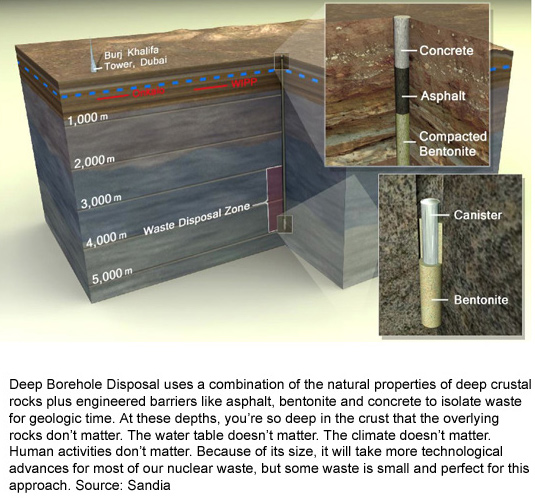
The proposal from Deep Isolation calls for drilling a 14-inch-wide vertical access channel up to a mile or more down, depending on geologic conditions, then gradually making the drill hole run horizontally along the line of the rock formation.
The horizontal bed, which could be as long as 2 miles, would serve as the nuclear waste storage area, deep in the subsurface where the rock has been stable and out of contact with the surface for millions of years and would remain out of contact for millions more, unaffected by surface impacts such as sea level rise.
Hundreds of corrosion-resistant canisters, each holding a spent fuel assembly, could be stored in a line inside a single drill hole, and since the technology already exists, the company could be placing fuel in the ground within two to three years, according to Sophie McCallum, Deep Isolation’s chief of staff.
And more than one drill hole can be made on a site.
We are in active discussions with potential customers in the U.S. and internationally to move forward disposal programs of stalled nuclear waste inventories,” McCallum said in an email .
Deep Isolation tested its system, installing a drill hole in Cameron, Texas, where it successfully placed a 5-foot-long canister — the kind used to store military waste such as cesium and strontium — in the horizontal storage area, deep underground. It then retrieved the canister, which Deep Isolation experts say could be done for up to about 50 years.
The company plans to begin with storage of defense waste in the U.S. and commercial waste in other countries, since the federal Waste Policy Act must be amended to allow for permanent storage of the nation’s commercial waste in places other than Yucca Mountain.
Currently about 80,000 metric tons of spent nuclear fuel produced by commercial reactors and another 14,000 metric tons from the nation’s weapons program is being temporarily stored at 80 sites in 35 states, in spent fuel pools or hulking dry casks.
Commercial reactor owners have sued the department for failing to provide promised permanent storage, and damages to date have cost the agency more than $6 billion.
In 2016, the department was investigating a method of storage that called for deep, vertical boreholes into crystalline basement rock, but the program was broken off in 2017 with Yucca Mountain once again taking over as the sole focus for permanent, high-level nuclear waste storage.
Holtec International and Waste Control Services have submitted applications to operate interim storage facilities in New Mexico and West Texas that are under review by the Nuclear Regulatory Commission. Spent fuel would be stored at those locations until a national repository is ready.
“We will provide an option for people not satisfied with existing options,” said Deep Isolation’s co-founder and CEO Elizabeth Muller. She pointed out the interim sites were not “deep geologic storage.”
They’re looking at being safe for decades,” Muller said. “They’re looking at temporary storage. We’re looking at disposal.”
……..Several nuclear watchdog groups have advocated for keeping waste at sites where it has been generated rather than transporting it across the country to other locations. Deep Isolation’s storage method can be done at or near the generation sites, depending on the geology.
…….Deep Isolation was established about three years ago and has operated to date without government or institutional funding but hopes that will change.
……The government estimates it will cost $100 billion to dispose of existing nuclear waste at Yucca. “We project that the cost of Deep Isolation disposal is about one-third of a mined repository,” McCallum said.
David Lochbaum, former director of the Nuclear Safety Program for the Union of Concerned Scientists, has taken a seat on Deep Isolation’s advisory board.
“There are technical, legal and political challenges facing Deep Isolation, to be sure,” Lochbaum said via email. “I think their proposal could very well meet all these challenges.
“The spent fuel storage status quo is only worsening with time,” he said. “We need to find a solution before we run out of time to do so without harm.” https://www.southcoasttoday.com/news/20190504/startup-promotes-permanent-nuclear-waste-storage-via-miles-long-drilling
No comments yet.
1 This Month


Tell the Ukrainian Government to Drop Prosecution of Peace Activist Yurii Sheliazhenko

Petition to revoke the licensing of the Near Surface Nuclear Disposal Facility (NSDF) at Chalk River. https://www.ourcommons.ca/petitions/en/Petition/Details?Petition=e-7247


of the week – STOP SMALL MODULAR REACTORS IN CANADA
To see nuclear-related stories in greater depth and intensity – go to https://nuclearinformation.wordpress.com
-
Archives
- March 2026 (204)
- February 2026 (268)
- January 2026 (308)
- December 2025 (358)
- November 2025 (359)
- October 2025 (376)
- September 2025 (258)
- August 2025 (319)
- July 2025 (230)
- June 2025 (348)
- May 2025 (261)
- April 2025 (305)
-
Categories
- 1
- 1 NUCLEAR ISSUES
- business and costs
- climate change
- culture and arts
- ENERGY
- environment
- health
- history
- indigenous issues
- Legal
- marketing of nuclear
- media
- opposition to nuclear
- PERSONAL STORIES
- politics
- politics international
- Religion and ethics
- safety
- secrets,lies and civil liberties
- spinbuster
- technology
- Uranium
- wastes
- weapons and war
- Women
- 2 WORLD
- ACTION
- AFRICA
- Atrocities
- AUSTRALIA
- Christina's notes
- Christina's themes
- culture and arts
- Events
- Fuk 2022
- Fuk 2023
- Fukushima 2017
- Fukushima 2018
- fukushima 2019
- Fukushima 2020
- Fukushima 2021
- general
- global warming
- Humour (God we need it)
- Nuclear
- RARE EARTHS
- Reference
- resources – print
- Resources -audiovicual
- Weekly Newsletter
- World
- World Nuclear
- YouTube
-
RSS
Entries RSS
Comments RSS
 nuclear-news
Leave a comment