Discussion on nuclear weapons, between Trump and Putin
|
Trump, Putin discuss nuclear weapons and Venezuela in phone call, Aljazeera, 3 May 19,
 US President Donald Trump tweets he ‘had a long and very good’ phone call with Russian President Vladimir Putin. US President Donald Trump and Russian President Vladimir Putin spoke for more than an hour on Friday, discussing the possibility of a new nuclear accord, North Korean denuclearisation, Ukraine and the political situation in Venezuela, the White House said. “Had a long and very good conversation with President Putin of Russia,” Trump said in a post on Twitter, noting they had discussed trade, Venezuela, Ukraine, North Korea, nuclear arms and Special Counsel Robert Mueller‘s investigation of Russian meddling in the 2016 US presidential campaign. White House spokeswoman Sarah Sanders told reporters that the call was an “overall positive conversation”……. Putin told Trump that any external interference in Venezuela’s internal business undermines the prospects of a political end to the crisis, the Kremlin said. Russian Foreign Minister Sergey Lavrov told US Secretary of State Mike Pompeo by phone on Wednesday that further “aggressive steps” in Venezuela would be fraught with the gravest consequences, the Russian ministry said……. New START treatySanders told reporters Trump and Putin talked about the possibility of a new multilateral nuclear accord between the US, Russia and China, or an extension of the current US-Russia strategic nuclear treaty. She did not say which arms control agreement Trump and Putin discussed, but the Russian state news agency Tass reported that they talked about the New START treaty, the last major arms-control treaty remaining between the US and Russia. The 2011 New START treaty expires in February 2021 but can be extended for five years if both sides agree. Without the agreement, it could be harder to gauge each other’s intentions, arms control advocates say. The New START treaty required the US and Russia to cut their deployed strategic nuclear warheads to no more than 1,550, the lowest level in decades, and limit delivery systems – land- and submarine-based missiles and nuclear-capable bombers. It also includes extensive transparency measures requiring each side to allow the other to carry out 10 inspections of strategic nuclear bases each year; give 48 hours notice before new missiles covered by the treaty leave their factories; and provide notifications before ballistic missile launches. Trump has called the New START treaty a “bad deal” and “one-sided”. “They discussed a nuclear agreement, both new and extended, and the possibility of having conversations with China on that as well,” Sanders said. The Kremlin said the two sides confirmed they intended to “activate dialogue in various spheres, including strategic security”. Trump earlier pulled the plug on a decades-old nuclear arms treaty with Russia. Trump accused Moscow of violating the 1987 Intermediate-Range Nuclear Forces Treaty (INF) with “impunity” by deploying missiles banned by the pact. Moscow denies violating it and has accused Washington of being in non-compliance…… North KoreaTrump also raised with Putin the issue of getting North Korea to dismantle its nuclear weapons and ballistic missile programmes. Trump has met twice with North Korean leader Kim Jong Un but Kim has yet to agree to a disarmament deal. Sanders said Trump mentioned several times “the need and importance of Russia stepping up and continuing to put pressure on North Korea to denuclearize.” The Kremlin said both leaders highlighted the need to pursue denuclearisation of the region. During an April summit with Kim in Vladivostok, Putin expressed Russian support for a gradual process of trading disarmament for sanctions relief. https://www.aljazeera.com/news/2019/05/trump-putin-discuss-nuclear-weapons-venezuela-phone-call-190503181032495.html |
|
|
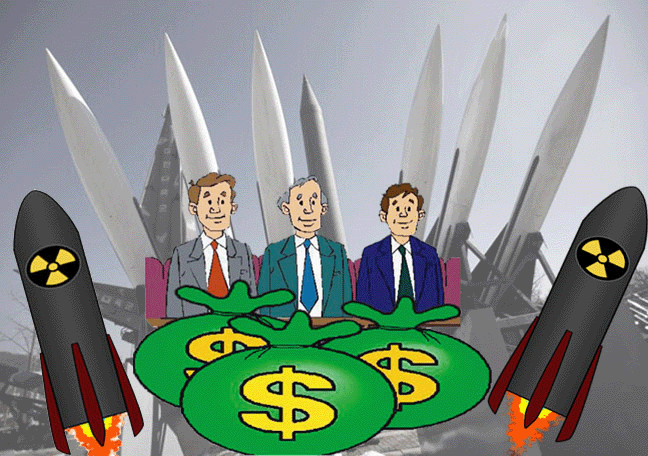
Listing the companies that make nuclear weapons
|
These 28 companies are building nuclear weapons http://www.icanw.org/action/these-28-companies-are-building-nuclear-weapons/?mc_cid=435c8bc6ec&mc_eid=e79c019cc0, May 2, 2019
ICAN and its partner organisation Pax have released a report with full profiles of 28 companies connected to the production of nuclear weapons.
Here are the 28 companies on ICAN’s Red Flag list. Download the full report here.
|
|

High blood pressure risk from prolonged exposure to low-dose ionising radiation
 Prolonged exposure to low-dose radiation may increase the risk of hypertension, a known cause of heart disease and stroke https://www.sciencedaily.com/releases/2019/05/190503080554.htm
- Date:
- May 3, 2019
- Source:
- American Heart Association
- Summary:
- A long-term study of Russian nuclear plant workers suggests that prolonged low-dose radiation exposure increases the risk of hypertension. This study is the first to associate an increased risk of hypertension to low doses of ionizing radiation among a large group of workers who were chronically exposed over many years. The higher the cumulative dose of radiation, the greater the risk, the study showed.
-
Prolonged exposure to low doses of ionizing radiation increased the risk of hypertension, according to a study of workers at a nuclear plant in Russia published in the American Heart Association’s journal Hypertension.
Uncontrolled hypertension, also known as high blood pressure, can to lead to heart attack, stroke, heart failure and other serious health problems.
Earlier studies linked exposure to high doses of radiation to increased risk of cardiovascular diseases and death from those diseases. This study is the first to find an increased risk of hypertension to low doses of ionizing radiation among a large group of workers who were chronically exposed over many years.
The study included more than 22,000 workers at the first large-scale nuclear enterprise in Russia known as the Mayak Production Association. The workers were hired between 1948 and 1982, with an average length of time on the job of 18 years. Half had worked there for more than 10 years. All of the workers had comprehensive health check-ups and screening tests at least once a year with advanced evaluations every five years.
The researchers evaluated the workers’ health records up to 2013. More than 8,400 workers (38 percent of the group) were diagnosed with hypertension, as defined in this study as a systolic blood pressure reading of ?140 mm Hg, and a diastolic reading ? 90 mm Hg. Hypertension incidence was found to be significantly associated with the cumulative dose.
- To put it in perspective, the hypertension incidence among the workers in the study was higher than that among Japanese survivors of the atomic bomb at the end of World War II, but lower than the risk estimated for clean-up workers following the Chernobyl nuclear accident.
The differences may be explained by variations in exposure among the three groups, according to the researchers. Following the atomic bombing, the Japanese experienced a single, high-dose exposure of radiation, the Chernobyl workers were exposed to radiation for a short time period (days and months), while the Mayak workers were chronically exposed to low doses of radiation over many years.
While the development of cancer is commonly associated with radiation exposure, “we believe that an estimate of the detrimental health consequences of radiation exposure should also include non-cancer health outcomes. We now have evidence suggesting that radiation exposure may also lead to increased risks of hypertension, cardiovascular disease and cerebrovascular disease, as well,” said Tamara Azizova, M.D., lead author of the study at the Southern Urals Biophysics Institute in Russia.
-
Azizova pointed out that in recent years, the number of people exposed to radiation in everyday life, such as during diagnostic procedures, has increased. “It is necessary to inform the public that not only high doses of radiation, but low to moderate doses also increase the risk of hypertension and other circulatory system diseases, which today contribute significantly to death and disability. As a result, all radiological protection principles and dose limits should be strictly followed for workers and the general public.”
How radiation exposure may increase the risk of hypertension is still a question, according to Azizova. “So far, the mechanisms remain unclear, not only for certain cohorts but also for the general population. One of the main tasks for the coming decade is to study the mechanisms of hypertension and heart and brain atherosclerosis occurring in people who are — and who were exposed — to radiation.”
The authors note that their study is a retrospective one, and while many health conditions and behaviors were documented in the medical records of the workers (such as age, smoking, alcohol consumption and body mass index), other factors, such as stress and nutrition, were unavailable for researchers to be taken into account in this study.
Story Source:
Materials provided by American Heart Association.
- Journal Reference:
- Tamara Azizova, Ksenia Briks, Maria Bannikova, Evgeniya Grigoryeva. Hypertension Incidence Risk in a Cohort of Russian Workers Exposed to Radiation at the Mayak Production Association Over Prolonged Periods. Hypertension, 2019; DOI: 10.1161/HYPERTENSIONAHA.118.11719
USA Defense Dept knew that radiation causes birth defects. Now nuclear test veterans worry
 Atomic veteran wonders at radiation’s effects, PostStar, Will Doolittle will@poststar.comMay 2, 2019, GLENS FALLS — Bill Jones went to paradise for 13 months in the mid-1950s, and it wasn’t until many years later, when he and others were finally released from their vows of secrecy, that he found out what a hell it really had been……. Atomic veteran wonders at radiation’s effects, PostStar, Will Doolittle will@poststar.comMay 2, 2019, GLENS FALLS — Bill Jones went to paradise for 13 months in the mid-1950s, and it wasn’t until many years later, when he and others were finally released from their vows of secrecy, that he found out what a hell it really had been…….
But he doesn’t know for sure, and the government isn’t telling, which is what really bothers him. He has scars on his scalp from having growths removed, but at 84 considers himself fortunate. Benefits are available for atomic veterans, and Jones called the Department of Justice about qualifying for them.
He was told, “As soon as I get a terminal illness, call back.” “There’s not an awful lot of these atomic veterans left. There’s a lot that don’t know about the program, so they waste away, shall we say,” he said. Fred Schafer, an officer with the National Association of Atomic and Nuclear Veterans, says the soldiers were guinea pigs. “They wanted to see what happened,” he said, referring to the U.S. military establishment, which was monitoring the soldiers’ reactions to nuclear radiation. “They wanted to see how fast they could get in after using these bombs.”
Jones wasn’t allowed to tell Charlotte what he was doing on Enewetak. He couldn’t take photos, he could make only one phone call every two or three months, and his letters were reviewed. Anything he sent home, like a sea shell scooped up from the sand, had to be checked with a Geiger counter first. |
|
|
Trump administration re-ignites the political issue of nuclear waste and Nevada’s Yucca Mountain
 In Nevada, Trump administration revives a radioactive campaign issue, CBS News, BY ALEXANDER TIN, MAY 2, 2019 /Last year, the Trump administration faced a dilemma: where could the Department of Energy stow a metric ton of surplus, weapons grade plutonium?
Efforts to recycle thousands of pounds in unwanted radioactive material had been crippled by cost overruns. Now the government faced a court ordered deadline to remove the plutonium from South Carolina, where it had been stockpiled.
For the plutonium’s new home, the administration turned to Nevada. Over the state’s objections, authorities planned to ship some of the radioactive material to a site adjacent to Yucca Mountain, where the federal government has long sought to store dangerous nuclear waste. ……
The state fought for months in court to block the new plutonium delivery, until a bombshell revelation in early 2019 that the administration had already quietly trucked in much of the plutonium, with details kept secret for “operational security.”
The response from Nevada’s government was swift.
“They lied to the state of Nevada, misled a federal court, and jeopardized the safety of Nevada’s families and environment,” Gov. Steve Sisolak said in a statement. Nevada Democratic Sen. Jacky Rosen slammed the move as “deceitful” and “unethical.”
Energy Secretary Rick Perry then struck a deal with Nevada Democratic Sen. Catherine Cortez-Masto, and department has since promised to pull out the plutonium. But the shipment has added fuel to a political firestorm in Nevada over recent efforts to resurrect Yucca Mountain, sowing mistrust over a key issue for the state, which is home an early and important presidential primary contest.
On Wednesday, the administration’s push to reopen Yucca Mountain that drew a forceful condemnation from Vermont Sen. Bernie Sanders.
“The proposal by President Trump and Republicans in Congress to send our nuclear waste to Yucca Mountain would be a geological, environmental, and social disaster,” the presidential candidate said in a statement.
Sanders joins a long list of fellow White House hopefuls in questioning the project’s future, including former Rep. Beto O’Rourke, Washington Gov. Jay Inslee, Minnesota Sen. Amy Klobuchar, Massachusetts Sen. Elizabeth Warren, New Jersey Sen. Cory Booker, California Sen. Kamala Harris, and former Obama HUD secretary Julián Castro.
Opponents have long cited the risks of seismic activity under the site, and its proximity to an aquifer and a military test range. They have rejected arguments that Yucca Mountain would hasten the transfer to a more environmentally friendly economy, warning of the risks for communities through which waste would pass through……
Testifying before the Senate Environment and Public Works Committee, Rosen — Heller’s successor — joined Cortez-Masto in calling on Congress to help Nevada block Yucca Mountain. Their bill would require consent from state and local authorities before storing nuclear waste in their respective jurisdictions.
Only six other senators have so far cosponsored the proposal: Cory Booker, Kamala Harris, Amy Klobuchar, Bernie Sanders, Elizabeth Warren, and Kirsten Gillibrand. https://www.cbsnews.com/news/in-nevada-trump-administration-revives-a-radioactive-campaign-issue/
Rivetting new documentary series on the Chernobyl nuclear catastrophe
Chernobyl (2019) | What Is Chernobyl? | HBO
|
HBO’s Chernobyl drama highlights the human cost of nuclear catastrophe https://www.newscientist.com/article/2201699-hbos-chernobyl-drama-highlights-the-human-cost-of-nuclear-catastrophe/
An intense new HBO miniseries about the world’s worst nuclear accident turns the Chernobyl Soviet scientists into unlikely heroes in its portrayal of a world superpower approaching meltdown, 3 May 2019 By Fifteen minutes into the second episode of HBO’s gripping saga of the 1986 Chernobyl nuclear disaster, we are treated to an idiot’s guide to how a nuclear power plant works. It is delivered by a top Soviet nuclear scientist, Valery Legasov, to a hapless, senior Soviet apparatchik as they fly to the unfolding disaster. As a plot device, it helps the viewer understand events as much as the politburo hack. But it also does something more interesting: it helps establish the nuclear scientist as the unlikely hero of the story. And give us some interesting insights into a pre-collapse Soviet Union.
In a disaster movie about a nuclear accident, told over five hour-long episodes, you might expect the scientists who designed the plant to be the bad guys. But, at least in the first two episodes available for preview, they come out smelling of roses. For the producers have bigger fish to fry – the entire edifice of communist rule in the Soviet Union, which was then only three years from toppling. It makes for a great story, but also has the ring of truth. The central human narrative is the tension between boffins and bureaucrats. Legasov, based at the Kurchatov Institute, Moscow, the Soviet Union’s main atomic research institute, is the man who first understood the scale of the disaster. He devised a way to douse the inferno by pouring thousands of tonnes of sand and boron into the stricken reactor from helicopters, and was also the first to insist on the evacuation of 50,000 local inhabitants who had been left to suffer the fallout by officials intent on covering up the entire disaster. In later episodes, however, we can expect to see him blamed by politicos, who disliked his appetite for speaking truth to the incompetents in power. So much so that he ends up hanging himself in the stairwell of his apartment on the second anniversary of the accident, shortly after telling his story to Pravda. This mini-series is brilliant and pointed storytelling, with gruesome early scenes of radiation sickness among the fire crews intercut with the local officials in their bunker, unwilling and unable to comprehend what was happening above them. Again, on the basis of the first two episodes, the story is told without taking too many liberties with the historical truth. Its main take is that the accident exposed as never before the callousness and dysfunction of the Soviet elite. And that by making this finally visible to Soviet citizens, it undermined the best of Communism, a sense of common purpose. It is a view shared by academics such as Kate Brown in her recent study of Chernobyl and its aftermath, Manual for Survival (Allen Lane, 2018). The dozens of plants workers, firefighters and helicopter pilots who died putting out the Chernobyl inferno, would never sacrifice themselves in that way again. The disaster replaced the common purpose with a sense of betrayal. It did not just symbolise the failings of communist rule, but precipitated its collapse. Early on, the series has Soviet leader Mikhail Gorbachev declaring angrily that the accident had to be kept secret because “our power comes from the perception of our power”. Chernobyl incinerated that perception, and their power was over. As he strung himself up, one imagines that Legasov already knew the truth. Chernobyl, starring Jared Harris, Stellan Skarsgård and Emily Watson, premieres 6 May on HBO. Fred Pearce is a New Scientist consultant and the author of Fallout: A journey through the nuclear age(Granta Books). |
|
Trump’s hypocrisy – talks of nuclear disarmament while spending $megabillions on new nuclear weapons
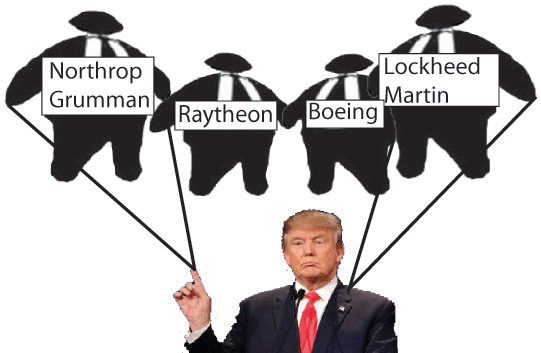 Trump to begin nuclear bomb-reduction talks with Russia, maybe China, ‘very shortly’ Washington Examiner, by Steven Nelson, May 03, 2019 President Trump said Friday that he expects to begin brokering a nuclear disarmament deal with Russia “very shortly,” with a possible addition of China later.
USA renews waivers of Iran sanctions for civilian nuclear work
|
Official: US renews Iran sanctions waivers for civilian nuclear work, The Times of Israel,
May 2019
Move allows Russia and European nations to continue work at nuclear sites without incurring US penalties; 2 waivers relating to heavy water and uranium enrichment not extended. The waivers, which were due to expire Saturday, are being extended for between 45 days and 90 days, shorter periods than had been granted in the past. But they will permit work at several Iranian nuclear sites to continue without US penalties. Under the terms of the 2015 Iran nuclear deal, Russia and several European nations help to maintain the facilities and are engaged in converting equipment there for exclusively civilian use. Facilities included in the waiver extensions include the Bushehr nuclear power plant, the foenrichment facility, the Arak nuclear complex and the Tehran Research Reactor, the official said. The official, who was not authorized to discuss the matter publicly and spoke on condition of anonymity, said the other two waivers — one that allowed Iran to store heavy water in Oman and the other that allowed Russia to process Iranian uranium — are not being renewed…..https://www.timesofisrael.com/official-us-renews-iran-sanctions-waivers-for-civilian-nuclear-work/ |
|
|
The Blue Pacific and the legacies of nuclear testing

The Strategist 1 May 2019| Patrick Kaiku States in the Pacific islands are small in landmass and population. Their limited terrestrial resources and lack of comparative advantage are compounded by their remoteness from global centres of commerce. This obviously has impacts on the costs of doing business and integration into global trade relations. Their invisibility in international relations means that small states must creatively frame their presence in the global community.It’s against this backdrop that the ‘Blue Pacific’, which is touted as an empowering worldview, should be understood. The core principles of the Blue Pacific must be read together with recent developments in the region. In 2017, Pacific Islands Forum leaders endorsed the concept as a ‘driving force’ connecting Pacific peoples ‘with their natural resources, environment, culture and livelihoods’. The Boe Declaration of 2018 formally recognised Pacific islanders’ stewardship over the Pacific Ocean.
While big states such as the US and China are competing for influence in the region, the Boe Declaration makes a case for prioritising the concerns of Pacific island communities. The strategic confrontations of big powers do not feature in the daily lives of Pacific peoples. What’s important to the survival of island states is their environment and the capacity of their resources to meet present needs and the needs of future generations. This logic is seen with the proposed Pacific Resilience Facility, which is a regional pool of resources to manage or mitigate the adverse effects of environmental challenges in the region.
….. a sticky issue in the region is the potential effects of nuclear contamination of the Pacific Ocean. The legacies of nuclear tests in the Pacific islands include highly radioactive waste materials stored on vulnerable atolls.
In the 1950s, the Pacific Ocean was considered an empty space by the Euro-American powers. With the onset of the arms race during the Cold War, some of the colonial powers used the Pacific as a testing ground for their nuclear weapons. More than 300 nuclear tests were conducted in the Pacific Ocean. Atolls in the Marshall Islands, Johnston Island, Christmas Island and French Polynesia were used as nuclear test sites, casting long shadows into the present.
On one low-lying Pacific island atoll, the toxic legacy of the nuclear tests remains. In 2017, Mark Willacy from the Australian Broadcasting Corporation investigated the nuclear-waste storage facility on the remote atoll of Enewetak in the Marshall Islands. It was there that the US conducted its series of tests of nuclear weapons, including the first full-scale hydrogen bomb. Before it abandoned its nuclear testing program in the 1970s, the US buried contaminated material on Runit Island.
An estimated 85,000 cubic metres of radioactive waste is buried on Runit Island, including some of the world’s most toxic materials. It will take more than 24,000 years for the waste to disintegrate. It’s buried in porous coral and sand and capped by a concrete dome. Marshallese and international non-government organisations are concerned that sea-level rise and major typhoons will destroy the dome, resulting in the contamination of not only the Marshall Islands but the wider Pacific Ocean. Since the sea is a free-flowing matrix of currents and borderless movements of water, a Pacific-wide disaster is a plausible scenario…….
The Pacific island states have an illustrious record in employing collective diplomacy to tackle difficult issues. Since the 1980s, the high-water marks of collective diplomacy have been the UN Convention on the Law of the Sea in 1982, the 1985 Rarotonga Treaty and the global moratorium on drift-net fishing. Currently, small states in the Pacific islands are actively engaged in framing the narrative on global cooperation to deal with climate change challenges.
The Blue Pacific is a timely framework, emphasising a Pacific islands worldview, and is an alternative to the zero-sum confrontations of big powers in the region. More importantly, it stresses the importance of cooperation on Pacific terms in dealing with transnational challenges. The various major powers embroiled in their great-power confrontations in the Pacific ought to be educated about the significance of the Blue Pacific and their participation in advancing the goals of that paradigm. After all, the Pacific Ocean connects all the large landmasses on the Pacific Rim. The state of affairs in the islands is a microcosm of the planet’s chances of surviving global environmental challenges.
Patrick Kaiku is a teaching fellow in the political science department at the University of Papua New Guinea. https://www.aspistrategist.org.au/the-blue-pacific-and-the-legacies-of-nuclear-testing/
Nevada presidential candidates have legislation planned to block nuclear waste dump for Yucca Mt
|
Presidential candidates join Nevada’s nuclear waste fight, SF Gate, Michelle L. Price,
Associated Press , May 3, 2019 LAS VEGAS (AP) — Nevada’s long crusade to block the creation of a national nuclear-waste dump at Yucca Mountain has pitted the state against a bipartisan group of lawmakers across the country, but a band of presidential hopefuls is joining the early voting state’s cause.
Nevada’s senior senator, Democrat Catherine Cortez Masto, has legislation that would bar the federal government from moving nuclear waste into a state without first receiving permission from the governor and local officials. Last year, Nevada’s two senators were the only sponsors of the measure. This year, they’ve got company in Democratic Sens. Cory Booker of New Jersey, Kirsten Gillibrand of New York, Kamala Harris of California, Amy Klobuchar of Minnesota, Bernie Sanders of Vermont and Elizabeth Warren of Massachusetts. The six senators’ move to establish opposition to the mothballed Yucca Mountain project is an appeal long-made by presidential candidates hoping to win favor in Nevada, which holds a pivotal role as a swing state and the third state to vote in the Democratic presidential contest. Any candidate hoping to win the support of Nevadans must be against Yucca Mountain,” Cortez Masto said in a statement Friday in response to a question about the new co-sponsors. ……
.
On Thursday, as Cortez Masto and Nevada Sen. Jacky Rosen testified in opposition to restarting the licensing project, Sanders issued a statement calling the Yucca Mountain plan “a geological, environmental, and social disaster” that must be abandoned. …….. https://www.sfgate.com/news/article/Presidential-candidates-join-Nevada-s-nuclear-13817561.php
|
|
|
Senator Chris Van Hollen on Gorging at the Nuclear Buffet Table
REMARKS: Gorging at the Nuclear Buffet Table Arms Control Association, May 2019By Sen. Chris Van Hollen “…….we gather here at another urgent moment. It has been important work all along, but we are in an urgent moment now. Because with the Trump administration, all signs indicate that we’re jettisoning, we’re abandoning what has been a bipartisan tradition of recognizing that we need to modernize our nuclear forces, we need to modernize our triad, we need to make sure its survivable and resilient, but that we should do it within the framework of an arms control architecture that leads to predictability, stability, and transparency. That has been an important formula even as relations between the United States and the Soviet Union, now Russia, have gone up and down. We have still maintained that conversation, we have still maintained that structure, and that structure has helped keep the peace.
13 exposed to radiation at hazmat incident in Seattle
|
https://www.seattlepi.com/news/article/13-exposed-to-radiation-at-hazmat-incident-in-13816716.php
SEATTLE (AP) — Thirteen people had to be decontaminated for radiation exposure – and eight of them hospitalized – after a breach of a radioactive substance in in Seattle.. KOMO reports that contractors were transporting Caesium-137 in Seattle’s First Hill neighborhood Thursday night. Hazmat crews were called to the scene and found 13 contract workers, custodial workers and others at the scene tested positive for radiation exposure and needed to undergo decontamination. While none of the workers showed any symptoms of radiation poisoning, eight of them were checked into nearby Harborview Medical Center for treatment and monitoring. The other five were cleared to go home. No firefighters or hazmat crews suffered any radiation exposure. |
|
No evidence for this, but a Republican lawmaker says Russia has nuclear weapons in Venezuela
|
GOP Rep. says Russia has nuclear weapons in Venezuela but offers no evidence, Roll Call, Griffin Connolly, 1 May 19,
Rep. Mario Díaz-Balart made the comments in a Fox News segment with host Tucker Carlson. Rep. Mario Díaz-Balart asserted Tuesday that Russia might already have nuclear missiles stationed in Venezuela as that country’s political turmoil continues to churn in the wake of a disputed presidential election. Díaz-Balart, a longtime Florida Republican, provided no evidence to support his claim…… “Are you saying the Russians will put nuclear missiles in Venezuela?” Carlson asked in a follow-up question. “What I am suggesting is that they are already there,” Diaz-Balart said. The Florida congressman did not provide any evidence to support that suggestion. The Russian military flew and landed a nuclear-capable bomber in Venezuela in 2018, but there have been no reports or claims that they have outfitted such aircraft with nuclear bombs or transported nuclear missiles to the country…… “Are you saying the Russians will put nuclear missiles in Venezuela?” Carlson asked in a follow-up question……. https://www.rollcall.com/news/russia-already-has-nuclear-bombs-in-venezuela-gop-rep-suggests-sans-evidence |
|
|
Southern Company says – no more nuclear projects after the costly Vogtle project in Georgia
|
Georgia Power’s parent: After Vogtle, no new nuclear until maybe 2040, AJC, 3 May 19, Georgia Power’s parent company is the only utility constructing nuclear power reactors in the United States, and it doesn’t plan to do it again anytime soon.
It probably will be in the 2030s or 2040s before Atlanta-based Southern Company attempts another nuclear construction project, Southern CEO Tom Fanning told analysts Wednesday. ……. on Wednesday, Fanning told analysts that his administration won’t embark on more nuclear. …..
Liz Coyle, the executive director of Georgia Watch, a consumer advocacy group that has long warned about the Vogtle’s ballooning costs, questions whether ratepayers should fund another nuclear project incorporating new reactor designs. “What we don’t want to see is Georgia once again being made the guinea pig … for unproven technologies that end up taking much longer to build and at a significantly higher cost than other forms of generation,” she said……… https://www.ajc.com/business/georgia-power-parent-after-vogtle-new-nuclear-until-maybe-2040/ADjetBmiCnISHQIOP10uvJ/
|
|
|
Prince William booed and heckled at service to mark 50 years of Royal Navy’s nuclear submarines
|
Telegraph Video Press Association 3 MAY 2019 Protesters shouted “shame on you” at the Duke of Cambridge as he entered Westminster Abbey for a service to mark 50 years of the Royal Navy’s nuclear submarines on Friday.
Activists from the Campaign for Nuclear Disarmament (CND), who were across the road from the Abbey booed and chanted, condemning the Duke’s attendance……The protesters, pinned back by a security cordon shouted various chants, including “Down with Trident” and “Down with War”, as they arrived and later left the building. CND said it was “horrified” at the service, with general secretary Kate Hudson adding that it was “morally repugnant”. She said: “This sends out a terrible message to the world about our country. It says that here in Britain we celebrate weapons, in a place of worship, that can kill millions of people.”…… https://www.telegraph.co.uk/news/2019/05/03/prince-william-booed-heckled-nuclear-deterrent-service/ |
|
1 This Month


Tell the Ukrainian Government to Drop Prosecution of Peace Activist Yurii Sheliazhenko

Petition to revoke the licensing of the Near Surface Nuclear Disposal Facility (NSDF) at Chalk River. https://www.ourcommons.ca/petitions/en/Petition/Details?Petition=e-7247


of the week – STOP SMALL MODULAR REACTORS IN CANADA
To see nuclear-related stories in greater depth and intensity – go to https://nuclearinformation.wordpress.com
-
Archives
- March 2026 (204)
- February 2026 (268)
- January 2026 (308)
- December 2025 (358)
- November 2025 (359)
- October 2025 (376)
- September 2025 (258)
- August 2025 (319)
- July 2025 (230)
- June 2025 (348)
- May 2025 (261)
- April 2025 (305)
-
Categories
- 1
- 1 NUCLEAR ISSUES
- business and costs
- climate change
- culture and arts
- ENERGY
- environment
- health
- history
- indigenous issues
- Legal
- marketing of nuclear
- media
- opposition to nuclear
- PERSONAL STORIES
- politics
- politics international
- Religion and ethics
- safety
- secrets,lies and civil liberties
- spinbuster
- technology
- Uranium
- wastes
- weapons and war
- Women
- 2 WORLD
- ACTION
- AFRICA
- Atrocities
- AUSTRALIA
- Christina's notes
- Christina's themes
- culture and arts
- Events
- Fuk 2022
- Fuk 2023
- Fukushima 2017
- Fukushima 2018
- fukushima 2019
- Fukushima 2020
- Fukushima 2021
- general
- global warming
- Humour (God we need it)
- Nuclear
- RARE EARTHS
- Reference
- resources – print
- Resources -audiovicual
- Weekly Newsletter
- World
- World Nuclear
- YouTube
-
RSS
Entries RSS
Comments RSS
 nuclear-news