Retaliation against Julian Assange over the past decade plus replicates a pattern of ruthless politicalretaliation against whistleblowers, in particular those who reveal truths hidden by illegal secrecy, VIPS says.
DATE: April 30, 2019
MEMORANDUM FOR: The governments and people of the United Kingdom and the United States
FROM: Veteran Intelligence Professionals for Sanity (VIPS)
SUBJECT: Extradition of Julian Assange Threatens Us All
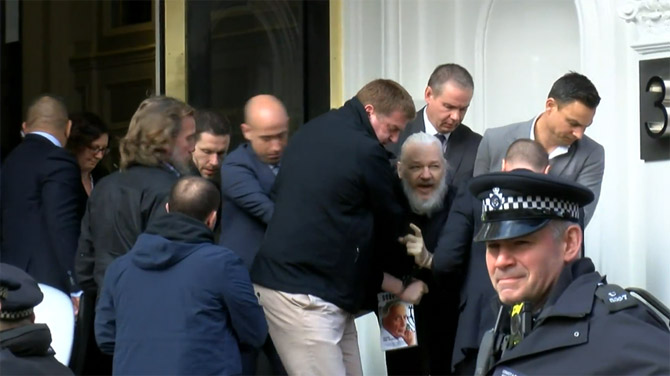
On April 11, London police forcibly removed WikiLeaks co-founder Julian Assange from the embassy of Ecuador after that country’s president, Lenin Moreno, abruptly revoked his predecessor’s grant of asylum. The United States government immediately requested Assange’s extradition for prosecution under a charge of “conspiracy to commit computer intrusion” under the Computer Fraud and Abuse Act (CFAA).
Former U.S. Government officials promptly appeared in popular media offering soothing assurances that Assange’s arrest threatens neither constitutional rights nor the practice of journalism, and major newspapers like The New York Times and The Washington Post fell into line.
Not So Fast
Others found reason for concern in the details of the indictment. Carie DeCel, a staff attorney for theKnight First Amendment Institute, noted that the indictment goes beyond simply stating the computer intrusion charge and “includes many more allegations that reach more broadly into typical journalistic practices, including communication with a source, encouraging a source to share information, and protecting a source.”
In an analysis of the indictment’s implications, the Project on Government Oversight (POGO) observed that it includes an allegation that “Assange and Manning took measures to conceal Manning as the source of the disclosure…including by removing usernames from the disclosed information and deleting chat logs between Assange and Manning,” and that they “used a special folder on a cloud drop box ofWikiLeaks to transmit classified records.”
“These are not only legitimate but professionally advised journalistic practices for source protection,”notes POGO. It is worth noting that Manning had Top Secret clearance and did not need Assange’s assistance to gain access to databases, but only to hide her identity.
The indictment’s implied threat thus reaches beyond Assange and even beyond journalists. The threat to journalists and others does not vanish if they subsequently avoid practices identified in the government’s indictment. The NSA’s big bag of past communications offers abundant material from which to spin an indictment years later, and even circumstantial evidence can produce a conviction. Moreover, the secret landscape—a recent and arbitrary development—continually expands, making ever more of government off limits to public view.
When politician and U.S. Secretary of State Mike Pompeo labeled WikiLeaks a “non-state hostile intelligence service,” he was describing the oft-stated duty of newspapers, “to comfort the afflicted, and to afflict the comfortable.”
The Devil in the Big Picture
One can look so closely at the indictment details that one misses the big picture and with it vital truths. Standing back for a broader view, a long-running campaign of harassment by U.S. authorities and former officials focused on WikiLeaks’ publication of embarrassing secrets becomes visible. The Project on Government Oversight observes:
“Even if the motives for Assange’s indictment are entirely legitimate, the litany of high-ranking government officials who called for Assange to be prosecuted for publishing classified documents have likely already irreparably harmed the freedom of the press. It will be virtually impossible to fully disentangle the government’s desire to prosecute Assange for his publishing activities from the government’s current prosecution of him, and as a result there will to some degree be an unavoidable chilling effect stemming from his prosecution.”
Standing back still further, a crowd of similar cases comes into view: other truth tellers subjected to similar persecution. These are not journalists but another species of truth teller — national security whistleblowers— who have warned for years that this day would come…….
The Takeaway
Retaliation against Julian Assange over the past decade plus replicates a pattern of ruthless politicalretaliationagainst whistleblowers, in particular those who reveal truths hidden by illegal secrecy. U.S. law prohibits classifying information “in order to conceal inefficiency, violations of law, or administrative error; to prevent embarrassmentto a person, organization, or agency.”
Whether U.S. authorities successfully prosecute Assange, accept a desperate plea deal or keep him tied up with endless litigation, they will succeed in sending the same chilling message to all journalists that they send to potential whistleblowers: Do not embarrass us or we’ll punish you—somehow, someday, however long it takes. In that respect, one could say damage to journalism already has been done but the battle is not over…….
This extension of a whistleblower reprisal regime onto a publisher of disclosures poses an existential threat to all journalists and to the right of all people to speak and hear important truths. …….. https://consortiumnews.com/2019/04/30/vips-extradition-of-julian-assange-threatens-us-all/





 nuclear-news
“Do not embarrass us or we’ll punish you” that mssg has already been heard, digested and excreted by the MSM. They are happy Assange is off the headlines so he can’t embarrass them all for showing the public what real journalism looks like.