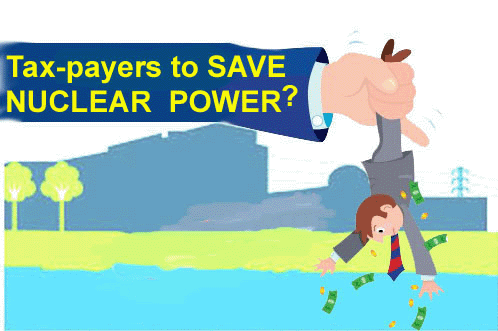
British govt about to give nuclear power a massive state-funded financial boost
|
For instance the Financial Times describes the use of “RAB” (regulated asset base) financing as similar to the system used to build the Thames Tideway tunnel’ Under such schemes the developers are allowed to charge consumers in advance for the capital building projects. What Ministers are not emphasising of course, is that in industries such as water the Government does not lend lots of money to the privatised companies. They raise this on private markets. But in the case of nuclear power plants the bulk of the money needed to build them will be borrowed from the Government.
RAB has been used to try to finance nuclear power plants in the USA, in the states of Georgia and South Carolina recently. The result was disaster and the developing company, Westinghouse, went bust. But this was ‘normal’ RAB where the developer takes the risk of cost overruns. But in the proposed UK nuclear version it will be the electricity consumer who goes bust when the almost inevitable cost-overruns set in! The nuclear RAB is really a cover for a nuclear bailout. So let’s call it a ‘nuke bailout RAB’.
What makes this move even more infuriating for green energy supporters is that Hammond offered what amount to a few superficial titbits for green energy in his Spring statement. Meanwhile renewable energy projects will not be able to take part in RAB projects. Not only will nuclear power be funded under much more preferential terms compared to offshore or onshore renewable energy projects but they will be directly funded by government and large parts, if not all, of their liabilities guaranteed by the treasury – again something that does not apply to renewable energy. (1)
According to Harminder Singh, Power Analyst at GlobalData, the RAB model would shift the risk from the developers to consumers, thus raising the electricity bills of consumers. Consumers will be effectively paying for an asset that will come up some time in the future, with all the risks associated with it. Furthermore, with the cost escalations associated with nuclear power projects, there is an additional uncertainty regarding how much it will add to the consumer power bill. The model has so far not been used for projects as expensive as nuclear power plants, which is seen as a key cause for concern. On the other hand, the RAB is a useful tool to attract private investments in the sector, as investors are able to see a fixed rate of return as the project is being built. The key problem that RAB addresses is that of high cost of capital for nuclear power projects. It is revised at regular intervals to take into account increases in capex – subject to regulatory approval. The regulatory protection and government backing means that the RAB is treated as a strong, secure asset. (2) http://www.no2nuclearpower.org.uk/wp/wp-content/uploads/2019/04/NuClearNewsNo116.pdf |
|
|
No comments yet.
1 This Month


Tell the Ukrainian Government to Drop Prosecution of Peace Activist Yurii Sheliazhenko

Petition to revoke the licensing of the Near Surface Nuclear Disposal Facility (NSDF) at Chalk River. https://www.ourcommons.ca/petitions/en/Petition/Details?Petition=e-7247


of the week – STOP SMALL MODULAR REACTORS IN CANADA
To see nuclear-related stories in greater depth and intensity – go to https://nuclearinformation.wordpress.com
-
Archives
- March 2026 (204)
- February 2026 (268)
- January 2026 (308)
- December 2025 (358)
- November 2025 (359)
- October 2025 (376)
- September 2025 (258)
- August 2025 (319)
- July 2025 (230)
- June 2025 (348)
- May 2025 (261)
- April 2025 (305)
-
Categories
- 1
- 1 NUCLEAR ISSUES
- business and costs
- climate change
- culture and arts
- ENERGY
- environment
- health
- history
- indigenous issues
- Legal
- marketing of nuclear
- media
- opposition to nuclear
- PERSONAL STORIES
- politics
- politics international
- Religion and ethics
- safety
- secrets,lies and civil liberties
- spinbuster
- technology
- Uranium
- wastes
- weapons and war
- Women
- 2 WORLD
- ACTION
- AFRICA
- Atrocities
- AUSTRALIA
- Christina's notes
- Christina's themes
- culture and arts
- Events
- Fuk 2022
- Fuk 2023
- Fukushima 2017
- Fukushima 2018
- fukushima 2019
- Fukushima 2020
- Fukushima 2021
- general
- global warming
- Humour (God we need it)
- Nuclear
- RARE EARTHS
- Reference
- resources – print
- Resources -audiovicual
- Weekly Newsletter
- World
- World Nuclear
- YouTube
-
RSS
Entries RSS
Comments RSS
 nuclear-news
Leave a comment