All Japan’s nuclear reactors may shutdown, as regulator is firm on safety measures
 Japan’s nuclear reactors face new near-total shutdown, Regulator refuses to extend deadlines for installing antiterrorism measures Ft.com, Robin Harding in Tokyo APRIL 25, 2019 Japan is heading towards another near-total shutdown of its nuclear reactors after regulators refused to extend deadlines for completing antiterrorism measures. The Nuclear Regulation Authority said it would enforce deadlines that expired next summer for many operating reactors. Electricity companies have said there was almost no chance they would be ready on time. The regulator’s stance is a fresh blow to a nuclear power sector that has never recovered from the Fukushima Daiichi disaster in 2011, when three reactors melted down after a tsunami knocked out their cooling systems. …….Each restarting reactor has its own deadline and a number of them expire next year — but none of the operators are likely to be ready in time. They will therefore have to shut the reactors down. For example, anti-terror work at the Sendai No 1 and No 2 reactors, run by Kyushu Electric, and the Takahama No 3 and No 4 reactors, run by Kansai Electric, must be completed next year.
……. Japan has struggled to restart its reactors in the face of strong public opposition and many are still offline. As of March 15, nine out of Japan’s 57 reactors had restarted. Several others have restarted only to shut down again because of injunctions issued by local courts.
……. the national government has not pushed for restarts, leaving it in the hands of regulators, utilities, courts and local politicians. The long-term future of the sector is therefore in doubt. https://www.ft.com/content/1b2c395e-6724-11e9-9adc-98bf1d35a056
Climate change poses huge flooding risk to USA’s nuclear stations, but this is ignored by Trump administration
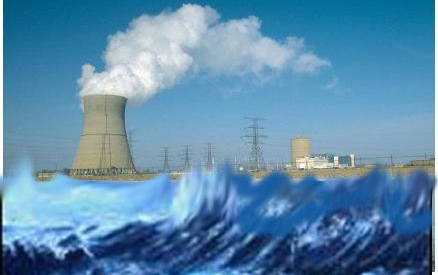 Trump administration is ignoring a massive problem at U.S. nuclear plants Trump administration is ignoring a massive problem at U.S. nuclear plants “54 of the [60] nuclear plants operating in the U.S. weren’t designed to handle the flood risk they face.” https://thinkprogress.org/nuclear-plants-flood-risk-trump-2eb58bc654a7/  At first, the main effort was a direct bailout — Energy Secretary Rick Perry’s failed planto subsidize nuclear (and coal) power plants by raising consumer energy bills. At first, the main effort was a direct bailout — Energy Secretary Rick Perry’s failed planto subsidize nuclear (and coal) power plants by raising consumer energy bills.
Now the administration has started cutting corners in nuclear safety and oversight. Trump appointees, who are a majority at the U.S. Nuclear Regulatory Commission (NRC), are allowing the nuclear industry to avoid costly upgrades to plants that are not designed to withstand current flood risk. What’s especially shocking about this decision, made by the NRC in January, is that a remarkable “54 of the [60] nuclear plants operating in the U.S. weren’t designed to handle the flood risk they face,” as Bloomberg reported last week after reviewing information exchanged between the plant owners and the NRC. Yet, even after examining all of the same information, the three NRC commissioners appointed by President Donald Trump decided to ignore NRC staff recommendations to address the problem. As a result, U.S. nuclear plants weren’t required to upgrade their designs or equipment. The NRC had ordered the original review of the flood risk to U.S. nuclear plants in the wake of the March 2011 Fukushima Daiichi disaster in Japan. In that tragic incident, an earthquake and tsunami led to three nuclear reactors melting down and widespread radiation releases. The cleanup effort will take decades and is currently estimated to cost $470 billion to $660 billion. Nuclear power plants are uniquely vulnerable to flooding because they need to be located next to a river, lake, or ocean since they require a dependable source of vast quantities of water for cooling. But if a major flood event disables the plant’s power and shuts off its cooling systems — as happened at Fukushima — then the reactor will overheat and start melting down, which, in turn can breach the containment vessel, leading to dangerous radioactive releases. Given the terrible cost of such a flood-driven failure, the NRC told all U.S. nuclear plant operators to examine their current flood risk and compare it to what the plants were designed to withstand. After all, since most of the decades-old plants were built, risks have increased thanks to urbanization and climate change. At the same time, flood modeling tools have vastly improved. The results were stunning. Of the 60 U.S. nuclear plants, Bloomberg reports that 53 “weren’t built to withstand their current risk from intense precipitation,” while 25 couldn’t handle current flood projections. Worse, 19 plants — nearly one third of the total — were now at risk of three or more flooding threats that they were not designed to weather, including the maximum storm surge they might face. And this review may actually understate the flood risk because the plant owners were allowed “not only to perform their own estimates of current flood risk but also to decide what assumptions to make.” Even so, some nuclear plants face flood risks of more than 10 feet above their design level. In response to the new flood risks, the NRC staff had proposed that U.S. nuclear plants upgrade their safety equipment. The industry, however, favors simply relying on an existing system called Flex, for Flexible Mitigation Capability, whereby emergency generators and pumps are put in concrete bunkers. On January 24, the three Trump-appointed commissioners overrode objections by the two other commissioners and ruled that U.S. nuclear operators could skip the upgrades required to handle the actual flood risk they face. What’s more, they were not required to routinely update their flood risk analysis as climate science advanced. The Trump appointees also did away with a requirement that U.S. nuclear plants perform Flex drills. That move is especially dangerous considering that as recently as December 2016, one of the emergency generators at the Palo Verde plant near Phoenix “exploded during a routine test,” as AZCentral.com reported in 2017. Nuclear plants clearly need more drills and tests, not fewer. But the Trump appointees appear to support the president’s view that essentially all regulations on industry are bad. The result, as former NRC chair Gregory Jaczko explained to Bloomberg, is that “any work that was done following Fukushima is for naught because the commission rejected any binding requirement to use that work.” Jaczko added, “It’s like studying the safety of seat belts and then not making automakers put them in a car.” So nine out of 10 U.S. nuclear plants are simply unprepared for the flood risk they face today — and they don’t have to plan for the ever-worsening risks posed by climate change. The president is once again failing to protect Americans from a very real threat to their health and safety. |
|
|
Mozambique hit again by a deadly cyclone
Deadly cyclone leaves trail of destruction across Mozambique, Aljazeera, 27 Apr 19
At least one killed as second powerful cyclone in six weeks strikes Mozambique. Cyclone Kenneth has killed at least one person and left a trail of destruction in northern Mozambique, destroying houses, ripping up trees and knocking out power, authorities said on Friday.
The cyclone brought storm surges and wind gusts of up to 280km per hour when it made landfall on Thursday evening, after killing three people in the island nation of Comoros.
It was the most powerful storm on record to hit Mozambique’s northern coast and came just six weeks after Cyclone Idai battered the impoverished nation, causing devastating floods and killing more than 1,000 people across a swath of Southern Africa.
The World Food Programme warned that Kenneth could dump as much as 600mm of rain on the region over the next 10 days – twice of that brought by Cyclone Idai …… https://www.aljazeera.com/news/2019/04/cyclone-kills-leaves-trail-destruction-mozambique-190426121837184.html
UN assesses world environment in new report – it’s a grim story

In degrading Nature humanity harms itself, UN report warns, https://www.france24.com/en/20190425-degrading-nature-humanity-harms-itself-un-report-warns Diplomats and scientists from 130 nations gather in Paris next week to vet and validate the first UN global assessment of the state of Nature in more than a decade, and the news is not good.A quarter of 100,000 species already assessed are on a path to extinction, and the total number facing a forced exit from the world stage is closer to a million, according to an executive summary, obtained by AFP, of a 1,800-page scientific report three years in the making.
But the focus of the five-day meet is not just pangolins, pandas, polar bears and the multitude of less “charismatic” lifeforms that humanity is eating, crowding or poisoning into oblivion.
Rather, the spotlight is on the one species that has so ravaged Earth’s natural systems as to imperil its own existence as well.
That, of course, would be us: homo sapiens.
The accelerating loss of clean air, drinkable water, healthy soil, pollinating insects, protein-rich fish and storm-blocking mangroves — to name but a few of the dwindling services rendered by Nature — poses no less of a threat to humanity than climate change, according to the report, set to be unveiled May 6.
“Up to now, we have talked about the importance of biodiversity mostly from an environmental perspective,” said Robert Watson, chair of the UN-mandated body that compiled the report, told AFP.
“Now we are saying that Nature is crucial for food production, for pure water, for medicines and even social cohesion.”
And to fight climate change, he added.
Forests and oceans, for example, soak up half of the planet-warming greenhouse gases we spew into the atmosphere. If they didn’t, Earth might already be locked into an unliveable future of runaway global warming.
And yet, an area of tropical forest five times the size of England has been destroyed since 2014, mainly to service the growing global demand for beef, biofuels, soy beans and palm oil.
It would be like setting fire to a lifeboat while lost at sea in order to cook the fish one just caught.
– Hidden impacts –
“We need to recognise that climate change and loss of Nature are equally important, not just for the environment, but as development and economic issues as well,” Watson said.
The way we produce our food and energy is undermining the regulating services that we get from Nature.”
Set up in 2012, the Intergovernmental Science-Policy Platform on Biodiversity and Ecosystem Services (IPBES) synthesises published science for policymakers in the same way the IPCC does for climate.
Both advisory bodies are tied to UN treaties.
But the Convention on Biological Diversity has always been a poor stepchild compared to its climate counterpart, and the IPBES — unlike the Intergovernmental Panel on Climate Change — was added two decades later as an afterthought, making its authority harder to establish.
For the public, “biodiversity” remains an abstract concept, and its impacts harder to see: species loss is invisible and remote compared to deadly heatwaves, superstorms and sea-level rise.
“There is no question that the climate convention is stronger,” Watson said.
“But our goal is to make sure that governments and the private sector really start to take biodiversity as seriously as they do climate.”
– Species disappearing –
One major finding of the report to be reviewed next week that might help do that is “an imminent rapid acceleration in the global rate of species extinction.”
The pace of loss “is already tens to hundreds of times higher than it has been, on average, over the last 10 million years,” it notes.
“Half-a-million to a million species are projected to be threatened with extinction, many within decades.”
Experts on biodiversity are also trying to engineer a “Paris moment,” something equivalent to the 2015 climate treaty that set a hard target for capping global warming at under two degrees Celsius (3.6 Fahrenheit).
That could come next year in China at the next full meeting of the Convention on Biodiversity, they say.
But the plan to save Nature — and humanity along with it — must be every bit as “transformative” as the changes proposed to avert a climate-addled future of human misery, said Watson.
“The way we produce and use energy, with way we produce and waste food — all of that has to be looked at,” he said.
“The global report will make the case that biodiversity is essential to a sustainable world and human well-being.”
Russia seeks a new nuclear weapons treaty with the United States and China.
 Russia ready to discuss nuclear treaty with China, US, https://nypost.com/2019/04/26/russia-ready-to-discuss-nuclear-treaty-with-china-us/ By Associated Press, April 26, 2019 , MOSCOW — A top Russian diplomat says Russia is willing to negotiate a new nuclear weapons treaty with the United States and China.Deputy Foreign Minister Sergei Ryabkov told reporters on Friday Moscow is closely following reports in the United States that the U.S. would like to reach a nuclear weapons deal with both Russia and China, and is “willing” to negotiate.
The story was reported by CNN earlier Friday.
Ryabkov also said that Russia “would like to convince” the U.S. to adopt a joint statement that would condemn any use of nuclear weapons.
Ryabkov’s comments come just months after the U.S. withdrew from the Intermediate-Range Nuclear Forces Treaty, a cornerstone of the post-Cold War security, and Russia followed suit.
Each claims breaches by the other.
Japan now has 9 operating nuclear reactors, all may close, due to inadequate safety measures
Japan nuclear plants threatened with closure over antiterrorism measures, Jakarta Post, The Japan News/Asia News Network, Tokyo, Japan / Fri, April 26, 2019 The Nuclear Regulation Authority has decided to order power companies to shut down nuclear reactors if they have not had certain facilities, legally required as antiterrorism measures, completed by specified deadlines.Nine reactors are currently online at five nuclear plants across the nation, and these are unlikely to have the necessary facilities completed before their deadlines. Consequently, it is possible that, one by one, these reactors will have to suspend operations.
NRA Chairman Toyoshi Fuketa emphasized the nuclear watchdog’s tough stance at a press conference Wednesday.
Reactors will be considered “nonconforming with required standards at the point the deadline passes,” Fuketa said.
“Overlooking any state of incompatibility would, in light of the authority’s position, be totally unacceptable,” he said.
The operators are required to build facilities from which nuclear reactors can be remotely controlled in the event of an emergency, such as an aircraft being deliberately flown into the plants. Installing such a facility became mandatory under new regulations introduced after the March 2011 accident at Tokyo Electric Power Company Holdings, Inc.’s Fukushima No. 1 nuclear power plant.
The Nuclear Reactor Regulation Law stipulates nuclear plants that do not meet certain conditions can be suspended from operating, but no decision had been made on how authorities would handle reactors currently online if the deadline for completing the emergency facility passes…….
Fuketa lobbed some stinging criticism at the utilities for the current situation.
“Not only were they overly optimistic about the construction work schedules, but they also were too optimistic about the reaction from the regulatory authorities,” Fuketa said. “They were grossly mistaken if they thought they might find a way through by asking for an extension when the deadline is drawing close.”
n a comment issued the same day, Kyushu Electric, Kansai Electric and Shikoku Electric said they would “continue making maximum efforts” to complete the facilities as soon as possible.
Profits could be hit
Halting the operation of nuclear reactors, which generate electricity at relatively low cost, could harm the earnings of power utilities and strike a major blow to their business performance.
Kyushu Electric is the utility facing the shortest deadline until it might have to switch off a reactor. Kyushu Electric’s No. 1 unit at the Sendai nuclear power plant was restarted in October 2015, which returned the company to profitability. Unplugging this reactor again would significantly affect the utility’s business performance……..https://www.thejakartapost.com/news/2019/04/26/japan-nuclear-plants-threatened-with-closure-over-antiterrorism-measures-.html
 |
ReplyForward
|
Russia’s President Putin supports North Korea, seeks multilateral talks on decnuclearising the Korean Peninsula
After Meeting Kim Jong-un, Putin Supports North Korea on Nuclear Disarmament, NYT, By Andrew E. Kramer and Choe Sang-Hun, April 25, 2019, MOSCOW — President Vladimir V. Putin of Russia made a public show of support for North Korea on nuclear disarmament, seeming to undermine President Trump’s approach to nuclear diplomacy, as Mr. Putin and Kim Jong-un on Thursday wrapped up their first summit meeting.
Russian officials have long insisted they wanted to support Mr. Trump’s efforts at one-on-one nuclear negotiations with Mr. Kim, the North Korean leader. But speaking to reporters after the meeting in Vladivostok, on Russia’s Pacific Ocean coast, Mr. Putin said that North Korea needs security guarantees from more nations than just the United States before abandoning its nuclear arsenal.
Mr. Putin also reiterated Russian backing for a gradual process of trading disarmament for sanctions relief. “If we take one step forward and two backward, then we would fail to achieve the desired result,” Mr. Putin said. “But it will eventually be possible to achieve this goal, if we move forward gradually and if we respect each other’s interests.”
At talks in February in the Vietnamese capital, Hanoi, Mr. Trump had proposed a “big deal” to lift punishing economic sanctions in return for a quick and complete elimination of North Korea’s nuclear weapons program. Mr. Kim offered, instead, only a partial dismantling of nuclear facilities — while keeping his arsenal of nuclear warheads and missiles — in exchange for relief from the most harmful sanctions.
With each side calling the other’s plan unacceptable the talks collapsed — in sharp contrast to the rosy picture both leaders painted of their first meeting in Singapore in June.
After the breakdown in talks in Hanoi, North Korea vented its frustration with a weapons test and accusations that Mr. Trump’s national security adviser, John R. Bolton, and secretary of state, Mike Pompeo, were sabotaging negotiations.
In his first trip abroad since the talks in Vietnam, Mr. Kim sought to stress his friendly relations with the Kremlin as a counterweight to the hard-line tactics of the Trump administration.
…….. Mr. Putin suggested Russia might welcome a revival of multilateral talks on North Korea, known as the six-party negotiations, which have been dormant for a decade and were previously derided by Mr. Trump
…….. “The most important thing, as we have discussed today during the talks, is to restore the rule of international law and revert to the position where global developments were regulated by international law instead of the rule of the fist,” Mr. Putin said. “If this happens, this would be the first and critical step toward resolving challenging situations such as the one on the Korean Peninsula.”
….. Before they collapsed in 2009, the six-party talks among China, Japan, North Korea, South Korea, the United States and Russia had produced agreements to halt North Korea’s nuclear program, but the North later abrogated them.
Any Russian attempt to revive them now is bad news for Mr. Trump, who has repeatedly cited them as the prime example of the failed tactics of previous administrations. He has claimed that his own leader-to-leader diplomacy with Mr. Kim stood a far better chance of bringing about the North’s denuclearization.
Russian foreign policy has a different starting point. “In Moscow’s thinking, Kim Jong-un has learned from the fates of Iraq’s Saddam Hussein and Libya’s Col. Muammar el-Qaddafi that for an authoritarian regime, the only safeguard against U.S. military intervention is the possession of nuclear weapons capable of hitting the American mainland,” Aleksandr Gabuev, a fellow at the Moscow Carnegie Center, wrote……… https://www.nytimes.com/2019/04/25/world/europe/summit-kim-putin-trump-nuclear-north-korea.html
Kim Jong Un’s round of summits: the latest with Vladimir Putin
 Ingram Pinn’s illustration of the week: Nuclear roundabout – (illustration on original) Kim Jong Un turns to Vladimir Putin, https://www.ft.com/content/fcd74e58-675a-11e9-a79d-04f350474d62 . INGRAM PINN
North Korean leader Kim Jong Un received a red-carpet welcome when he arrived by armoured train in Russia’s pacific port of Vladivostok for his first summit with Russian President Vladimir Putin. After four summits with Chinese President Xi Jinping and two with US President Donald Trump, Mr Kim has now turned to Mr Putin. The US-North Korea talks in Hanoi in February broke down in acrimony. Since then, North Korean state media has said they no longer wanted to deal with Mike Pompeo, US secretary of state, as a nuclear negotiator and that they wanted to work with someone “more careful and mature in communicating”. Mr Kim was also claimed to have launched a new missile designed to carry a “powerful warhead” and that the test was “of a very weighty significance in increasing the combat power of the (Korean) People’s Army”. “Chairman Kim Jong Un himself personally asked us to inform the American side about his position and the questions he has about what’s unfolding on the Korean Peninsula,” Mr Putin told reporters after the summit ended. “[And] of course I will speak tomorrow in Beijing, probably with the leadership of the People’s Republic of China.” INGRAM PINN
North Korean leader Kim Jong Un received a red-carpet welcome when he arrived by armoured train in Russia’s pacific port of Vladivostok for his first summit with Russian President Vladimir Putin. After four summits with Chinese President Xi Jinping and two with US President Donald Trump, Mr Kim has now turned to Mr Putin. The US-North Korea talks in Hanoi in February broke down in acrimony. Since then, North Korean state media has said they no longer wanted to deal with Mike Pompeo, US secretary of state, as a nuclear negotiator and that they wanted to work with someone “more careful and mature in communicating”. Mr Kim was also claimed to have launched a new missile designed to carry a “powerful warhead” and that the test was “of a very weighty significance in increasing the combat power of the (Korean) People’s Army”. “Chairman Kim Jong Un himself personally asked us to inform the American side about his position and the questions he has about what’s unfolding on the Korean Peninsula,” Mr Putin told reporters after the summit ended. “[And] of course I will speak tomorrow in Beijing, probably with the leadership of the People’s Republic of China.”
Europe’s oldest nuclear reactors: safety problem at Hunterston B
 Cracks found in nuclear reactor that could lead to the full evacuation of Edinburgh and Glasgow, edinburgh live, 26 Apr 19,The Hunterston B reactors in Ayrshire are the oldest in Europe, and dangerous cracks have been found, The two reactors at Hunterston B nuclear power plant near Ardrossan are 43 years old – the oldest in Europe.They’re already well beyond their operating lifetimes, which have twice been extended by EDF Energy, and they’re scheduled to close down for good in 2023. Cracks found in nuclear reactor that could lead to the full evacuation of Edinburgh and Glasgow, edinburgh live, 26 Apr 19,The Hunterston B reactors in Ayrshire are the oldest in Europe, and dangerous cracks have been found, The two reactors at Hunterston B nuclear power plant near Ardrossan are 43 years old – the oldest in Europe.They’re already well beyond their operating lifetimes, which have twice been extended by EDF Energy, and they’re scheduled to close down for good in 2023.
“In the very worst case the hot graphite core could become exposed to air and ignite leading to radioactive contamination of…the metropolitan areas of Glasgow and Edinburgh.”The reactors have been closed since October 2018 as a result, but owners EDF Energy are currently making a case for turning them back on, with help from trade union GMB. Although the probability of a meltdown is still low, the consequences could be incredibly severe. In such an event, both Glasgow and Edinburgh would need to be entirely evacuated due to radioactive contamination. According to Dr Ian Fairlie, an independent consultant on radioactivity in the environment, and Dr David Toke, Reader in Energy Policy at the University of Aberdeen, the two reactors definitely should not be restarted. Speaking about the cracks in the barrels, they say: “This is a serious matter because if an untoward incident were to occur – for example an earth tremor, gas excursion, steam surge, sudden outage, or sudden depressurisation, the barrels could become dislodged and/or misaligned. “These events could in turn lead to large emissions of radioactive gases. Further, if hot spots were to occur and if nuclear fuel were to react with the graphite moderator they could lead to explosions inside the reactor core. “In the very worst case the hot graphite core could become exposed to air and ignite leading to radioactive contamination of large areas of central Scotland, including the metropolitan areas of Glasgow and Edinburgh.” ….. The operational limit for the latest period of operation was 350 cracks but an inspection found that allowance had been exceeded.https://www.edinburghlive.co.uk/news/edinburgh-news/cracks-found-nuclear-reactor-could-15944122?fbclid=IwAR02Y5JATa8g9RAlmeuO1dLy2XInrIKdtKP7lbb4DBkYmls_AjMjJMkniWs |
|
London’s Extinction Rebellion climate protestors made an impact, and they’re keeping on
The Greta Thunberg effect: her visit to London in 2 minutes
Why the climate protests that disrupted London were different, Extinction Rebellion skillfully used civil disobedience to sound the alarm on the climate emergency., VOX By Thousands of activists unleashed strategic disorder in London for 10 days to draw attention to the accelerating climate crisis. In costume and in tents, they barricaded roads and bridges at major city landmarks, with more than 1,000 peacefully submitting to arrest.
The coordinated direct actions across the city were organized by Extinction Rebellion, a movement founded last year to demand a more aggressive climate target from the British government: net-zero greenhouse gas emissions by 2025.
With a core message that climate change is an “emergency” that threatens the survival of the human species, Extinction Rebellion sounded a shriller alarm than past climate protests. Members also deployed ostentatious, nonviolent tactics — such as gluing themselves to the Waterloo Bridge — at a scale that “has never been done before,” according to Alanna Byrne, a press coordinator with Extinction Rebellion.
“We know we have disrupted your lives,” the group said Wednesday in a statement. “We do not do this lightly. We only do this because this is an emergency.”
Extinction Rebellion’s urgency and energy on climate change is aligned with a wave of youth climate activism bubbling up in Europe, the United States, and beyond — including a series of student strikes, led by the riveting Greta Thunberg, a 16-year-old from Sweden……..
not all Londoners were unhappy with the disruption, and many tweeted about how much they enjoyed the opportunity to participate.
Extinction Rebellion protesters in London have three key demands
The protestors want three things from the UK government:
- For climate change to be treated as an emergency
- A commitment to net-zero greenhouse gas emissions by 2025
- The creation of a citizen assembly for climate action
“We don’t want to be doom and gloom, but we also think it’s really, really important to use emergency messaging,” said XR’s Byrne. “One of the major problems that we have is that so many people are not aware of the crisis we’re in and we want the government to be talking about it.”
While the UK government is already mired in Brexit negotiations that have continued to drag on, protestors argue that climate change poses an even bigger threat to the long-term health and security of the country and deserves the same, if not more, political attention.
Extinction Rebellion protesters in London have three key demands
The protestors want three things from the UK government:
- For climate change to be treated as an emergency
- A commitment to net-zero greenhouse gas emissions by 2025
- The creation of a citizen assembly for climate action
“We don’t want to be doom and gloom, but we also think it’s really, really important to use emergency messaging,” said XR’s Byrne. “One of the major problems that we have is that so many people are not aware of the crisis we’re in and we want the government to be talking about it.”
While the UK government is already mired in Brexit negotiations that have continued to drag on, protestors argue that climate change poses an even bigger threat to the long-term health and security of the country and deserves the same, if not more, political attention.
………in this moment of crisis, young leaders will keep reminding us of how resourceful humans can be in the face of a challenge. “Sometimes we just simply have to find a way. The moment we decide to fulfill something, we can do anything,” Thunberg said. “And I’m sure that the moment we start behaving as if we were in an emergency, we can avoid climate and ecological catastrophe. Humans are very adaptable: We can still fix this.”
Can the UK fix it to the tune of net-zero emissions by 2025? Why not try? https://www.vox.com/energy-and-environment/2019/4/24/18511491/climate-change-protests-london-extinction-rebellion
33rd anniversary of Chernobyl, the biggest nuclear plant disaster in history
|
Gallery: Chernobyl, the biggest nuclear plant disaster in history, marks 33rd anniversary EuroNews, Natalia Liubchenkova 26/04/2019 -Ukraine marks the 33rd anniversary of the Chernobyl disaster, the biggest one in the history of nuclear energy. |
|
|
Japan’s nuclear regulators not impressed by nuclear facilities’ flimsy excuses about safety
VOX POPULI: Flimsy excuses by nuclear plant operators are unacceptable, Vox Populi, Vox Dei is a daily column that runs on Page 1 of The Asahi Shimbun., April 26, 2019 …………. three operators of nuclear power plants, seeking an extension of a very different kind of deadline, found the Nuclear Regulation Authority to be quite unforgiving.Kansai Electric Power Co., Shikoku Electric Power Co. and Kyushu Electric Power Co. were initially required to install anti-terror facilities against airborne attacks at their nuclear power plants by July 2018.
Having already failed to meet that deadline, the utilities on April 17 asked the government’s nuclear watchdog to extend it by another 12 to 30 months, but the plea was rejected on April 24.
The utilities have insisted in unison that installing facilities to remotely cool nuclear reactors would require the time-consuming work of drilling through mountains.
They probably thought this “excuse” was good enough to sway the government into extending the deadline.
No such luck.
The Sendai nuclear power plant in Kagoshima Prefecture will likely be shut down as a result, according to the NRA.
The utilities must be underestimating the odds of any of their nuclear power plants being targeted for a terrorist attack.
Have they already forgotten that North Korea was repeatedly test-launching its missiles until recently? And what about the Fukushima disaster of 2011, which occurred because virtually nobody wanted to consider the possibility of a mega-quake triggering a tsunami?
The “deadline” book mentioned above also contains an anecdote about author Akira Yoshimura (1927-2006), a stickler for punctuality who always handed in his manuscripts early, claiming he had a tendency to start panicking as the deadline approached. And he always attached a note to his editor, apologizing, in effect, for jumping the gun.
I guess it’s useless to expect the three utilities to emulate Yoshimura. http://www.asahi.com/ajw/articles/AJ201904260032.html
Trident celebrations ignore Aboriginal victims of British nuclear weapons testing
https://www.greenleft.org.au/content/trident-celebrations-ignore-aboriginal-victims-british-nuclear-weapons-testing, Linda Pearson, April 26, 2019 Issue 1218, Scotland
Campaign for Nuclear Disarmament (CND) General Secretary Kate Hudson said the plan is “morally repugnant” and the organisation is urging supporters to convey their opposition to Defence Secretary, Gavin Williamson. Two Bishops and more than 20 priests have called on Westminster Abbey to cancel the service, which is set to take place on May 3……
The rhetoric of “deterrence” and “defence” is routinely invoked by nuclear-armed states to obscure the horrifying truth about nuclear weapons and justify national security doctrines that rely on them. Nuclear weapons are unique in their destructive power; “designed to indiscriminately kill and destroy thousands of innocent civilians”, as the Bishop of Colchester told The Times last week. This reality was recognised by most of the world’s countries, which voted to ban nuclear weapons in 2017.
Britain’s nuclear weapons program has already destroyed the lives of countless innocent civilians. More than 1200 Indigenous Australians were exposed to radiation during British nuclear weapons testing in the 1950s and 1960s, while many others were displaced. The effects continue to be experienced by their families today. Some are now calling on the British government to apologise for the testing, instead of celebrating Trident.
Nuclear testing in Australia
Britain conducted 12 major nuclear weapons tests in Australia at the Montebello Islands, and at Emu Field and Maralinga in South Australia.
After securing the agreement of the Australian government, the British established a permanent test site at Maralinga in 1955. Seven major and several hundred “minor” tests were carried out there, releasing 100kg of radioactive materials into the surrounding area.
The British and Australian governments of the day demonstrated a callous disregard for the lives of Aboriginal people that is characteristic of the settler-colonial mindset. Permission to conduct the testing was not sought from Aboriginal landowners and the Australian government decided they should not be informed of the risks.
When an Australian scientist asked British authorities about the potential danger to local Aboriginal people, the response was that “a dying race couldn’t influence the defence of Western civilisation”.
Many Aboriginal people were forcibly removed from their land prior to the tests, destroying their way of life. Others experienced serious health issues as a result of their exposure to radiation.
Yankunytjatjara man Yami Lester went blind after a “black mist” from the explosions enveloped his country. Others experienced skin rashes, diarrhea and vomiting. Today, Aboriginal communities in the area experience high rates of diseases associated with the effects of radiation poisoning.
Yami Lester’s daughter, Karina Lester, and her family played a crucial role in the International Campaign to Abolish Nuclear Weapons (ICAN). They collected and shared stories from the survivors of nuclear weapons testing that were instrumental in convincing 122 states that the only safe way to deal with nuclear weapons is to eliminate them.
ICAN won the Nobel Peace Prize for its efforts to bring about the 2017 United Nations Treaty on the Prohibition of Nuclear Weapons. The historic treaty recognises “the disproportionate impact of nuclear-weapon activities on Indigenous peoples”. The British and Australian governments boycotted the UN negotiations, however, and have ruled out signing the treaty.
No cause for celebration
Karina Lester said “survivors of the British Nuclear Tests carried out on Australian soil in the 1950’s and 1960’s in South Australia’s outback are still haunted. The Indigenous communities still suffer with high numbers of deaths, cancers, respiratory illnesses and autoimmune disease.”
Several attempts to clean up the Maralinga site have been made by British and Australian governments, thanks to the campaigning of survivors like Yami Lester, but contamination at the site remains. In 1995, Aboriginal peoples received just £7.5 million for the loss and contamination of their land. Only £110,000 has been paid to five Aboriginal people to compensate for their exposure to radiation. A class action was blocked by Britain’s Supreme Court in 2013.
Karina Lester said that the affected communities “have had no apology for the wrongdoings on our traditional lands to this day. As the British Government celebrates 50 years with nuclear weapons, Australia’s Indigenous communities in South Australia wear the scars.”
Instead of celebrating, Lester said, “we Indigenous South Australians urge the British government to own up and apologise for your actions
Aboriginal communities in South Australia now fear that they will be forced to bear the risks of radioactive contamination again. The Australian government is currently considering three sites for the location of a national nuclear waste dump, two on Barngarla land, near Kimba, and one on Adnyamathanha land at Wallerberdina Station, near the Finders Ranges.
The dump will host nuclear material currently stored at different sites in Australia, plus waste from Britain pursuant to a 2012 agreement between the British and Scottish governments. The agreement relates to waste generated by the reprocessing of Australian nuclear fuel at Dounreay. However, that waste is to remain where it is and a substituted amount will be shipped from the Sellafield nuclear reprocessing and decommissioning site, located on the coast of the Irish Sea.
The views of traditional owners have been sidelined throughout the process for choosing the dump’s location and Adnyamathanha’s traditional owners say that federal government contractors have already damaged sacred sites. As a result, two separate human rights complaints are outstanding in Australian courts.
Campaigners have called on the British and Scottish governments to halt the shipment while there is a risk that it will end up dumped on Aboriginal land without the consent of the Traditional Owners. However, the British government said the shipment “will comply with all relevant international laws” and the eventual destination of the waste is “a matter for the Australian authorities”. The British Environment Agency has so far failed to respond to requests to halt the shipment of waste from Sellafield.
The Scottish government has also failed to act to stop the shipment, despite expert advice it commissioned, which states that the Scottish Environment Protection Agency and, ultimately, Scottish ministers could refuse to authorise the shipment on human rights grounds.
Britain’s plans to celebrate 50 years of at-sea nukes erases the experience of Indigenous people affected by nuclear weapons testing. Those experiences should be front and centre in any discussion about nuclear weapons, as ICAN recognised.
Instead of celebrating, we should be looking at ways to redress the past and prevent future harm. Britain should apologise for its nuclear weapons testing and pay adequate compensation to those affected. The shipment of nuclear waste from Sellafield should be stopped.
But there is only one way we can prevent more lives being destroyed by nuclear weapons and that is by eliminating them altogether. https://www.greenleft.org.au/content/trident-celebrations-ignore-aboriginal-victims-british-nuclear-weapons-testing
British govt about to give nuclear power a massive state-funded financial boost
|
For instance the Financial Times describes the use of “RAB” (regulated asset base) financing as similar to the system used to build the Thames Tideway tunnel’ Under such schemes the developers are allowed to charge consumers in advance for the capital building projects. What Ministers are not emphasising of course, is that in industries such as water the Government does not lend lots of money to the privatised companies. They raise this on private markets. But in the case of nuclear power plants the bulk of the money needed to build them will be borrowed from the Government.
RAB has been used to try to finance nuclear power plants in the USA, in the states of Georgia and South Carolina recently. The result was disaster and the developing company, Westinghouse, went bust. But this was ‘normal’ RAB where the developer takes the risk of cost overruns. But in the proposed UK nuclear version it will be the electricity consumer who goes bust when the almost inevitable cost-overruns set in! The nuclear RAB is really a cover for a nuclear bailout. So let’s call it a ‘nuke bailout RAB’.
What makes this move even more infuriating for green energy supporters is that Hammond offered what amount to a few superficial titbits for green energy in his Spring statement. Meanwhile renewable energy projects will not be able to take part in RAB projects. Not only will nuclear power be funded under much more preferential terms compared to offshore or onshore renewable energy projects but they will be directly funded by government and large parts, if not all, of their liabilities guaranteed by the treasury – again something that does not apply to renewable energy. (1)
According to Harminder Singh, Power Analyst at GlobalData, the RAB model would shift the risk from the developers to consumers, thus raising the electricity bills of consumers. Consumers will be effectively paying for an asset that will come up some time in the future, with all the risks associated with it. Furthermore, with the cost escalations associated with nuclear power projects, there is an additional uncertainty regarding how much it will add to the consumer power bill. The model has so far not been used for projects as expensive as nuclear power plants, which is seen as a key cause for concern. On the other hand, the RAB is a useful tool to attract private investments in the sector, as investors are able to see a fixed rate of return as the project is being built. The key problem that RAB addresses is that of high cost of capital for nuclear power projects. It is revised at regular intervals to take into account increases in capex – subject to regulatory approval. The regulatory protection and government backing means that the RAB is treated as a strong, secure asset. (2) http://www.no2nuclearpower.org.uk/wp/wp-content/uploads/2019/04/NuClearNewsNo116.pdf |
|
|

Reviewing the state of the Treaty on the Non-Proliferation of Nuclear Weapons
Open Forum: Time for a reality check on nuclear diplomacy, San Francisco Chronicle, By Jerry Brown and William Potter April 24, 2019 On Monday,diplomats from around the world are meeting at the United Nations in New York to review the state of the Treaty on the Non-Proliferation of Nuclear Weapons. This treaty, commonly known as the NPT, came into force 49 years ago, and is widely regarded as the cornerstone of international disarmament and nonproliferation diplomacy.……..In some respects, the promise of the NPT has been realized. The pace of proliferation has been much slower than anticipated, and the treaty’s membership now includes almost all the nations of the world. To be sure, three nuclear-armed states — India, Pakistan and Israel — refused to join. A fourth — North Korea — joined and then chose to withdraw. But of the 13 past and present nuclear nations, four countries (South Africa, Belarus, Kazakhstan and Ukraine) renounced those weapons and ratified the treaty.
The size of the global nuclear arsenal is much smaller today than it was at the peak of the Cold War — a fact that the two states with the largest nuclear forces, the United States and Russia, say shows their good faith under the treaty to pursue negotiations to stop the nuclear arms race at an early date and eventually achieve nuclear disarmament.
What is less evident is whether any of the nuclear-armed states actually believes in nuclear disarmament.
It is also unclear if the overall reduction in nuclear weapons has made the world a safer place. Indeed, we believe that the use of nuclear weapons is actually more likely today than at any time in recent memory.
The greatest nuclear danger today is the potential for a military confrontation among nuclear-armed states because of mistake, miscalculation or accident. The danger of nuclear blunder has always existed. In fact, there have been a large number of “close calls” in the past that did not escalate into military conflict.
The biggest difference between today and the past is that there is an absence of trust between the United States and Russia. There simply is no inclination on either side to interpret ambiguous information — such as an early warning signal of a missile launch — as anything other than the worst case.https://www.sfchronicle.com/opinion/openforum/article/Open-Forum-Time-for-a-reality-check-on-nuclear-13793344.php
1 This Month


Tell the Ukrainian Government to Drop Prosecution of Peace Activist Yurii Sheliazhenko

Petition to revoke the licensing of the Near Surface Nuclear Disposal Facility (NSDF) at Chalk River. https://www.ourcommons.ca/petitions/en/Petition/Details?Petition=e-7247


of the week – STOP SMALL MODULAR REACTORS IN CANADA
To see nuclear-related stories in greater depth and intensity – go to https://nuclearinformation.wordpress.com
-
Archives
- March 2026 (204)
- February 2026 (268)
- January 2026 (308)
- December 2025 (358)
- November 2025 (359)
- October 2025 (376)
- September 2025 (258)
- August 2025 (319)
- July 2025 (230)
- June 2025 (348)
- May 2025 (261)
- April 2025 (305)
-
Categories
- 1
- 1 NUCLEAR ISSUES
- business and costs
- climate change
- culture and arts
- ENERGY
- environment
- health
- history
- indigenous issues
- Legal
- marketing of nuclear
- media
- opposition to nuclear
- PERSONAL STORIES
- politics
- politics international
- Religion and ethics
- safety
- secrets,lies and civil liberties
- spinbuster
- technology
- Uranium
- wastes
- weapons and war
- Women
- 2 WORLD
- ACTION
- AFRICA
- Atrocities
- AUSTRALIA
- Christina's notes
- Christina's themes
- culture and arts
- Events
- Fuk 2022
- Fuk 2023
- Fukushima 2017
- Fukushima 2018
- fukushima 2019
- Fukushima 2020
- Fukushima 2021
- general
- global warming
- Humour (God we need it)
- Nuclear
- RARE EARTHS
- Reference
- resources – print
- Resources -audiovicual
- Weekly Newsletter
- World
- World Nuclear
- YouTube
-
RSS
Entries RSS
Comments RSS
 nuclear-news