$70 trillion cost predicted, as Arctic permafrost thaws
 Melting permafrost in Arctic will have $70tn climate impact – study https://www.theguardian.com/environment/2019/apr/23/melting-permafrost-in-arctic-will-have-70tn-climate-impact-study Jonathan Watts, Global environment editor @jonathanwatts, 23 Apr 2019
Study shows how destabilised natural systems will worsen man-made problem The release of methane and carbon dioxide from thawing permafrost will accelerate global warming and add up to $70tn (£54tn) to the world’s climate bill, according to the most advanced study yet of the economic consequences of a melting Arctic.
If countries fail to improve on their Paris agreement commitments, this feedback mechanism, combined with a loss of heat-deflecting white ice, will cause a near 5% amplification of global warming and its associated costs, says the paper, which was published on Tuesday in Nature Communications.
The authors say their study is the first to calculate the economic impact of permafrost melt and reduced albedo – a measure of how much light that hits a surface is reflected without being absorbed – based on the most advanced computer models of what is likely to happen in the Arctic as temperatures rise. It shows how destabilised natural systems will worsen the problem caused by man-made emissions, making it more difficult and expensive to solve.
They assessed known stocks of frozen organic matter in the ground up to 3 metres deep at multiple points across the Arctic. These were run through the world’s most advanced simulation software in the US and at the UK Met Office to predict how much gas will be released at different levels of warming. Even with supercomputers, the number crunching took weeks because the vast geography and complex climate interactions of the Arctic throw up multiple variables. The researchers then applied previous economic impact models to assess the likely costs.
The authors say their study is the first to calculate the economic impact of permafrost melt and reduced albedo – a measure of how much light that hits a surface is reflected without being absorbed – based on the most advanced computer models of what is likely to happen in the Arctic as temperatures rise. It shows how destabilised natural systems will worsen the problem caused by man-made emissions, making it more difficult and expensive to solve.
They assessed known stocks of frozen organic matter in the ground up to 3 metres deep at multiple points across the Arctic. These were run through the world’s most advanced simulation software in the US and at the UK Met Office to predict how much gas will be released at different levels of warming. Even with supercomputers, the number crunching took weeks because the vast geography and complex climate interactions of the Arctic throw up multiple variables. The researchers then applied previous economic impact models to assess the likely costs.
It would also add to global inequalitybecause most of the economic burden – equivalent to almost the entire world’s current annual GDP – is likely to be borne by countries in warmer poorer regions such as India and Africa, which are most vulnerable to a rise in temperatures.
It would also add to global inequality because most of the economic burden – equivalent to almost the entire world’s current annual GDP – is likely to be borne by countries in warmer poorer regions such as India and Africa, which are most vulnerable to a rise in temperatures.
No comments yet.
1 This Month
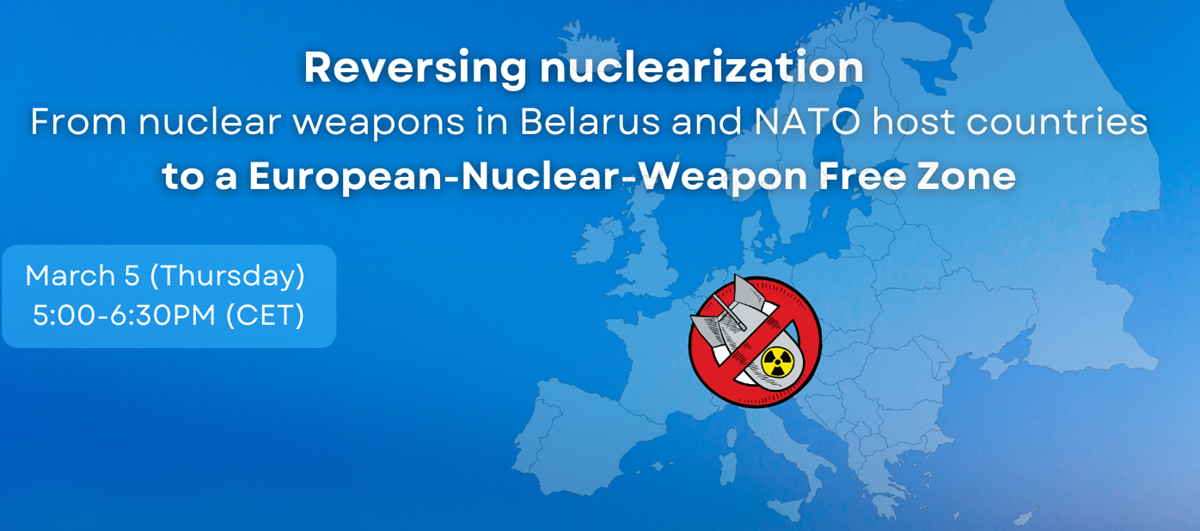
5 March -Online – Reversing nuclearization:
From nuclear weapons in Belarus and NATO host countries to a European-Nuclear-Weapon Free Zone
11am-12:30pm Eastern Time USA / 5pm-6:30pm CET

of the week – Advocating for a
nuclear free beach – https://www.samuellawrencefoundation.org/
The Samuel Lawrence Foundation advocates for a Nuclear Waste Free Beach at San Onofre, join us and take action!

10 March A LIVE WEBINAR THE REAL EFFECTS OF NUCLEAR POWER
What the Industry Isn’t Telling Us
1:00 PM Mountain, 2 pm Central, 3 pm Eastern. Live on the Keepers of the Water Facebook page


18 March Webinar @ 1 PM EST: An Assessment of SMR Projects: The Case of Canada
register for the zoom:
https://us02web.zoom.us/webinar/register/WN_o8BIIOUvQ2ONJR1nta65DQ#/registration

of the week – STOP SMALL MODULAR REACTORS IN CANADA
To see nuclear-related stories in greater depth and intensity – go to https://nuclearinformation.wordpress.com
-
Archives
- March 2026 (18)
- February 2026 (268)
- January 2026 (308)
- December 2025 (358)
- November 2025 (359)
- October 2025 (376)
- September 2025 (258)
- August 2025 (319)
- July 2025 (230)
- June 2025 (348)
- May 2025 (261)
- April 2025 (305)
-
Categories
- 1
- 1 NUCLEAR ISSUES
- business and costs
- climate change
- culture and arts
- ENERGY
- environment
- health
- history
- indigenous issues
- Legal
- marketing of nuclear
- media
- opposition to nuclear
- PERSONAL STORIES
- politics
- politics international
- Religion and ethics
- safety
- secrets,lies and civil liberties
- spinbuster
- technology
- Uranium
- wastes
- weapons and war
- Women
- 2 WORLD
- ACTION
- AFRICA
- Atrocities
- AUSTRALIA
- Christina's notes
- Christina's themes
- culture and arts
- Events
- Fuk 2022
- Fuk 2023
- Fukushima 2017
- Fukushima 2018
- fukushima 2019
- Fukushima 2020
- Fukushima 2021
- general
- global warming
- Humour (God we need it)
- Nuclear
- RARE EARTHS
- Reference
- resources – print
- Resources -audiovicual
- Weekly Newsletter
- World
- World Nuclear
- YouTube
-
RSS
Entries RSS
Comments RSS
 nuclear-news
Leave a comment