Lawmakers and media are being conned, as nuclear industry manipulates climate change rules
|
In state after state, operators have figured out how turn green-power incentives into sweetheart deals. https://www.politico.com/agenda/story/2019/04/23/nuclear-energy-climate-change-000893, By TRAVIS KAVULLA 04/23/2019 Yet these laws remain on the books, and recently some of the nation’s largest energy producers have started to turn them to their own benefit. For the past several years, I’ve been researching clean-energy regulations at the state level, and a troubling pattern has begun to emerge: In numerous states, companies with large investments in nuclear energy — including Exelon, First Energy, Dominion and PSEG — have lobbied states to reconfigure their clean-power incentives to subsidize existing nuclear plants, rather than the emergent technologies that the laws were intended for.
 The result is a contagion of subsidies to nuclear power plants that started in Democratic states like Illinois and New York in 2016, spread to Connecticut in 2017 and New Jersey in 2018. Bills to this effect are now being considered by Republican-led chambers in Ohio and Pennsylvania. If those measures pass, nuclear interests will have executed a clean sweep of the six northeastern states that have the largest quantities of nuclear generation.The state nuclear-handout schemes are all slightly different. But they all take advantage of green-sounding energy incentives, and they share a basic outline intended to avoid the appearance of being a naked subsidy. For example, Illinois’ program creates a commodity called a “zero emission credit,” or ZEC. A ZEC may only be created by a “zero emission facility” — which makes it sound like they are available to any form of zero-carbon energy. But the law defines “zero emission facility” as being a power plant “fueled by nuclear power.” The law then creates an artificial demand for ZECs, requiring utilities to buy a certain quantity. The law sets this number at a level tellingly similar to the total expected output of the state’s nuclear power fleet. All of this is topped off with a requirement that a government commission pass through the costs of these ZECs to customers through a mandatory rate they have no choice (other than cutting the cord entirely) but to pay. The result is a contagion of subsidies to nuclear power plants that started in Democratic states like Illinois and New York in 2016, spread to Connecticut in 2017 and New Jersey in 2018. Bills to this effect are now being considered by Republican-led chambers in Ohio and Pennsylvania. If those measures pass, nuclear interests will have executed a clean sweep of the six northeastern states that have the largest quantities of nuclear generation.The state nuclear-handout schemes are all slightly different. But they all take advantage of green-sounding energy incentives, and they share a basic outline intended to avoid the appearance of being a naked subsidy. For example, Illinois’ program creates a commodity called a “zero emission credit,” or ZEC. A ZEC may only be created by a “zero emission facility” — which makes it sound like they are available to any form of zero-carbon energy. But the law defines “zero emission facility” as being a power plant “fueled by nuclear power.” The law then creates an artificial demand for ZECs, requiring utilities to buy a certain quantity. The law sets this number at a level tellingly similar to the total expected output of the state’s nuclear power fleet. All of this is topped off with a requirement that a government commission pass through the costs of these ZECs to customers through a mandatory rate they have no choice (other than cutting the cord entirely) but to pay.In short, the law seems to be creating a program that promotes adoption of all kinds of clean energy, but in fact creates a direct subsidy for nuclear power plants and guarantees them customers for years to come. Instead of spurring competition between emissions-reducing power sources, it locks in one energy supplier for the foreseeable future. These state policies starkly differ from other carbon-reduction policies, such as a carbon tax or a cap-and-trade program. Those policies have the advantage of aiming directly at their target: carbon emissions. While potentially costly, either would circulate revenue back to consumers or taxpayers, or use that revenue on government spending intended to amplify the program’s core purpose. THAT’S NOT THE case here. The nuclear subsidy schemes are an elaborate greenwashing that neither returns money to the public nor further reduces carbon emissions.
It’s also important to keep sight of the big picture: Lower energy prices are a good thing for consumers, both private citizens and businesses. Lower prices are only a crisis for energy suppliers who can’t compete. In my conversations with state officials, some have struggled to understand how this has emerged as a political issue if the nuclear fleet is not, in fact, facing an existential crisis. This is naïve. Executives at corporations that own nuclear power plants, watching as neighboring states hand out subsidies, have a fiduciary duty to their shareholders to try to get it for themselves—whether or not their plants are already turning a profit. Debra Raggio, senior vice president for regulatory affairs for Talen Energy, admitted as much when she testified before a Pennsylvania legislative committee at an April 8 hearing, saying that if the state’s legislation featured a needs test to determine whether nuclear plants actually needed a subsidy to remain open, her company would oppose the bill. Bowring projects that the company’s only Pennsylvania nuclear plant, located along the Susquehanna River, will be profitable in each of the coming three years. In Ohio and Pennsylvania, the whole drama is unfolding on terms dictated by the nuclear plant owners, with utility corporations making threats to shut down certain facilities to force sweeping legislative action without the time for meaningful scrutiny. BY PROPPING UP older technologies, these state bailouts actually risk doing harm to innovative technologies looking to break into the market. Pennsylvania provides a useful example. In 2004, the state Legislature set aside a relatively modest amount of consumer demand to be served by renewable and other technologies in its Alternative Energy Portfolio Standard. That program constitutes 18 percent of consumer demand. Under the current proposal, a whopping 50 percent would be carved out for existing nuclear plants. In other words, 68 percent of customer demand would be met by power plants preordained by government officials for that purpose. That leaves energy producers who don’t benefit from subsidies left to fight for the scraps. One cannot encourage innovation when the innovators have only one-third of the market share to compete for. Sadly, these handouts are unraveling a successful state policy that has benefited customers and reduced carbon emissions in the process. Pennsylvania and the other nuclear battleground states adopted policies two decades ago to replace government planning and monopolies with competition between generators. The results have been significant. Customers in these so-called restructured states have seen their electricity costs drop an average of 8 percent between 2008 and 2016, according to a 2017 study by Phil O’Connor, the late chairman of the Illinois Commerce Commission. Customers in states where legislatures, government commissions, and monopolies together select the “right” resource mix have seen prices rise 15 percent. Meanwhile, these competitive markets ensured that when the Marcellus natural gas shale supply boomed, that uneconomic coal plants did not hang around. Carbon emissions from the U.S. power sector have declined 3,855 million metric tons between 2005 and 2017, according to the Energy Information Administration. The majority of those savings, 2,360 million metric tons, come from natural gas’ replacement of coal, and not zero-emission facilities. It’s deeply ironic that these competitive markets might become a victim of their own successes. The necessity of acting on climate change is palpable in our politics today. But the answer is a genuine competition between low-emission producers through a market for carbon, not handouts to the nuclear industry. The legislation proposed in the Pennsylvania House of Representatives plays footsie with this issue, suggesting that if a price of $15 per ton of carbon emissions were enacted, the nuclear handout would sunset. This is silly. After all, if you’ve got your subsidy, are you going to be willing to support a law that sets a more level playing field between clean-energy technologies—or where you might lose out to efficient gas generators? It would be next to impossible to obtain a comprehensive carbon policy if technology-specific handouts such as these continue to become law, because the political support that might have existed for a carbon policy would have been sapped. Whatever your view of nuclear energy, it should compete fairly against other electricity sources. In the run-up to this year’s legislative session in Harrisburg, Exelon tripled its lobbying expenditures in Pennsylvania, to $1.7 million, which is a lot of money in state politics. But the company stands to obtain a large portion of the annual $500 million dole of the Pennsylvania nuclear program. That’s a good return on investment—and easier to earn than having to compete for it. Travis Kavulla is director of energy and environment policy at the R Street Institute. |
|
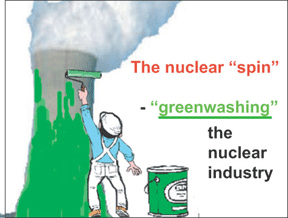


Safety and language problems, as Tepco plans to bring in foreign workers for Fukushima clean-up

|
Editorial: Safety, language measures needed for foreigners to work at Fukushima plant https://mainichi.jp/english/articles/20190424/p2a/00m/0na/004000c 24 Apr 19, Tokyo Electric Power Co. (TEPCO) is preparing to bring in foreign workers with special technical skills to join decommissioning work on the disaster-stricken Fukushima Daiichi nuclear plant.
At present, an average of 4,000 employees of TEPCO and cooperating firms work at the facility every day. Laws and regulations stipulate that workers’ radiation exposure must be limited to 50 millisieverts in a single year, and 100 millisieverts over five years. No one is allowed to stay at the plant once they hit one of these caps, so waves of new employees must be brought in to maintain worker numbers. Decommissioning the Daiichi plant, which suffered a triple core meltdown in the wake of the March 2011 Great East Japan Earthquake and tsunami, is expected to take 30 to 40 years. Whether the companies involved can sustain sufficient staffing levels will be one factor that determines the success or failure of the project. When it comes to tapping foreign labor to make up the required numbers, the Justice Ministry — which has jurisdiction over Japan’s immigration system — has already declined to approve sending foreign technical intern trainees to work at the plant. One of the core tenets of the foreign technical trainee program is that the job placements must provide the trainees with skills they can use in their home countries, and working to decommission a devastated nuclear plant did not fit the bill. TEPCO is now turning its eyes to foreign workers with Category 1 work visas, one of the new residency statuses launched on April 1 and aimed at those with certain skills and experience. Technical trainees with three years’ experience in Japan can obtain this visa without a skills exam. However, there is a real risk of radiation exposure at the Daiichi plant, and the terminology used on-site is highly technical, making for a difficult environment. TEPCO and its partners must not treat the new foreign worker system as an employee pool they can simply dip into. The workers’ Japanese level is particularly a cause for worry. To obtain a Category 1 visa, applicants must speak Japanese at only a “daily conversational” level. However, anyone working at the Daiichi site must understand a slew of technical terms related to radiation and other facets of the decommissioning process, meaning a very high level of Japanese is absolutely indispensable. If foreign employees begin working there without having learned the necessary terminology, we believe there is a real risk they could be ordered to do jobs that exposed them to radiation. TEPCO has said it is up to its project partners whether they employ Category 1 foreign workers. In fact, the majority of people at Fukushima Daiichi are employed by one of the firms that make up the layers upon layers of subcontractors working on the decommissioning. Nevertheless, as the company heading the project, TECPO has a responsibility to oversee the conditions of every worker, right down to the bottom of the pyramid. Furthermore, if a foreign worker has been exposed to radiation overseas, that dose must be added to their sievert count at the plant. However, it is up to the worker to report any previous radiation exposure, which can make it difficult to properly track and manage their doses. If a worker develops a radiation-related illness after returning to their home country, will they be able to smoothly apply for workers’ accident compensation? This is also a serious worry. If Japan is to accept foreign workers to help decommission the Fukushima Daiichi plant, it is absolutely essential to create the appropriate environment, including measures to boost their Japanese skills and strengthen radiation exposure management. |
|
New report – half a million species for extinction within a few decades
A million species face extinction due to humans, UN report finds https://www.heraldscotland.com/news/17592216.a-million-species-face-extinction-due-to-humans-un-report-finds/ Arts Correspondent, 24 Apr 19, UP to a million species face extinction due to the actions of humanity, a new UN report finds.
$70 trillion cost predicted, as Arctic permafrost thaws
 Melting permafrost in Arctic will have $70tn climate impact – study https://www.theguardian.com/environment/2019/apr/23/melting-permafrost-in-arctic-will-have-70tn-climate-impact-study Jonathan Watts, Global environment editor @jonathanwatts, 23 Apr 2019
Study shows how destabilised natural systems will worsen man-made problem The release of methane and carbon dioxide from thawing permafrost will accelerate global warming and add up to $70tn (£54tn) to the world’s climate bill, according to the most advanced study yet of the economic consequences of a melting Arctic.
If countries fail to improve on their Paris agreement commitments, this feedback mechanism, combined with a loss of heat-deflecting white ice, will cause a near 5% amplification of global warming and its associated costs, says the paper, which was published on Tuesday in Nature Communications.
The authors say their study is the first to calculate the economic impact of permafrost melt and reduced albedo – a measure of how much light that hits a surface is reflected without being absorbed – based on the most advanced computer models of what is likely to happen in the Arctic as temperatures rise. It shows how destabilised natural systems will worsen the problem caused by man-made emissions, making it more difficult and expensive to solve.
They assessed known stocks of frozen organic matter in the ground up to 3 metres deep at multiple points across the Arctic. These were run through the world’s most advanced simulation software in the US and at the UK Met Office to predict how much gas will be released at different levels of warming. Even with supercomputers, the number crunching took weeks because the vast geography and complex climate interactions of the Arctic throw up multiple variables. The researchers then applied previous economic impact models to assess the likely costs.
The authors say their study is the first to calculate the economic impact of permafrost melt and reduced albedo – a measure of how much light that hits a surface is reflected without being absorbed – based on the most advanced computer models of what is likely to happen in the Arctic as temperatures rise. It shows how destabilised natural systems will worsen the problem caused by man-made emissions, making it more difficult and expensive to solve.
They assessed known stocks of frozen organic matter in the ground up to 3 metres deep at multiple points across the Arctic. These were run through the world’s most advanced simulation software in the US and at the UK Met Office to predict how much gas will be released at different levels of warming. Even with supercomputers, the number crunching took weeks because the vast geography and complex climate interactions of the Arctic throw up multiple variables. The researchers then applied previous economic impact models to assess the likely costs.
It would also add to global inequalitybecause most of the economic burden – equivalent to almost the entire world’s current annual GDP – is likely to be borne by countries in warmer poorer regions such as India and Africa, which are most vulnerable to a rise in temperatures.
It would also add to global inequality because most of the economic burden – equivalent to almost the entire world’s current annual GDP – is likely to be borne by countries in warmer poorer regions such as India and Africa, which are most vulnerable to a rise in temperatures.
India, Ghana, Japan, Columbia, New Zealand, Ireland, Australia, Belgium, South Africa, Extinction Rebellion climate activists speak out
From India to Ireland: a week of Extinction Rebellion actions
Activists tell us why they have taken part in the protest group’s international rebellion week https://www.theguardian.com/environment/2019/apr/24/from-india-to-ireland-a-week-of-extinction-rebellion-actions, Jessie McDonald and Guardian readers, 24 Apr 2019
Russia urges for six-part talks as the practical way to deal with North Korea
 Kremlin: Six-party talks only efficient way to tackle nuclear North Korea https://www.reuters.com/article/us-northkorea-russia-kremlin/kremlin-six-party-talks-only-efficient-way-to-tackle-nuclear-north-korea-idUSKCN1S01BNMOSCOW (Reuters) Writing by Anton Kolodyazhnyy; Editing by Maria Kiselyova – 24 Apr 19,The Kremlin said on Wednesday that six-party talks, which are currently stalled, were the only efficient way of addressing the de-nuclearisation of the Korean peninsula, but all other efforts also merited support. Kremlin: Six-party talks only efficient way to tackle nuclear North Korea https://www.reuters.com/article/us-northkorea-russia-kremlin/kremlin-six-party-talks-only-efficient-way-to-tackle-nuclear-north-korea-idUSKCN1S01BNMOSCOW (Reuters) Writing by Anton Kolodyazhnyy; Editing by Maria Kiselyova – 24 Apr 19,The Kremlin said on Wednesday that six-party talks, which are currently stalled, were the only efficient way of addressing the de-nuclearisation of the Korean peninsula, but all other efforts also merited support.
North Korean leader Kim Jong Un arrived in the Russian city of Vladivostok on Wednesday for a summit he is likely to use to seek support from Russian President Vladimir Putin while Pyongyang’s nuclear talks with Washington are in limbo. “There are no other efficient international mechanisms at the moment,” Kremlin spokesman Dmitry Peskov said. “But, on the other hand, efforts are being made by other countries. Here all efforts merit support as long as they really aim at de-nuclearisation and resolving the problem of the two Koreas,” he told reporters. |
|
Japan’s nuclear regular demands safety steps, or reactors must close down
Japan to shut down nuclear plants if counterterror steps not taken in time, Japan Times, KYODO, AFP-JIJI, REUTERS, APR 24, 2019
Japan’s nuclear regulator decided Wednesday not to let power companies operate reactors if they fail to install sufficient counterterrorism measures by specified deadlines.
The decision by the Nuclear Regulation Authority came after three utilities that operate five nuclear plants in western and southwestern Japan requested that their deadlines be extended as they expect delays in completing counterterrorism steps required under stricter regulations introduced in 2013 following the Fukushima nuclear crisis.
Kyushu Electric Power Co., Kansai Electric Power Co. and Shikoku Electric Power Co. had sought to postpone their five-year deadlines by one to three years, citing reasons such as the need to carry out massive construction work.
The three companies told the NRA that the measures would not be on time at 10 of their reactors, according to documents published on the regulator’s website.
But the regulator has declined their requests for extensions.
The power plant operators are required to build facilities that can keep reactors cool via remote control and prevent the massive release of radioactive materials if the units are the target of a terrorist attack, such as from planes being flown into them.
Nuclear plant operators need to set up such facilities within five years of the nuclear safety watchdog approving detailed construction plans for the plants.
But several firms have warned they will not meet these criteria. The NRA said after a meeting earlier Wednesday it would no longer push back the deadline as it has done in the past.
“There is no need to extend the deadline, and nuclear facilities have to stop operations if the operators fail to meet it,” an NRA official said.
He added that several other reactors were also at risk of being shut down……… https://www.japantimes.co.jp/news/2019/04/24/business/corporate-business/japan-halt-nuclear-plants-operations-anti-terrorism-steps-not-taken-time/#.XMDXGDAzbGg
Turkish nuclear power project looks like being shelved
|
Clouds gather over Turkey’s nuclear ambitions Pantelis Oikonomou is a former nuclear inspector at the International Atomic Energy Agency. The article is an excerpt from his upcoming book “Global Nuclear Threat” (published by Sideris). In early December 2018, five years after Turkey and Japan signed a bilateral agreement concerning the construction of four nuclear reactors in the city of Sinop on the Black Sea, the project looks like it might be shelved. According to foreign news agencies, the Japanese-French consortium is set to abandon the project.The consortium says that delays in launching construction have more than doubled the estimated costs. Tougher international safety measures that came into force following the Fukushima nuclear disaster in 2011 have reportedly inflated the bill from 20 billion to 44 billion dollars. Turkey’s economic problems and the significant plunge of the Turkish lira also played a role. It should be noted that the Turkey-Japan deal and the Turkey-Russia agreement for the construction of the Akkuyu power station in the southern province of Mersin both contain controversial clauses (articles 8 and 12 respectively) giving Ankara access to enriched uranium and plutonium. Both nuclear materials are, under certain conditions, required to build nuclear weapons. According to a senior official in the Japanese Foreign Ministry, Article 8 was included on Turkey’s persistent request. In early December 2018, five years after Turkey and Japan signed a bilateral agreement concerning the construction of four nuclear reactors in the city of Sinop on the Black Sea, the project looks like it might be shelved. According to foreign news agencies, the Japanese-French consortium is set to abandon the project. The consortium says that delays in launching construction have more than doubled the estimated costs. Tougher international safety measures that came into force following the Fukushima nuclear disaster in 2011 have reportedly inflated the bill from 20 billion to 44 billion dollars. Turkey’s economic problems and the significant plunge of the Turkish lira also played a role. It should be noted that the Turkey-Japan deal and the Turkey-Russia agreement for the construction of the Akkuyu power station in the southern province of Mersin both contain controversial clauses (articles 8 and 12 respectively) giving Ankara access to enriched uranium and plutonium. Both nuclear materials are, under certain conditions, required to build nuclear weapons. According to a senior official in the Japanese Foreign Ministry, Article 8 was included on Turkey’s persistent request. Pantelis Oikonomou is a former nuclear inspector at the International Atomic Energy Agency. The article is an excerpt from his upcoming book “Global Nuclear Threat” (published by Sideris). |
|
An Australian Maralinga nuclear test veteran reveals his grim story
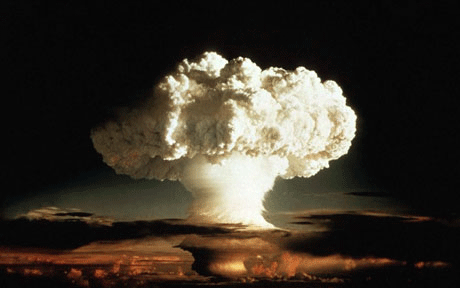 Maralinga nuclear bomb test survivor reveals truth of what happened in the SA desert https://www.adelaidenow.com.au/messenger/east-hills/maralinga-nuclear-bomb-test-survivor-reveals-truth-of-what-happened-in-the-sa-desert/news-story/697b17f6d3427a78aa0262b09727c169, 24 Apr 19
The nuclear bomb tests, under British Government control, at Maralinga in far west South Australia in the 1950s were conducted at the highest level of secrecy. But they had thousands of witnesses. Most were Australian servicemen, innocently used as guinea pigs and exposed to deadly radiation. Craig Cook talks to a survivor, one of the last of a group of men who built the Maralinga camp as part of 23 Construction Squadron and watched in awe as the bombs were exploded, little knowing they were risking their lives and the futures of their children.
Tony Spruzen knew the drill at the top secret Maralinga facility in the South Australian desert in the spring of 1956.
Just like hundreds of others at the nuclear site at 11-mile camp during Operation Buffalo, he was told to turn his back and cover his eyes to protect himself from the gigantic glare of the exploding atomic bomb.
What they didn’t tell the Australian Army sapper was, at the moment of the flash of detonation, he would see the bones of his hand through his tightly shut eyelids.
“It was like a massive x-ray,” Tony, 83, from Glengowrie says. ‘Unlike anything I’d ever known before.”
A week after One Tree, on October 6, 1956, Spruzen witnessed the detonation of Buffalo 2, named Marcoo.
The bomb was only a tenth the size of One Tree but this time was detonated directly above and just under the ground.
“The bomb was in an amphitheatre of hills and we were far closer to that one, maybe only 200 yards away,” he remembers.
“We were close enough to see the trenches with dummy soldiers in them holding rifles and fake aeroplanes and tanks used to test the blast effect.
“And we could see the scientists walking around in their white suits checking out the site before and afterwards but we were just in khaki shorts and short sleeved shorts. Even the dignitaries had no protection.”
Every hour, from five hours out, an elaborate PA system across the complex announced the timing of the bomb detonation.
In the final 30 seconds, and with a rising and excited inclination, the voice on the PA dramatically counted….ten, nine, eight…down to zero.
When Marcoo exploded at 7am it only took a few seconds for a heavy shower of dust to descend on the witnesses.
“We had this large piece of litmus paper attached to our shirts,” Spruzen recalls
Spruzen, originally from Victoria and a carpenter by trade, enlisted in the Army at just 16.
Four year later he was at Maralinga as part of a detachment of 23 Construction Squadron, an acclaimed unit of the Royal Australian Engineers and exclusively raised in South Australia.
Around 40 young men were selected from the unit to build a desert tent camp with cook houses and latrines for the Commonwealth military ‘high-ups’ who were having their first look at the impact of the devastating nuclear weapon.
Around 200km from the ocean, the tent city gained the facetious name of the ‘Sea View Holiday Camp’.
“It was an adventure…we were all excited,” he recalls.
“A lot of young single guys together and we had some fun.”
The lads knew it was serious too as this was a hush-hush operation. They weren’t even allowed to take a camera along for snapshots so Spruzen has no personal photos from Maralinga.
“Then we all turned around to see this mushroom cloud climbing into the sky. The next thing was the blast. The boom was deafening…and then the wind came about thirty seconds after that blowing dust and soil and debris all over us.”
But he does have a terrible reminder of his three months spent in far western South Australia.
“Of the 40 men who went up with me I only know of three of us still around,” he says. “The rest have all died – many from cancers.”
The first Maralinga bomb, Buffalo 1, with the nickname One Tree, was detonated after being dropped from a 31m high tower.
At 15 kiloton it was the same size as Little Boy, the bomb dropped by the US air force that demolished the Japanese city of Hiroshima in August 1945, killing more than 100,000 instantly and tens of thousands slowly in the aftermath from burns and radiation poisoning.
“They said, keep an eye on that and if it changes to pink come and see us. Well it turned pink for every one of us.
“Had I have known what I know now I wouldn’t have been so close.”
Transferred to Sydney on a training course, Spruzen missed the final two detonations at Maralinga that year: on October 11, 1956, Buffalo 3 (Kite) was released by a Royal Air Force Vickers Valiant bomber, the first drop of a British nuclear weapon from an aircraft; and then on October 22, and again dropped from the 31m tower, (Buffalo 4) Breakaway exploded.
There were a total of seven nuclear desert tests at Maralinga performed during Operations Buffalo and Antler.
The 1985 McClelland Royal Commission heavily criticised the detonations, declaring the weather conditions were inappropriate and led to the widespread scattering of radioactive material.
The radioactive cloud from Buffalo 1 reached more than 11,000m into the air and with a northerly wind blowing radioactivity was detected across Adelaide.
Radioactive dust clouds from other bombs were detected in Northern Territory, Queensland and across New South Wales, as far away as Sydney, 2500km from Maralinga.
Around 12,000 Australian servicemen served at British nuclear test sites in the southern hemisphere between 1952 and 1963.
In recent years, the British Government’s claim that they never used humans “for guinea pig-type experiments” in nuclear weapons trials in Australia has been revealed to be a lie.
Tony Spruzen has struggled to come to terms with being placed in danger by his own government who had full knowledge of the consequences of exposure to radiation.
“Once we all found out later what we’d been exposed to at Maralinga it makes you very angry,” he says.
“We believed them when we were told we would be safe — but we haven’t been.”
Spruzen met his wife Shirley, the daughter of an army veteran, in Adelaide where they settled after marriage in June 1960. He left the army seven months later to work in civil construction. He thought his Maralinga days were well behind him but soon after they came to haunt him.
In the first four years of marriage, the couple agonisingly suffered six miscarriages, including twins.
Alarm bells started ringing when he was sent a survey from Veterans Affairs asking about his general health and, specifically his history of cancers.
“It turned out those involved in the atomic tests had a 30 per cent higher chance than getting cancers than the general public,” he says.
“Most of those got them within the first five years and a majority of those were dead before a decade had passed.”
Spruzen, who eventually had three children with Shirley, didn’t get cancer at that time, although he has since had several melanomas removed.
But when his son was diagnosed with acute myeloid leukaemia at the age of 41, he wondered about the possibility of faulty genes, damaged by exposure to radiation, as has been documented in Japanese survivors of the atomic bombs, jumping a generation.
“My son was told by the QEH (Queen Elizabeth Hospital) there was nothing could be done for him but we went up to Queensland and after a bone marrow transfer from his sister he survived,” he adds.
“A decade on he’s working as strong as he has but I don’t think his condition was a coincidence given my history.
“There’s been nothing (compensation) for those of us who were there although they gave us a white card for our cancers and now we have a (full health) gold card.”
Ken Daly, President Royal Australian Engineers Association says it is the least the men, who literally put their bodies on the line, deserve.
“You get these young men, aged around 25-30, with a history of exposure to radiation, coming down with cancers in those numbers and you just know what has caused it,” he says.
“Many died within a few years of being exposed to the fallout and many passed on generational health problems and birth defects to their children.”
Mr Daly, who was based at Warradale Barracks for 15 years, where 23 Construction was based until being disbanded in the early 1960s, hadn’t heard of the Squadron until around five years ago.
Since then he has been central to the group gaining due recognition.
In its earliest days the Squadron, with a strength of eight officers and 160 in other ranks, built the El Alamein Army Reserve camp, part of which later became the Baxter Detention Centre, outside of Port Augusta.
It also assisted the South Australian community by providing aid during bush fires, the grasshopper plague of 1955, and significant infrastructure construction.
During the record flood of 1956, while those squad members were at Maralinga, the rest of 23 Construction were out sandbagging River Murray towns and then cleaning up after the water receded.
In 2011, the Royal Australian Engineers constructed a memorial at Warradale to all who have served in its ranks.
This year a bronzed engineer’s slouch hat, of actual size, by Western Australian sculptor and former army engineer Ron Gomboc will be incorporated into the memorial.
“The hat will be mounted on the memorial in such a way it will look like it’s suspended in mid-air,” Daly adds.
“It acknowledges the ultimate sacrifice of the more than 1250 engineers who died in World War I and the remarkable service and sacrifice of 23 Construction Squadron that has never been recognised before.”
The slouch hat, costing $6,000 and one of only six to have been cast, will be unveiled during a service at Warradale Barracks at midday on Sunday April 28.
Contact Ken Daly at dailydouble@bigpond.com for further details.
Teenage climate activist Greta Thunberg addresses UK Parliament
BBC 23rd April 2019 Teenage activist Greta Thunberg has described the UK’s response to climate change as “beyond absurd”. In a speech to MPs, the Swedish 16-year-old
criticised the UK for supporting new exploitation of fossil fuels and
exaggerating cuts to carbon emissions. She was invited to Westminster after
inspiring the school climate strikes movement. Environment Secretary
Michael Gove said “we have not done nearly enough”. In her speech in
Parliament on Tuesday, Miss Thunberg said the UK was supporting shale gas
fracking, greater exploitation of North Sea oil and gas fields and
expanding airports. “This ongoing irresponsible behaviour will no doubt be
remembered in history as one of the greatest failures of humankind,” she
said. She also described the UK’s carbon emissions reduction as the result
of “very creative” accounting. The country’s reported 37% reduction in
emissions since 1990 was only 10% when aviation, shipping, imports and
exports were counted, she said. Miss Thunberg said her generation’s future
had been “stolen” so that “a small number of people could make unimaginable
amounts of money”.
https://www.bbc.co.uk/news/uk-48017083
admiration but also a sense of responsibility and guilt because I recognise
I am of your parents’ generation. I recognise we have not done nearly
enough to deal with the problem of climate change,” he said. “Suddenly,
thanks to the leadership of Greta and others, it has become inescapable
that we have to act . . . Greta, your voice has been heard and we are all
responsible for making sure that we listen and we respond and that we
change.”
https://www.thetimes.co.uk/article/e43d91d8-660e-11e9-adc2-05e1b87efaea
Decommissioning contracts announced for Dounreay nuclear site in Scotland.
£400m decommissioning contract winners for Scotland nuclear site revealed, Infrastructure Intelligence Ryan Tute, 24 Apr 19, Dozens of companies and their supply chains have been announced as winners for six decommissioning framework contracts, worth up to £400m, at the Dounreay nuclear site in Scotland.
Dounreay Site Restoration Limited (DSRL), was the site of Britain’s former centre of nuclear fast reactor research and development for 60 years and is set to be demolished and cleaned up.
Initially for up to four years with the possibility of extensions of up to an additional three years, winners will take work at the site, delivered on behalf of the Nuclear Decommissioning Authority (NDA). ……
Full list of winners:
- AECOM E&C UK; MW Hargreaves; Kier Infrastructure and Overseas; Morson Projects; NIS; NSG Environmental; Squibb Group; Westinghouse Electrical Company UK
- Dounreay Decommissioning Framework (DDF) Alliance; Cavendish Nuclear; BAM Nuttall; KDC Contractors; JGC Engineering and Technical Services
- Dounreay Wood Alliance (DWA); Wood; Aquila Nuclear Engineering; GD Energy Services; Orano Projects
- Jacobs UK; Atkins
- Nuclear Decommissioning Ltd (NDL); James Fisher Nuclear; REACT Engineering; Shepley Engineers; WYG Engineering; JBV Demolition; RPS Consulting Services
- Nuvia; Graham Construction; Oxford Technologies; Thompson of Prudhoe http://www.infrastructure-intelligence.com/article/apr-2019/%C2%A3400m-decommissioning-contract-winners-scotland-nuclear-site-revealed
End of nuclear cooperation waivers could quietly kill Iran deal
|
Forget oil sanctions, end of nuclear cooperation waivers could quietly kill Iran deal https://www.al-monitor.com/pulse/originals/2019/04/iran-jcpoa-nuclear-deal-sanctions-waivers-trump-arak-fordow.html April 24, 2019 Much of the current debate on the Donald Trump administration’s “maximum pressure campaign” against Iran concerns its decision not to extend waivers allowing eight nations – including China, India and Turkey – to import limited amounts of Iranian oil. However, it is the possible revocation of waivers that allow the remaining parties to the deal signed in 2015 to engage in civil nuclear cooperation with Iran — with the aim of reducing the proliferation risks of the Iranian nuclear program — that poses the greatest threat to the future of the nuclear deal. US national security adviser John Bolton and a group of hawkish lawmakers in Congress are agitating for the Trump administration to cancel three key waivers issued in November 2018, when the United States reimposed secondary sanctions on Iran. These waivers pertain to technical work on Iran’s civil nuclear program required under the terms of the Joint Comprehensive Plan of Action (JCPOA) and cover activities at three sites: Fordow, Arak and Bushehr. The aim of this cooperation is to jointly work toward significantly reducing proliferation risks. In Arak, a waiver is necessary to enable Iran to redesign its heavy water research reactor in order to “support peaceful nuclear research and radioisotope production for medical and industrial purposes.” The proposed redesigned Arak reactor would vastly cut the potential for a plutonium path to the bomb. The underground uranium enrichment facility of Fordow is being converted into a “nuclear, physics and technology center.” The aim here is to keep uranium enrichment literally closer to the surface and thus more vulnerable in case of an Iranian dash for the bomb. At Bushehr, the site of a Russian-built nuclear power plant that became operational in 2011, the waiver is necessary to allow Iran to continue to purchase the fuel it needs to run the reactor and produce electricity. A decision to revoke the waivers for civil nuclear cooperation would constitute perhaps the most direct US assault on the JCPOA to date. For this reason, Secretary of State Mike Pompeo and other figures in the Trump administration, worried about political blowback, have been arguing for their continuation, with European governments lobbying the United States aggressively on the issue. Note, however, that even with the present waivers in place, it is apparent that implementation of the nuclear cooperation has been faltering. Revocation of the waivers would have further and grave consequences for the future of the JCPOA. |
|
|
Narendra Modi using threat of nuclear bombing Pakistan, as an election campaign tactic
 Dear Mr. Modi, A Nuclear Bomb Is Not A Campaign Prop, https://www.newsclick.in/narendra-modi-nuclear-bomb-diwali-pakistan In a campaign speech in Rajasthan on April 22, prime minister Narendra Modi casually threatened Pakistan with the use of nuclear bombs, saying India’s nuclear arsenal has not been saved for Diwali. Newsclick Team, 24 Apr 2019
Russia’s attitude to North Korea’s nuclear weapons
What Russia thinks about North Korea’s nuclear weapons, Bulletin of the Atomic Scientists, By Anastasia Barannikova, April 24, 2019, North Korean leader Kim Jong Un arrived in Russia today for a meeting with President Vladimir Putin….. Despite Russia’s past vote in favor of sanctions on Kim’s regime, Moscow has many reasons not to lean too hard on Kim over nuclear disarmament…………
Russia wants a stable North more than a non-nuclear North. Although, Russia continues to officially oppose North Korea’s nuclear status on the basis of its strict interpretation of the NPT, experts already speak about “nuclear emancipation” for the North, meaning recognition of its status as a lesser nuclear state. These ideas coincide with an idea some Chinese scholars have developed whereby North Korea would reduce its nuclear arsenal but keep some weapons as a deterrent. From Russia’s perspective, nuclear weapons now guarantee the security of the North Korean regime. The weapons can prevent attempts at violent regime change by external force. Through them, North Korean leadership has the independence to make changes within its borders. That’s good for Russia.
Many Russian analysts consider North Korea’s nuclear program to be defensive. Looking at the North’s nuclear doctrine, it seems likely the country wouldn’t use its nuclear weapons against a country that isn’t planning an attack. While little is known about Russia’s military planning beyond its publicly available doctrines, the specifics of the bilateral relations it holds with the North may guarantee that Russia has no plans to attack its neighbor.
……….The security of Kim’s regime, in turn, guarantees stability near Russia’s eastern borders. For Russia, a stable North Korean regime guarantees the absence of refugees flows, a normal feature of conflict zones, but also prevents US troops from deploying in a potentially disintegrating North. And with its nuclear weapons as diplomatic leverage, North Korea can maintain some independence from China. Thus, Moscow views Kim’s stability as providing something of a buffer between Russia and China.
Do North Korean nuclear weapons pose a threat to Russia? From Moscow’s perspective, the Korean Peninsula and Northeast Asia are relatively stable and don’t pose any immediate threats to security. Relations between Russia and North Korea are neutral, if not friendly. North Korean leadership appreciates Russia’s cautious, slow approach to the relationship, in contrast to China’s activist take on issues on the Korean Peninsula. Russia’s emphasis on the need to respect state sovereignty as a fundamental principle of international relations further lubricates the bilateral relationship: Russia avoids any attempt to interfere in the internal affairs of the North, so Pyongyang does not consider Russia as an external threat.
Many Russian analysts consider North Korea’s nuclear program to be defensive. Looking at the North’s nuclear doctrine, it seems likely the country wouldn’t use its nuclear weapons against a country that isn’t planning an attack. While little is known about Russia’s military planning beyond its publicly available doctrines, the specifics of the bilateral relations it holds with the North may guarantee that Russia has no plans to attack its neighbor.
But there is one scenario whereby North Korea’s nuclear weapons could threaten Russia. If Kim launches missiles against the United States, experts say they’ll fly over Russian territory. A US anti-missile response could, thus, risk a war between Russia and the United States. But Russian experts don’t believe that North Korea would ever attack the United States; they consider Kim Jong Un too rational for that. ………https://thebulletin.org/2019/04/what-russia-thinks-about-north-koreas-nuclear-weapons/
Campaign for Nuclear Disarmament (CND) holds public meeting in Burnley
 Organisation that has called for nuclear Organisation that has called for nuclear  weapons to be banned for six decades holds public meeting in Burnley, 23 Apr 19, https://www.burnleyexpress.net/news/organisation-that-has-called-for-nuclear-weapons-to-be-banned-for-six-decades-holds-public-meeting-in-burnley-1-9730392An organisation that has existed for 62 years and campaigns to ban nuclear weapons held a public meeting in Burnley.And the strong message that came forward from the meeting of the East Lancashire branch of the Campaign for Nuclear Disarmament was that the public should be made more aware of the humanitarian consequences of a deliberate or accidental detonation of nuclear weapons as well as the dangers that the population of UK are exposed to by the government persisting in maintaining and developing them. weapons to be banned for six decades holds public meeting in Burnley, 23 Apr 19, https://www.burnleyexpress.net/news/organisation-that-has-called-for-nuclear-weapons-to-be-banned-for-six-decades-holds-public-meeting-in-burnley-1-9730392An organisation that has existed for 62 years and campaigns to ban nuclear weapons held a public meeting in Burnley.And the strong message that came forward from the meeting of the East Lancashire branch of the Campaign for Nuclear Disarmament was that the public should be made more aware of the humanitarian consequences of a deliberate or accidental detonation of nuclear weapons as well as the dangers that the population of UK are exposed to by the government persisting in maintaining and developing them.
Between her international anti-nuclear commitments , Rebecca is currently acting as a legal observer in the XR demonstrations in London where over two hundred people have been arrested for committing acts of non-violent direct action. Rebecca showed a short film about the horrific humanitarian consequences of the use of nuclear weapons before going on to describe how, over a number of years, the nations of the world that do not have nuclear weapons have come together to negotiate the Treaty on the Prohibition of Nuclear Weapons. It was adopted by the United Nations in July 2017 by 122 nations of the UN General Assembly. Currently 70 nations have signed the Treaty and 22 have ratified it. Once 50 countries have ratified it, then it will become part of International law, like the laws against other WMD’s -chemical weapons, cluster bombs and landmines. It is expected that this could happen sometime next year. |
|
1 This Month


Tell the Ukrainian Government to Drop Prosecution of Peace Activist Yurii Sheliazhenko

Petition to revoke the licensing of the Near Surface Nuclear Disposal Facility (NSDF) at Chalk River. https://www.ourcommons.ca/petitions/en/Petition/Details?Petition=e-7247


of the week – STOP SMALL MODULAR REACTORS IN CANADA
To see nuclear-related stories in greater depth and intensity – go to https://nuclearinformation.wordpress.com
-
Archives
- March 2026 (204)
- February 2026 (268)
- January 2026 (308)
- December 2025 (358)
- November 2025 (359)
- October 2025 (376)
- September 2025 (258)
- August 2025 (319)
- July 2025 (230)
- June 2025 (348)
- May 2025 (261)
- April 2025 (305)
-
Categories
- 1
- 1 NUCLEAR ISSUES
- business and costs
- climate change
- culture and arts
- ENERGY
- environment
- health
- history
- indigenous issues
- Legal
- marketing of nuclear
- media
- opposition to nuclear
- PERSONAL STORIES
- politics
- politics international
- Religion and ethics
- safety
- secrets,lies and civil liberties
- spinbuster
- technology
- Uranium
- wastes
- weapons and war
- Women
- 2 WORLD
- ACTION
- AFRICA
- Atrocities
- AUSTRALIA
- Christina's notes
- Christina's themes
- culture and arts
- Events
- Fuk 2022
- Fuk 2023
- Fukushima 2017
- Fukushima 2018
- fukushima 2019
- Fukushima 2020
- Fukushima 2021
- general
- global warming
- Humour (God we need it)
- Nuclear
- RARE EARTHS
- Reference
- resources – print
- Resources -audiovicual
- Weekly Newsletter
- World
- World Nuclear
- YouTube
-
RSS
Entries RSS
Comments RSS
 nuclear-news