
U.S. Nuclear Power Plants Weren’t Built for Climate Change, [excellent pictures on original] Bloomberg , By Christopher Flavelle and Jeremy C.F. Lin, April 18, 2019
In 2011, after an earthquake and tsunami caused a meltdown at Japan’s Fukushima-Daiichi power plant, Gregory Jaczko, then the chairman of the U.S. Nuclear Regulatory Commission, had to worry about two things: whether radioactive fallout would harm the U.S. and whether a similar accident could befall an American plant. The answer to the first question turned out to be no. The second question preoccupies him still.
The NRC directed the operators of the 60 or so working U.S. nuclear power plants to evaluate their current flood risk, using the latest weather modeling technology and accounting for the effects of climate change. Companies were told to compare those risks with what their plants, many almost a half-century old, were built to withstand, and, where there was a gap, to explain how they would close it.
That process has revealed a lot of gaps. But Jaczko and others say that the commission’s new leadership, appointed by President Donald Trump, hasn’t done enough to require owners of nuclear power plants to take preventative measures—and that the risks are increasing as climate change worsens.
….. After Fukushima, U.S. regulators told operators to calculate their exposure to various flood risks and compare that with what the plant was designed for. Ninety percent of plants had at least one risk exceeding their design.
According to a Bloomberg review of correspondence between the commission and plant owners, 54 of the nuclear plants operating in the U.S. weren’t designed to handle the flood risk they face. Fifty-three weren’t built to withstand their current risk from intense precipitation; 25 didn’t account for current flood projections from streams and rivers; 19 weren’t designed for their expected maximum storm surge. Nineteen face three or more threats that they weren’t designed to handle.
The industry argues that rather than redesign facilities to address increased flood risk, which Jaczko advocates, it’s enough to focus mainly on storing emergency generators, pumps, and other equipment in on-site concrete bunkers, a system they call Flex, for Flexible Mitigation Capability. Not only did the NRC agree with that view, it ruled on Jan. 24 that nuclear plants wouldn’t have to update that equipment to deal with new, higher levels of expected flooding. It also eliminated a requirement that plants run Flex drills………
The commission’s three members appointed by President Trump wrote that existing regulations were sufficient to protect the country’s nuclear reactors. Jaczko disagrees. “Any work that was done following Fukushima is for naught because the commission rejected any binding requirement to use that work,” he says. “It’s like studying the safety of seat belts and then not making automakers put them in a car.”
The commission “is carrying out the Trump deregulatory philosophy,” says Edwin Lyman, head of the Nuclear Safety Project at the Union of Concerned Scientists. “The NRC basically did everything the industry wanted.” The two Democratic appointees objected to the NRC’s ruling. “The majority of the commission has decided that licensees can ignore these reevaluated hazards,” commissioner Jeff Baran wrote in dissent. His colleague Stephen Burns called the decision “baffling.” Through a spokesman, the Republican appointees declined to comment.
“Nuclear power is weird—it exists to produce electricity, and at the same time it can’t exist without electricity,” says Allison Macfarlane, who chaired the NRC from 2012 through 2014. Plants need constant power to pump cool water into a reactor’s core; if flooding interrupts that power supply for long enough, as happened in Fukushima, the core can overheat, melting through its container and releasing deadly levels of radiation.
The true risk to U.S. nuclear facilities may be even greater than what the documents from the nuclear commission show. The commission allowed nuclear plant operators not only to perform their own estimates of current flood risk but also to decide what assumptions to make—for example, the maximum likely hurricane speed or how much rain would fall in an extreme storm. (The commission reviews that work.) The commission also rejected a recommendation by their own staff that would require nuclear power plants to update their risk assessments periodically to reflect the advancing threat of climate change.
While plant owners weren’t required to project their future storm surge risk, the Union of Concerned Scientists has done its own estimates for some of those regions. The images included here show that projected increase.
Turkey Point Nuclear Generating Station, 35 miles south of Miami, was designed to withstand a storm surge of 16 feet, according to documents submitted to regulators by its owner, Florida Power & Light Co. But the updated storm surge is expected to range from 17.4 feet to 19.1 feet at different parts of the plant. Last year, Florida Power & Light sought permission from regulators to extend Turkey Point’s operating license until 2053.
……….. The Waterford power plant, a half-hour drive up the Mississippi River from New Orleans, was designed to withstand a maximum storm surge of 23.7 feet above sea level, according to documents provided to the NRC by Entergy Corp., which owns the plant. The company told regulators that a combination of storm surge and river flooding would create a maximum surge of 31.8 feet.
……… One of the largest gaps in storm surge protection is at Dominion Energy Inc.’s Surry Power Station, whose two reactors sit on a peninsula jutting into the James River just north of Norfolk, Va. The plant’s east side, which is most exposed to a potential storm surge, was designed to withstand a wall of water as high as 28.6 feet above sea level, Dominion told regulators. The company found that under current conditions, a storm surge combined with river flooding would bring a surge of as much as 38.8 feet. “
…… Dominion asked the NRC to extend its license for Surry to 2053. The commission has yet to rule on that request.
…….. According to documents provided to the commission by Exelon Corp., which owns Peach Bottom, the plant wasn’t designed for its current flood risk from heavy precipitation, storm surge, ice-induced flooding, or a standing wave called a seiche.
The fight over regulation and climate change comes when the nuclear industry, under pressure from cheap natural gas and still viewed with suspicion by many environmentalists, can least afford it, according to Peter Bradford, a former commissioner. “Anything that increases their costs now threatens their existence,” he says.
…… Macfarlane, the former NRC chairman, says the lesson of Fukushima is that the nuclear industry, including regulators, needs to prepare for seemingly unlikely threats. “Boy, did we misjudge natural hazards,” she says. “If something happens and you don’t learn from it, woe unto you.”https://www.bloomberg.com/graphics/2019-nuclear-power-plants-climate-change/
April 20, 2019
Posted by Christina Macpherson |
2 WORLD, climate change |
Leave a comment
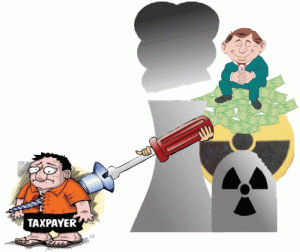 State Nuclear Subsidies Not Needed, Forbes, Adam Millsap-19 Apr 19
Natural gas has become the dominant source of electricity generation in the United States and this is creating some financial issues for the nuclear industry. Since 2010, several nuclear plants around the country have closed and economic conditions, particularly low natural gas prices, are often citedas a factor. Officials from companies that own and operate struggling plants are seeking government assistance to stay afloat, but state lawmakers should be skeptical.
The decline in the price of natural gas since 2008, shown in the figure below, [on original] has made it difficult for some nuclear plants to compete. Prior to 2008, some thought a nuclear renaissance was on the horizon. Now this seems unlikely.
Nuclear power is characterized by the initial high costs of plant construction followed by relatively low operating costs. When alternative energy sources—such as coal, oil, solar, etc.—are expensive, it can make economic sense to bear the high costs of nuclear plant construction. But when other prices are low, as with today’s abundant natural gas and increasingly competitive wind and solar power, it’s harder to justify new plant construction.
Not only are economic conditions working against new nuclear plants, but they are also unfavorable to many existing plants. Unsurprisingly, officials from the companies that own and operate the struggling plants want some government help. A recent report in Pennsylvania’s York Dispatch shows that Exelon Corp.—the owner of some of the struggling plants—significantly increased its lobbying spending in Pennsylvania in 2018 compared to the previous five election cycles. Spending increased from an average of just over $646,000 from 2008 to 2016 to nearly $1.8 million in 2018.
There is some evidence that the lobbying is working. …..
Subsidies work by taxing one group and giving the revenue to another. In the Pennsylvania and Ohio bills, the funding for the subsidy is raised via higher electricity rates on consumers.
Supporters of both bills argue that nuclear is a vital source of clean energy and that without legislation nuclear plants will continue to shut down. But despite competition from natural gas and renewables, it’s not clear that the nuclear industry as a whole is in deep financial trouble. According to a recent analysis, all but one of Pennsylvania’s five nuclear plants are covering their costs. Since there is no financial stress requirement in the Pennsylvania bill, profitable plants in the state will benefit just as much as the current unprofitable one—Three Mile Island Unit 1.
More broadly, a recent State of the Market Report for PJM, which is the regional transmission organization that coordinates the movement of wholesale electricity in Pennsylvania, Ohio, and other nearby states, also casts doubt on the general unprofitability of nuclear power. The report projects that only three of 18 nuclear plants in the region—Three Mile Island along with Davis-Besse and Perry in Ohio—won’t be able to cover their costs for at least one year between 2019 to 2021. ……
it’s not clear that subsidizing inefficient nuclear plants is the most economical way to address climate change , since subsides have problems of their own……
subsidies to nuclear plants are also likely to crowd out new, more efficient electricity plants. Total electricity generation in the United States has declined slightly since 2010 despite economic growth in the form of real GDP per capita, as shown below. [on original]
In a world of declining or even stable electricity use, the profit motive for investing in new capacity is weakened if new plants are not allowed to out-compete less efficient plants for market share. So as long as less efficient nuclear plants are meeting consumer demand, newer plants powered by natural gas, wind, solar, or some other source will have a difficult time finding a market.
Stu Bressler, senior vice president of operations and markets for PJM Interconnection, recently said essentially this when he told Ohio lawmakersthat subsidizing less competitive plants “…could prevent the building of more efficient and cost effective plants, including cleaner technologies like solar and wind.”
Finally, just because a subsidy has the potential to improve economic efficiency doesn’t mean it will. A subsidy that is too small will not generate enough of the good or service. A subsidy that is too large can generate too much, leading to more inefficiency than no subsidy at all. The bureaucratic costs of estimating the correct subsidy, implementing it, and administering it must also be considered. If these costs outweigh the potential gains in efficiency from the subsidy, then the economy would be better off without it.
It doesn’t appear that Ohio or Pennsylvania lawmakers have rigorously estimated the appropriate subsidy or accounted for the costs of implementing and administering one in their proposals. Without such analysis, it’s unlikely that the proposed nuclear subsidies will lead to an improvement in consumer welfare. Instead, these subsidies will likely do more harm than good, as they seem to be primarily designed to help a few unprofitable nuclear plants rather than carefully thought out pieces of a broader, market-based energy plan.
Adam A. Millsap is the Assistant Director of the L. Charles Hilton Jr. Center at Florida State University and an Affiliated Scholar at the Mercatus Center at George Mason University. https://www.forbes.com/sites/adammillsap/2019/04/19/state-nuclear-subsidies-not-needed/#e532f23111dc
April 20, 2019
Posted by Christina Macpherson |
politics, USA |
Leave a comment
Japan Aims to Hire Foreigners for Nuclear Cleanup
The country’s largest utility is working to decommission the Fukushima plant amid radiation risks at the site of the 2011 disaster, WSJ , By Mayumi Negishi and Chieko Tsuneoka, April 18, 2019 TOKYO—Japan’s largest utility is looking to foreign blue-collar workers to help decommission its Fukushima Daiichi nuclear-power plant amid a labor shortage exacerbated by radiation risks at the site of the 2011 nuclear disaster.
Tokyo Electric Power Co., or Tepco, said Thursday it has informed dozens of contractors that foreigners could qualify for a new type of visa that allows manual workers to stay in the country for five years. Workers who enter areas with elevated radiation would need sufficient Japanese-language skills...(subscribers only) https://www.wsj.com/articles/japan-aims-to-hire-foreigners-for-nuclear-clean-up-11555595613
April 20, 2019
Posted by Christina Macpherson |
Fukushima continuing |
Leave a comment
The legacy of nuclear power is checkered at best, Delware State News, Apr 18th, 2019 · by Alan Muller
Forty years ago, on March 28, 1979, the Three Mile Island (TMI) Unit 2 nuclear power reactor in central Pennsylvania — about 95 miles northwest of Dover — partially melted down and experienced at least one explosion.
Many of us living in Delaware at the time were very concerned about being downwind and somewhat downstream of a nuclear accident of unknown magnitude.
The causes were a combination of equipment failures, design defects and operator errors. The operators did not have accurate indications of what was going on in the reactor, so they couldn’t make the right decisions. Reportedly, more than half of the radiation monitors in the area were broken, so there was not adequate indication of how much radioactivity was released and where it went.
Days afterwards: “[Pa.] Governor Thornburgh advised pregnant women and pre-school age children to leave the area within a five-mile radius of the Three Mile Island facility until further notice. This led to the panic the governor had hoped to avoid; within days, more than 100,000 people had fled surrounding towns.”
Ever since the TMI meltdown, nuke industry sources and public health authorities have claimed that too little radioactivity was released to harm people’s health…….
Failure to investigate TMI health effects was published in the Bulletin of the Atomic Scientists in 2004. This included failure to investigate, media blackouts and the firing of Pennsylvania Health Commissioner Gordon MacLeod by Gov. Thornburgh after he pointed out increases in infant mortality and other health problems near TMI.
Jane Lee, a local farmer, with others, went door-to-door and said they had found and documented many acute health problems. I knew Jane towards the end of her life. She’d been unable to arrange publication of her work, and wasn’t online A deposit of Jane Lee Papers at Dickenson College (Carlisle, Pa.) may hold some of this information.
More recently in 2017:
“A new Penn State College of Medicine study has found a link between the 1979 Three Mile Island accident and thyroid cancer cases in south central Pennsylvania. The study marks the first time the partial meltdown can be connected to specific cancer cases, the researchers have said. The findings may pose a dramatic challenge to the nuclear energy industry’s position that radiation released had no impact on human health.” …….
All nuclear plants release radiation to air and water during normal operation, as do other parts of the nuclear fuel cycle such as uranium mining. Many nuclear plants have tall stacks intended to disperse “noncondensible” radioactive emissions. See one in pictures of the Peach Bottom nuclear plant — three of this same General Electric design melted down in Japan in 2011. Evidence is accumulating that these releases from normal operations may have health impacts.
Some reports claim the only health effects from TMI were mental health impacts from stress, as if “mental health impacts” were unimportant.
The TMI meltdown ended expansion of the U.S. nuclear power industry — after TMI, no new reactors were ordered in the U.S. and many projects were stopped.
Now, 40 years later, the remaining industry is collapsing, largely because wind and solar have become cheaper. The remaining TMI unit is to shut down this year. But the nuke industry isn’t going down without a fight, trying to rebrand itself as a climate change solution. In fact, the nuclear fuel cycle releases less climate-changing carbon dioxide than fossil-fuel burning but much more than wind or solar (per unit of electricity generated).
It is timely to think about TMI as Delaware is surrounded by nuclear power reactors. About 10 percent of all those in the U.S. are within 50 miles of Delaware. The Salem/Hope Creek reactors, the nearest, have recently received an enormous subsidy from the state of New Jersey to stay open. On the other hand, the Oyster Creek, N.J., reactor has closed.
This contraction of the nuclear power industry won’t be easy for people working in it, or for some of the nuclear host communities. But it will happen regardless and ultimately we will be safer and healthier for it.
To ignore the human impacts of the nuclear industry is a moral failure.
Alan Muller is executive director of Green Delaware. https://delawarestatenews.net/opinion/commentary-the-legacy-of-nuclear-power-is-checkered-at-best/
April 20, 2019
Posted by Christina Macpherson |
health, USA |
Leave a comment




 he Supreme Court has just now certified the deadliest and most economically



 nuclear-news