More disappointments for Europe’s new nuclear stations- no nuclear future for Europe?
 Europe’s new nuclear plants hit more snags https://climatenewsnetwork.net/europes-new-nuclear-plants-hit-more-snags/ Europe’s new nuclear plants hit more snags https://climatenewsnetwork.net/europes-new-nuclear-plants-hit-more-snags/
|
|
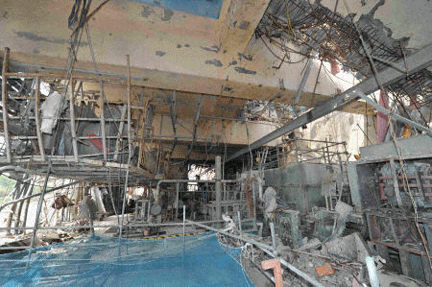
Japan’s massive task to clean up nuclear fuel pools of Fukushima stricken reactors
|
Japan begins massive nuclear pool clean-up after Fukushima disaster, https://www.abc.net.au/news/2019-04-15/japan-taking-nuclear-fuel-rods-from-fukushima-reactor/11009422 The operator of the tsunami-wrecked Fukushima nuclear plant has begun removing fuel from a cooling pool at one of three reactors that melted down in the 2011 disaster, a milestone in the decades-long process to decommission the plant.
Key points:
The process involves taking out spent nuclear fuel rods by using remote-controlled cranes to lift hundreds of radioactive cylinders from a highly contaminated reactor site. Tokyo Electric Power Co (TEPCO) said on Monday that workers started removing the first of 566 used and unused fuel units stored in the pool at Unit 3. The fuel units in the pools located high up in reactor buildings are intact despite the disaster, but the pools are not enclosed, so removing the units to safer ground is crucial to avoid disaster in case of another major quake. “The work is expected to be completed in March 2021, but safety is our first priority,” spokesman Joji Hara said. TEPCO says the removal at Unit 3 would take two years, followed by the two other reactors, where about 1,000 fuel units remain in the storage pools. If the rods are exposed to air or if they break, radioactive gases could be released into the atmosphere. The 2011 disaster forced 160,000 people to evacuate areas near the Fukushima plant, and many of them have never returned to the most contaminated areas. Obstacles to removing melted fuelRemoving fuel units from the cooling pools comes ahead of the real challenge of removing melted fuel from inside the reactors, but details of how that might be done are still largely unknown. Experts say the melted fuel in the three reactors amounts to more than 800 tons. Removing the fuel in the cooling pools was delayed more than four years by mishaps, high radiation and radioactive debris from an explosion that occurred at the time of the reactor meltdown. Workers are remotely operating a crane to raise the fuel from a storage rack in the pool and place it into a protective cask. The whole process occurs underwater to prevent radiation leaks. Each cask will be filled with seven fuel units, then lifted from the pool and lowered to a truck that will transport the cask to a safer cooling pool elsewhere at the plant. The work is directed remotely from a control room about 500 metres away because of still-high radiation levels inside the reactor building that houses the pool. Robotic removalIn 2014, TEPCO safely removed all 1,535 fuel units from the storage pool at a fourth reactor that was idle and had no fuel inside its core when the March 11, 2011, earthquake and tsunami occurred. Robotic probes have photographed and detected traces of damaged nuclear fuel in the three reactors that had meltdowns, but the exact location and other details of the melted fuel are largely unknown. In February, a remote-controlled robot with tongs removed pebbles of nuclear debris from the Unit 2 reactor but was unable to remove larger chunks, indicating a robot would need to be developed that can break the chunks into smaller pieces. TEPCO and government officials plan to determine methods for removing the melted fuel from each of the three damaged reactors later this year so they can begin the process in 2021. |
|
Climate Change Could Unleash Long-Frozen Radiation

Atomic bombs, Chernobyl,Fukushima—radiation has traveled and frozen all over the world. Global warming is changing that.
Melting could be one of the most important phenomena of the 21st century. Thanks to man-made climate change, Arctic ice levels have hit a record low this year. Among the many profound changes that could stem from ice melting across the world, according to a new study from an international group of scientists, is the release of deeply buried radiation.
The international team studied 17 icy locations across the globe, including the Arctic, the Antarctic, Iceland, the Alps, the Caucasus mountains, and British Columbia. While radiation exists naturally, the scientists were looking for example of human-made radiation. It was common to find concentrations at least 10 times higher than levels elsewhere.
“They are some of the highest levels you see in the environment outside nuclear exclusion zones,” says Caroline Clason, a lecturer in Physical Geography at the University of Plymouth, speaking in a press statement.
When human-made radiation is released into the environment, be it in small amounts like the Three Mile Island accident of 1979 or larger quantities like the Chernobyl disaster of 1986and the Fukushima Daichii accident of 2011, it goes into the atmosphere. That includes elements like radioactive cesium, which have been known to make people sick to the point of death across the globe.
After Chernobyl, clouds of cesium traveled across Europe. Radiation spread without regard for borders, reaching as far as England through rains. But when rain freezes, it takes the form of ice. And within ice, it can lay trapped.
“Radioactive particles are very light so when they are taken up into the atmosphere they can be transported a very long way,” Clason tells the AFP. “When it falls as rain, like after Chernobyl, it washes away and it’s sort of a one-off event. But as snow, it stays in the ice for decades and as it melts in response to the climate it’s then washed downstream.”
What does that response look like? Humanity is starting to find out, Clason says. She points to wild boar in Sweden, who in 2017 were found to have 10 times the levels of normal radiation.
Traces of human-made radiation last a famously long time. Ice around the globe contains nuclear material not just from accidents involving nuclear power plants, but also man’s use of nuclear weapons.
“We’re talking about weapons testing from the 1950s and 1960s onwards, going right back in the development of the bomb,” Clason says. “If we take a sediment core you can see a clear spike where Chernobyl was, but you can also see quite a defined spike in around 1963 when there was a period of quite heavy weapons testing.”
Elements within radiation have different life spans. Perhaps the most notorious of these, Plutonium-241 has a 14 year half-life. [ed. most plutonium isotopes have half-lives of many thousands of years] But Americium-241, a synthetic chemical element, has a half life of 432 years. It can stay in ice a long time, and when that ice melts will spread. There isn’t much data yet on its ability to spread into the human food chain, but Clason called the threat of Americum “particularly dangerous”.
A term popular in science these days is the Anthropocene, which refers to the idea that humans have permanently altered the very core of how the Earth functions as a living ecosystem. Looking for radiation buried within icy soil and sediment could offer stronger proof of those changes.
“These materials are a product of what we have put into the atmosphere. This is just showing that our nuclear legacy hasn’t disappeared yet, it’s still there,” she says.
“And it’s important to study that because ultimately it’s a mark of what we have left in the environment.”
The long-lasting unsolved problem of Three Mile Island’s radioactive trash
 Where will the nuclear waste go after Three Mile Island shuts down? The Inquirer, by Andrew Maykuth, After the infamous Three Mile Island nuclear accident 40 years ago, most of the reactor’s partially melted uranium fuel was hauled away to the Idaho National Lab, where the radioactive waste now slowly decays in steel and concrete containers, awaiting long-term disposal.
But the formal decommissioning of the damaged Unit 2 reactor near Harrisburg, site of America’s worst commercial nuclear disaster, has not yet really begun. Its owner, FirstEnergy Corp., has said that the plant would remain dormant until the surviving reactor, owned by a different company, shuts down.
FirstEnergy, in a 2013 filing with the U.S. Nuclear Regulatory Commission, said that both reactors would be decommissioned simultaneously “to achieve economies of scale, by sharing costs between the units, and coordinating the sequence of work activities.”
The timing of the final dismantlement and interment of Three Mile Island plant was thrown into uncertainty last week when the owner of the operating reactor, Exelon Generation, announced that it would take nearly 60 years to decommission its unit if it prematurely shut down operations in September. Exelon says it is losing money on the plant and has no option but to shut it down without a state rescue.
The prolonged decommissioning of the operational reactor — and by implication, the damaged reactor — could push back the final cleanup and remediation of Three Mile Island to 2079, a century after the meltdown.
“We’ve been living with this for 40 years,” said Eric Epstein, chairman of Three Mile Island Alert, a Harrisburg nuclear watchdog group. “Out of a sense of fairness, we need to have this cleaned up.”
The fate of the damaged reactor is further complicated because FirstEnergy Solutions, an Akron company that operates FirstEnergy Corp.’s power generation plants, including the Beaver Valley Power Station in Pennsylvania, last year filed for bankruptcy.
The Unit 2 decommissioning costs, which FirstEnergy last year estimated at $1.26 billion, would be paid out of a trust fund. (Exelon estimates its reactor, TMI Unit 1, would need an additional $1.2 billion to decommission, paid from a separate trust fund.)………
FirstEnergy has until 2053 to decommission the site, 60 years after operations ceased. It contracts Exelon to maintain the dormant reactor, and provide security.
FirstEnergy can request an exemption to push back its decommissioning date if it appeared the task could not be completed within 60 years, said Neil Sheehan, an NRC spokesman.
FirstEnergy, in its 2013 filing, anticipated that Exelon would run its reactor through to the expiration of its license in 2034, and then the companies would jointly complete decontamination and dismantlement of both reactors in less than 20 years.
By decommissioning both reactors simultaneously, FirstEnergy said, it can use Exelon’s fuel storage equipment to contain the “small quantities of core debris and fission products” that still remain from Unit 2′s partial meltdown, which occurred after a series of mechanical and human errors led to a loss of coolant, allowing the uranium fuel to overheat.
Any spent fuel from the operating reactor, or any remaining radioactive debris collected during decontamination of the damaged unit, could be stored in dry casks on the reactor site, at federal expense, until the federal government builds a long-term underground disposal facility. ……..
Until the issue is sorted out, most decommissioned U.S. reactors will be forced to keep their spent fuel in canisters on the former reactor sites.
But 99 percent of the fuel from Three Mile Island’s damaged reactor was already packed up and shipped to the Idaho National Laboratory after the TMI accident.
The U.S. Department of Energy stores 2,750 tons of nuclear waste at four sites in South Carolina, Washington, Colorado and Idaho from an assortment of commercial, naval, and weapons-related reactors.
The site in eastern Idaho, which holds 358 tons of spent fuel, is kind of a mausoleum of nuclear detritus. It contains 46.9 tons of waste from the Shippingport Atomic Power Station in Beaver County, Pa., the nation’s first commercial reactor. It’s also home to 1.8 tons of thorium‐uranium carbide fuel from Philadelphia Electric Co.’s Peach Bottom Unit 1, an experimental reactor in Delta, Pa., that shut down in 1974.
The 90.8 tons of ruined nuclear fuel from Three Mile Island’s damaged reactor is the biggest contributor of waste to the Idaho site. It is contained in 29 steel canisters encased in concrete containers.
But it is an unwelcome long-term resident in Idaho.
The agreement specifically includes Three Mile Island’s waste. https://www.philly.com/business/what-happened-to-three-mile-island-nuclear-waste-after-the-accident-20190414.html
USA Congressmen concerned at slow clean-up of dangerous San Onofre nuclear site
 The Nuclear Cleanup At San Onofre Isn’t Moving Fast Enough, Congressmen Say, laist.com, APRIL 17, 2019 About 8 million people live within 50 miles of San Onofre, the now-defunct, beach-adjacent nuclear plant located between Oceanside and San Clemente. Inside the plant is 1,600 tons of radioactive waste. Much of the spent nuclear fuel is currently sitting in cooling pools waiting to be moved to a safer location — specifically, one that’s less vulnerable to earthquake faults and rising sea levels.On Tuesday, Rep. Mike Levin and Orange County Rep. Harley Rouda spoke to reporters at Southern California Edison’s decommissioned facility about a proposal to speed up the removal of that waste. The Nuclear Cleanup At San Onofre Isn’t Moving Fast Enough, Congressmen Say, laist.com, APRIL 17, 2019 About 8 million people live within 50 miles of San Onofre, the now-defunct, beach-adjacent nuclear plant located between Oceanside and San Clemente. Inside the plant is 1,600 tons of radioactive waste. Much of the spent nuclear fuel is currently sitting in cooling pools waiting to be moved to a safer location — specifically, one that’s less vulnerable to earthquake faults and rising sea levels.On Tuesday, Rep. Mike Levin and Orange County Rep. Harley Rouda spoke to reporters at Southern California Edison’s decommissioned facility about a proposal to speed up the removal of that waste.
There are two moves needed. One is to get it out of the cooling ponds at San Onofre and into the dry concrete bunkers. That will enable the defunct plant to be dismantled. But the members of Congress want to accelerate another move of the spent fuel out of state to “interim” storage and eventually to permanent storage Nuclear waste cleanup at the San Onofre nuclear power plant has been on hold since last summer after a mishap involving a 50-ton container of radioactive material. Rep. Mike Levin says Congress should set new priorities for which power plants get top priority to ship the fuel elsewhere. The oceanfront San Onofre plant within his Oceanside Congressional district would be right at the top of the list, according to his proposed new criteria. “We probably shouldn’t have had a nuclear power plant here in the first place,” Levin said. “But now that we do, and we’re stuck with 1,600 tons of spent radioactive nuclear fuel, we better do everything we can do to prioritize.” He wants plants that are closed, and located near near large population centers and at risk from earthquake faults and rising sea levels to get priority permits to transport the waste out of state. Levin said he would introduce a bill when he returns to Congress that would change the criteria. He said he disagreed with current policies that call for the oldest fuel to be shipped to remote storage first, citing the higher risk to dense nearby populations. Rouda and Levin were among 15 members who called on Congress earlier this month to spend $25 million hurrying the development of interim storage spots. Two locations, in West Texas and New Mexico, are in the process of getting permits to store nuclear waste on an interim basis while the federal government seeks a permanent home for it. WHAT WENT WRONG AT SAN ONOFRE LAST AUGUST? Spent nuclear fuel is being held in cooling ponds and being transferred in giant canisters to new concrete bunkers about 100 feet from the ocean. A 28-foot high seawall is meant to keep seawater out of the bunkers. Edison contractors had already transferred 29 of 73 containers of nuclear waste to the new location. But on August 3, a 20-foot tall canister containing more than 50 tons of radioactive waste was left suspended on a metal flange 18 feet above a storage bunker floor during its transfer. Safety slings to keep the canister from falling were disabled, so the danger was that the canister could have fallen and perhaps ruptured. SCE’s contractor doing the work did not properly disclose the incident that day. The Nuclear Regulatory Commission found that from Jan. 30 to Aug. 3, 2018, workers loading the canisters into the bunkers “frequently” knocked the canister against components of the vault, potentially gouging the steel container. Again, the contractors didn’t immediately tell Edison that was happening, depriving the company and other workers of a chance to correct the loading procedure. The NRC cited “apparent weaknesses in management oversight” of how the waste canisters were stored, and fined Edison $116,000 for the violation. The company did not sufficiently oversee its contractor doing the work of moving the canisters, the NRC said. The company is waiting for the green light from the Nuclear Regulatory Commission to resume the work of transferring the waste. Here is the NRC’s November 2018 report that criticized Edison’s handling of waste………https://laist.com/2019/04/17/the_nuclear_cleanup_at_san_onofre_isnt_moving_fast_enough_congressmen_say.php |
|
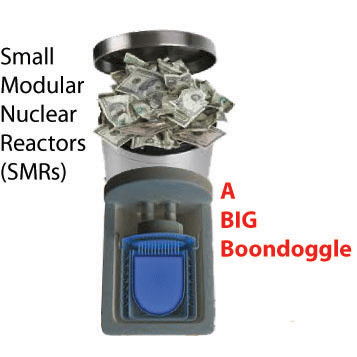
Nuclear Transparency Watch warns on the unwisdom of UK government subsidising Small Modular Nuclear Reactors (SMRs)
 Small Modular Reactors – of SMRs and ANTs, by Jan Haverkamp http://www.nuclear-transparency-watch.eu/activities/small-modular-reactors-of-smrs-and-ants-by-jan-haverkamp.html
15 April 2019 The debate on Small Modular Reactors continues to warm up. The IAEA recently updated its webpages on the issue. SMRs are currently promoted by parts of the nuclear industry as an answer to the decrease of interest in normal gigawatt (GW)-scale reactors because of economic and technical realities.
Dr. David Lowry thinks it is time for a warning: “This article focuses on the UK, but similar arguments as I brought forward in Bratislava would apply to any other European government confronted with requests for support of this new sector.”
Trump’s administration speeds up the revolving door between Pentagon and nuclear weapons companies
 Tomgram: Smithberger and Hartung, The Pentagon’s Revolving Door Spins Faster Tomgram: Smithberger and Hartung, The Pentagon’s Revolving Door Spins Faster
|
|
Some consternation in France, as EDF plans to split off its nuclear section
Le Monde 15th April 2019 For several weeks, EDF’s management and the executive have been
preparing a plan to separate nuclear activities from the rest of the group.
A high-risk issue for the government.
Le Monde 15th April 2019 The CGT secretary of the EDF works council, François Dos Santos, protested against the government’s desire to divide the group into two separate
subsidiaries.
Electricite de France (EDF) €33 billion debt, and more problems – its nuclear section to be nationalised.

 Times 16th April 2019 A row erupted in France yesterday after it emerged that EDF’s board will discuss plans to renationalise the group’s nuclear activities and split them from the rest of its business. Unions reacted with anger to what they depicted as the first step towards the dismantling of the energy group that is building Britain’s new reactors at Hinkley Point in Somerset.
The board is due to review the restructuring plan next month before presenting it to senior managers and union representatives in June, according to a source. The scheme involves the creation of a parent company to run the group’s 58 reactors in France, as well as new ones that it may build.
This part of the group could be renationalised, rolling back the partial privatisation of EDF in 2004, which left the state with an 83.7 per cent stake. Most of the rest of the group’s activities then would be placed in a subsidiary that would continue to seek private investors under the plan, which has been codenamed Project Hercules, according to the newspaper Le Parisien.
People close to President Macron, who has the final say, claim that he broadly supports the idea, but may backtrack if the price of compensating shareholders proves to be beyond the means of France’s hard-pressed state budget. A fierce union reaction also could prompt him to retreat,
commentators said.
Although a source insisted that the restructuring would have no direct impact on Hinkley Point, it is likely to create short-term uncertainty for EDF Energy, the group’s British division.
EDF is struggling to meet the cost of renovating its ageing French nuclear fleet, which is estimated at between €55 billion and €75 billion. In addition, the group, which has a debt of €33 billion, is facing several other difficulties, not least that it is committed to funding two thirds of the estimated £22.3 billion cost of the new-generation European pressurised reactors being built at Hinkley Point.
A similar reactor at Flamanville in northern France was meant to cost €3 billion and come on stream in 2012. The reactor is still not operating and the budget has reached €10.9 billion. Last week, it emerged that experts had advised that EDF should repair faulty weldings at Flamanville, which would add hundreds of millions of euros to the bill and lead to a further delay.
Earth’s surface temperature steadily rose from 2003
 Earth’s ‘skin temperature test’ shows undeniable evidence of global warming, https://metro.co.uk/2019/04/17/earths-skin-temperature-test-shows-undeniable-evidence-global-warming-9230191/ Jeff Parsons, Wednesday 17 Apr 2019
Satellite measurements of the Earth’s ‘skin temperature’ have confirmed that global warming is heating up the planet. The infra-red sensitive system was used to record temperature trends from 2003 to 2017. It showed a warming pattern consistent with other land-based measurements. Dr Joel Susskind, from Nasa’s Goddard Space Flight Centre, said: ‘Both data sets demonstrate the Earth’s surface has been warming globally over this period, and that 2016, 2017, and 2015 have been the warmest years in the instrumental record, in that order.’
The satellite system, called Airs (Atmospheric Infra-Red Sounder), records temperature at the surface of the ocean, land and snow-covered regions. Its findings were compared with station-based data from the Goddard Institute for Space Studies Surface Temperature Analysis (Gistemp).
The results are published in the journal Environmental Research Letters. Co-author Dr Gavin Schmidt, also from the Goddard Institute, said: ‘Interestingly, our findings revealed that the surface-based data sets may be underestimating the temperature changes in the Arctic. ‘This means the warming taking place at the poles may be happening more quickly than previously thought.’
Climate change rallies block London roads
SBS News, 17 Apr 19 Thousands of activists led by Extinction Rebellion have blocked major roads in London to demand action on climate change, and promised to keep it up a week. Thousands of environmental activists have paralysed parts of central London by blocking Marble Arch, Oxford Circus and Waterloo Bridge in a bid to force the government to do more to tackle climate change.Under sunny skies on Monday, activists sang songs or held signs that read “There is no Planet B” and “Extinction is forever” at some of the capital’s most iconic locations.
Roadblocks will continue night and day at each site and the demonstrators say the protests could last at least a week….
The group is demanding the government declare a climate and ecological emergency, reduce greenhouse gas emissions to net zero by 2025, and create a citizen’s assembly of members of the public to lead on decisions to address climate change. ….
Extinction Rebellion wrote to Prime Minister Theresa May on Monday outlining their demands and asking for face-to-face talks, warning that they will escalate their disruptive actions over the coming weeks unless the government acts.
“Make no mistake, people are already dying,” the letter states. “In the majority world, indigenous communities are now on the brink of extinction. This crisis is only going to get worse … Prime Minister, you cannot ignore this crisis any longer. We must act now.”
Organisers of the protests circulated legal advice to anyone planning to attend, requesting they refrain from using drugs and alcohol, and asking them to treat the public with respect.
London’s police have advised people travelling around the city in the coming days to allow extra time for their journey in the event of road closures and general disruption. …… Extinction Rebellion wrote to Prime Minister Theresa May on Monday outlining their demands and asking for face-to-face talks, warning that they will escalate their disruptive actions over the coming weeks unless the government acts.
“Make no mistake, people are already dying,” the letter states. “In the majority world, indigenous communities are now on the brink of extinction. This crisis is only going to get worse … Prime Minister, you cannot ignore this crisis any longer. We must act now.”
Organisers of the protests circulated legal advice to anyone planning to attend, requesting they refrain from using drugs and alcohol, and asking them to treat the public with respect.
London’s police have advised people travelling around the city in the coming days to allow extra time for their journey in the event of road closures and general disruption………https://www.sbs.com.au/news/climate-change-rallies-block-london-roads
Extinction Rebellion: The activists risking prison to save the planet
 DW, 17 Apr 19, In the face of runaway climate chaos, governments around the world are in denial, say the activists hoping to land themselves in jail in defence of our planet — and the survival of our species.Many environmentalists — particularly the major international NGOs — have long argued that frightening people will only put them off engaging with climate protection. If the problem feels too big, we feel hopeless and switch off to think about something else.
But with scientists telling us that the planet’s sixth mass extinction is already underway, and that we have scarcely more than a decade to avert devastating, irreversible climate change, a growing number of activists now believe it’s too late to sugar coat the the truth.
This week, they will be taking to streets around the world in acts of mass civil disobedience, with the message that unless we take immediate action humankind itself faces extinction.
“Emissions are still going up, so we need to disrupt normal life,” says Nick Holzberg, who works full time for Extinction Rebellion in Berlin. “The only way to do that is peaceful civil disobedience.”
State of emergency
Extinction Rebellion first emerged in fall last year, when thousands of demonstrators took to the streets of London. UK “Extinction Rebels” have since occupied bridges over the Thames and stripped off in the British Parliament. And their movement has expanded to 35 countries around the world………
The group is demanding that governments declare a “climate emergency,” to shift into a crisis mode where “business as unusual” is suspended to make climate protection the priority.
More concretely, they want governments to commit to carbon neutrality by 2025 — instead of mid-century as the European Union and many national governments are aiming for. ….
With little faith in governments taking such radical action alone, Extinction Rebellion is also demanding a “people’s assembly” to oversee the transition. …… https://www.dw.com/en/extinction-rebellion-the-activists-risking-prison-to-save-the-planet/a-48302957
Holtec’s nuclear decommissioning and wastes empire to grab Indian Point

 Holtec to snap up Indian Point nuclear units for decommissioning, Utility Dive,Iulia Gheorghiu@IMGheorghiu – 17 Apr 19 Holtec to snap up Indian Point nuclear units for decommissioning, Utility Dive,Iulia Gheorghiu@IMGheorghiu – 17 Apr 19
Dive Brief:
Dive Insight:The sale of Indian Point to a decommissioning firm marks the beginning of the end for the nuclear plant — the only one in New York not to receive subsidies under the state’s Zero Emission Credit program. “The sale of Indian Point to Holtec is expected to result in the completion of decommissioning decades sooner than if the site were to remain under Entergy’s ownership,” Leo Denault, Entergy CEO and chairman, said in a statement. The NRC is still reviewing the license transfer applications for Pilgrim and Exelon’s Oyster Creek. The regulators had not yet received any formal application regarding Indian Point and Palisades, the latter of which is set to be retired in 2022. Entergy has not announced the value of the nominal cash considerations it would receive for Indian Point or any of its other nuclear decommissioning transfers. However, another spent nuclear fuel specialist, NorthStar Group Services, took over Entergy’s closed Vermont Yankee nuclear power plant in October. In that case, the NRC required “some additional financial guarantees” beyond the plant’s nearly half a billion dollars in its decommissioning trust fund, according to NRC spokesperson Neil Sheehan …… The decision for Entergy to shut down its merchant nuclear generation early comes amid several other recent nuclear plant closures. “The plant owners have found it difficult to deal with the financial realities of low costs of natural gas, subsidies to other forms of power and other factors,” Sheehan told Utility Dive. Situated near the Hudson River in Buchanan, New York, Indian Point’s two operating units power New York City and the surrounding county. The Department of Energy is otherwise obligated to remove the waste to a permanent storage site, though selecting one has proved to be a drawn out process in Congress. Until the DOE acts or the waste can be sent to Holtec, the company plans to transfer the spent nuclear fuel to dry cask onsite storage, which will be under guard, monitored during the shutdown and decommissioning activities. …….. Two interim storage facilities for nuclear waste are currently seeking regulator approval to begin their intake of used fuel. One of them is Holtec’s proposed facility in New Mexico, HI-STORE Consolidated Interim Storage (CIS). …… https://www.utilitydive.com/news/holtec-to-snap-up-indian-point-nuclear-units-for-decommissioning/552894/ |
Japan’s plutonium surplus, its history, and its danger
 Japan’s Plutonium Overhang, Wilson Center, Nuclear Proliferation International History Project Jun 7, 2017 By William Burr Plutonium, a key element of nuclear weapons, has been an issue in U.S.-Japan relations for decades. During the administration of Jimmy Carter, the Japanese government pressed Washington for permission to process spent reactor fuel of U.S. origin so that the resulting plutonium could be used for experiments with fast breeder nuclear reactors. The government of Japan wanted to develop a “plutonium economy,” but U.S. government officials worried about the consequences of building plants to reprocess reactor fuel. According to a memo by National Security Council staffer Gerald Oplinger, published for the first time by the National Security Archive and the Nuclear Proliferation International History Project, the “projected plants would more than swamp the projected plutonium needs of all the breeder R&D programs in the world.” That “will produce a vast surplus of pure, weapons grade plutonium … which would constitute a danger in itself.” Indeed, as a result of reprocessing activities since then, Japan possesses 48 tons of plutonium and could be producing more, with no clearly defined use, when a new reprocessing facility goes on line in 2018………
-
- The risk of nuclear of proliferation was a significant element in Jimmy Carter’s presidential campaign, which raised questions about the hazards of nuclear energy and attacked the Ford administration for ignoring the “deadly threat posed by plutonium in the hands of terrorists.” Not long after his inauguration, Carter signed
Presidential Directive 8,-which declared that “U.S. non-proliferation policy shall be directed at preventing the development and use of sensitive nuclear power technologies which involve direct access to plutonium, highly enriched uranium, or other weapons useable material in non-nuclear weapons states, and at minimizing the global accumulation of these materials.”
When NSC staffer Gerald Oplinger wrote that the plutonium surplus would constitute a “danger in itself,” he probably assumed an environmental hazard and possibly a proliferation risk and vulnerability to terrorism. He did not mention the latter risks, although the reference to surpluses of “weapons grade” material evoked such concerns. While Japanese reprocessing plants would be producing reactor-grade plutonium, it nevertheless has significant weapons potential. On the question of Japan’s nuclear intentions, the documents from this period that have been seen by the editor are silent; it is not clear whether U.S. officials wondered whether elements of the government of Japan had a weapons option in the back of their mind. Any such U.S. speculation, however, would have had to take into account strong Japanese anti-nuclear sentiment, rooted in terrible historical experience, Japan’s membership in good standing in the nonproliferation community, and that since the days of Prime Minister Sato, the “three Nos” has been official national policy: no possession, no manufacture, and no allowing nuclear weapons on Japanese territory. According to a 1974 national intelligence estimate, Japan was keeping “open” the possibility of a nuclear weapons capability and had the resources to produce weapons in a few years, but the intelligence agencies were divided over the likelihood of such a development. The CIA, State Department intelligence, and Army intelligence saw such a course of action as highly unlikely without a collapse of U.S. security guarantee and the emergence of a significant threat to Japan’s security.
Sources for this posting include State Department FOIA releases as well as recently declassified records at the National Archives, including the records of Gerard C. Smith and Secretary of State Edmund Muskie. Many documents on Japan from the Smith files are awaiting declassification review.
Documents in this release:…..https://www.wilsoncenter.org/publication/japans-plutonium-overhang
Lawsuit against Santee Cooper, claims that investors were deceived over nuclear project risks
 Lawsuit: Santee Cooper misled investors about failed SC nuclear project, Post and Courier, By John McDermott jmcdermott@postandcourier.comm Apr 17, 2019
1 This Month


18 March Webinar @ 1 PM EST: An Assessment of SMR Projects: The Case of Canada
register for the zoom:
https://us02web.zoom.us/webinar/register/WN_o8BIIOUvQ2ONJR1nta65DQ#/registration


of the week – STOP SMALL MODULAR REACTORS IN CANADA
To see nuclear-related stories in greater depth and intensity – go to https://nuclearinformation.wordpress.com
-
Archives
- March 2026 (141)
- February 2026 (268)
- January 2026 (308)
- December 2025 (358)
- November 2025 (359)
- October 2025 (376)
- September 2025 (258)
- August 2025 (319)
- July 2025 (230)
- June 2025 (348)
- May 2025 (261)
- April 2025 (305)
-
Categories
- 1
- 1 NUCLEAR ISSUES
- business and costs
- climate change
- culture and arts
- ENERGY
- environment
- health
- history
- indigenous issues
- Legal
- marketing of nuclear
- media
- opposition to nuclear
- PERSONAL STORIES
- politics
- politics international
- Religion and ethics
- safety
- secrets,lies and civil liberties
- spinbuster
- technology
- Uranium
- wastes
- weapons and war
- Women
- 2 WORLD
- ACTION
- AFRICA
- Atrocities
- AUSTRALIA
- Christina's notes
- Christina's themes
- culture and arts
- Events
- Fuk 2022
- Fuk 2023
- Fukushima 2017
- Fukushima 2018
- fukushima 2019
- Fukushima 2020
- Fukushima 2021
- general
- global warming
- Humour (God we need it)
- Nuclear
- RARE EARTHS
- Reference
- resources – print
- Resources -audiovicual
- Weekly Newsletter
- World
- World Nuclear
- YouTube
-
RSS
Entries RSS
Comments RSS
 nuclear-news