 Putin Offers Russian Help To Build Kazakh Nuclear Plant, April 06, 2019 Radio Free Europe, By Bruce Pannier ,
There is once again talk in Kazakhstan of constructing a nuclear power plant (NPP) — a proposal that’s been debated on and off since the late 1990s. This time, the idea seems to have quickly picked up momentum.
President Vladimir Putin proposed Russian help to build such a plant when he met with Kazakhstan’s new president, Qasym-Zhomart Toqaev, in Moscow on April 3.
A day later, Deputy Kazakh Energy Minister Magzum Mirzagaliev said there was no “concrete decision” to construct a nuclear power plant in Kazakhstan, but he also revealed that officials have already chosen a site for such a project near the town of Ulken, in the southeastern Almaty Province.
Both Russia and Kazakhstan have agreements with many nations about cooperation in civilian atomic-energy use, but the Kazakh-Russian nuclear relationship is probably the most complicated of all.
Putin’s overture to Toqaev was far from the first time Moscow has offered help building a nuclear plant in Kazakhstan, though it was interesting that Putin decided to publicly repeat the proposal to Toqaev, who only became Kazakhstan’s president on March 20 and was making his first official visit abroad in that capacity.
It is also far from the first time the issue of nuclear power has been raised in Kazakhstan. It is a difficult sell in a land that has seen more nuclear tests than virtually any place on the planet. Between 1949 and 1989, when Kazakhstan was part of the Soviet Union, 340 underground and 116 atmospheric tests were conducted in the Semipalatinsk region of northeastern Kazakhstan. Health problems continue to plague residents of the area.
No wonder Kazakhstan’s Energy Ministry released a public statement on April 4 assuring the public would be consulted about building any such plant until “after public hearings and consent from local executive bodies on the territory where construction of an [nuclear power plant] is possibly planned.”
‘Russian Technology’
On April 3, Russian media carried the headline Putin Offers Toqaev The Construction Of An NPP In Kazakhstan Using Russian Technology. Putin was quoted as saying the two countries would be moving to a new form of cooperation.
By “Russian technology,” Putin presumably means Rosatom, Russia’s state nuclear company.
China has pushed its Belt and Road Initiative global trade network forward by extending huge loans and sending Chinese companies and workers to some of the world’s poorer countries. The loans, and the reliance on Chinese companies for training, spare parts, repairs, and such, promise to keep these countries dependent on China for decades to come, simultaneously increasing Beijing’s influence around the globe.
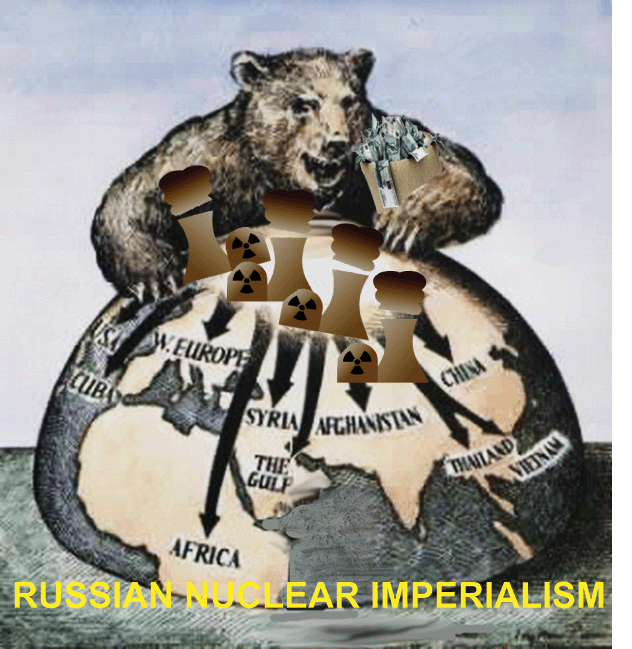
Rosatom does the same thing. The company boasts a $100 billion portfolio, and its website says it has 36 nuclear reactor projects in 12 countries — in places like Bangladesh, Egypt, India, Belarus, Iran, Turkey, Hungary, and China. Rosatom submits bids for every nuclear-power-plant contract worldwide. And Rosatom also has nuclear cooperation agreements with countries in South America, Africa, Asia, and Europe.
The cost of a nuclear power plant starts at around $8 billion, and that is in cases where there is only one reactor, such as Rosatom’s VVER-1000. During Putin’s visit to India in October, Rosatom signed a contract to construct six VVER reactors at a new site in India, in addition to the four other reactors Rosatom is already contracted to build at India’s Kudankulum site. Two VVER reactors are already in operation there.
Russian financial institutions usually loan most, or nearly all, of the money to those countries for the construction of such plants, and Russian nuclear-fuel provider TVEL frequently receives the contract for fuel supplies.
Different Sort Of Customer
Kazakhstan would be a different sort of customer for Rosatom. It has been the world’s leading uranium producer and exporter since 2009. And Kazakhstan does more than just extract uranium. State company Kazatomprom has worked for years, and is now able to take uranium through all the cycles, from raw uranium to nuclear fuel. From 2007 to 2017, Kazatomprom owned a 10-percent stake in Westinghouse.
So Kazakhstan has a large domestic source of uranium and can produce its own nuclear fuel; and Kazatomprom has nuclear technicians trained mostly by Russia but also some trained in Japan, France, and other countries.
Russia and Kazakhstan cooperate to mine uranium in Kazakhstan. Putin mentioned “six Russian-Kazakh enterprises for extracting and enriching uranium.”
Kazatomprom exported nearly 15,290 tons of uranium in 2018, and about 17 percent of that went to Russia.
Kazakhstan and Russia established the International Uranium Enrichment Center in Angarsk in 2007. As its name suggests, the center will provide low-enriched uranium (LEU) to interested parties. The center has been internationally hailed as ensuring a steady supply of uranium for nuclear reactors while not transferring the technology to enrich uranium.
The International Atomic Energy Agency (IAEA) and Kazakhstan’s government also established an LEU bank at Kazakhstan’s Ulba Metallurgical Plant in Oskemen, “a physical reserve of up to 90 metric tons of low enriched uranium suitable to make fuel for a typical light water reactor.”
The IAEA and Russia have an agreement on transporting the uranium to the LEU bank in Oskemen.
The April 4 statement from Kazakhstan’s Energy Ministry said nuclear-power-plant technologies from five countries, “including Rosatom,” were being studied. But the ministry also said other projects were being reviewed, such as more gas-fired plants, hydropower projects, and coal-fired thermal plants.
Proposed Locations
Russian news agency Interfax noted in its report that Russian Ambassador to Kazakhstan Aleksei Boroodavkin said in February, “We are hopeful that a decision will be taken soon for the construction of an atomic power station that we hope Rosatom will construct.”………. https://www.rferl.org/a/kazakhstan-putin-offers-russian-nuclear-plant-help/29865177.html
April 8, 2019
Posted by Christina Macpherson |
Kazakhstan, marketing, Russia |
Leave a comment
Nuclear bailout plan should fix wind-farm restrictions https://www.crainscleveland.com/letters-editor/letter-editor-nuclear-bailout-plan-should-fix-wind-farm-restrictions Paul Dvorak, Strongsville, 7 Apr 19, The March 25 article “Bailout chances may be good for FES plants” discussed how a bailout might fix the crumbling Davis-Besse and Perry nuclear plants. One proposal, the article tells, would add $5 per month to the bill of Ohio ratepayers for an unspecified period, or about $300 million per year.
By itself, this is not a good solution to the problem because, aside from being crony capitalism, it just rewards the mismanagement of plant owner FirstEnergy Solutions. Still, it just might get a green light from the Ohio Legislature because FirstEnergy has greased the skids for its passage with generous donations to the re-election of key legislative members. Verify that for yourself at www.votesmart.org.
The Union of Concerned Scientists also voiced objections to the bailout on five grounds: 1) Safety — Davis-Besse, says UCS, has one of the worst safety records in the United States. 2) Transparency — Demonstrate a need for economic support. 3) Flexibility — Financial support should be temporary and adjustable. 4) Strengthened renewable-energy and efficiency standards — FirstEnergy has worked for the opposite. 5) A commitment to impacted communities.
Meanwhile, the wind industry in Ohio struggles to grow because of a late-night change in the laws, possibly due to similar FirstEnergy donations. The change lengthened the setback distance, which is the distance from a wind turbine to a property line. It is now so great that few rural locations qualify for a turbine. The wind industry, unlike the electric utility, is not looking for a handout but rather a fair chance to compete.
Any proposed nuclear bailout should include a fix to the wind turbine setback law. The bailout should also have a limit of, say, five years, to the $5 per month increase, along with a renewable-energy goal of 15% to 30% or more to the Ohio energy mix. (Oklahoma gets about 33% of its electricity from wind power. Why not Ohio?)
FirstEnergy and a few Ohio legislators are currently working overtime to make the state look unfriendly to investors because a bailout will push electric rates higher. Worse yet, the state looks like it is run by people looking backward while companies such as Microsoft, Amazon, General Motors and others are looking for renewable energy to power and expand their businesses. Loud and clear, Ohio’s message seems to be: “Go somewhere else.”
Wind power has the lowest production cost of any generation method, can lower electric bills and make Ohio look like a modern state looking to a bright future. We ignore this reality to our economic peril.
April 8, 2019
Posted by Christina Macpherson |
politics, USA |
Leave a comment
SAFCEI concerned at Koekerg nuclear power station ‘incidents’ Koeberg released radioactive waste into the environment in three separate incidents years ago. The Citizen, 7 Apr 19,
The recent revelations by Public Enterprises Minister Pravin Gordhan that three separate safety “incidents” had occurred at the Koeberg nuclear power station north of Cape Town in 2014 and 2015 should raise red flags for South African citizens, the Southern African Faith Communities’ Environment Institute (SAFCEI) said on Saturday.
“Not only is the executive decision to keep the public in the dark about these incidents problematic, but possible safety issues contradict the South African government’s assertion that nuclear energy is safe, clean, and a solution to climate change,” SAFSEI said in a statement……..
In the SAFCEI statement, Peter Becker of the Koeberg Alert Alliance said, “When something happens at Koeberg, the [NNR] decides whether it should be classed as an ‘incident’ or not. If it is an incident, they need to report on this and the public would be better informed. But, if they deem it to be less than an incident, then they do not need to report on it, and since the public is none the wiser, there would be no public outcry. The question is, how does the NNR decide what to report on and what to omit? And, shouldn’t citizens have some say in what the NNR is obliged to share with them?
“While the NNR’s 2014 annual report does mention ‘minor occurrences’, the 2015 report stated that there were no nuclear incidents reported during that period,” Becker said.
Government and the nuclear industry were “downplaying the dangers associated with nuclear energy production and have concealed incidents from the public”, SAFCEI’s executive director Francesca de Gasparis said in the statement.
“Not alerting the public to nuclear incidents is problematic because it gives a false picture of the realities of nuclear energy production. The issue of access to information, what information is available in the public realm, and who gets to decide what is shared is particularly risky when dealing with this kind of energy production. It makes us ask, once again, whether South Africa needs or wants nuclear energy as a part of its energy future?” De Gasparis said.
– African News Agency (ANA) https://citizen.co.za/news/south-africa/environment/2113171/safcei-concerned-at-koekerg-nuclear-power-station-incidents/
April 8, 2019
Posted by Christina Macpherson |
incidents, South Africa |
Leave a comment
https://www.eurekalert.org/pub_releases/2019-04/uoo-rrc040519.php UNIVERSITY OF OXFORD, 5 Apr 19, A new modelling study from the University of Oxford and collaborators has estimated how changing the reflectivity of roofs can help keep cities cooler during heatwaves and reduce heat-rated mortality rates.
Cities are generally a few degrees warmer than the countryside, due to the urban heat island effect. This effect is caused partly by a lack of moisture and vegetation in cities compared with rural landscapes, and because urban building materials store up heat. During heatwaves, daytime temperatures can get dangerously high in cities, leading to serious health effects and increasing mortality risk.
The idea of ‘cool’ roofs is to make roof surfaces more reflective to sunlight (for example by painting roofs a lighter colour) thereby reducing local temperatures.
Scientists used a regional weather model to look at how temperatures changed across the study city of Birmingham and the West Midlands, depending on the extent of cool roof deployment. They looked at the hot summers of 2003 and 2006, and found that the intensity of the urban heat island (the urban-rural temperature difference) reached up to 9oC for Birmingham city.
Previous work has shown that the extra heat associated with the urban heat island is responsible for around 40-50% of heat related mortality in the West Midlands during heatwaves.
This latest study, published in Environment International, suggests that implementing cool roofs across the city can reduce peak daytime local temperatures by up to 3oC during a heatwave. This reduction in temperature could potentially offset around 25% of the heat-related mortality associated with the urban heat island during a heatwave.
The urban heat island effect is most pronounced at night time, because urban materials slowly release their stored heat overnight, however, the biggest benefits of cool roofs were seen to be during the hottest part of the day where sunlight was reflected away. The type of building made a difference too: modifying only half of all the industrial and commercial buildings had the same impact on lowering temperatures as modifying all the high-intensity residential buildings.
Co-author Dr Clare Heaviside, of the University of Oxford’s Environmental Change Institute comments: “Climate change and increasing urbanisation mean that future populations are likely to be at increased risk of overheating in cities, although building and city scale interventions have the potential to reduce this risk.
“Modelling studies like this one can help to determine the most effective methods to implement in order to reduce health risks in our cities in the future.”
April 8, 2019
Posted by Christina Macpherson |
2 WORLD, climate change |
Leave a comment
MKG 4th April 2019 [Machine Translation] SKB speaks to the government on copper corrosion:
“Still no problem” The power industry’s nuclear waste company On April 4,
SKB expressed its opinion to the government with a supplement to, in the
first place, certain that the copper canister will function as intended in
the planned final repository for spent nuclear fuel in Forsmark.
Not surprisingly, the company will claim that there are no problems. This is
the same claim that the court rejected in its opinion to the government on
January 23, 2018. In a first analysis, the environmental organizations’
nuclear waste review has concluded that the compilation is very weak and
does not show that the court’s concerns are unfounded. It is now important
that the Swedish Radiation Safety Authority performs a renewed thorough and
unconditional review of both the old and the new data.
http://www.mkg.se/skb-yttrar-sig-till-regeringen-om-kopparkorrosion-fortfarande-inget-problem
April 8, 2019
Posted by Christina Macpherson |
safety, Sweden, wastes |
Leave a comment
Saudi nuclear program accelerates, raising tensions in volatile region, Country building experimental reactor
Click Orlando , April 06, 2019 On the outskirts of Riyadh, a building site is quickly being transformed into the birthplace of Saudi Arabia’s quest for nuclear power, a bid that has sparked concern in the US Congress and fury in Tehran.
New satellite imagery shows that construction on an experimental reactor is making “expeditious” progress — just three months after the Kingdom announced plans to build it, according to former director for nuclear inspections at the International Atomic Energy Agency (IAEA), Robert Kelley.
Kelley estimated that the reactor could be completed in “nine months to a year.”
The Kingdom has been open about its nuclear program with the IAEA, which sent a team to Saudi Arabia last July to check on building plans. It has repeatedly pledged that the program is peaceful. But Crown Prince Mohammed bin Salman said last year that “without a doubt if Iran developed a nuclear bomb, we will follow suit as soon as possible.”
Also raising concern among industry experts and some in Congress is the Saudi insistence that it should be allowed to produce its own nuclear fuel, rather than import it under strict conditions.
In an interview last year, Saudi Energy Minister Khalid al Falih said: “It’s not natural for us to bring enriched uranium from a foreign country to fuel our reactors,” citing the country’s uranium reserves.
Vision 2030
Saudi Arabia went public with its nuclear ambitions nine years ago, but the plans have gone into overdrive as part of the Crown Prince’s “Vision 2030” — a strategy to wean Saudi Arabia off its reliance on oil and diversify both the economy and its energy mix……….
The IAEA sent a team to Saudi Arabia in July last year to review the development of its nuclear power infrastructure. That mission concluded that the Kingdom is “well placed to finalize its plans for construction of its first nuclear power plant” through partnerships with countries that have nuclear power industries.
In a visit to Riyadh in January, Mikhail Chudakov, IAEA Deputy Director General, confirmed Saudi Arabia had “made significant progress in the development of its nuclear power infrastructure.”
But when the Saudis want to move to the next stage — fueling the reactor at King Abdulaziz City and any commercial plants — they will have to submit to more intrusive IAEA involvement.
“They’ve been exempt for 30 years since they signed a non-proliferation treaty,” said Kelley. “Now they’re going to have to make some serious paperwork and agree to inspections,” if they want to acquire nuclear fuel.
US concerns
Skepticism in the US Congress over whether Saudi Arabia can be a trusted partner has grown since the gruesome murder of journalist Jamal Khashoggi in Istanbul last year. That’s now manifested itself in critical scrutiny of the Saudi nuclear program — and especially whether the Trump Administration is doing enough to ensure non-proliferation…….
US concerns
Skepticism in the US Congress over whether Saudi Arabia can be a trusted partner has grown since the gruesome murder of journalist Jamal Khashoggi in Istanbul last year. That’s now manifested itself in critical scrutiny of the Saudi nuclear program — and especially whether the Trump Administration is doing enough to ensure non-proliferation.
Asked whether it was acceptable for Saudi Arabia to become a nuclear power, US Secretary of State Mike Pompeo was unequivocal in a TV interview on Friday.
“We will not permit that to happen. We will not permit that to happen anywhere in the world,” Pompeo told CBS. “The President understands the threat of proliferation. We will never write a $150 million check to the Saudis and hand them over the capacity to threaten Israel and the United States with nuclear weapons, never.”
A bipartisan resolution introduced in the Senate in February demanded that the use of any US nuclear power technology in Saudi Arabia must be accompanied by safeguards to ensure Saudi Arabia cannot enrich uranium or reprocess spent fuel.
“The last thing America should do is inadvertently help develop nuclear weapons for a bad actor on the world stage,” said Democratic Senator Jeff Merkley, one of the resolution’s sponsors………
Iran claims that the Trump Administration plans to sell Saudi Arabia nuclear technology without sufficient safeguards. “First a dismembered journalist; now illicit sale of nuclear technology to Saudi Arabia fully expose #USHypocrisy,” Foreign Minister Javad Zarif tweeted in February.
And in March, Ali Shamkhani, secretary of Iran’s Supreme National Security Council, accused unnamed regional states of developing “suspicious nuclear projects,” which would force Tehran to revise its defense strategy. Quoted by Iranian news agencies, Shamkhani said such plans would “force us to revise our strategy.”
Whatever Saudi Arabia’s energy strategy, and however sincere its pledge that it has no wish to develop nuclear weapons, the mere existence of a nuclear program is bound to inflame tensions across the Gulf. https://www.clickorlando.com/news/international/saudi-nuclear-program-accelerates-raising-tensions-in-volatile-region
April 8, 2019
Posted by Christina Macpherson |
politics international, Saudi Arabia |
1 Comment
Ministers are under pressure to own up to any potential risks to health and security, after emergency advice was quietly issued to organisations and businesses.
Under the measure, they are being allowed to bust limits if they are unable to export waste because of Brexit – or if they fear they will be unable to obtain the radioactive material they need.
The rules have been relaxed regardless of whether the UK leaves the EU or – as seems increasingly likely – there is an extension to Article 50 until next year or beyond.
Rosie Duffield, a Labour MP and supporter of the People’s Vote campaign for a new Brexit referendum, said it was another example of consequences “nobody voted” for in 2016.
“It is essential that a minister comes to the Commons and makes a statement about the environmental and security risks that storing more waste at industrial or NHS sites pose,” Ms Duffield said.
“It is not acceptable that the rules on something like this can be changed without proper public discussion and accountability.”
The Environment Agency acknowledged the substances were hazardous but insisted there was “no risk to the public or the environment” from the new rules…… https://www.independent.co.uk/news/uk/politics/brexit-radioactive-supply-limit-hospitals-universities-factories-a8856796.html
April 8, 2019
Posted by Christina Macpherson |
politics, UK, wastes |
Leave a comment
David Lowry’s Blog 5th April 2019 On Friday last week (29th March) in Liverpool I attended my first meeting
as an appointed expert on the Independent Advisory Panel for the UK Chief
Nuclear Inspector of the UK nuclear regulator, the Office for Nuclear
Regulation (ONR).
IAP members have been invited to nominate issues or
themes to be considered at the next meeting in the autumn, and I came away
thinking nuclear security – and how it can be discussed meaningfully with
politicians and the public – is an important and under-addressed matter
that the IAP could engage.
No sooner had I started to think how best this
might be considered than ONR’s United States equivalent, the US Nuclear
Regulatory Commission, came under fire from another US Governmental body –
the Government Accountability Office – in a hard-hitting, and frankly
very disturbing report, on how a radioactive ‘dirty bomb’ (or as it is
more technically calleda Radiation Dispersal Device)could be made from
materials secreted out of US commercial nuclear facilities.
http://drdavidlowry.blogspot.com/2019/04/nuclear-nightmare-threat-from-dirty.html
April 8, 2019
Posted by Christina Macpherson |
general |
Leave a comment





 nuclear-news