Climate change is getting REALLY serious – could produce Financial Crisis
-
Regional Fed paper says carbon tax could address the threat
-
The Fed doesn’t have tools to confront the crisis, paper says
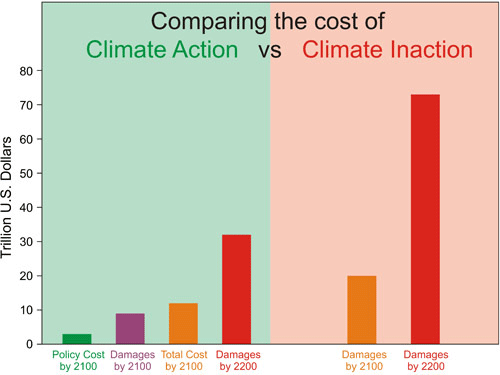
Climate change is becoming increasingly relevant to central bankers because losses from natural disasters that are magnified by higher temperatures and elevated sea levels could spark a financial crisis, a Federal Reserve Bank of San Francisco researcher found.
“Climate-related financial risks could affect the economy through elevated credit spreads, greater precautionary saving, and, in the extreme, a financial crisis,’’ Glenn Rudebusch, the San Francisco Fed’s executive vice president for research, wrote in a paper published Monday.
“There could also be direct effects in the form of larger and more frequent macroeconomic shocks associated with the infrastructure damage, agricultural losses, and commodity price spikes caused by the droughts, floods, and hurricanes amplified by climate change,’’ according to Rudebusch, who is also a senior policy adviser at the reserve bank.
While the Fed’s primary policy tools — short-term interest rates and large-scale asset purchases — aren’t designed to address phenomenon like global warming, policy makers may need to take climate-related damages into account when considering the long-term economic outlook, the researcher wrote. “Many central banks already include climate change in their assessments of future economic and financial risks when setting monetary and financial supervisory policy,” he wrote.
‘Fair Question’
Fed Chairman Jerome Powell told legislators in February it was a “fair question’’ to ask how the central bank would evaluate the economic impact of climate change and promised to look into it.
Rudebusch, whose bank operates as part of the Fed system but isn’t directed by Powell, suggested lawmakers could promote a transition to cleaner technologies by imposing a carbon tax, which is a fee on emissions. Former Fed chairmen Alan Greenspan and Paul Volcker in January endorsed a plan to tax emissions and distribute the revenue to U.S. households.
Some pressure is mounting in Congress to take aim at climate change, with House Speaker Nancy Pelosi pledging to take up climate legislation. That effort may not go far in the current political environment, as Republicans control the Senate and the White House. President Donald Trump said during the campaign he opposed taxing emissions and has expressed skepticism that humans contribute to global warming.
No comments yet.
1 This Month

of the week – Shut Down Drone Warfare!


Tell the Ukrainian Government to Drop Prosecution of Peace Activist Yurii Sheliazhenko

Petition to revoke the licensing of the Near Surface Nuclear Disposal Facility (NSDF) at Chalk River. https://www.ourcommons.ca/petitions/en/Petition/Details?Petition=e-7247
To see nuclear-related stories in greater depth and intensity – go to https://nuclearinformation.wordpress.com
-
Archives
- April 2026 (114)
- March 2026 (251)
- February 2026 (268)
- January 2026 (308)
- December 2025 (358)
- November 2025 (359)
- October 2025 (376)
- September 2025 (257)
- August 2025 (319)
- July 2025 (230)
- June 2025 (348)
- May 2025 (261)
-
Categories
- 1
- 1 NUCLEAR ISSUES
- business and costs
- climate change
- culture and arts
- ENERGY
- environment
- health
- history
- indigenous issues
- Legal
- marketing of nuclear
- media
- opposition to nuclear
- PERSONAL STORIES
- politics
- politics international
- Religion and ethics
- safety
- secrets,lies and civil liberties
- spinbuster
- technology
- Uranium
- wastes
- weapons and war
- Women
- 2 WORLD
- ACTION
- AFRICA
- Atrocities
- AUSTRALIA
- Christina's notes
- Christina's themes
- culture and arts
- Events
- Fuk 2022
- Fuk 2023
- Fukushima 2017
- Fukushima 2018
- fukushima 2019
- Fukushima 2020
- Fukushima 2021
- general
- global warming
- Humour (God we need it)
- Nuclear
- RARE EARTHS
- Reference
- resources – print
- Resources -audiovicual
- Weekly Newsletter
- World
- World Nuclear
- YouTube
-
RSS
Entries RSS
Comments RSS
 nuclear-news
Leave a comment