US nuclear research programme potentially 40% over budget https://www.power-technology.com/news/us-department-energy-nuclear-research/, By Jack Unwin, 5 Apr 19,
The US Department of Energy estimates the nuclear versatile test reactor (VTR) research programme could cost between £3.9bn and $6bn, potentially 40% more than the original $3.5bn estimate given by Idaho National Laboratory head Kemal Pasamehmetoglu. The new estimate comes via a freedom of information request placed by the non-governmental organisation (NGO) Union of Concerned Scientists (UCS).
The VTR was originally announced by Energy Secretary Rick Perry in February 2018 as part of the Trump administration’s policy to revitalise the US nuclear industry. The facility is expected to be built by 2025 and would be the first nuclear test reactor built by the Department of Energy (DOE) for decades.
It would be the first of a number of fast reactors, which breed their own fuel and increase the amount of energy produced from uranium compared with light water reactors.
Research for the VTR will be led by Idaho National Laboratory, with General Electric (GE) and Hitachi forming a partnership called GE Hitachi Nuclear to provide support for design and safety of the plant.
UCS also estimate that the VTR would cost between $550-$850m per year for the next seven years compared to the $740m in the 2019 budget for the DOE’s entire nuclear technology development, $65m of which was allocated to VTR.
UCS senior scientist Ed Lyman said: “UCS received documents from a Freedom of Information Act request that contained the DOE’s current “rough order-of-magnitude” cost estimate for the Versatile Test Reactor project of US $3.9-6.0 billion.
“These values assume different cost escalation factors over a roughly seven-year period. I estimate the corresponding unescalated cost to be as much as $5 billion. The reactor isn’t really “over budget” yet, because there was no official cost estimate prior to this.
“UCS has many concerns about this project. First, we don’t generally support the development of fast reactors because of their proliferation and nuclear terrorism risks, so we question the rationale for building this facility. Second, we believe this reactor will not be a reliable test reactor because the design is experimental. Third, there are much cheaper options that the DOE has not adequately explored to provide a source of fast neutrons to reactor developers.
“Given the likelihood that any DOE first-of-a-kind nuclear construction project will experience major delays and cost overruns, the project may well end up costing $10 billion or more. That money could be far better spent on working to improve the safety and security of light-water reactors.”
How global climate change is already devastating Banglades
Climate change threatens millions of Bangladeshi children, warns UNICEFSBS News A new report shows environmental disasters linked to climate change are threatening the lives and futures of more than 19 million children in Bangladesh, including prompting many families to push their daughters into child marriages., BY CHARLOTTE LAM, 5 Apr 19,
Climate change in Bangladesh could impact the lives of more than 19 million children, according to a new UNICEF report.
The humanitarian agency said on Friday that the country’s flat topography, dense population and weak infrastructure makes it “uniquely vulnerable to the powerful and unpredictable forces that climate change is compounding”.
The report author, Simon Ingram, said the danger was “flooding is extreme and it is almost on an annual basis”.
The report, titled “Gathering Storm: Climate change clouds the future of children in Bangladesh”, showed about 12 million children currently live in and around powerful river systems, which flow through Bangladesh and regularly burst their banks.
A further 3 million Bangladeshi children live in farming communities, which are facing increasing periods of drought.
The report also found a link between climate change and child marriage, child labour and access to education is evident in various parts of Bangladesh.
“Climate change is undoubtedly increasing the number of children who are pushed into the workplace, where they miss out on an education and are terribly exposed to violence and abuse,” UNICEF Bangladesh Child Protection specialist Kristina Wesslund said……….
Mr Ingram said there were already six million climate refugees in Bangladeshi cities, a number that could double by 2050.
Fortunately, Chernobyl health records are now available to the public. They show that people living in the radioactive traces fell ill from cancers, respiratory illness, anaemia, auto-immune disorders, birth defects, and fertility problems two to three times more frequently in the years after the accident than before. In a highly contaminated Belarusian town of Veprin, just six of 70 children in 1990 were characterised as “healthy”. The rest had one chronic disease or another. On average, the Veprin children had in their bodies 8,498 bq/kg of radioactive caesium (20 bq/kg is considered safe).
Currently, policymakers are advocating a massive expansion of nuclear power as a way to combat climate change. Before we enter a new nuclear age, the declassified Chernobyl health records raise questions that have been left unanswered about the impact of chronic low doses of radioactivity on human health.
As researchers monitored Chernobyl radioactivity, they made a troubling discovery. Only half of the caesium-137 they detected came from Chernobyl. The rest had already been in the Cumbrian soils; deposited there during the years of nuclear testing and after the 1957 fire at the Windscale plutonium plant. The same winds and rains that brought down Chernobyl fallout had been at work quietly distributing radioactive contaminants across northern England and Scotland for decades. Fallout from bomb tests carried out during the cold war scattered a volume of radioactive gases that dwarfed Chernobyl.
The Chernobyl explosions issued 45m curies of radioactive iodine into the atmosphere. Emissions from Soviet and US bomb tests amounted to 20bn curies of radioactive iodine, 500 times more. Radioactive iodine, a short lived, powerful isotope can cause thyroid disease, thyroid cancer, hormonal imbalances, problems with the GI tract and autoimmune disorders.
As engineers detonated over 2,000 nuclear bombs into the atmosphere, scientists lost track of where radioactive isotopes fell and where they came from, but they caught glimpses of how readily radioactivity travelled the globe.
Chernobyl’s disastrous cover-up is a warning for the next nuclear age
https://www.theguardian.com/commentisfree/2019/apr/04/chernobyl-nuclear-power-climate-change-health-radioactivity, Kate Brown , 5 Apr 19, Before expanding nuclear power to combat climate change, we need answers to the global health effects of radioactivity In 1986, the Soviet minister of hydrometeorology, Yuri Izrael, had a regrettable decision to make. It was his job to track radioactivity blowing from the smoking Chernobyl reactor in the hours after the 26 April explosion and deal with it. Forty-eight hours after the accident, an assistant handed him a roughly drawn map. On it, an arrow shot north-east from the nuclear power plant, and broadened to become a river of air 10 miles wide that was surging across Belarus toward Russia. If the slow-moving mass of radioactive clouds reached Moscow, where a spring storm front was piling up, millions could be harmed. Izrael’s decision was easy. Make it rain.So that day, in a Moscow airport, technicians loaded artillery shells with silver iodide. Soviet air force pilots climbed into the cockpits of TU-16 bombers and made the easy one-hour flight to Chernobyl, where the reactor burned. The pilots circled, following the weather. They flew 30, 70, 100, 200km – chasing the inky black billows of radioactive waste. When they caught up with a cloud, they shot jets of silver iodide into it to emancipate the rain.In the sleepy towns of southern Belarus, villagers looked up to see planes with strange yellow and grey contrails snaking across the sky. Next day, 27 April, powerful winds kicked up, cumulus clouds billowed on the horizon, and rain poured down in a deluge. The raindrops scavenged radioactive dust floating 200 metres in the air and sent it to the ground. The pilots trailed the slow-moving gaseous bulk of nuclear waste north-east beyond Gomel, into Mogilev province. Wherever pilots shot silver iodide, rain fell, along with a toxic brew of a dozen radioactive elements.
If Operation Cyclone had not been top secret, the headline would have been spectacular: “Scientists using advanced technology save Russian cities from technological disaster!” Yet, as the old saying goes, what goes up must come down. No one told the Belarusians that the southern half of the republic had been sacrificed to protect Russian cities. In the path of the artificially induced rain lived several hundred thousand Belarusians ignorant of the contaminants around them.
The public is often led to believe that the Chernobyl exclusion zone, a depopulated 20-mile circle around the blown plant, safely contains Chernobyl radioactivity. Tourists and journalists exploring the zone rarely realise there is a second Chernobyl zone in southern Belarus. In it, people lived for 15 years in levels of contamination as high as areas within the official zone until the area was finally abandoned, in 1999.
In believing that the Chernobyl zone safely contained the accident, we fall for the proximity trap, which holds that the closer a person is to a nuclear explosion, the more radioactivity they are exposed to. But radioactive gases follow weather patterns, moving around the globe to leave shadows of contamination in shapes that resemble tongues, kidneys, or the sharp tips of arrows.
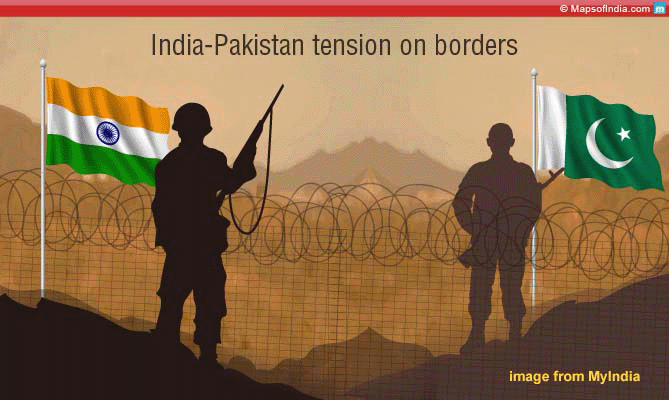
South Asia’s Overlooked Nuclear Crisis, While few were watching, India and Pakistan may have just narrowly avoided a nuclear confrontation. The Nation, By Dilip Hiro 5 Apr 19,It’s still the most dangerous border on Earth. Yet compared to the recent tweets of President Donald Trump, it remains a marginal news story. That doesn’t for a moment diminish the chance that the globe’s first (and possibly ultimate) nuclear conflagration could break out along that 480-mile border known as the Line of Control (and, given the history that surrounds it, that phrase should indeed be capitalized). The casus belli would undoubtedly be the more than seven-decades-old clash between India and Pakistan over the contested territory of Kashmir. Like a volcano, this unresolved dispute rumbles periodically—as it did only weeks ago—threatening to spew its white-hot lava to devastating effect not just in the region but potentially globally as well.
The trigger for renewed rumbling is always a sensational terrorist attack by a Pakistani militant group on an Indian target. That propels India’s leadership to a moral high ground. From there, bitter condemnations of Pakistan are coupled with the promise of airstrikes on the training camps of the culprit terrorist organizations operating from the Pakistan-controlled part of Kashmir. As a result, the already simmering relations between the two nuclear-armed neighbors are quickly raised to a boiling point. This, in turn, prompts the United States to intervene and pressure Pakistan to shut down those violent jihadist groups. To placate Washington, the Pakistani government goes through the ritual of issuing banning orders on those groups, but in practice, any change is minimal.
And in the background always lurks the possibility that a war between the two neighbors could lead to a devastating nuclear exchange. Which means that it’s time to examine how and why, by arraying hundreds of thousands of troops along that Line of Control, India and Pakistan have created the most perilous place on Earth.
HOW IT ALL BEGAN
The Kashmir dispute began with the birth of the kicking twins—Hindu-majority India and Muslim-majority Pakistan—as independent countries. They emerged from the belly of the dying British Raj in August 1947. The princely states in British India were given the option of joining either of the new nations. The dithering Hindu ruler of Muslim-majority Jammu and Kashmir (its full title) finally signed a legally binding instrument of accession with New Delhi after his realm was invaded by armed tribal raiders from Pakistan. This document offered that state’s citizens the chance to choose between the two countries once peace had been restored. This has not happened so far and there is no credible prospect that it will………..
while India has long been in a nuclear arms race with Pakistan, it is no longer sticking to the same race course. In late March, Modi announced that India recently launched a rocket successfully shooting down one of its satellites. This creates the possibility that, in a future nuclear war with Pakistan, it could preemptively “blind” the Pakistanis by destroying their space-based communication and surveillance satellites. A race of another kind could be in the offing.
The central motive that drove Pakistan to develop its nuclear arsenal, however, remains unchanged. It was the only way Islamabad could deter New Delhi from defeating it in a war waged with conventional weapons……….
Pompeo hopes North Korea’s Kim does ‘right thing’ on nuclear weapons in parliament speech, David Brunnstrom, WASHINGTON (Reuters) 5 Apr 19, – U.S. Secretary of State Mike Pompeo said on Friday he hoped North Korean leader Kim Jong Un would use a meeting of the country’s parliament next week to state publicly “it would be the right thing” for Pyongyang to give up its nuclear weapons.
North Korea’s Supreme People’s Assembly is due to hold its first meeting this year on Thursday and could feature the first public comments from Kim about a second summit between him and U.S. President Donald Trump Hanoi in February that collapsed………..
Pompeo said he was “confident” there would be a third summit between Trump and Kim but did not have a timetable although he hoped it would be soon.
Pompeo stressed though that economic sanctions would not be lifted until North Korea gave up its nuclear weapons.
……..North Korea has warned that it is considering suspending talks and may rethink a freeze on missile and nuclear tests, in place since 2017, unless Washington makes concessions.
Saudi Arabia’s first nuclear reactor nearly finished, sparking fears over safeguards, Riyadh has so far resisted international watchdog’s requests to accept a strict inspection regime, Guardian, Julian Borger in Washington 4 Apr 2019
Saudi Arabia is within months of completing its first nuclear reactor, new satellite images show, but it has yet to show any readiness to abide by safeguards that would prevent it making a bomb.
The reactor site is in the King Abdulaziz city for science and technology on the outskirts of Riyadh. The site was identified by Robert Kelley, a former director for nuclear inspections at the International Atomic Energy Agency (IAEA), who said it was very small 30-kilowatt research reactor, not far from completion.
“I would guess they could have it all done, with the roof in place and the electricity turned on, within a year,” said Kelley, who worked for more than three decades in research and engineering in the US nuclear weapons complex………
Before inserting nuclear fuel into the reactor, Saudi Arabia would have to implement a comprehensive set of rules and procedures, including IAEA inspections, designed to ensure no fissile material was diverted for use in weapons – something it has so far avoided
The reactor has been designed by an Argentinian state-owned company, Invap SE……..Saudi Arabia joined the Non-Proliferation Treaty (NPT) in 1988 but signed a comprehensive safeguards agreement with the IAEA only in 2005, and at the same time exempted itself from regular inspections, by signing a “small quantities protocol” (SQP), designed for countries with negligible quantities of nuclear material.
Evacuees can return next week to parts of Okuma, host of Fukushima nuclear plant, but few likely to. Japan Times, 5 Apr 19, KYODO The government formalized on Friday its decision to partially lift from next Wednesday a mandatory evacuation order for residents of a town that jointly hosts the crippled Fukushima No. 1 nuclear power plant.
The town of Okuma — which saw all of its roughly 10,000 residents evacuate after one of the world’s worst nuclear disasters, triggered by a deadly earthquake and tsunami — will allow former residents to return for the first time in eight years, the government decided. The decision was said to be based on the lower radiation levels achieved through decontamination work.
Futaba, the other town that hosts the plant, remains a no-go zone.
Despite the decision, a very small number of residents are expected to return to Okuma. As of late March, only 367 people from 138 households, or around 3.5 percent of the original population of 10,341, were registered as residents of areas where the order will be lifted. …..
APRIL 8 & 9 – TAKE ACTION TO GET KEN AND TARAK HOME! Nuclear Resister,
————————————————————
Ken Mayers and Tarak Kauff, two American members of Veterans for Peace, were arrested at Ireland’s Shannon Airport on March 17 after entering the airfield to inspect and investigate an OMNI Air International plane on contract to the U.S. military. The pair were refused bail in Ennis District Court the following day. They were granted bail at a later court hearing, and released from Limerick Prison on March 29 pending trial. Their passports were taken and they were ordered to stay away from airports. The men are currently not able to leave Ireland before their trial. An April 4 court hearing was postponed until May 8, and they were not able to raise the issue of being allowed to return to the U.S.
SUPPORT ACTIONS NEEDED
People are asked to make calls, letters and visits to Irish Embassies and Consulates, the State Department, and elected officials on April 8 and 9 so that these institutions experience a flood of support for Tarak and Ken and protest against U.S. military flights through Shannon Airport. Letters to the editor of your local paper are also important.
Ask that Tarak and Ken be allowed to return home to the U.S. until their trial, which is months if not years away. Being forced to stay in Ireland amounts to punishment before being convicted, and not being allowed to return home is damaging to their health, their finances and their families. The two U.S. veterans were arrested trying to get the Irish government to enforce the law and end illegal U.S. military flights (including rendition flights) through Shannon Airport, and stop Ireland’s complicity in the illegal U.S. wars in the Middle East.
————————————————————
** SIGN A PETITION CALLING FOR ALL CHARGES AGAINST THE KINGS BAY PLOWSHARES TO BE DISMISSED
————————————————————
One year ago, on April 4, 2018, seven Catholic nuclear disarmament activists entered Georgia’s Kings Bay Trident nuclear submarine base with banners, crime scene tape, hammers and an indictment charging the U.S. government for crimes against peace. Three of the seven Kings Bay Plowshares (Elizabeth McAlister, Fr. Steve Kelly and Mark Colville) remain in jail in Brunswick, Georgia; four are out on bond with ankle monitors (Patrick O’Neill, Carmen Trotta, Clare Grady and Martha Hennessy). They are waiting for the court’s decision on motions for dismissal of their charges based on the Religious Freedom Restoration Act.
(My comment sent to the article below, – comment not appearing there so far).To suggest nuclear power as a cure for climate change is like suggesting cigarette smoking as a cure for obesity. Nuclear power is NOT CLEAN. It involves an entire fuel chain from uranium mining through to deep disposal of radioactive trash. At every point in that chain, (even in the reactor operation itself) carbon is emitted. (The reactor’s operation emits a tiny amount of carbon 14) There are also carbon emissions from all the transport involved.
Meanwhile the nuclear industry continues to emit ionising radiation. You can’t see it, hear it, smell it, feel it. Does that mean that ionising radiation is clean? With evidence from epidemiological research from many sources, and from animal experiments, it’s clear that ionising radiation is a prome cause of cancer, birth defects, heart abnormalities. It’s time that journalists stopped swallowing the lying nuclear industry line.
Why some environmental groups oppose a bill to help out low-carbon nuclear plants, Pennsylvania Capital Star, By Elizabeth Hardison -April 5, 2019 After Sen. Ryan Aument revealed his version of a plan to prop up the state’s nuclear power plants on Wednesday, it didn’t take long for the criticism to start rolling in.“We don’t need to see the forthcoming bill to know that any proposed legislation would rob ratepayers, including Pennsylvania’s most vulnerable citizens, to support corporate greed,” the No Nukes Bailout Coalition, a group that includes the AARP, gas industry interests, and commercial electric users, said in a statement Wednesday.
The debate over whether lawmakers should forestall the shutdowns of two of the state’s five nuclear power plants is one of the most divisive issues of this legislative session. A bill similar to Aument’s was introduced in the House in March.
And it’s made unlikely allies among some critics, which include everyone from liberal consumer advocates to the conservative Americans for Prosperity.
While arguing against a proposal that would raise consumer electricity prices, these critics point out that the companies that own nuclear plants are profitable, even if individual nuclear facilities, such as the Three Mile Island reactor in Dauphin County, are not.
Two of Pennsylvania’s five nuclear power plants are slated to close by 2021, their owners say, if state lawmakers do not help them generate more revenue. That includes Three Mile Island, which neighbors Aument’s Lancaster County district.
A bill Aument introduced Wednesday would amend the state’s clean energy law to designate nuclear power as a clean energy resource, making nuclear companies eligible to sell clean energy credits to electricity companies.
Aument said the goal of his bill is to promote clean energy and “take climate change seriously.” But his proposal has failed to woo environmental groups, which have emerged instead as some of its most vocal critics.
While environmental organizations say they recognize the contributions of nuclear power to reducing carbon emissions, they also say a bill tailored to a specific industry isn’t the same thing as a commitment to clean energy.
“Pennsylvania’s energy sector is one of the dirtiest in the country, and it risks being left behind in the regional marketplace without a comprehensive approach to carbon pollution,” Andrew Williams of the Environmental Defense Fund said in a statement. “The current bill saddles consumers with costs and risks, with no guarantee of securing the carbon reductions Pennsylvania must achieve.”
The New York-based Natural Resources Defense Council made a similar argument in a letter it sent to Pennsylvania lawmakers in February.
It’s Not Just Pork: Trump Is Also Letting Nuclear Plants Regulate Their Own Safety
The administration’s deregulation obsession is endangering Americans’ health and safety. New Republic, By EMILY ATKIN, April 5, 2019 “………
Trump’s desire to let industries regulate their own safety doesn’t begin and end with the pork industry. Salmonella and E. coli are one thing. Nuclear explosions, plane crashes, and offshore oil spills are another entirely.
…….in many cases, Republicans don’t see why the government itself has to be the regulator. Why should taxpayers pay for federal inspectors to badger businesses when the businesses themselves have an economic incentive not to threaten public health and safety?
But the record is clear: Industry self-regulation often fails, and a lot of people wind up getting hurt.
………..The day before the Post’s story on pork inspections broke, the Senate Environment and Public Works committee held an oversight hearing for the Nuclear Regulatory Commission (NRC). The hearing was called, in part, to discuss a new safety regulation designed to protect American nuclear reactors from earthquake and flooding events, like the one that caused the 2011 disaster at the Fukushima Daiichi power plant in Japan. Though the health impact of that disaster so far appears to be minimal, the plant is still not secured—large swaths of land and water remain contaminated, and surrounding villages are still uninhabited.
The draft version of the rule, released by the NRC in 2016, required all nuclear plant owners to do two things: reassess all flood and earthquake risks, then implement new safety measures taking the reassessment into account. But in January 2019, with Trump appointees making up a majority of the commission, it approved a final version of the rule making the safety measures voluntary. Nuclear power plants, in other words, will still have to do new risk assessments—but now they can choose whether they want to prepare for those risks or not.
The nuclear industry is also pushing the NRC to cut down on safety inspections and rely instead on plants to police themselves. The NRC “is listening” to this advice, the Associated Press reported last month. “Annie Caputo, a former nuclear-energy lobbyist now serving as one of four board members appointed or reappointed by President Donald Trump, told an industry meeting this week that she was ‘open to self-assessments’ by nuclear plant operators, who are proposing that self-reporting by operators take the place of some NRC inspections.”……….
But time and again, industries have proven that they will skimp on safety and cheat the rules if the government has made clear that it’s not watching. Sometimes that causes millions of Americans to lose their jobs and homes. Sometimes it causes thousands of people to get sick. And sometimes it causes hundreds to die. Trump is doing everything in his power to increase the chance of all of the above. https://newrepublic.com/article/153465/its-not-just-pork-trump-also-letting-nuclear-plants-regulate-safety
Living with the legacy of British Nuclear testing: Bobby Brown
Maralinga No More: The British Nuclear Bombing of First Nations Lands , Sydney Criminal Lawyers, By Paul Gregoire 31/03/2019“……..Around 800 kilometres northeast of Adelaide, Maralinga was chosen as the main nuclear testing site, as the government found that the Maralinga Tjarutja people – who’d been living there since time immemorial – weren’t actually using the land.
The local Indigenous peoples were never consulted about the testing. Many were forcibly removed from their lands and taken to Yalata mission in SA, which effectively served as a prison camp. Some remained in the vicinity of the test site. Signs written in English were erected warning them to leave.
Indeed, on 27 September 1956, when the first nuclear device, One Tree, was detonated at Maralinga, First Nations peoples had no rights under Commonwealth Law. The vote didn’t come until 1962, while citizenship rights weren’t granted until the 1967 Referendum.
A toxic legacy
The Menzies Liberal government passed the Defence (Special Undertakings) Act 1952, which effectively allowed the British to access remotes parts of Australia to test atomic weapons. The general public for the most part had no awareness or understanding of what would take place.
British and Australian servicemen built a test site, airstrip and township at Maralinga known as Section 400. Australian troops signed documents under Australian secrecy laws that required them never to divulge any operational information, with the threat of harsh prison sentences.
Between September 1956 and October 1957, the British set off seven above ground nuclear bombs ranging from 1 to 27 kilotons. The first four were part of Operation Buffalo, while the last three made up Operation Antler.
Following these tests, the British continued to carry out around 600 minor nuclear warhead tests up until 1963. And it was these that caused the greatest contamination. The most dire being the Vixen B tests that led to massive contamination of plutonium, which has a half-life of over 24,000 years.
The impact upon First Nations
Around 1,200 Aboriginal people were exposed to the radioactive fallout of the tests. This could lead to blindness, skin rashes and fever. It caused the early deaths of entire families. And long-term illnesses such as cancer and lung disease became prevalent amongst these communities.
As for those who were moved away from their homelands, their way of life was destroyed. The Maralinga Tjarutja Land Rights Act was passed by the SA parliament in 1984, which ensured the damaged land was handed back freehold to traditional owners, as soon as it became “safe” again.
The Maralinga Tjarutja people, as well as other First Nations peoples, gradually returned to their homelands. Australia and reluctant British governments carried out initially terribly shonky clean-ups, that got progressively better, of the Maralinga site in 1967, 2000 and 2009.
And the British government eventually paid affected Aboriginal peoples $13.5 million in compensation for the loss and contamination of their lands in 1995.
Prior to Maralinga
The late Yankunytjatjara elder Yami Lester was just a boy living at Walatinna in the South Australian outback, when at 7 am on 15 October 1953, the British detonated a nuclear bomb at a test site at Emu Fields, northeast of Maralinga.
Mr Lester watched as a long, black cloud of smoke stretched out from the bomb site towards his homelands. In the wake of two tests carried out at Emu Fields within 12 days of each other, Yemi permanently lost his site, sudden deaths occurred, and his people suffered long-term illnesses.
The Emu Fields blasts were not the first on Australian soils. The initial nuclear bomb blast was carried out on the Monte Bello Islands in October 1952, while two more blasts took place in this Indian Ocean region in 1956.
And just like the Maralinga and Emu Fields blasts, the radioactive waste from these islands travelled across the entire continent. Two hotspots of excessive radioactive fallout resulting from the Emu Fields blasts were the NSW towns of Lismore and Dubbo.
Adding insult to injury
In 1989, the federal government announced it was establishing a nuclear waste dump near Coober Pedy in SA on the lands the Kupa Piti Kungka Tjuta, a senior women’s council representing the local peoples, many of whom had directly suffered the impacts of British nuclear testing.
As opposition to the dump grew, the government used the provisions of the Land Acquisition Act 1989 to seize the land, where it proposed to store the waste that was being produced at Sydney’s Lucas Heights reactor.
n July 2004, after a six year long battle the Kungka Tjuta senior women brought a stop the nuclear waste repository being situated on their land. And the federal government then turned to the NT’s Muckaty Station to dump the NSW waste. However, after that fell through, it’s still looking for a site.
The global threat continues
Maralinga took place at the height of the Cold War, after the US government refused to continue its nuclear program with British participation. And following World War Two, the crumbling empire sought to develop its own nuclear capacities in its faraway colonial backyard.
But, while many believe the threat of nuclear war faded with the end of the Cold War, renowned political analyst Noam Chomsky still warns that the two major threats in the world today are climate change and nuclear war.
Chomsky has pointed to a March 2007 article published in the Bulletin of the Atomic Sciences that revealed the “extremely dangerous” threat the Trump administration’s nuclear forces modernisation program is creating.
U.S. nuclear regulators do not recognize real danger of dirty bombs, watchdog says
Besides killing people with radiation, a dirty bomb would spread panic, prompt evacuations, require cleanup and undermine the economy, says a new report. NBC News, By Dan De Luce,5 Apr19
WASHINGTON — The Nuclear Regulatory Commission is failing to recognize the full range of dangers posed by a potential dirty bomb attack and needs to take more action to secure high-risk radioactive material, according to a government watchdog report released Thursday.
In assessing the possible effect of a radioactive dirty bomb detonated in an American city, the U.S. nuclear regulator has only focused on the possible health effects caused by the spread of radiation, the Government Accountability Office report said. But the NRC has not taken into account the potential consequences of a panic-driven evacuation and costly decontamination effort, according to the report.
“NRC’s regulatory approach in many ways is based on the idea that a dirty bomb would not be a high consequence event,” said David Trimble, director of the National Resources and Environment office at the GAO.
“Their view of what the risk is is very circumscribed, it’s very narrow.”
Rather than deaths or harm caused by radiation, the most significant impact of a radioactive dirty bomb would be its disruptive effect, by spreading panic, prompting evacuations, requiring cleanup work and undermining economic activity, said the report, citing experts convened by the National Academy of Sciences as well as other studies.
A chaotic evacuation could cause more deaths than any radiation released in an attack, and the results of the disruption and contamination could cause billions of dollars in damage, the report said………
The NRC’s staff operates under guidelines that require it to only evaluate the risk of a dirty bomb based on immediate deaths and other health effects of the radiation released.
“If you’re using that as a criteria to regulate, you’re kind of missing the boat,” Trimble said.
IAEA asks Saudis for safeguards on first nuclear reactor France 24, Washington (AFP), 5 Apr 19, The head UN nuclear inspector said Friday that his agency is asking Saudi Arabia to agree to safeguards on nuclear material for its first atomic reactor that could arrive by the end of the year.Satellite imagery recently emerged of the project on the outskirts of Riyadh, which comes amid controversy in Washington over what Democrats say is President Donald Trump’s rush to approve nuclear projects with the oil-rich kingdom.
But Yukiya Amano, director general of the International Atomic Energy Agency, said there was nothing secret about the reactor and that Saudi Arabia informed the Vienna-based UN body about its plans in 2014.
Nuclear power has never lived up to the promise of cheap energy for all, but the costs have included displacement and sickness to nearby communities, contamination of land and water resources, and a build up of 70 years worth of nuclear waste.
In the UK, the costs of nuclear developments have been borne by the taxpayer. Under the ‘Contracts for Difference’ scheme, bills for electricity from the new plant at Hinkley C will be twice what we currently pay.
This does not cover the costs of accidents, which are underwritten by the Government. Nuclear plants typically run overtime and over-budget.
Nuclear waste
The Government’s consultation about burying nuclear waste is about to end, kicking off a five-year search for a willing host community with ‘suitable’ ground conditions.
We are presented with two options: leave the waste in crumbling storage facilities like Sellafield; or bury it and let it contaminate the environment.
In Scotland, new surface-level management facilities are being built but in England this is deemed too expensive. It is clear that we need a solution to managing the waste before we create more of it.
Springfields is where nuclear fuel is produced for both civil and military use, and waste processed from both the UK and abroad.
‘Surround Springfields’ on 27 April is an opportunity to follow the route of radioactive waste and to understand how this issue affects everyone, everywhere.
Creative action
We will even be dressing as barrels of waste in an attempt to break a world record for surrounding a nuclear site.
We will also be having a live conversation with indigenous people in other countries via a webinar about the impacts of uranium mining and nuclear waste. You can join this remotely if you cannot get there – check our Facebook page for details.
Do we choose a long term, socially responsible and ethical energy supply, with a moral commitment to the wellbeing of future generations?
We need to come together and make the Government approach these challenges with vision and creativity, not with the poverty of ambition, opacity and lack of foresight that characterises the nuclear solution.
Take part
Surround Springfields will take place on Saturday 27 April. For more information, contact the organisers.
This Author
Chris Bluemel is a music teacher and campaigner and part of the Stop New Nuclear network. He has been involved in a wide range of campaigning from standing in elections as a Green Party candidate to direct action against road-building, fracking, the DSEI arms fair, and Trident. He is also part of the radical protest-folk band Seize The Day.
Daily on Energy: Congress targets nuclear regulators over Saudi dealmaking, Washington Examiner,
by John Siciliano, & Josh Siegel, April 05, 2019CONGRESS TARGETS NUCLEAR REGULATORS OVER SAUDI DEALMAKING: The Nuclear Regulatory Commission has been drawn into the growing controversy over the administration’s approval of seven licenses for exporting U.S. nuclear know-how to Saudi Arabia.
Members of Congress are complaining that the administration granted the licenses without their consent and oversight, and to a country that has threatened to develop a nuclear weapon while opposing nuclear safety protocols.
One GOP Senate aide tells John that the transfer of U.S. nuclear material and knowledge to Saudi Arabia is a “special case” that necessitates congressional oversight, and that Rif the administration won’t cooperate, Congress will force them.
The Department of Energy maintains that, under the section of the Atomic Energy Law that provides the authority for the export licenses in question, it does not need congressional approval. That line of argument has only spurred senators to demand more answers.
The NRC was the latest federal agency to be brought into the controversy during the budget hearings early this week. Sen. Chris Van Hollen, D-Md., put NRC Chairwoman Kristine Svinicki, a Republican, on the spot about whether the commission raised concerns about the exports, as the NRC is designated under the law to provide an advisory role to the Energy Department on exports.
Svinicki and the other commissioners before the Environment and Public Works Committee said that they didn’t have direct involvement in the consultations between the NRC and the Energy Department, as Van Hollen barked that the commission is required to consult with the administration.
Svinicki suggested that staff would have likely been involved but not the commissioners.
Van Hollen asked for a full briefing from the commission on the Saudi nuclear license approvals.











 nuclear-news