The huge financial risks of nuclear incidents
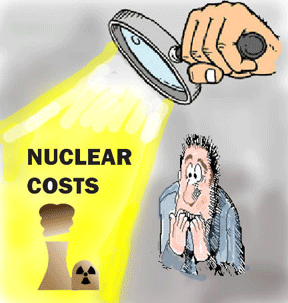 Why the financial community should work to prevent the market and economic shocks of a nuclear incident, Bulletin of the Atomic Scientists, By David Epstein, March 29, 2019 The risks of a nuclear incident—including the detonation of a nuclear bomb or dirty bomb, or a cyberattack on a nuclear power plant—have been discussed ad nauseam. Investment icon Warren Buffett and many international security experts have expounded on the significant risks of a nuclear incident in the coming decades. Many experts, in fact, actually consider it no small miracle that there has not been some major nuclear incident (outside of accidental nuclear meltdowns) since World War II. More than a few of them phrase the potential for some such nuclear catastrophe not as a matter of “if” but of “when.” Why the financial community should work to prevent the market and economic shocks of a nuclear incident, Bulletin of the Atomic Scientists, By David Epstein, March 29, 2019 The risks of a nuclear incident—including the detonation of a nuclear bomb or dirty bomb, or a cyberattack on a nuclear power plant—have been discussed ad nauseam. Investment icon Warren Buffett and many international security experts have expounded on the significant risks of a nuclear incident in the coming decades. Many experts, in fact, actually consider it no small miracle that there has not been some major nuclear incident (outside of accidental nuclear meltdowns) since World War II. More than a few of them phrase the potential for some such nuclear catastrophe not as a matter of “if” but of “when.”
Although nuclear issues are sometimes covered by the financial and business media, the risks of a nuclear incident are something of an elephant in the room in the financial and business communities. Most participants in the capital markets discuss nuclear risks little day-to-day and do even less to prepare for a potential incident. They need to do more. As stewards of the capital markets and economy, bankers, money managers, regulators, and leaders of the broader business community should pursue a dual track, working to prevent nuclear incidents while simultaneously preparing for the market and economic shocks that will undoubtedly ensue if prevention efforts fail. An age of nuclear threats. The blustery rhetoric of 2017 has eased, but the North Korean nuclear situation is far from resolved. Recent satellite imagery has indicated that North Korea is currently rebuilding at least one of its missile test facilities. At some point, the world could see renewed tension or even a violent showdown over the definition of and nature of any nuclear disarmament on the Korean peninsula. Meanwhile, there has been a terrible deterioration in Western relations with Russia. The United States has announced that it will withdraw from the Intermediate-Range Nuclear Forces (INF) Treaty with Russia in six months if Russia does not stop violating it. Russia, in response, suspended its own obligations under the treaty, contending that the United States is violating the pact. Separately, there are factions within the Trump administration and the Russian government that believe smaller-payload nuclear weapons could be detonated in limited warfare without setting off a much broader conflict. Such thinking is, to understate, dangerous. Relations between India and Pakistan were recently at their tensest levels in decades. …… Beyond these tensions, the danger of a nuclear terror attack somewhere in the world is ever present. Terrorists have tried many times to obtain nuclear bombs and weapons-grade materials and are assuredly going to make such attempts in the future. ……… Many experts believe that miscalculation—a situation in which two state actors blunder into a nuclear exchange—is a likely way for nuclear conflict to begin. ……… The potential economic aftermath of a limited nuclear incident. Investment portfolios, the capital markets, and the economy in general could have been irrelevant had the United States and Soviet Union allowed the Cold War to turn hot, fighting a full-scale nuclear war that involved tens of thousands of nuclear weapons. But that particular risk has receded. There is now a much higher probability that any nuclear incident the world sees will be a limited one that kills less than one percent of the global population. In such a scenario, the broader public clearly is going to care about what is happening to its investment portfolios and companies, and to the overall economy……… Even if a major incident doesn’t occur in the short to intermediate term (i.e. a couple years or less), the likelihood that a nuclear device will at some point be detonated in a major city should not be ignored. If it does happen, anywhere, the global financial repercussions will likely be enormous. The markets, the level of inflation, and the economy could well react violently in the short-term wake of a nuclear explosion……….. It is actually encouraging that there is currently some momentum on Wall Street toward discussion of climate risk, not just for society generally but in terms of companies’ bottom lines and how they might need to mitigate the effects of future climate risks. These conversations are part of so-called sustainable investing or the related ESG (environmental, social and governance) investing and SRI (socially responsible investing) movements. I hope to similarly increase Wall Street’s attention to risks related to nuclear weapons and other weapons of mass destruction and disruption. Nuclear risks differ from climate risk in one major way: Climate change’s destructive force likely won’t manifest itself in a singular, instantaneous event. But a single nuclear event could be so severe and so instantaneous that the economic response could be almost immediate and absolutely catastrophic……….. https://thebulletin.org/2019/03/why-the-financial-community-should-work-to-prevent-the-market-and-economic-shocks-of-a-nuclear-incident/ |
|
No comments yet.
1 This Month

10 March A LIVE WEBINAR THE REAL EFFECTS OF NUCLEAR POWER
What the Industry Isn’t Telling Us
1:00 PM Mountain, 2 pm Central, 3 pm Eastern. Live on the Keepers of the Water Facebook page

18 March Webinar @ 1 PM EST: An Assessment of SMR Projects: The Case of Canada
register for the zoom:
https://us02web.zoom.us/webinar/register/WN_o8BIIOUvQ2ONJR1nta65DQ#/registration


of the week – STOP SMALL MODULAR REACTORS IN CANADA
To see nuclear-related stories in greater depth and intensity – go to https://nuclearinformation.wordpress.com
-
Archives
- March 2026 (62)
- February 2026 (268)
- January 2026 (308)
- December 2025 (358)
- November 2025 (359)
- October 2025 (376)
- September 2025 (258)
- August 2025 (319)
- July 2025 (230)
- June 2025 (348)
- May 2025 (261)
- April 2025 (305)
-
Categories
- 1
- 1 NUCLEAR ISSUES
- business and costs
- climate change
- culture and arts
- ENERGY
- environment
- health
- history
- indigenous issues
- Legal
- marketing of nuclear
- media
- opposition to nuclear
- PERSONAL STORIES
- politics
- politics international
- Religion and ethics
- safety
- secrets,lies and civil liberties
- spinbuster
- technology
- Uranium
- wastes
- weapons and war
- Women
- 2 WORLD
- ACTION
- AFRICA
- Atrocities
- AUSTRALIA
- Christina's notes
- Christina's themes
- culture and arts
- Events
- Fuk 2022
- Fuk 2023
- Fukushima 2017
- Fukushima 2018
- fukushima 2019
- Fukushima 2020
- Fukushima 2021
- general
- global warming
- Humour (God we need it)
- Nuclear
- RARE EARTHS
- Reference
- resources – print
- Resources -audiovicual
- Weekly Newsletter
- World
- World Nuclear
- YouTube
-
RSS
Entries RSS
Comments RSS
 nuclear-news
Leave a comment