
nuclear-news

The News That Matters about the Nuclear Industry Fukushima Chernobyl Mayak Three Mile Island Atomic Testing Radiation Isotope

  • Home
  • 1 This Month
  • ACTION !
  • Disclaimer
  • Links
  • PAGES on NUCLEAR ISSUES

The Nuclear Free Local Authorities (NFLA) dismiss the need for Sizewell C nuclear station, and call for renewables

  Councils call for fresh look at nuclear power as current policy ‘flawed’, East Anglian Daily Times, 24 March 2019, Richard Cornwell

Campaigners fighting proposals for new-build nuclear power plants have dismissed the need for Sizewell C – and called on the Government to reassess future electricity usage and generation.

The Nuclear Free Local Authorities (NFLA) group, which represents 40 councils across the country, believes renewable energy alternatives, with energy efficiency and energy storage, are more effective options.

The group points to the recent scrapping of the Sellafield Moorside development, and the decision to halt the Wylfa B and Oldbury B projects as evidence of the state of the new-build programme.

NFLA steering committee and English Forum chairman David Blackburn said: “In our submission, NFLA shows in detail why the Government’s ongoing support for new nuclear is flawed and that there is no need for such reactors at a time when the renewable sector is rapidly moving forward.

“Sizewell C also has some serious issues over the waste it would produce remaining on site for many decades, and the serious accident scenarios international agencies have

developed suggesting much more alarming consequences than EDF foresee.

“If the local councils in Suffolk are not particularly impressed with EDF’s current proposals, then there is indeed much work for it to do. NFLA see no ‘need’ for new nuclear at a time of major changes to future energy use.”

New research on nuclear accidents shows that a Chernobyl level incident at Sizewell C could require large areas of southern and central England to be evacuated.

NFLA claims electricity generation has fallen 16% in the past 14 years despite a 10% rise in population. ……..

People wanting to respond to the consultation can complete a questionnaire at www.sizewellc.co.uk or email comments to info@sizewellc.co.uk or by post to Freepost SZC Consultation. https://www.eadt.co.uk/news/nuclear-free-local-authorities-views-sizewell-c-1-5955745

March 25, 2019 Posted by Christina Macpherson | opposition to nuclear, UK | Leave a comment

Ontario’s govt about to sabotage energy saving systems, – in the interests of the nuclear lobby

Nuclear power company backs Ford government energy plan, Canada’s National Observer , By Alastair Sharp March 21st 2019 Premier Doug Ford’s Progressive Conservative government said on Thursday it will reform Ontario’s electricity system in a bid to reduce costs overall and lower rates for businesses, a move critics say limits the most efficient way to save money in the power grid and threatens thousands of clean energy jobs.

The plan, announced by Energy Minister Greg Rickford, confirm details reported exclusively by National Observer on Wednesday about a series of cuts to programs that were designed to save energy in buildings. …….

Environmental groups and opposition political parties say the moves don’t make economic sense, pointing to the IESO’s estimates that it costs more than four times more to produce nuclear energy than to conserve electricity, with nuclear costs likely to double in coming years.

The IESO estimates that it costs 1.7 cents to save a kilowatt hour (kWh) of electricity while Ontario Power Generation’s (OPG) nuclear electricity costs 8.8 cents per kWh and is forecast to rise to 16.5 cents per kWh by 2025 to pay for the re-building of the Darlington Nuclear Station.

“I’m worried that today’s announcement might set the stage for the abandonment of energy efficiency efforts while going all-in on expensive, outdated nuclear power,” Ontario Green Party Leader Mike Schreiner said in a statement.

Rickford’s plan would also threaten thousands of jobs in companies working on energy efficiency projects, according to Efficiency Canada, a lobby group that represents companies that provide energy efficiency products and services.

Corey Diamond, executive director of Efficiency Canada, said that this field of the economy has the potential to create over 14,000 jobs per year.

“Energy efficiency is the best bang for the buck for the people of Ontario,” said Diamond in a statement. “Scaling back on programs means fewer local jobs in communities across the province,” he said.

The group representing local power distributors also criticized the changes, citing IESO data showing local hydro utilities had saved over 5.8 billion kWh, enough to power more than 640,000 homes for a full year.

Local distribution companies “have made a vital contribution to delivering savings to all customers across Ontario, including families, small businesses, farmers, medium and large businesses,” said Teresa Sarkesian, president and CEO of the Electricity Distributors Association (EDA).

Ontario NDP energy and climate change critic Peter Tabuns said he agreed that the previous government’s plan was disastrous, but said that the Ford government was about to make the situation worse.

“For years, families saw their utility bills skyrocket under the Wynne Liberals and were left struggling to make ends meet each month,” Tabuns said. “Instead of making things better, and dropping the disastrous Liberal hydro borrowing scheme, the Conservatives are ripping up programs that help everyday families save money on their utility bills, so families and businesses will see their bills jump, yet again.”  https://www.nationalobserver.com/2019/03/21/news/nuclear-power-company-backs-ford-government-energy-plan

March 25, 2019 Posted by Christina Macpherson | Canada, politics | 1 Comment

REMEMBERING Katsuko Saruhashi THE TRAILBLAZING SCIENTIST WHO UNCOVERED NUCLEAR FALLOUT IN THE PACIFIC

Katsuko Saruhashi made waves internationally when she tracked and raised a global alarm on the dangers of nuclear testing by the U.S. Pacific Standard, LAURA MAST, MAR 22, 2019

Determining the measure of a great scientist is a challenge. Is it an enormous contribution to science, noted by awards and distinctions? Publications in peer-reviewed journals or keynotes at conferences? Serving as an expert to governments, effecting change on national and international policy? Or can this measure be more granular: beyond being a role model, to be present and provide sustaining mentorship, lifting up others?

No matter how you slice it, Katsuko Saruhashi is one such great scientist, and a woman who certainly lived up to her name, which translates to strong-minded or victorious in Japanese. Not only did she conduct groundbreaking research—developing the first method to measure carbon dioxide levels in seawater—but her work also made waves internationally, as she tracked and raised a global alarm on the dangers of nuclear testing. Throughout her 35-year career as a geochemist, she collected numerous awards and led the way for women to follow her in science……….

After graduating in 1943 with her undergraduate degree in chemistry, Saruhashi joined the Geochemistry Laboratory at the Meteorological Research Institute (now called the Japan Meteorological Agency). There, she studied not rain, but oceans, specifically carbon dioxide (CO) levels in seawater. Saruhashi developed the first method for measuring CO using temperature, pH, and chlorinity, called Saruhashi’s Table. This method became a global standard. Perhaps more importantly, she discovered that the Pacific Ocean releases more carbon dioxide than it absorbs: a concept with dire consequences today as the climate changes.

Saruhashi also led the way in studying ocean-borne nuclear contamination. Although World War II had ended years before, the United States continued to carry out nuclear tests, particularly in the Pacific Ocean near Bikini Atoll, 2,300 miles southwest of Japan. After several Japanese fishermen became mysteriously ill while out trawling downwind of the testing site in March of 1954, the Japanese government asked Saruhashi and her colleagues at the Geochemical Laboratory to investigate.

…….Saruhashi and her team ultimately found nuclear fallout didn’t travel evenly throughout the ocean. They tracked ocean circulation patterns using radionuclides, discovering that currents pushed radiation-contaminated waters clockwise, from Bikini Atoll northwest toward Japan. As a result, fallout levels were much higher in Japan than along the western U.S.

Their results were stunning: the radioactive fallout released in the testing had reached Japan in just 18 months. If testing continued, the entire Pacific Ocean would be contaminated by 1969, proving that nuclear tests even conducted out in the middle of the ocean, seemingly in isolation, could have dangerous consequences.

Even now, more than 60 years later, Bikini Atoll is still unlivable.

This data, unsurprisingly, sparked controversy, and the U.S. Atomic Energy Force ultimately funded a lab swap, bringing Saruhashi to the Scripps Institute of Oceanography to compare the Japanese technique for measuring fallout with the American method, developed by oceanographer Theodore Folsom. Her method turned out to be more accurate, settling the science and providing the critical evidence needed to bring the U.S. and Soviet Union in agreement to end above-ground nuclear testing in 1963: an amazing accomplishment at the height of the Cold War. Saruhashi returned to Japan and later became the executive director of the Geochemical Laboratory in 1979. …….

Saruhashi died in September of 2007 at the age of 87 …….https://psmag.com/environment/the-japanese-scientists-who-uncovered-nuclear-fallout

March 25, 2019 Posted by Christina Macpherson | Japan, oceans, PERSONAL STORIES | Leave a comment

To increase energy self-sufficiency after the 2011 nuclear disaster, renewables are Japan’s only option.

Rethinking Japan’s Energy Security 8 Years After Fukushima

To increase energy self-sufficiency after the 2011 nuclear disaster, renewables are Japan’s only option.

The Diplomat, By Xie Zhihai
March 21, 2019 “………How should Japan tackle the challenges of energy security, then? It will take another round of strategic efforts for Japan to develop new alternative energy sources. To bring back its energy self-sufficiency rate to the 2010 level or even higher, renewable energy is the only possible solution as Japan has a very low primary energy reserve. Also it is not practical to reopen most nuclear power plants while the decommissioning of Fukushima Daiichi doesn’t appear to be going smoothly and many Fukushima people still haven’t been able to return to a normal life

In July 2018, the government of Japan formulated the Strategic Energy Plan in order to show the public the basic direction of Japan’s energy policy. The Plan set the goal to raise Japan’s energy self-sufficiency rate from around 8 percent in 2016 to 24 percent in 2030. This looks unrealistic, but it’s not impossible if Japan can concentrate on the development and spread of renewable energy.

However, the Strategic Energy Plan stays ambiguous about Japan’s future energy policy, despite its aim to shed light on that very subject. One big problem with the Plan is that the priority of the energy policy is not clear. The government aims to use renewable energy as the major power source by 2030, according to the Plan — but at the same time, the plan also attempts to restore nuclear energy and raise its share to 20 percent-30 percent.

Former Prime Minister Koizumi Junichiro is well known for advocating the “zero nuclear energy” campaign after the 3.11 triple disaster. He continues to argue that Japan must be able to live without nuclear energy. In a recent talk show, he questioned the current Japanese government’s energy policy and said it was a lie to claim that nuclear energy is safe, low-cost, and clean.

Some commentators criticize Japan for being poor at decisively changing track when necessary. When the time came for Japan to give up nuclear energy once and for all, the government was not ready to make a tough political decision. In the wake of the Fukushima nuclear accident, countries such as Germany declared they would abandon nuclear energy. However, it is ironic that Japan, the direct victim of the nuclear disaster, still doesn’t dare to say goodbye to nuclear energy completely.

The Fukushima nuclear accident caused a crisis for Japan’s energy security. But it is this very crisis that could provide an opportunity for Japan to redirect its energy policy and accelerate the development of renewable energy. Despite the government’s hesitation, many Japanese already believe that nuclear energy is outdated and renewable energy is the correct direction for Japan. As recent TV programs have reported, some ordinary people are starting to invest in solar energy and sell electricity to power companies.

Japan must build confidence that renewable energy has the potential to secure its energy supply. For example, it is said that during the golden week in May 2018, 93 percent of the electricity supply in the Kyushu area was from renewable energy. If Japan could get through the past eight years nearly without nuclear energy, then it must be able to do better in the future with the spread of renewable energy.

Finally, to solve the energy problem, Japan also needs revolutionary innovation. For example, Toyota has just launched the new generation of its Mirai (Future) hydrogen fuel cell vehicle. The new Mirai not only has zero emissions, but also can produce and store electricity to provide energy in an emergency. The Toyota automobile is not only an energy consumer, but also an energy supplier. Mirai points to the future for Japan’s energy policy. Similar innovation should take place in other industries.

Xie Zhihai is an associate professor at Kyoai Gakuen University in Japan.  https://thediplomat.com/2019/03/rethinking-japans-energy-security-8-years-after-fukushima/

March 25, 2019 Posted by Christina Macpherson | Japan, renewable | Leave a comment

Communities, lawmakers call for action to reduce nuclear threat 

My Turn: https://www.concordmonitor.com/A-call-to-action-to-reduce-nuclear-threat-24334038, By ARNIE ALPERT, For the Monitor, 3/24/2019 

With the March 20 passage in the N.H. House of Representatives of a resolution calling for a policy of no-first-use of nuclear weapons and opposing development of so-called “low yield” nuclear weapons, the state’s legislators added their voices to a growing movement aimed at reducing the risk of nuclear conflict and moving the world toward abolition of nuclear weapons.

Other measures, based on a resolution known as “Back from the Brink,” also cleared the City Council in Portsmouth last Monday and town meetings earlier this month in Warner, Alstead, Lee and Exeter. The Durham Town Council passed one in December. New London’s town meeting kicked off the latest round two years ago.

It’s not a coincidence.

The resolutions flow from an organized effort by groups including N.H. Peace Action, the American Friends Service Committee, Seacoast Peace Response, Rights and Democracy, and the Union of Concerned Scientists to spotlight concerns about nuclear weapons at a time when presidential candidates are flocking to New Hampshire.

The candidates are also starting to get questions on the campaign trail.

The reason should be obvious: 75 years into the atomic age and three decades after the Cold War ended, the world is still threatened by the possibility that through escalation of international conflict, accident or technological malfunction, nuclear weapons could be exploded. Consider, for example, the festering tensions along the border between India and Pakistan, two of the world’s nine nuclear-armed powers, that could spin out of control.

As the Portsmouth resolution put it, “the detonation of even a small number of these weapons anywhere in the world could have catastrophic human, environmental and economic consequences that could affect everyone on the planet.”

“A large-scale nuclear war could kill hundreds of millions of people directly and cause unimaginable environmental damage, producing conditions wherein billions of people could die from starvation or disease,” the resolution added.

Yet, the United States and other nuclear powers are pursuing new nuclear weapons, even ones designed for battlefield use, rather than diplomatic courses to de-escalate tensions and reduce the chance that nuclear weapons would ever be used.

The decisions by U.S. and Russian leaders to pull out of the Intermediate Nuclear Forces agreement and possibility that the New START treaty might go unrenewed in 2020 stand as stark examples.

For our country, this is a dangerous change of course from the approaches of previous presidential administrations, Republican and Democratic, which even at the height of the Cold War knew that restraint was preferable to an uncontrolled nuclear arms race.

According to a recent poll conducted by the Union of Concerned Scientists, 84 percent of New Hampshire residents think it is very (54 percent) or somewhat (30 percent) important for candidates in the upcoming 2020 presidential election to lay out their views regarding nuclear weapons.

Presidential candidates take notice. When you visit New Hampshire, you may be asked questions like:

“Will you oppose current plans to spend upward of 1½ trillion dollars on a plan to rebuild the entire American nuclear arsenal?”

“Will you agree that no president, even yourself should you be elected, should have unilateral authority to launch a nuclear attack?”

“Will you live up to long-standing U.S. treaty obligations and support multilateral negotiations leading to the worldwide elimination of nuclear weapons?”

Voters will welcome the responses.

(Arnie Alpert is co-director of the American Friends Service Committee’s New Hampshire Program.)

March 25, 2019 Posted by Christina Macpherson | general | Leave a comment

Dispelling the hype and hot air about Small Modular Nuclear Reactors (SMRs)

  No2NuclearPower, March 2019, Small Modular Reactors Last year was undoubtedly the year of the small modular reactor (SMR) ‒ the amount of hot air and hype spouted about the “most influential and innovative energy disruptors the world has ever seen” could power the world indefinitely.
The WISE/NIRS Nuclear Monitor magazine has produced a special double which focuses exclusively on SMRs. It is available without the usual paywall to inform the debate, but also to generate new subscriptions. See: The WISE/NIRS Nuclear Monitor magazine has produced a special double which focuses exclusively on SMRs. It is available without the usual paywall to inform the debate, but also to generate new subscriptions. See: https://wiseinternational.org/sites/default/files/NM872-873-final.pdf
http://www.no2nuclearpower.org.uk/wp/wp-content/uploads/2019/03/NuClearNewsNo115.pdf

March 25, 2019 Posted by Christina Macpherson | Uncategorized | Leave a comment

Earthquake in France, not that far away from nuclear reactors

IRSN 22nd March 2019 On Wednesday, March 20, 2019, at 10:56 local time, an earthquake of moderate magnitude (between 4.7 and 5.0 on the Richter scale) occurred in Montendre (Charente-Maritime). This earthquake was followed at 11:30 of a magnitude replica of 2.8.

The closest nuclear installation to the earthquake is the Blayais nuclear power generation center, located 27 km
from the epicenter. The Civaux and Golfech power plants are located respectively at 145 and 169 km from the epicenter. The Seismic Risk Assessment Office for Facility Safety (BERSSIN) of IRSN has prepared a briefing note on the characteristics of this earthquake.

https://www.irsn.fr/FR/Actualites_presse/Actualites/Pages/20190322_fiche-seisme-montendre-charente-maritime-20032019.aspx

March 25, 2019 Posted by Christina Macpherson | France, safety | Leave a comment

In the Middle East, world’s most volatile region, nuclear power is taking off – what could possibly go wrong?

Above all, nuclear power needs stability and systems where everyone works together. The Middle East is one of the world’s most volatile regions, full of rivalries between states and internal divisions. 

Israel has never disclosed the full extent of its nuclear programme and, in the past, has launched air strikes on nuclear facilities in both Iraq and Syria.

Spectre of Chernobyl hangs over Middle East’s nuclear ambitions, Middle East Eye , Kieran Cooke

22 March 2019 

To avoid a potential disaster, nuclear power needs stability and systems where everyone works together    The Middle East is going nuclear.The United Arab Emirates is home to the Barakah nuclear power station, the Arab world’s first such facility and the biggest nuclear power plant currently under construction.

Saudi Arabia has plans for two large nuclear plants to cope with national energy demands, increasing by more than eight percent annually.

Initial land-clearing work has also begun for a nuclear facility at Akkuyu, on Turkey’s southern coast, while Egypt is due to start building a nuclear power plant in El Dabaa, west of Alexandria, next year. Jordan has plans for a number of smaller nuclear facilities. …..

The Barakah facility, expected to supply a quarter of the UAE’s energy needs, will cost upwards of $30bn.

Equally expensive is the cost of decommissioning a nuclear plant at the end of its working life. Nuclear power has been around for more than 60 years, but no one has really come to grips with how to dispose of spent but still highly dangerous nuclear waste, handing a poisoned legacy to future generations.

And then there is the safety factor. On the morning of 26 April 1986, engineers at the Chernobyl nuclear power plant in Ukraine were carrying out routine turbine and reactor tests when they heard a sudden roar, followed by a loud blast.

Some thought there had been an earthquake. In a recently published book on Chernobyl, Serhii Plokhy – now a history professor at Harvard but in 1986 a Ukraine resident – said the idea of a nuclear accident was inconceivable. “As far as they [the engineers] were concerned, the reactor and its panoply of safety systems were idiot proof. No textbook they had ever read suggested that reactors could explode.”

Obsessed with secrecy

The nuclear industry today – whether in Russia, Europe, China, the US or the Middle East – is similarly confident of its safety.

Chernobyl’s reactor exploded, throwing vast clouds of radiation up into the atmosphere that were blown by winds over Scandinavia, much of Europe and Ukraine itself. Plokhy’s book – billed as the most extensively researched work yet on the Chernobyl disaster – should be required reading for any government official contemplating a nuclear-driven future………

Safety concerns

Plokhy says a combination of factors was to blame for events at Chernobyl, which beyond the immediate deaths, is believed to be responsible for tens of thousands of cases of fatal diseases, such as cancer. There were shortcuts in construction and pressure to increase energy quotas. Testing procedures were not followed. There were serious design faults, yet staff who foresaw dangers were afraid to speak out for fear of losing their jobs.

Plokhy foresees similar consequences in modern-day nuclear power programmes, wondering whether safety measures will be followed scrupulously in countries such as Egypt, the UAE and Pakistan.

“Are we sure that all these reactors are sound, that safety measures will be followed to the letter, and that the autocratic regimes running most of these countries will not sacrifice the safety of their people and the world as a whole to get extra energy and cash to build up their military, ensure rapid economic development, and try to head off public discontent?” he said. “That is exactly what happened in the Soviet Union back in 1986.”

Of course, these are early days in the nuclear power industry in the Middle East,  but already there are problems. The first reactor unit of the four being built at the Barakah plant in Abu Dhabi was supposed to have come on-stream in 2017, but there is reportedly evidence of cracks in some of the containment walls and delays due to shortages of trained staff.

On Wednesday, Qatar asked the United Nations’ nuclear watchdog to intervene in a dispute over a a nuclear power plant that is under construction in the United Arab Emirates, Reuters reported.

Citing a letter Qatar sent to the International Atomic Energy Agency (IAEA), the news agency said that Doha argued that Barakah, a nuclear plant being built near its border with the UAE, threatens the stability of the region and the environment.

Qatar said that a radioactive plume from an accidental discharge could reach its capital Doha in five to 13 hours, while a radiation leak would have a devastating effect on the region’s water supply because of its reliance on desalination plants.

The biggest prize

Rosatom, Russia’s state nuclear corporation, is developing Egypt’s 4.8GW nuclear power plant, with work due to start next year. But there have been a number of protests at the site of the proposed plant, just as there have been demonstrationsas building work gets underway at Turkey’s Akkuyu nuclear facility, also being built by Rosatom.

In Jordan, the government seems to have abandoned plans for a $10bn nuclear plant to be built by Rosatom due to worries over costs. Instead, Amman is planning to build a number of much smaller reactors.

At the same time, the nuclear industry is falling over itself for what’s considered the biggest prize of all: Saudi Arabia. Competition for building the first two reactors in the kingdom’s ambitious nuclear power programme is intense, with US, Chinese, South Korean and French companies, along with Rosatom, involved in the process.

The US Congress is investigating reports that the White House has been transferring sensitive nuclear technology to Saudi Arabia so that US firms allegedly linked to President Donald Trump could win multibillion-dollar nuclear contracts……….

Regional volatility

Above all, nuclear power needs stability and systems where everyone works together. The Middle East is one of the world’s most volatile regions, full of rivalries between states and internal divisions.

Israel has never disclosed the full extent of its nuclear programme and, in the past, has launched air strikes on nuclear facilities in both Iraq and Syria. There are ongoing arguments over the status of Iran’s nuclear industry. ……..https://www.middleeasteye.net/opinion/spectre-chernobyl-hangs-over-middle-easts-nuclear-ambitions

March 25, 2019 Posted by Christina Macpherson | MIDDLE EAST, safety | Leave a comment

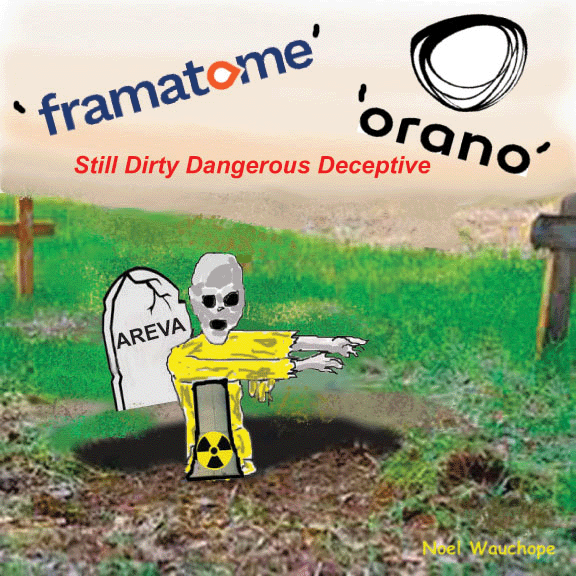
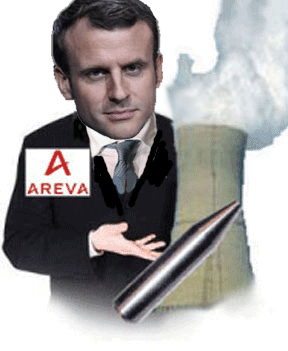
Orano (makeover of bankrupt AREVA ) not getting anywhere in selling nuclear reprocessing plant to China

Les Echos 23rd March 2019 Another place, another atmosphere. Xi Jinping’s visit to France is not expected to lead to any major breakthrough on Orano’s long-awaited contract to build a used nuclear fuel processing and recycling plant in China.

Fifteen months after Emmanuel Macron’s visit to Beijing during which the French industrialist and his partner CNNC had concluded a new memorandum of understanding , Orano (the former Areva refocused on the fuel cycle) is still far from to have won the bet. At the time, Orano and CNNC had given themselves until the end of 2018 to formally agree on this mega contract of more than 10 billion dollars.

ttps://www.lesechos.fr/monde/chine/0600942449579-la-gueule-de-bois-du-nucleaire-francais-en-chine-2254727.php#xtor=CS1-33

March 25, 2019 Posted by Christina Macpherson | China, France, marketing | Leave a comment

Energy expert dismisses Zuma’s nuclear deal comment

https://www.enca.com/news/energy-expert-rubbishes-zumas-nuclear-deal-comment 23 March 2019 – JOHANNESBURG – Former President Jacob Zuma has defended a proposed nuclear energy deal, saying it would’ve solved Eskom’s crisis.

Zuma said the country would have spent trillions over a short period, but it would have been able to make returns.

But energy expert Tobias Bischof-Niemz disagrees with Zuma, saying the process could have taken about ten years, leaving the country in crisis till 2023.

“The nuclear project that was in discussion for years stems from the integrated nuclear plan.

“As for that plan, the first reactor would have come online in 2023,” said Bischof-Niemz.

“Even if we had implemented the IRP 2010, the first reactor would come online in four years from now.”

March 25, 2019 Posted by Christina Macpherson | politics, South Africa | Leave a comment

Proposed cuts to Hanford funding unacceptable

Congress needs to fully fund cleanup of the nuclear waste at Hanford. It’s a federal responsibility. Union Bulletin, Editorial Board  24 Mar 19, 

    • The radioactive waste stored in leaking underground tanks at the Hanford Nuclear Reservation are an environmental disaster waiting to happen. That’s something nobody wants to think about.

But, unfortunately, many of those with the power to get this nuclear mess cleaned up are among those who continue to ignore this reality.

The Trump administration is proposing cutting Hanford Nuclear Reservation spending for fiscal year 2020 by $416 million, the Tri-City Herald reported last week. The annual budget would drop from about $2.5 billion this fiscal year to $2.1 billion next year under the budget request submitted to Congress by the administration, according to the Herald……

Walla Walla is less  than 70 miles away from the nuclear reservation where 56 million gallons of radioactive nuclear waste are stored in tanks: Efforts to remove the deadly waste are important. In addition, 67 of the tanks — some with confirmed leaks — are buried relatively close to the Columbia River.

But this isn’t merely a local or regional concern, it’s a national one. Cleaning up this radioactive nuclear waste is a federal responsibility. ….. http://www.union-bulletin.com/opinion/editorials/proposed-cuts-to-hanford-funding-unacceptable/article_5c16da48-4cc9-11e9-9bc8-a35c25381b02.html

March 25, 2019 Posted by Christina Macpherson | general | Leave a comment

    Next Entries »

1 This Month

19 February – VIRTUAL EVENT-Decision Time: AI and Our Nuclear Arsenal 

12:45 p.m. Central / 1:45 p.m. Eastern

https://pages.thebulletin.org/ai-in-nuclear-command-and-control?utm_source=ActiveCampaign&utm_medium=email&utm_content=Can%20the%20%22ick%20factor%22%20stop%20alt%20meat%3F&utm_campaign=20260212%20Thursday%20Newsletter

​To see nuclear-related stories in greater depth and intensity – go to https://nuclearinformation.wordpress.com

  • Categories

    • 1
      • Arclight's Vision
    • 1 NUCLEAR ISSUES
      • business and costs
        • employment
        • marketing
      • climate change
      • culture and arts
      • ENERGY
        • renewable
          • decentralised
          • energy storage
      • environment
        • oceans
        • water
      • health
        • children
        • psychology – mental health
        • radiation
        • social effects
        • women
      • history
      • indigenous issues
      • Legal
        • deaths by radiation
        • legal
      • marketing of nuclear
      • media
        • investigative journalism
        • Wikileaks
      • opposition to nuclear
      • PERSONAL STORIES
      • politics
        • psychology and culture
          • Trump – personality
        • public opinion
        • USA election 2024
        • USA elections 2016
      • politics international
      • Religion and ethics
      • safety
        • incidents
      • secrets,lies and civil liberties
        • civil liberties
      • spinbuster
        • Education
      • technology
        • reprocessing
        • Small Modular Nuclear Reactors
        • space travel
      • Uranium
      • wastes
        • – plutonium
        • decommission reactor
      • weapons and war
        • Atrocities
        • depleted uranium
      • Women
    • 2 WORLD
      • ANTARCTICA
      • ARCTIC
      • ASIA
        • Burma
        • China
        • India
        • Indonesia
        • Japan
          • – Fukushima 2011
          • Fukushima 2012
          • Fukushima 2013
          • Fukushima 2014
          • Fukushima 2015
          • Fukushima 2016
          • Fukushima continuing
        • Malaysia
        • Mongolia
        • North Korea
        • Pakistan
        • South Korea
        • Taiwan
        • Turkey
        • Vietnam
      • EUROPE
        • Belarus
        • Bulgaria
        • Denmark
        • Finland
        • France
        • Germany
        • Greece
        • Ireland
        • Italy
        • Kazakhstan
        • Kyrgyzstan
        • Russia
        • Spain
        • Sweden
        • Switzerland
        • UK
        • Ukraine
      • MIDDLE EAST
        • Afghanistan
        • Egypt
        • Gaza
        • Iran
        • Iraq
        • Israel
        • Jordan
        • Libya
        • Saudi Arabia
        • Syria
        • Turkey
        • United Arab Emirates
      • NORTH AMERICA
        • Canada
        • USA
          • election USA 2020
      • OCEANIA
        • New Zealand
        • Philippines
      • SOUTH AMERICA
        • Brazil
    • ACTION
    • AFRICA
      • Kenya
      • Malawi
      • Mali
      • Namibia
      • Niger
      • Nigeria
      • Somalia
      • South Africa
    • Atrocities
    • AUSTRALIA
    • Christina's notes
    • Christina's themes
    • culture and arts
    • Events
    • Fuk 2022
    • Fuk 2023
    • Fukushima 2017
    • Fukushima 2018
    • fukushima 2019
    • Fukushima 2020
    • Fukushima 2021
    • general
    • global warming
    • Humour (God we need it)
    • Nuclear
    • RARE EARTHS
      • thorium
    • Reference
      • Reference archives
    • resources – print
    • Resources -audiovicual
    • Weekly Newsletter
    • World
    • World Nuclear
    • YouTube
  • Pages

    • 1 This Month
    • ACTION !
    • Disclaimer
    • Links
    • PAGES on NUCLEAR ISSUES
      • audio-visual news
      • Anti Nuclear, Clean Energy Movement
        • Anti Nuclear movement – a success story
          • – 2013 – the struggle for a nuclear-free, liveable world
          • – 2013: the battle to expose nuclear lies about ionising radiation
            • Speakers at Fukushima Symposium March 2013
            • Symposium 2013 Ian Fairlie
      • Civil Liberties
        • – Civil liberties – China and USA
      • Climate change
      • Climate Change
      • Economics
        • – Employment
        • – Marketing nuclear power
        • – Marketing Nuclear Power Internationally
        • nuclear ‘renaissance’?
        • Nuclear energy – the sick man of the corporate world
      • Energy
        • – Solar energy
      • Environment
        • – Nuclear Power and the Tragedy of the Commons
        • – Water
      • Health
        • Birth Defects in the Chernobyl Radiation Affected Region.
      • History
        • Nuclear History – the forgotten disasters
      • Indigenous issues
      • Ionising radiation
        • – Ionising radiation – medical
        • Fukushima FACT SHEET
      • Media
        • Nuclear Power and Media 2012
      • Nuclear Power and the Consumer Society – theme for December 2012
      • Peace and nuclear disarmament
        • Peace on a Nuclear Free Earth
      • Politics
        • – Politics USA
      • Public opinion
      • Religion and ethics
        • -Ethics of nuclear power
      • Resources – print
      • Safety
      • Secrets and lies
        • – NUCLEAR LIES – theme for January 2012
        • – Nuclear Secrets and Lies
      • Spinbuster
        • 2013 nuclear spin – all about FEAR -theme for June
        • Spinbuster 1
      • Technology
        • TECHNOLOGY Challenges
      • Wastes
        • NUCLEAR WASTES – theme for October 2012
        • – Plutonium
      • Weapons and war
      • Women
  • Archives

    • February 2026 (181)
    • January 2026 (308)
    • December 2025 (358)
    • November 2025 (359)
    • October 2025 (376)
    • September 2025 (258)
    • August 2025 (319)
    • July 2025 (230)
    • June 2025 (348)
    • May 2025 (261)
    • April 2025 (305)
    • March 2025 (319)
  • Categories

    • 1
      • Arclight's Vision
    • 1 NUCLEAR ISSUES
      • business and costs
        • employment
        • marketing
      • climate change
      • culture and arts
      • ENERGY
        • renewable
          • decentralised
          • energy storage
      • environment
        • oceans
        • water
      • health
        • children
        • psychology – mental health
        • radiation
        • social effects
        • women
      • history
      • indigenous issues
      • Legal
        • deaths by radiation
        • legal
      • marketing of nuclear
      • media
        • investigative journalism
        • Wikileaks
      • opposition to nuclear
      • PERSONAL STORIES
      • politics
        • psychology and culture
          • Trump – personality
        • public opinion
        • USA election 2024
        • USA elections 2016
      • politics international
      • Religion and ethics
      • safety
        • incidents
      • secrets,lies and civil liberties
        • civil liberties
      • spinbuster
        • Education
      • technology
        • reprocessing
        • Small Modular Nuclear Reactors
        • space travel
      • Uranium
      • wastes
        • – plutonium
        • decommission reactor
      • weapons and war
        • Atrocities
        • depleted uranium
      • Women
    • 2 WORLD
      • ANTARCTICA
      • ARCTIC
      • ASIA
        • Burma
        • China
        • India
        • Indonesia
        • Japan
          • – Fukushima 2011
          • Fukushima 2012
          • Fukushima 2013
          • Fukushima 2014
          • Fukushima 2015
          • Fukushima 2016
          • Fukushima continuing
        • Malaysia
        • Mongolia
        • North Korea
        • Pakistan
        • South Korea
        • Taiwan
        • Turkey
        • Vietnam
      • EUROPE
        • Belarus
        • Bulgaria
        • Denmark
        • Finland
        • France
        • Germany
        • Greece
        • Ireland
        • Italy
        • Kazakhstan
        • Kyrgyzstan
        • Russia
        • Spain
        • Sweden
        • Switzerland
        • UK
        • Ukraine
      • MIDDLE EAST
        • Afghanistan
        • Egypt
        • Gaza
        • Iran
        • Iraq
        • Israel
        • Jordan
        • Libya
        • Saudi Arabia
        • Syria
        • Turkey
        • United Arab Emirates
      • NORTH AMERICA
        • Canada
        • USA
          • election USA 2020
      • OCEANIA
        • New Zealand
        • Philippines
      • SOUTH AMERICA
        • Brazil
    • ACTION
    • AFRICA
      • Kenya
      • Malawi
      • Mali
      • Namibia
      • Niger
      • Nigeria
      • Somalia
      • South Africa
    • Atrocities
    • AUSTRALIA
    • Christina's notes
    • Christina's themes
    • culture and arts
    • Events
    • Fuk 2022
    • Fuk 2023
    • Fukushima 2017
    • Fukushima 2018
    • fukushima 2019
    • Fukushima 2020
    • Fukushima 2021
    • general
    • global warming
    • Humour (God we need it)
    • Nuclear
    • RARE EARTHS
      • thorium
    • Reference
      • Reference archives
    • resources – print
    • Resources -audiovicual
    • Weekly Newsletter
    • World
    • World Nuclear
    • YouTube
  • RSS

    Entries RSS
    Comments RSS

Site info

nuclear-news
Create a free website or blog at WordPress.com.
Privacy & Cookies: This site uses cookies. By continuing to use this website, you agree to their use.
To find out more, including how to control cookies, see here: Cookie Policy
  • Subscribe Subscribed
    • nuclear-news
    • Join 2,076 other subscribers
    • Already have a WordPress.com account? Log in now.
    • nuclear-news
    • Subscribe Subscribed
    • Sign up
    • Log in
    • Report this content
    • View site in Reader
    • Manage subscriptions
    • Collapse this bar
 

Loading Comments...