Climate change brings more extreme weather – Mozambique is drowning
|
Cyclone Idai: thousands still missing in Mozambique Mozambique Is Drowning. Nebraska Has Flooded. We Need a Green New Deal. BY William Rivers Pitt, Truthout, March 23, 2019 The ocean has come for the coastal African nation of Mozambique. Tropical Cyclone Idai, a devastating storm that pummeled the country with fierce winds, was followed by a massive flood that has obliterated dams, swept away homes and bridges, erased roads, shuttered airports, and damaged 90 percent of the city of Beira, home to more than 500,000 people. There are bodies in the water and no one to collect them, making diseases like cholera an imminent threat.
More than 1,000 are confirmed dead, a number that is sure to rise. Thousands more are homeless and seeking refuge. “Many people were waiting for food, water and medicine,” reports The New York Times, “in makeshift shelters in primary schools and other government buildings.” Satellite imagery over Mozambique shows a new flood-made inland sea that is 30 miles wide in places. “We’ve never had something of this magnitude before in Mozambique,” said non-governmental organization coordinator Emma Beatty. To the west in Zimbabwe and Malawi, more than 100 people are known dead, hundreds more are missing and the damage is extensive. “There are at least three major ways that the Mozambique floods are related to climate change,” reports Eric Holthaus for Grist. “First, a warmer atmosphere holds more water vapor, which makes rainfall more intense. Idai produced more than two feet of rainfall in parts of the region — nearly a year’s worth in just a few days. Second, the region had been suffering from a severe drought in recent years in line with climate projections of overall drying in the region, hardening the soil and enhancing runoff. Third, sea levels are about a foot higher than a century ago, which worsens the effect of coastal flooding farther inland.” For years, stories of massive climate disasters such as these may have felt distant to many U.S. readers, but the climate crisis has arrived here, too. Eastern Nebraska Flooding – March 15 2019 A massive climate change-driven flood has transformed the middle of the United States into a bowl of soup. The waters have rolled down the Mississippi and Missouri Rivers and inundated huge swaths of Kansas, Nebraska, Missouri, Minnesota, Wisconsin and Iowa. Multiple towns in every state have been severely damaged, and thousands of farms that were already struggling have been scourged. On average, it takes about 28 days for river-borne floodwaters to recede, but repairing the wreckage left behind is expected to take years. Tens of thousands of people have been affected, and many are now without homes. “In case you were wondering, the climate crisis isn’t coming. It’s already here,” writes Charles P. Pierce regarding flood preparations at Offutt Air Force Base near Omaha. “The one institution of government that actually believes that is the United States military, and that’s a good thing, too, because, in this case, the exaggerated effect of the crisis and the extreme weather that results from it — the blizzards, the ‘bomb cyclone,’ the huge snowmelt, and the flooding — has become the national security threat that the Pentagon has seen coming.”…….. The ongoing pushback against the Green New Deal (GND) by most Republicans and some Democrats highlights the degree to which our leaders are willing to wait until the roof caves in on us before they act. …… According to various polls, more than 70 percent of people in the U.S. believe that climate change is happening right now, and two-thirds of Republicans believe their party is out of step with reality on the issue. Activists like those in the Sunrise Movement are petitioning lawmakers to get it in gear, and are planning a traveling explanation tour through coal states like Kentucky and Pennsylvania to make the case that waiting is no longer an option. Let us hope their entreaties do not again go ignored. We are out of time. Nebraska can tell you all about it. https://truthout.org/articles/mozambique-is-drowning-nebraska-has-flooded-we-need-a-green-new-deal/ |
|
|
Limits to South Korean President Moon’s ability to negotiate US-N. Korea nuclear deal
 Moon’s inter-Korean agenda is collateral damage of US-N. Korea nuclear impasse By KIM GAMEL | STARS AND STRIPES, March 24, 2019
SEOUL, South Korea – North Korea had a clear message for the South last week – it’s us or the United States.
The North’s decision to pull out of a recently established liaison office near the border on Friday cast a spotlight on the limits facing President Moon Jae-in’s signature policy of engaging with the communist state within the confines of U.S.-led efforts to denuclearize the divided peninsula.
It also underscored concerns that Moon has reached an endpoint in his ability to play mediator after the collapse of the second summit last month between President Donald Trump and North Korean leader Kim Jong Un.
Instead, North Korea has stepped up efforts to divide the longtime allies by pressuring the South to follow through with an ambitious agenda of inter-Korean projects that have been stalled by international sanctions…..
The two Koreas opened the liaison office in the border town of Kaesong in September to facilitate a slew of economic and cultural exchanges in accordance with agreements between Moon and Kim, who held three summits of their own last year.
That was followed by a series of high-profile events, including a groundbreaking ceremony for a planned project to modernize North Korea’s railways and roads and eventually connect them with the South. But U.S.-led sanctions prevented the effort from going further……..
Moon, who took office in May 2017 promising to pursue peace with the North, has vowed to continue working to get Pyongyang and Washington back to the table.
But experts said the impasse in nuclear talks between Washington and Pyongyang has left him little room to maneuver…………..https://www.stripes.com/news/moon-s-inter-korean-agenda-is-collateral-damage-of-us-n-korea-nuclear-impasse-1.574106
Strong opposition in Holywell County Council to hosting nuclear waste dump

 Leader Live 22nd March 2019 , HOLYWELL councillors were quick to back a bid to reject nuclear waste being dumped in the town. Earlier this year, North Wales residents were consulted in the search for a site to dump 60 years’ worth of the UK’s most dangerous radioactive waste.
At their monthly meeting, town council members were quick to support the motion that Holywell would not become the host of a nuclear waste dump. Plaid Cymru’s Jill Evans MEP sent the town council an email on the subject that was read out at the meeting. “We are writing to you to urge your council to pass a motion stating that your community
will not volunteer to host an underground waste dump.
CND Cymru will keep a record of every community, town and county council that passes such a motion, and submit a list to the government’s consultation as part of our submission to the consultation.” From the end of March, this list of
councils who support this motion will be available on the Campaign for Nuclear Disarmament’s website
Despite £1 million just to listen , UK County Councillors not keen to host nuclear waste dump
 Daily Post 22nd March 2019 , Any plans to find a site to store nuclear waste in Denbighshire will be strongly resisted despite an offer of £1 million just to listen to a government pitch for the plans. The UK government is searching for sites that will allow nuclear waste to be buried.
As part of the process county councils have been offered £1 million to listen to the government sales pitch for the scheme. If a council agrees to the start of work on taking in the waste they will be then given £2.5 million if authorities take part in
the planning stage. Denbighshire councillors will be presented with details of the scheme when they meet next week but already opposition councillors have said there is no way they would support such a move.
https://www.dailypost.co.uk/news/north-wales-news/1m-sweetener-store-nuclear-waste-16015159
Sizewell C and nuclear accidents
 No2Nucear Power March 2019, EDF Energy has been running its third stage of public consultation on the proposals for a new nuclear power station at Sizewell in Suffolk. The consultation closes on 29 March 2019. (1) As with earlier consultations on proposed new nuclear stations, the principle of nuclear power generation is deemed to have been settled during the process of drawing up National Policy Statements. (2) Nevertheless, with the anniversaries of Fukushima, Chernobyl and Three Mile Island all occurring during March, this seems like a good opportunity to re-visit the risk of a nuclear accident at the proposed nuclear stations.
A severe accident scenario was postulated by the Radiological Protection Institute of Ireland in 2013. (3) This would involve a loss of coolant combined with a bypass of the containment. Core damage would be initially delayed by actions of the plant operators, but eventually takes place after 12.75 hours. The release of fission products to the environment starts 12.8 hours after reactor shutdown, and lasts for 35.2 hours eventually stopping 48 hour after reactor shutdown.
Nuclear engineer, the late John Large, expanded on this type of scenario pointing out that the fuel core would completely melt after about 16 hours and the corium mass slumps to the bottom of the Reactor Pressure Bessel (RPV), thereafter burning through the RPV steel shell to fall and slump onto the primary containment floor. At this point in time, the hydrogen gas in the RPV circuit is released into the primary containment whereupon it reacts with the air in the containment, deflagrating and exploding with sufficient might to breach the containment surety and, with this, the first phase release of radioactivity to the atmosphere for dispersion and deposition further afield commences. He said this scenario is very similar to the events at Fukushima. (4)
According to EDF Energy´s Environmental Statement for Hinkley Point C (Appendix 7E “Assessment of Transboundary impacts”), the likely impacts of an accident do not extend beyond the county of Somerset and the Severn Estuary. In contrast a report for the Austrian Environment Agency says severe accidents at HPC with considerable releases of caesium-137 cannot be ruled out, although their probability may be low. There is no convincing rationale why such accidents should not be addressed in the Environmental Statement (ES); quite to the contrary, it would appear rather evident that they should be included in the assessment since their effects can be widespread and long-lasting. (5)
The RPII Severe Accident Scenario suggests a radioactive release of I-131 and Cs-137 amounting to 610,000TBq which is quite a bit larger than Fukushima. Cs-137 has a half-life of 30 years, whereas I-131 only has a half- life of 8 days. So Cs-137 is much more important in the longer term. With its longer half-life Cs-137 is around for much longer. Having said that I-131 distribution after an accident is important when looking at the incidence of thyroid cancer. Austria had the second highest average I-131 deposition density, outside Belarus, Ukraine and Russia, after Chernobyl. (As ever, whether there was an increase in thyroid cancer in Austria after Chernobyl is controversial – see TORCH 2016).
Spent Fuel Storage Unlike spent fuel generated by existing UK nuclear reactors, it is not the intention of future reactor operators to reprocess spent fuel from new nuclear reactors, so spent fuel will almost certainly remain on-site for decades, rather than being transported off-site to Sellafield as it is at the moment at most sites apart from Sizewell B. Although it is possible that spent fuel might start to be transported off site during the 60 year lifetime of new reactors, prospective operators generally take the view that it is prudent to plan to store all of the lifetime arisings of the planned reactors on-site probably in spent fuel storage ponds. At Hinkley Point C, EDF is planning to be able to extend the life of the storage ponds for up to 100 years after the reactors close. (14)
A recent study in the US detailed how a major fire in a spent fuel pond “could dwarf the horrific consequences of the Fukushima accident.” The author Frank von Hippel, a nuclear security expert at Princeton University, who teamed with Princeton’s Michael Schoeppner on the modelling exercise said “We’re talking about trillion-dollar consequences.” (15) This would clearly involve major transboundary radioactive releases much larger than those suggested in the RPII scenario, because the spent fuel store could contain up to 60 years’ worth of spent fuel.
According to the Austrian Analysis PSA 2 results (in the Pres-Construction Safety Reports by EDF and Areva) show that a possible severe accident in the spent fuel pool could result in a release of 1,780,000 TBq of Cs-137. (16) In other words, the greatest risk is one that could remain in place until at least 2130. …………..
http://www.no2nuclearpower.org.uk/wp/wp-content/uploads/2019/03/NuClearNewsNo115.pdf
Brazil’s former president Michel Temer arrested on charges of corruption relating to Angra 3 nuclear plant.
 Guardian 21st March 2019 Brazil’s former president Michel Temer – who played a key role in the 2016 impeachment of his rival Dilma Rousseff – has been arrested by federal police while driving in São Paulo.
Judge Marcelo Breitas issued arrest warrants on Thursday for Temer and nine others in “Operation Radioactivity” – part of Operation Car Wash, the country’s largest ever corruption investigation, which has led to the convictions of numerous
members of Brazil’s political elite.
Federal prosecutors in Rio de Janeiro said Temer had led “a criminal organization”, which was involved in the construction of Brazil’s Angra 3 nuclear plant. According to prosecutors, Temer received a R$1m bribe in exchange for awarding three
companies a construction contract for the nuclear facility.
Cyclone Idai Lays Bare Deadly Reality of Climate Change in Africa
 https://allafrica.com/view/group/main/main/id/00066940.html 24 Mar 19,
Although experts have said it was too early to draw specific conclusions from Idai, for a continent already wracked by the effects of climate change, the Tropical Cyclone has been another chilling reminder of the destructive power of the kind of storms that will become more common in the future. It has been described as the worst weather-related disaster to hit the southern hemisphere, and the UN says more than 2 million people have been affected.
VERDADE By Adérito Caldeira
A week after Tropical Cyclone IDAI “massacred” the center of Mozambique, there are still people under siege in the trees and on the roofs of houses in the provinces of Sofala and Manica.
“The affected area is much larger than we thought, there are almost 125 kilometers of flood areas” said Saviano Abreu of the United Nations Office for the Coordination of Humanitarian Affairs (OCHA). The location of 92 more corpses raised the number of fatalities to 294.
In Nhamatanda in Sofala province 47 bodies were found. Government official Toze Joseph said that there are other communities under water with which communication is impossible
The remaining 45 bodies were located and removed at Dombes administrative post in Sussundenga, Manica province.
In the neighboring province of Manica other 45 bodies were removed from the water at the Administrative office of Dombe in Sussendenga district, said the governor Manuel Rodrigues.
Since Tuesday, March 19, the Government has not publicly updated the number of affected people or fatalities.
“We are still updating the numbers. When the flood waters subside, more bodies will be discovered. When I addressed the nation and world, I said the numbers of dead will increase and that is what is happening,” said President Philip Nyusi in Tete.
Nyusi had earlier said that the number of deaths could rise to a thousand.
Small and Medium Nuclear Reactors (SMRs) – cost estimates, and what they cost to build
SMR cost estimates, and costs of SMRs under construction, Nuclear Monitor Issue: #872-873 4777 07/03/2019Jim Green ‒ Nuclear Monitor editor
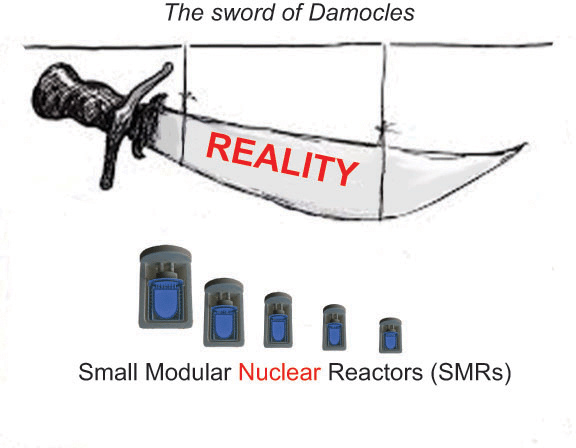 Costs of SMRs under construction https://wiseinternational.org/nuclear-monitor/872-873/smr-cost-estimates-and-costs-smrs-under-construction?fbclid=IwAR1TQA0xJ4bYxnVxJ0Aulcxvp0miMhEP4Vt8YqvLQKrhI3lTDhnrzZxQCE8Estimated construction costs for Russia’s floating nuclear power plant (with two 35-MW ice-breaker-type reactors) have increased more than four-fold and now equate to over US$10 billion / gigawatt (GW) (US$740 million / 70 MW).1 A 2016 OECD Nuclear Energy Agency report said that electricity produced by the plant is expected to cost about US$200/MWh, with the high cost due to large staffing requirements, high fuel costs, and resources required to maintain the barge and coastal infrastructure.2
Little credible information is available on the cost of China’s demonstration 2×250 MW high-temperature gas-cooled reactor (HTGR). If the demonstration reactor is completed and successfully operated, China reportedly plans to upscale the design to 655 MW (three modules feeding one turbine, total 655 MW) and to build these reactors in pairs with a total capacity of about 1,200 MW (so much for the small-is-beautiful SMR rhetoric). According to the World Nuclear Association, China’s Institute of Nuclear and New Energy Technology at Tsinghua University expects the cost of a 655 MWe HTGR to be 15-20% more than the cost of a conventional 600 MWe PWR.3
A 2016 report said that the estimated construction cost of China’s demonstration HTGR is about US$5,000/kW ‒ about twice the initial cost estimates.4 Cost increases have arisen from higher material and component costs, increases in labor costs, and increased costs associated with project delays.4 The World Nuclear Association states that the cost of the demonstration HTGR is US$6,000/kW.5
The CAREM (Central Argentina de Elementos Modulares) SMR under construction in Argentina illustrates the gap between SMR rhetoric and reality. Argentina’s Undersecretary of Nuclear Energy, Julián Gadano, said in 2016 that the world market for SMRs is in the tens of billions of dollars and that Argentina could capture 20% of the market with its CAREM technology.6 But cost estimates have ballooned: Continue reading
Residents around TMI exposed to far more radiation than officials claimed — Beyond Nuclear International

Research was gagged and radiation monitors weren’t functioning
Too cheap to meter now needs a bailout? — Beyond Nuclear International

Time for Three Mile Island nuclear plant to close
via Too cheap to meter now needs a bailout? — Beyond Nuclear International
March 24 Energy News — geoharvey

Opinion: ¶ “Propaganda, Politics, And The Environment” • Democratic systems can fail when those in the position of making and maintaining laws, the politicians, put their personal ends before the society that the system was originally built to benefit. They use propaganda to achieve their ends. Democracy in America is failing because of it. [CleanTechnica] […]
Despite recently renewed licences, Texas nuclear power stations look like closing before long
 Nuclear power woes extend to Texas, Houston Chronicle, James Osborne March 24, 2019 WASHINGTON – By the standards of the U.S. nuclear energy industry, Texas’s two nuclear plants are fairly new. Neither one is more than three decades old, while many nuclear sites across the country are nearing the five-decade mark.
But as the economics of nuclear power in this country continue to slide, even the futures of the South Texas Project, near Bay City, and Comanche Peak, located 60 miles southwest of Dallas, are far from certain.
When Manan Ahuja, senior director of North American power at the research arm of credit rating agency Standard & Poor’s, recently updated his firm’s list of nuclear plants at risk of closing, he listed both Texas plants at “moderate” risk of closing as early as 2030 – despite the fact that NRG Energy recently renewed its operating license for the South Texas Project for another 20 years………
The situation in Texas mirrors states across the country are grappling with, as nuclear power plants face increased pressure to reduce costs to compete with a surge of cheap natural gas and increasingly efficient wind turbines and solar plants. …….
According to S&P, over the next six years more than 10 percent of the nuclear power plants operating in this country have either announced they are closing or are at “high risk” of doing so – with another 15 percent at “moderate risk” of closure by 2033…….. https://www.houstonchronicle.com/business/article/Nuclear-power-woes-extend-to-Texas-13709604.php
Nuclear convoy in Brazil attacked by armed men
They said the truck carrying the nuclear fuel and its police escort came under attack when it was passing by the town of Frade, about 30 km (19 miles) from Angra dos Reis, where the reactor is located.
Policemen guarding the convoy returned the attackers’ fire, police said. They said there were no injuries or arrests and the armed men fled……..
police escorting the truck fanned out alongside the road as a precautionary measure after hearing nearby gunshots. The armed men then started firing on some of the heavily armed “shock battalion” accompanying the shipment, Eletronuclear said.
The nuclear fuel used in the two reactors in Brazil, Angra 1 and Angra 2, is produced in a government installation in Resende, a city in the interior of Rio de Janeiro state located 130 km (80.78 miles) from Angra dos Reis……. https://taskandpurpose.com/a-convoy-carrying-uranium-to-a-brazilian-nuclear-plant-was-attacked-by-armed-men
French Nuclear test victim ordered to repay compensation
Nuclear test victim ordered to repay compensation, https://www.radionz.co.nz/international/pacific-news/385484/nuclear-test-victim-ordered-to-repay-compensation A victim of the French nuclear tests in the South Pacific has been ordered to repay more than $US60,000 paid out in compensation to her.Florence Bourel is a former secretary of the Atomic Energy Commission, who was sent to the weapons test site at Moruroa over a 12-year period.
 She developed thyroid cancer which in 2002 was recognised as a work-related condition.
The test veterans organisation in France reports that in 2008, a court ordered for her to be compensated but the health insurance successfully appealed the decision.
A reassessment placed her condition below the disability level eligible for compensation, which she says implies that nothing had ever happened to her.
She says out of her pension she has to repay $60,000 and there is no recourse.
She also says her daughters have also been affected and one of her grand-daughters had an operation for a radiation-induced disease.
Pro nuclear governor and lawmakers to bail out Ohio nuclear plants?
 Bailout chances may be good for FirstEnergy Solutions’ Ohio nuclear plants, Crains Cleveland Business
1 This Month

of the week – Shut Down Drone Warfare!


Tell the Ukrainian Government to Drop Prosecution of Peace Activist Yurii Sheliazhenko

Petition to revoke the licensing of the Near Surface Nuclear Disposal Facility (NSDF) at Chalk River. https://www.ourcommons.ca/petitions/en/Petition/Details?Petition=e-7247
To see nuclear-related stories in greater depth and intensity – go to https://nuclearinformation.wordpress.com
-
Archives
- March 2026 (244)
- February 2026 (268)
- January 2026 (308)
- December 2025 (358)
- November 2025 (359)
- October 2025 (376)
- September 2025 (257)
- August 2025 (319)
- July 2025 (230)
- June 2025 (348)
- May 2025 (261)
- April 2025 (305)
-
Categories
- 1
- 1 NUCLEAR ISSUES
- business and costs
- climate change
- culture and arts
- ENERGY
- environment
- health
- history
- indigenous issues
- Legal
- marketing of nuclear
- media
- opposition to nuclear
- PERSONAL STORIES
- politics
- politics international
- Religion and ethics
- safety
- secrets,lies and civil liberties
- spinbuster
- technology
- Uranium
- wastes
- weapons and war
- Women
- 2 WORLD
- ACTION
- AFRICA
- Atrocities
- AUSTRALIA
- Christina's notes
- Christina's themes
- culture and arts
- Events
- Fuk 2022
- Fuk 2023
- Fukushima 2017
- Fukushima 2018
- fukushima 2019
- Fukushima 2020
- Fukushima 2021
- general
- global warming
- Humour (God we need it)
- Nuclear
- RARE EARTHS
- Reference
- resources – print
- Resources -audiovicual
- Weekly Newsletter
- World
- World Nuclear
- YouTube
-
RSS
Entries RSS
Comments RSS
 nuclear-news