Is it REALLY a good idea for American tax-payers to prop up the failing nuclear power industry?
 Does the United States Need a Civilian Nuclear Industry? The National Interest,
 Instead of a greater financial cushion, what the nuclear industry needs is more transparent exposure to market signals.
Advocates and industry lobbyists are proposing a new structure of subsidies to prop up the industry. Instead of a greater financial cushion, however, what the nuclear industry needs is more transparent exposure to market signals. …..
improved battery storage and transmission technology could make the entire idea of baseload energy obsolete. Government subsidies, whether to renewables, natural gas, or nuclear, only cloud the issue. It should be up to investors, with access to diverse and comprehensive market information, to bet for (or against) nuclear energy.
Another argument for subsidizing the civil nuclear industry relies on its importance for national defense. Here, the United States walks a fine line: on one hand, the United States has a commitment to uphold the nonproliferation regime. On the other hand, the United States seeks to maintain and even modernize its nuclear arsenal to provide deterrence. In August 2017, former energy secretary Ernest Moniz coauthored the Energy Futures Initiative, a report arguing for greater government support for “robust nuclear energy enterprise” that serves both nonproliferation and nuclear deterrence goals. A particular concern was ensuring the supply of tritium , a hydrogen isotope important for powering nuclear weapons. Government reactors produced tritium until 1988, when they were closed because of cost.
On closer inspection, however, these concerns about the health of the nuclear elements of national security are overblown. The Government Accountability Office finds that tritium reserves are sufficient through the 2030s, and there are other ways to acquire tritium by enriching uranium.
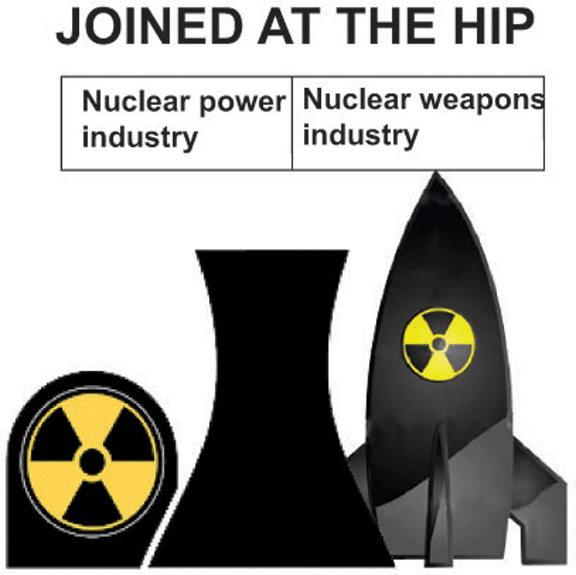 The civilian industry makes the case for electric rate subsidies and exemption of onerous licensing and export controls because of their importance for nuclear weapons and nuclear powered submarines. However, it seems just as likely that the civil nuclear industry is as dependent on the defense industry for talent and investment. The training for civil and military nuclear technology requires the same basic physics, but beyond that, the education diverges. Naval reactors are not the same as civilian ones, and the navy operates approximately 160 nuclear reactors compared to ninety-eight in the civilian sector.
Civilian universities foster research on nuclear science and technology, but the defense establishment may be more interested in state-of-the-art work on artificial intelligence or autonomous technology than nuclear energy. Many of the advances in defense nuclear operations come not from basic nuclear science, but from improved safety and storage technology or warhead design.
No comments yet.
1 This Month

of the week – Shut Down Drone Warfare!


Tell the Ukrainian Government to Drop Prosecution of Peace Activist Yurii Sheliazhenko

Petition to revoke the licensing of the Near Surface Nuclear Disposal Facility (NSDF) at Chalk River. https://www.ourcommons.ca/petitions/en/Petition/Details?Petition=e-7247
To see nuclear-related stories in greater depth and intensity – go to https://nuclearinformation.wordpress.com
-
Archives
- March 2026 (244)
- February 2026 (268)
- January 2026 (308)
- December 2025 (358)
- November 2025 (359)
- October 2025 (376)
- September 2025 (257)
- August 2025 (319)
- July 2025 (230)
- June 2025 (348)
- May 2025 (261)
- April 2025 (305)
-
Categories
- 1
- 1 NUCLEAR ISSUES
- business and costs
- climate change
- culture and arts
- ENERGY
- environment
- health
- history
- indigenous issues
- Legal
- marketing of nuclear
- media
- opposition to nuclear
- PERSONAL STORIES
- politics
- politics international
- Religion and ethics
- safety
- secrets,lies and civil liberties
- spinbuster
- technology
- Uranium
- wastes
- weapons and war
- Women
- 2 WORLD
- ACTION
- AFRICA
- Atrocities
- AUSTRALIA
- Christina's notes
- Christina's themes
- culture and arts
- Events
- Fuk 2022
- Fuk 2023
- Fukushima 2017
- Fukushima 2018
- fukushima 2019
- Fukushima 2020
- Fukushima 2021
- general
- global warming
- Humour (God we need it)
- Nuclear
- RARE EARTHS
- Reference
- resources – print
- Resources -audiovicual
- Weekly Newsletter
- World
- World Nuclear
- YouTube
-
RSS
Entries RSS
Comments RSS
 nuclear-news
Leave a comment