US Congressman Swalwell: Trump Lost Focus On Nuclear Deal Because His Former Fixer Testifying? Now That’s A Guilty Conscience…; Cohen Hearing Originally Feb 7th But Cancelled Due To Threats — Mining Awareness +

Originally, Michael Cohen was supposed to testify on February 7th. This was postponed due to reported threats by Trump and Giuliani: “Michael Cohen won’t testify. Slowly but surely, Trump’s abuses of power keep mounting. https://www.washingtonpost.com/opinions/2019/01/23/michael-cohen-wont-testify-slowly-surely-trumps-abuses-power-keep-mounting/ “Major League Choke. Our Commander-in-Chief lost his focus on a nuclear deal b/c his fmr fixer was testifying? Now that’s […]
No way to get rid of spent nuclear fuel (but they still keep making it anyway!)
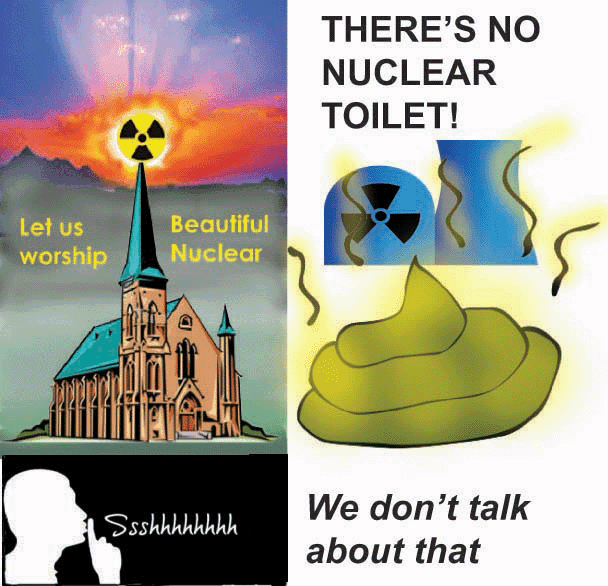
U.S. still has no place for spent nuclear fuel, so Maine Yankee’s owner gets millions
The award will help pay for the roughly $10 million per year to maintain the repository at the closed nuclear plant in Wiscasset. PressHerald, BY TUX TURKEL STAFF WRITER 3 Mar 19, For the fourth time since 1998, a federal judge has awarded the owners of three closed nuclear power plants, including Maine Yankee, millions of dollars for the federal government’s failure to remove spent nuclear fuel.
According to Connecticut Yankee Atomic Power Co., Yankee Atomic Electric Co., and Maine Yankee Atomic Power Co., the owners won a partial summary judgment last week totaling $103.2 million. Maine Yankee’s share is $34.4 million.
The award will help offset the roughly $10 million per year cost of operating an interim spent fuel storage site on plant property in Wiscasset. It will indirectly benefit ratepayers, who otherwise foot the bill. The actual financial impact hasn’t been determined, but is expected to be minimal.
In 2016, for instance, Maine Yankee was awarded about $24.6 million. Roughly $3.6 million of the total award was returned to utilities, including Central Maine Power. The balance, $21 million, went to operate the spent fuel storage site…….
Wayne Norton, president of the three companies urged Congress to authorize funding for a pilot program to remove and consolidate spent nuclear fuel and high-level waste from closed reactor sites, and to complete a review for a permanent repository at Yucca Mountain in Nevada.
Maine Yankee operated from 1972 to 1996. Although activists fought for years to close the plant, it was the company’s board that ultimately voted to pull the plug rather than fix expensive, safety-related problems.
Yankee, in Rowe, Massachusetts, closed in 1992. Connecticut Yankee shut down in 1996.
By law, the federal government is charged with coming up with a long-term solution for disposing of radioactive waste from nuclear reactors. It was supposed to begin removing waste in 1998. Facing ongoing public and political opposition, that process hasn’t happened.
Plans to build a permanent waste repository in the Nevada desert were scrapped in 2009 by President Obama. The Trump administration has sent mixed signals about whether it supports reviving Yucca Mountain.
 For the foreseeable future, highly radioactive fuel rods are being stored in 60 airtight steel canisters and housed in concrete casks in Wiscasset. Another four canisters hold radioactive steel from the decommissioning process. Maintaining them costs roughly $10 million a year, according to Maine Yankee.
The current award is for a period from 2013 to 2016, and the three companies are seeking an additional $1.2 million in costs. The federal government has 60 days to appeal the award.
Tux Turkel can be contacted at 791-6462 or at:
tturkel@pressherald.com https://www.pressherald.com/2019/02/25/judge-awards-34-million-to-offset-costs-of-storing-spent-fuel-rods-in-wiscasset/
Faslane nuclear submarine base had hundreds of health and safety incidents in 2018

 Daily Record 3rd March 2019 More than 500 “significant” health and safety incidents were recorded at the Faslane nuclear submarine base last year, the Sunday Mail can reveal. Documents released to the SNP under Freedom of Information for the Royal Navy facility near Helensburgh, in Dunbartonshire, show the figure has almost quadrupled since 2014.
Last year, there were 481 health and safety incidents at the high security base compared to 123 in 2015, 377 in 2016 and 501 in 2017. A statement confirmed that under Naval command, only those deemed as “significant” were now recorded on central systems.
https://www.dailyrecord.co.uk/news/politics/faslane-nuclear-fears-after-500-14079043
New defects, after a series of problems and delays, in France’s supposed “nuclear flagship” Flamanville
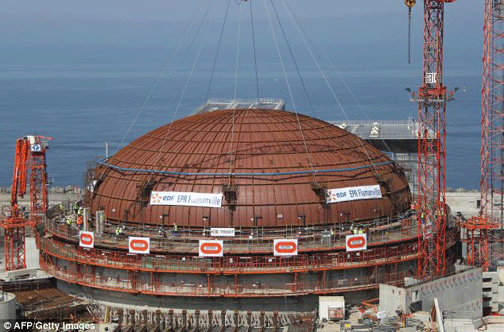 France Info 1st March 2019 Machine Translation] Cracks, failed welds … How the site of the EPR Flamanville has turned into a fiasco to nearly 11 billion euros.
The third generation nuclear reactor, which was to take office in 2012, will finally be operational only in 2020 after the discovery of new defects. Back on those days when the yard slipped. It was to be the flagship of the French nuclear industry, the EPR of Flamanville (Manche) is today its ball.
The construction site of the European Pressurized Reactor (EPR) experienced numerous delays, the last of which occurred on July 25, 2018, after the discovery of poorly made welds. Originally scheduled for 2012, its entry into service is (for the moment) postponed to 2020. And nothing says that the yard will be spared by new counter-time. The Nuclear Safety Authority (ASN) thus pinned EDF on Wednesday (February 27th) for a lack of “traceability” of certain equipment qualification operations on the EPR.
USA and South Korea cancel big war games – in a conciliatory gesture to North Korea
 US, S. Korea officially call off annual military exercises amid nuclear talks with N. Korea, By KIM GAMEL | STARS AND STRIPES March 2, 2019
SEOUL, South Korea — The United States and South Korea canceled key war games in favor of low-profile drills, the allies said Sunday, in a major concession to North Korea days after its nuclear summit with President Donald Trump collapsed without agreement.
The springtime exercises known as Key Resolve and Foal Eagle, along with their autumn counterpart Ulchi Freedom Guardian, have long been the lynchpin of the alliance between Seoul and Washington.
The drills, which include computer simulations and live-fire bombing runs, also have been a touchstone for tensions as the North considers them a rehearsal for an invasion.
The decision to cancel Key Resolve and Foal Eagle had been widely expected after Trump reiterated his own antipathy for the drills, which he has called “very expensive” and “provocative.”
Rebranding exercises
A rebranded “combined command post exercise” will be held from Monday to March 12, according to a separate statement issued Sunday by the top U.S. and South Korean commanders on the divided peninsula.
Commanders and other military officials insisted they can maintain a strong defensive posture with scaled-back training…… https://www.stripes.com/news/pacific/us-s-korea-officially-call-off-annual-military-exercises-amid-nuclear-talks-with-n-korea-1.571119
YouTube has become a leader in climate change denial
Can YouTube Solve Its Serious Climate Science Denial Problem? DESMOG, By Graham Readfearn • Sunday, February 24, 2019 “What are we in for next?” asks the narrator on the YouTube video.“Will the temperature resume an upward trend? Will it remain flat for a lengthy period? Or will it begin to drop? No one knows, not even the biggest, fastest computers.”
The video — with the clickbait title “What They Haven’t Told You about Climate Change” — has been watched more than 2.5 million times on the Google-owned video platform.
Produced by the conservative group PragerU, the video sees Canadian lobbyist and fossil fuels advocate Patrick Moore run through a long-debunked argument that because the world’s climate has changed before, there’s no problem with burning record amounts of fossil fuels.
Moore claims, for example, there has been “no significant warming trend” in the 21st century — not mentioning that nine of the 10 warmest years on record have occurred since 2005, or that the world’s oceans have been heating rapidly.
Despite the clear errors, the video has gathered more views than any other climate science denial clip on YouTube. All up, PragerU claims the video has been watched 4.4 million times across all platforms.
A search on YouTube for the most viewed “climate change” videos has Moore’s effort ranked 13th — searching for “global warming” has it ranked 19th.
But where the problems really start, are when YouTube’s “up next” algorithm takes a guess at what you might want to watch next after seeing Moore’s video.
Recommending Denial
When I viewed YouTube without signing in, almost all the videos suggested by the algorithm would sit firmly in the climate science denial folder. There’s so much of this material on YouTube that it’s not hard to find once the algorithm opens the door.
There’s a Nobel Laureate who apparently “Smashes the Global Warming Hoax” — just don’t mention the 76 other laureatesasking for “rapid progress towards lowering current and future greenhouse gas emissions.”
Then there are two other videos, both titled “The Truth About Global Warming,” and both delivering the opposite to what its title claims.
Before you know it, you’re in a world of “climate cults,” “global warming hysteria,” and claims of failed predictions and Al Gore getting “slammed.”
For an unsuspecting viewer, watching just one video can lead you quickly into an alternate universe where facts, physics, and real-world experiences are replaced by conspiracies, cherry-picking, and fossil fuel–backed propaganda.
All of this exists after YouTube declared in January 2019 that it had been working on its recommendations algorithm and making “hundreds of changes to improve the quality of recommendations for users on YouTube.”……… https://www.desmogblog.com/2019/02/24/youtube-video-serious-climate-science-denial-problem?utm_source=dsb%20newsletter
Trump’s son-in-law, Jared Kushner, helping Saudi Crown Prince towards getting nuclear weapons?
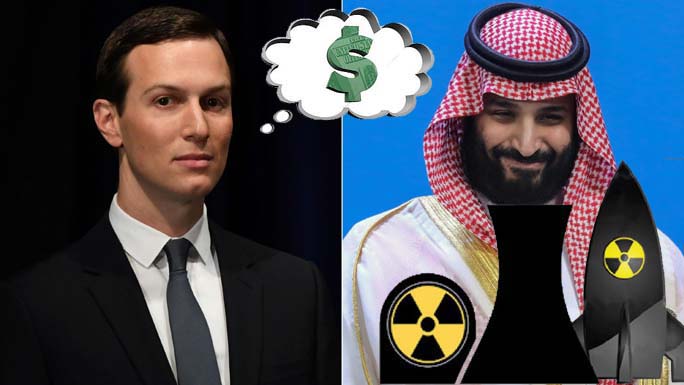
There are too many unanswered questions about the White House’s role in advancing Saudi ambitions. By Nicholas Kristof, March 2, 2019
Jared Kushner slipped quietly into Saudi Arabia this week for a meeting with Crown Prince Mohammed bin Salman, so the question I’m trying to get the White House to answer is this: Did they discuss American help for a Saudi nuclear program?
Of all the harebrained and unscrupulous dealings of the Trump administration in the last two years, one of the most shocking is a Trump plan to sell nuclear reactors to Saudi Arabia that could be used to make nuclear weapons.
Even as President Trump is trying to denuclearize North Korea and Iran, he may be helping to nuclearize Saudi Arabia. This is abominable policy tainted by a gargantuan conflict of interest involving Kushner.
Kushner’s family real estate business had been teetering because of a disastrously overpriced acquisition he made of a particular Manhattan property called 666 Fifth Avenue, but last August a company called Brookfield Asset Management rescued the Kushners by taking a 99-year lease of the troubled property — and paying the whole sum of about $1.1 billion up front.
Alarm bells should go off: Brookfield also owns Westinghouse Electric, the nuclear services business trying to sell reactors to Saudi Arabia.
Saudi swamp, meet American swamp.
It may be conflicts like these, along with even murkier ones, that led American intelligence officials to refuse a top-secret security clearance for Kushner. The Times reported Thursday that Trump overruled them to grant Kushner the clearance.
This nuclear reactor mess began around the time of Trump’s election, when a group of retired U.S. national security officials put together a plan to enrich themselves by selling nuclear power plants to Saudi Arabia. The officials included Michael Flynn, Trump’s national security adviser, and they initially developed a “plan for 40 nuclear power plants” in Saudi Arabia, according to a report from the House Oversight and Reform Committee. The plan is now to start with just a couple of plants.
As recently as Feb. 12, Trump met in the White House with backers of the project and was supportive, Reuters reported.
These are civilian nuclear power plants, and Saudi Arabia claims it wants them for electricity. But the Saudis insist on producing their own nuclear fuel, rather than buying it more cheaply abroad. Producing fuel is a standard way for rogue countries to divert fuel for secret nuclear weapons programs, and the Saudi resistance to safeguards against proliferation bolsters suspicions that the real goal is warheads.
Trump may be vigilant (destructively so) about Iran’s nuclear plants, but in the Saudi case his response seems to be: There’s money to be made! When Israeli Prime Minister Benjamin Netanyahu raised objections to the transfer last year, Axios reported, “Trump and his advisers told Netanyahu that, if the U.S. does not sell the Saudis nuclear reactors, other countries like Russia or France will.”
Trump seems to believe that the Saudis have us over a barrel: If we don’t help them with nuclear technology, someone else will. That misunderstands the U.S.-Saudi relationship. The Saudis depend on us for their security, and the blunt truth is that we hold all the cards in this relationship, not them.
Why on earth would America put Prince Mohammed on a path to acquiring nuclear weapons? He is already arguably the most destabilizing leader in an unstable region, for he has invaded Yemen, kidnapped Lebanon’s prime minister, started a feud with Qatar, and, according to American intelligence officials, ordered the murder of the Washington Post columnist Jamal Khashoggi.
The prince has also imprisoned and brutally tortured women’s rights activists, including one who I’m hoping will win the Nobel Peace Prize, Loujain al-Hathloul. As Representative Brad Sherman, a California Democrat, has noted, “A country that can’t be trusted with a bone saw shouldn’t be trusted with nuclear weapons.”
There’s another element of Trump’s Saudi policy that is simply repulsive: the fawning courtship of a foreign prince who has created in Yemen the world’s worst humanitarian crisis, murdered a journalist and tortured women’s rights activists. The White House genuflections are such that Prince Mohammed had a point when, according to The Intercept, he bragged that he had Kushner in his “pocket.”
No one knows whether Prince Muhammed will manage to succeed his father and become the next king, for there is opposition and the Saudi economic transformation he boasts of is running into difficulties. Trump and Kushner seem to be irresponsibly trying to boost the prince’s prospects, increasing the risk that an unstable hothead will mismanage the kingdom for the next 50 years. Perhaps with nuclear weapons.
The colonial mindset that caused eternal pain — Beyond Nuclear International

Pacific peoples still suffer due to March 1, 1954 US ‘Bravo’ atomic blast
via The colonial mindset that caused eternal pain — Beyond Nuclear International
Will the peace bell sound in the Koreas? — Beyond Nuclear International

Worrying nuclear flashpoints in Asia
via Will the peace bell sound in the Koreas? — Beyond Nuclear International
Rolls Royce largely getting out of the nuclear industry
Times 3rd March 2019 Rolls-Royce is selling the vast bulk of its civil nuclear business, dealing a new blow to efforts to rebuild Britain’s atomic power industry. The FTSE 100 engineer has hired consultants from KPMG to find a buyer for the
nuclear division, which could fetch up to £200m.
The move marks the end of an era for the country’s premier engineering company, which has more than 50 years’ expertise in nuclear power but is being slimmed down by chief executive Warren East to focus on jet engines, power generators and defence. The nuclear business makes instruments and controls to monitor radiation and temperature and prevent reactors overheating. Its equipment is installed in more than 200 reactors around the world, and it has a big presence in France, where it works with the state-backed engineering firm Orano , [formerly Areva, which went bankrupt]
Rolls-Royce’s retreat from civil nuclear work reflects the industry’s broader problems. Plans for new power stations in Britain have been left in tatters after the Japanese industrial giants Toshiba and Hitachi withdrew, leaving just Hinkley Point in Somerset under way.
The Japanese exit has triggered an inquiry by the Commons business committee into future investment in energy infrastructure. The sale will not include Rolls-Royce’s work on Hinkley Point, which is ringfenced, the company’s
project to develop small reactors or its nuclear submarine reactor business.
Rolls-Royce has been in talks to install its equipment at a plant in Essex planned by China General Nuclear, to help assuage security concerns. This work is likely to be transferred to the new owner. Sources said the business, which has more than 1,000 staff, was likely to go to a trade buyer. A Chinese deal is unlikely.
https://www.thetimes.co.uk/edition/business/rolls-royce-to-offload-civil-nuclear-unit-zsq59zlmm
US Senator Markey Statement on Abrupt End to Trump-Kim Hanoi Summit — Mining Awareness +
US “Senator Markey Statement on Abrupt End to Trump-Kim Hanoi Summit Thursday, February 28, 2019 Administration needs to brief Congress to explain next steps to ensure continued engagement Washington (February 28, 2019) – As the summit between President Donald Trump and North Korean leader Kim Jong Un in Hanoi came to an abrupt end, Senator […]
via US Senator Markey Statement on Abrupt End to Trump-Kim Hanoi Summit — Mining Awareness +
US Lawmakers Introduce Legislation to Block Saudi Arabia’s Nuclear Weapons Ambitions — Mining Awareness +

“As I’ve said before, a government that cannot be trusted with a bone saw, should not be trusted with a nuclear weapon,” said US Congressman Sherman. “This bill empowers Congress to block any nuclear cooperation agreement that allows Saudi Arabia to acquire the technologies necessary to build a nuclear bomb.” US “Senators Markey and Rubio, and […]
March 3 Energy News — geoharvey

Opinion: ¶ “Freak Weather ‘Will Make Life Harder For Business’” • First we had the Beast from the East, then the joint hottest summer on record, and now February winter temperatures have soared to all-time highs. The UK’s weather is getting more difficult to predict, and for UK businesses that is creating both opportunities and […]
Cold War-like arms race is likely to follow the collapse of a historic nuclear treaty
Key points:
- The landmark INF treaty was integral to ending the Cold War
- Short and intermediate range missiles were banned because of the short flight time
- Analyst say it’s unlikely to be renegotiated within the six-month notice period
Last week, Russian President Vladimir Putin said Russia was ready for a Cuban Missile-style crisis if the US wanted one, referring to the 1962 standoff that brought the world to the edge of nuclear war.
Decades later, tensions between the two nations are heating up again.
Mr Putin warned that Moscow would retaliate if the US placed new missiles closer to Russia, telling local media that Moscow could deploy hypersonic missiles on ships and submarines outside US territorial waters.
The comments were made after the Trump administration announced it would officially abandon a historic nuclear pact that had kept nuclear missiles out of Europe for three decades.
Here’s a look at what the treaty is, what may come next, and why analysts believe its demise could lead to a 21st-century arms race.
The Intermediate-Range Nuclear Forces Treaty (INF) bans the US and the Russian Federation, previously the Soviet Union, from developing, testing and possessing short- and intermediate-range missiles that could be launched from the ground, as opposed to the sea or sky.
The treaty — signed by former US president Ronald Reagan and Soviet leader Mikhail Gorbachev in December 1987 — declared that “nuclear war cannot be won and must never be fought” and took seven years to negotiate.
Both sides agreed to destroy a total of 2,692 short-, medium- and intermediate-range missiles with a range between 500 and 5,500 kilometres that were stationed in, or aimed at Europe.
The treaty is credited with helping to ending the Cold War.
Maria Rublee, a former US intelligence officer and nuclear politics expert at Monash University, told the ABC these missiles were seen as a “hair trigger for nuclear war” due to how quickly they could strike a target.
“You don’t have time to talk, to pick up the phone, the red hotline, to say what’s going on and ask if this is a mistake.”
Washington and its North Atlantic Treaty Organisation (NATO) allies claim Moscow has been violating the terms of the treaty by developing missiles within the range for years, but Russia has repeatedly denied the allegations.
Earlier this month the Trump administration declared it would suspend US obligations under the treaty, with the intention of withdrawing because of Russia’s alleged non-compliance.
The day after the announcement, Russia also said it would withdraw from the treaty, and accused the US of fabricating the allegations so it could develop new missiles.
The treaty is not dead just yet — both parties must give six months notice before they can officially withdraw — but Dr Rublee said the chances of the treaty being revived were low, although there was some hope.
“[The first step] is not going to come from the Trump administration and it’s not going to come from Russia,” she said.
“It would need to come from NATO because the countries most at risk are European countries.”…….. https://www.abc.net.au/news/2019-03-03/collapse-of-treaty-could-lead-to-new-arms-race/10845950
It was easy enough to build U.S army’s nuclear stations – but difficult to get rid of them
Kerr: Army planning to demolish Fort Belvoir’s nuclear plant Inside Nova, BY DAVID KERR 3 Mar 19″……
 nuclear core was removed. …..
1 This Month
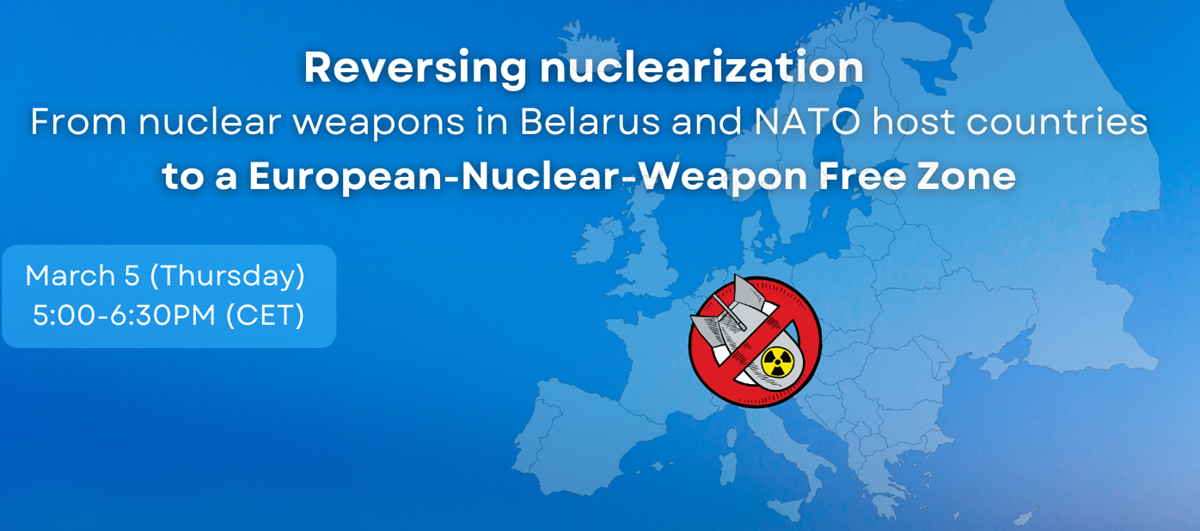
5 March -Online – Reversing nuclearization:
From nuclear weapons in Belarus and NATO host countries to a European-Nuclear-Weapon Free Zone
11am-12:30pm Eastern Time USA / 5pm-6:30pm CET

of the week – Advocating for a
nuclear free beach – https://www.samuellawrencefoundation.org/
The Samuel Lawrence Foundation advocates for a Nuclear Waste Free Beach at San Onofre, join us and take action!

10 March A LIVE WEBINAR THE REAL EFFECTS OF NUCLEAR POWER
What the Industry Isn’t Telling Us
1:00 PM Mountain, 2 pm Central, 3 pm Eastern. Live on the Keepers of the Water Facebook page

18 March Webinar @ 1 PM EST: An Assessment of SMR Projects: The Case of Canada
register for the zoom:
https://us02web.zoom.us/webinar/register/WN_o8BIIOUvQ2ONJR1nta65DQ#/registration

of the week – STOP SMALL MODULAR REACTORS IN CANADA
To see nuclear-related stories in greater depth and intensity – go to https://nuclearinformation.wordpress.com
-
Archives
- March 2026 (51)
- February 2026 (268)
- January 2026 (308)
- December 2025 (358)
- November 2025 (359)
- October 2025 (376)
- September 2025 (258)
- August 2025 (319)
- July 2025 (230)
- June 2025 (348)
- May 2025 (261)
- April 2025 (305)
-
Categories
- 1
- 1 NUCLEAR ISSUES
- business and costs
- climate change
- culture and arts
- ENERGY
- environment
- health
- history
- indigenous issues
- Legal
- marketing of nuclear
- media
- opposition to nuclear
- PERSONAL STORIES
- politics
- politics international
- Religion and ethics
- safety
- secrets,lies and civil liberties
- spinbuster
- technology
- Uranium
- wastes
- weapons and war
- Women
- 2 WORLD
- ACTION
- AFRICA
- Atrocities
- AUSTRALIA
- Christina's notes
- Christina's themes
- culture and arts
- Events
- Fuk 2022
- Fuk 2023
- Fukushima 2017
- Fukushima 2018
- fukushima 2019
- Fukushima 2020
- Fukushima 2021
- general
- global warming
- Humour (God we need it)
- Nuclear
- RARE EARTHS
- Reference
- resources – print
- Resources -audiovicual
- Weekly Newsletter
- World
- World Nuclear
- YouTube
-
RSS
Entries RSS
Comments RSS
 nuclear-news