|
‘Reset’ on nation’s nuclear waste policy includes Yucca Mountain By Gary Martin / Las Vegas Review-Journal
February 27, 2019 WASHINGTON — A panel of scientists are urging a “reset” of the nation’s stalled nuclear waste management system and recommendations to manage and store the material that include using Yucca Mountain as a potential repository.
The proposals were included in a 126-page report, “Reset of America’s Nuclear Waste Management,” that addresses the buildup of highly radioactive waste from commercial power plants and military programs stranded at 75 sites around the country.
Scientists involved with the report were on Capitol Hill on Wednesday to discuss a way forward, or a reset of current management and policy to address the lack of safe storage for the waste.
The report, released in January, includes development of a consensus-based siting process, but one that would still include Yucca Mountain as a candidate.
The inclusion of the site located 90 miles northwest of Las Vegas would continue the travesty of the 1987 decision by Congress that singled out “Yucca Mountain as the only site to be considered for development of a national nuclear waste repository,” said Steve Frishman, a technical consultant to the state of Nevada.
He noted that state, local and tribal leaders, as well as business groups and environmentalists in Nevada, are staunchly opposed to permanent waste storage in Nevada, and claim that the site is unsafe despite Department of Energy studies and recommendations.
Opposition to Yucca Mountain has led to an impasse on storing nuclear waste.
“The site for the proposed Yucca Mountain repository was formally selected in 2002,” the reported noted. “Today, the fate of that site is in political limbo.”
The report further noted that there is “no clear path forward” to manage nuclear waste produced by commercial power plants.
The report compiled by scientists at Stanford University and George Washington University recommends taking the management of nuclear waste storage away from the DOE and creating either a new single-purpose nuclear waste management organization, or a non-profit corporation owned by the nuclear utility industry to handle the waste.
Many of the topics covered in the reset report were also covered, with differing emphasis, by the Blue Ribbon Commission on America’s Nuclear Future in 2012, Frishman said. The commission did not consider Yucca Mountain as a potential repository.
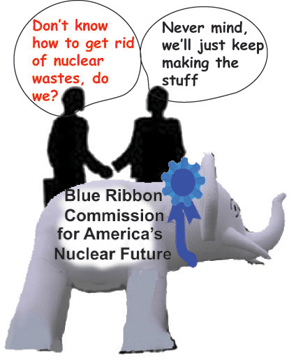
The report comes as Sen. Lamar Alexander, R-Tenn., plans a push in the Senate to resolve the three-decade impasse that has left nuclear waste piled up at generating plants across the country……..
Former Sen. Harry Reid, D-Nev., told the Review-Journal in an interview this month that Yucca Mountain would never be developed because of the astronomical cost to complete the facility. He suggested utility companies place the waste in dry casks and bury them on site. …..
President Donald Trump has proposed restarting the licensing process in his past two budget proposals to Congress. The House also passed a law to streamline the procedure, but all attempts died in the Senate, which stripped out funding in spending bills and never took up the House bill.
If the licensing process restarts, Nevada has filed 218 “contentions,” or objections that would have to be settled before a construction permit is issued.
Experts testified before the House in 2016 that that process could take three to five years.
Meanwhile, two private groups have filed applications with the Nuclear Regulatory Commission for permits to build interim storage facilities in New Mexico and Texas.
Alexander said he favors developing interim storage sites while a strategy on permanent storage can be settled. He told his subcommittee last year that he views Yucca Mountain as part of the solution. https://www.reviewjournal.com/local/local-nevada/reset-on-nations-nuclear-waste-policy-includes-yucca-mountain-1606813/
Contact Gary Martin at gmartin@reviewjournal.com or 202-662-7390. Follow @garymartindc on Twitter.

|
|
March 2, 2019
Posted by Christina Macpherson |
politics, USA, wastes |
Leave a comment

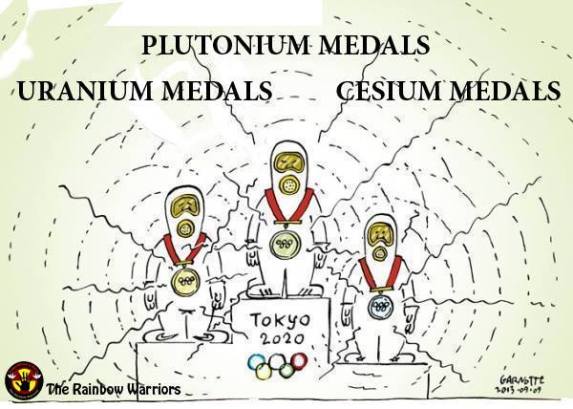
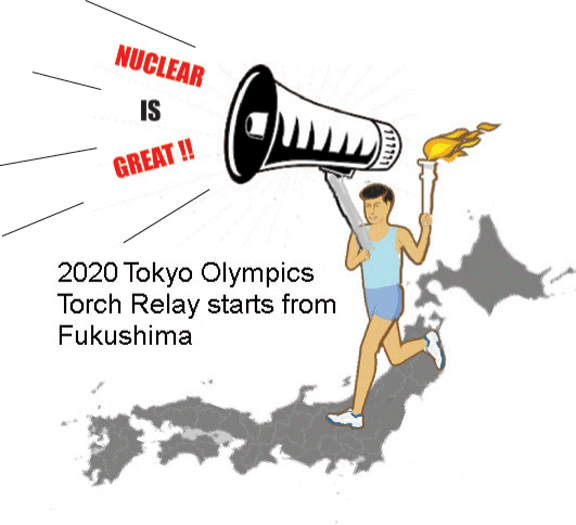
March 01, 2019, Fairewinds Energy Education, By Arnie Gundersen “……….To determine whether or not Olympic athletes might be affected by fallout emanating from the disaster site, Dr. Marco Kaltofen and I were sponsored by Fairewinds Energy Education to look at Olympic venues during the fall of 2017.We took simple dirt and dust samples along the Olympic torch route as well as inside Fukushima’s Olympic stadium and as far away as Tokyo. When the Olympic torch route and Olympic stadium samples were tested, we found samples of dirt in Fukushima’s Olympic Baseball Stadium that were highly radioactive, registering 6,000 Bq/kg of Cesium, which is 3,000 times more radioactive than dirt in the US. We also found that simple parking lot radiation levels were 50-times higher there than here in the US.
Thirty of the dirt and fine dust samples that I took on my last two trips to Japan in February and March 2016 and September 2017 were analyzed at WPI (Worchester Polytechnic Institute. The WPI laboratory analysis are detailed in the report entitled: Measuring Radioactivity in Soil and Dust Samples from Japan, T. Pham, S. Franca and S. Nguyen, Worchester Polytechnic Institute, which found that:
With the upcoming XXXII Olympiad in 2020 hosted by Japan, it is necessary to look into the radioactivity of Olympic venues as well as tourist attractions in the host cities… Since thousands of athletes and millions of visitors are travelling to Japan for the Olympics, there has been widespread concern from the international community about radiation exposure. Therefore, it is important to investigate the extent of radioactive fallout from the Fukushima Dai-ichi incident.
The measured results showed a much higher activity of Cesium-137 in the proposed torch route compared to other areas. Overall, the further away from the Fukushima Dai-ichi Nuclear Power Plant, the lower the radioactivity. The activity of Cesium-137 in Tokyo, the furthest site from the plant, was the lowest when compared to the other sites. Therefore, the activity of Cesium-137 in Tokyo sample was used as the baseline to qualitatively estimate the human exposure to radiation.
At the Azuma Sports Park, the soil and dust samples yielded a range of 78.1 Bq/kg to 6176.0 Bq/kg. This particular Olympic venue is around 90 km from the Nuclear Power Plant. The other sites that are closer to the Nuclear Power Plant like the tourist route, proposed torch route, and non-Olympic samples have higher amounts due to the close proximity to ground zero of the disaster.
… the proposed torch route samples had the highest mean radioactivity due to their close proximity to the plant. Based on the measurement, we estimated qualitatively that the radiation exposure of people living near the Azuma Sports Park area was 20.7 times higher than that of people living in Tokyo. The main tourist and proposed torch routes had radiation exposure of 24.6 and 60.6 times higher, respectively, than in Tokyo…. Olympic officials should consider using the results of this project to decide whether the radioactivity level at the proposed torch route and the Olympic venues are within acceptable level…… https://www.fairewinds.org/demystify/atomic-balm-part-1-prime-minister-abe-uses-the-tokyo-olympics-as-snake-oil-cure-for-the-fukushima-daiichi-nuclear-meltdowns
March 2, 2019
Posted by Christina Macpherson |
environment, Japan, radiation |
Leave a comment
Nuclear waste meeting in Swansea is cancelled and replaced with an online event Wales Online, By Robert DallingSenior Reporter 1 MAR 2019
It was one of a series of meetings taking place across the country to discuss where to bury the country’s most dangerous radioactive waste.
The organisation that had planned a meeting in Swansea about where to store nuclear waste has cancelled it, and said it’s staging an online event instead.
Government-run Radioactive Waste Management was behind the meetings in Swansea and Llandudno to discuss where to create a geological disposal facility for burying the UK’s stockpile of the most dangerous radioactive waste.
No details of any potential sites were made public and it was understood that the body was seeking “a willing host community” where radioactive waste could be stored hundreds of metres underground.
The Swansea meeting was planned for Tuesday, March 1
A statement from the firm read: “Radioactive Waste Management (RWM) respects the views expressed by Swansea Council in their proposed motion (for consideration on 28 February) about hosting a Geological Disposal Facility (GDF) in their area.
“RWM also reaffirms that none of its regional events, including the one for Swansea , is linked in any way to where a GDF might be sited and no site anywhere in England or Wales has been targeted, proposed or chosen. A GDF can only be sited in Wales if a community is willing to host it…….
It is expected that the process of selecting an underground site and going through the planning and construction process will take decades with any chosen site first receiving waste in the 2040s.
The Government said communities interested in hosting a GDF could receive up to £1m a year initially and up to £2.5m a year if deep borehole investigations took place.
Swansea Lib Dem councillor Peter Black criticised the move to cancel the physical meeting.
He said: “I think we should have met them face to face so as to get some clarity as to what exactly they were proposing.
“A webinar means that many people who might want to contribute to this debate, who are not on the internet, will now be excluded.”
Leader of Swansea Council, Rob Stewart said: “I’m pleased that RWM has listened to the very strong representations that we have made and cancelled this meeting in Swansea.
“We note that they have replaced it with an online event so I will make it clear that we will not let up on in our fight until the Swansea Bay area is ruled-out as a potential location for a dump for radioactive waste.
“The reaction of most councillors, our local residents and businesses is clear – nuclear waste is not and never will be welcome here and we will not allow it.” https://www.walesonline.co.uk/news/wales-news/nuclear-waste-meeting-swansea-cancelled-15901315
March 2, 2019
Posted by Christina Macpherson |
politics, UK, wastes |
Leave a comment
 ABC News 28 Feb 19 Pakistan’s Prime Minister Imran Khan will stage an emergency parliamentary session and meet with the body in control of Islamabad’s nuclear arsenal in response to India’s first air strikes on Pakistan since 1971.
Key points:
- Indian fighter jets struck an area 50 kilometres into Pakistan on Tuesday
- India said the strike was in response to a terrorist attack that killed 44 Indian police
- Pakistan said its own warplanes had scattered Indian jets, forcing them to drop their payload over uninhabited areas
The two nuclear-armed neighbours have fought three wars since partition in 1947, and the majority of them have been over Kashmir — a territory both India and Pakistan claim in full…….https://www.abc.net.au/news/2019-02-27/imran-khan-stages-meetings-response-to-indian-air-strikes/10853290
March 2, 2019
Posted by Christina Macpherson |
Pakistan, politics |
Leave a comment

According to the New York Times: “Trump Ordered Officials to Give Jared Kushner a Security Clearance – The president overruled concerns from intelligence officials and the top White House lawyer about giving his son-in-law access to sensitive information… The full scope of intelligence officials’ concerns about Mr. Kushner is not known. But the clearance had been held […]
via Trump Ordered Officials To Give Kushner Security Clearance Despite FBI-CIA Concerns Re Kushner’s Foreign & Business Contacts With Israel, Russia; UAE; & Others — Mining Awareness +
March 2, 2019
Posted by Christina Macpherson |
Uncategorized |
Leave a comment

Radiation Free Lakeland have sent a letter to the Environment Agency and the Nuclear Installations Inspectorate urging them not to reward failings at the Cyclife (EDF) radioactive scrap metal plant at Lillyhall. Cyclife have asked for an increase to dispose of liquid radioactive discharge to the drain at Lillyhall. This is due to a fault […]
via Radioactive Scrap Metal Plant at Workington wants to INCREASE Radioactive effluent —
March 2, 2019
Posted by Christina Macpherson |
Uncategorized |
Leave a comment
COULD THE CONFLICT BETWEEN PAKISTAN AND INDIA LEAD TO NUCLEAR WAR? Experts say it’s unlikely, but Pakistan’s lack of a “No First Use” doctrine for nuclear weapons means it’s not impossible. Pacific Standard, FEB 27, 2019
In 1999, Pakistan’s foreign minister explained why the country refused to adopt a No First Use policy, declaring that Islamabad would use “any weapon” in its arsenal to defend the country. Today, experts believe that, unlike India, Pakistan could plausibly deploy a nuclear weapon in response to a conventional attack. Pakistan maintains a smaller army and less weaponry than India, and would likely be overwhelmed if the Indian military invaded Pakistani territory with its full force. Facing loss of territory and national collapse, Islamabad could decide to launch a nuclear weapon against India in an attempt to even the playing field………
.To this day, Pakistan’s nuclear doctrine remains ambiguous, in what
many experts consider to be a deliberate choice. ……..
Does that mean the current conflict between Pakistan and India could escalate into a nuclear confrontation? Commentators regard that possibility as unlikely. Pakistan first began developing nuclear weapons in response to its humiliating loss of territory in 1971. Thus far, the current conflict with India does not appear to be a land grab, which suggests Pakistan does not have reason to engage its nuclear option………
https://psmag.com/news/could-the-conflict-between-pakistan-and-india-lead-to-nuclear-war
March 2, 2019
Posted by Christina Macpherson |
India, Pakistan, politics international, weapons and war |
Leave a comment
THE BIG PICTURE: Japan’s Nuclear Comeback [excellent graphic on original] https://www.powermag.com/the-big-picture-japans-nuclear-comeback/
03/01/2019 | Sonal Patel After the Great Tohoku Earthquake and tsunami, and ensuing crisis at the Fukushima Daiichi nuclear plant in March 2011, Japan issued stringent safety regulations and reviews that affected its entire 50-reactor fleet. It meant that as each Japanese nuclear reactor entered its scheduled maintenance and refueling outage, it could not returned to operation until restart was approved by both Japan’s Nuclear Regulation Authority (NRA) and the central government. Nuclear operators also need consent from governments of local prefectures.
Between September 2013—when Ohi 3 and 4 were shut down—and August 2015, when Sendai 1 and 2 restarted, Japan’s entire reactor fleet went black. In 2013, though there was no consensus on how long the approval process could take, some industry observers forecast reactors under NRA review could be back online within a year. As of December 2018, only nine reactors had restarted. Sixteen others were under review by the NRA, where average review duration stretched beyond 1,000 days, owing to staffing issues. Japan’s fleet of operable reactors, meanwhile, has dwindled to 38, owing to announced retirements.
According to Japan’s Institute of Energy Economics, safety investment costs for the current fleet were estimated at 4.4 trillion yen ($39 billion today) as of April 2018. “Given that detailed designs are still left undecided for severe accident management facilities at some plants, the estimated costs may increase further as safety examinations make progress.”
March 2, 2019
Posted by Christina Macpherson |
Japan, politics |
Leave a comment
https://www.deseretnews.com/article/900058129/letter-we-cannot-let-nuclear-waste-come-to-utah.html, By Leslie and Gail Ellison, Deseret News March 1, 2019 HB220 recently passed by our Legislature opens the door to allow Class B and Class C nuclear wastes to be stored at the EnergySolutions Clive Skull Valley repository. These wastes increase in toxicity over time. No matter one’s political persuasion, Independent, Republican, Libertarian or Democrat, this bill must be halted in its tracks.
This is a Utah state issue. Other states and the U.S. Department of Energy are salivating and jumping for joy about this scenario. They probably cannot believe that our state will actually welcome in these toxic wastes.I urge Gov. Gary Herbert to be courageous, put the politics aside and exercise his veto on this legislation. This should not be a political issue — these are extremely serious health and safety matters threatening our families, our children and our children’s children.
March 2, 2019
Posted by Christina Macpherson |
general |
Leave a comment
As we prepare for the eighth remembrance of the March 11, 2011 earthquake, tsunami and triple meltdowns at Fukushima Daiichi, Fairewinds is ever mindful of what is currently happening in Japan.
There has never been a roadmap for Japan to extricate itself from the radioactive multi-headed serpentine Hydra curse that has been created in an underfunded, unsuccessful attempt to clean-up the ongoing spread of migrating radioactivity from Fukushima. Rather than focus its attention on mitigating the radioactive exposure to Japan’s civilians, the government of Japan has sought instead to redirect world attention to the 2020 Olympics scheduled to take place in Tokyo.
Truthfully, a situation as overwhelming as Fukushima can exist in every location in the world that uses nuclear power to produce electricity. The triple meltdowns at Fukushima Daiichi are the worst industrial catastrophe that humankind has ever created.
Prior to Fukushima, the atomic power industry never envisioned a disaster of this magnitude anywhere in the world. Worldwide, the proponents and operators of nuclear power plants still are not taking adequate steps to protect against disasters of the magnitude of Fukushima!……….
……Are the Japanese government and the IAEA protecting the nuclear industry and not the people of Japan by claiming that Fukushima is stable when it is not? Fairewinds’ chief engineer Arnie Gundersen outlines major inconsistencies and double-speak by the IAEA, Japanese Government, and TEPCO claiming that the Fukushima accident is over. Dynamic versus static equilibrium, escalated dose exposures to the Japanese children and nuclear workers, and the blending of radioactive materials with non-contaminated material and spreading this contaminated ash throughout Japan are only a small part of this ongoing nuclear tragedy.
Later in 2013, Japan pressed the International Olympic Committee and bribed some of its members to accept the Olympics in 2020 according to an Associated Press article February 18, 2019 by Journalist Haruka Nuga.
Members of the JOC executive board are up for re-election this summer. There is speculation Takeda…[ Japanese Olympic Committee President Tsunekazu Takeda, who is being investigated for his part in an alleged bribery scandal] will not run, or could be replaced. French investigators believe he may have helped Tokyo win the 2020 Olympics in a vote by the International Olympic Committee.
Takeda has been JOC president since 2001. He is also a powerful IOC member and the head of its marketing commission. He has not stepped aside from either position while the IOC’s ethics committee investigates.
…French authorities suspect that about $2 million paid by the Tokyo bid committee — headed by Takeda — to a Singapore consulting company, Black Tidings, found its way to some IOC members in 2013 when Tokyo won the vote over bids from Istanbul and Madrid… Takeda last month acknowledged he signed off on the payments but denied corruption allegations. An internal report in 2016 by the Japanese Olympic Committee essentially cleared Takeda of wrongdoing.
Tokyo is spending at least $20 billion to organize the Olympics. Games costs are difficult to track, but the city of Tokyo appears to be picking up at least half the bill.
Much of Japan’s focus has been to show that the Fukushima area is safe and has recovered from a 2011 earthquake, tsunami, and the meltdowns at three nuclear reactors.
Here is what I said in a video on Fairewinds website in 2013, when the original Tokyo Olympic announcement was made.
I think hosting the Olympics in 2020 is an attempt by the Japanese to change the topic. I don’t think people around the world are going to care until 2020 approaches. There is a seven-year window for the Japanese government to work to make Tokyo a showcase for the entire world to view. I think the Japanese government wanted to host the Olympics to improve the morale of the people of Japan after the Fukushima Daiichi accident. Unfortunately, it’s taking people’s attention off of the true cost of the accident, in terms of both money and public health.
Placing the Olympics in Tokyo was and still is a ploy to minimize the consequences of the Fukushima Daiichi meltdowns and to take the public’s attention away from a pressing emergency that still needs resolution for the health and safety of the people of Japan.
Fairewinds Energy Education will keep you informed with Part 2, at fairewinds.org. https://www.fairewinds.org/demystify/atomic-balm-part-1-prime-minister-abe-uses-the-tokyo-olympics-as-snake-oil-cure-for-the-fukushima-daiichi-nuclear-meltdowns
March 2, 2019
Posted by Christina Macpherson |
Japan, spinbuster |
Leave a comment
The Saturday Paper, Jonathan Pearlman 2 Mar 19, Vietnam: In Hanoi this week, Donald Trump and Kim Jong-un met for a second summit to address North Korea’s nuclear program. Trump revels in the theatrics of these summits, apparently overlooking that he is lending stature to a despot who holds power through mass enslavement, torture, imprisonment and murder.
“[You are] a great leader,” Trump told Kim after their dinner on Wednesday at the Metropole Hotel. “I think you will have a tremendous future with your country.”
Before the formal talks began on Thursday, journalists covering the event were advised of the expected outcome: there would be an “agreement signing ceremony” at the Metropole at 3.50pm.
By Thursday afternoon, the ceremony had been cancelled as the realities of trying to resolve this decades-old conflict overcame Trump’s apparent belief that a deal would flow from a “wonderful dialogue”.
The success of a potential deal will depend on detail, and on Kim’s predilections, not Trump’s jubilant tweets. This became clear in Hanoi, as the talks faltered over Kim’s demands that international sanctions should be entirely lifted.
“It wasn’t a good thing to sign anything,” Trump said. “Sometimes you have to walk.”
The Trump–Kim encounters, reminiscent of the great Soviet–American summits, are designed to be spectacles, yet the Hanoi meeting was quickly overshadowed by events in Washington……..https://www.thesaturdaypaper.com.au/world/north-america/2019/03/02/making-nuclear-summits-great-again/15514452007564
March 2, 2019
Posted by Christina Macpherson |
politics international, USA |
Leave a comment
Over 100 nukes and counting.
India has 130 to 140 nuclear warheads—and more are coming, according to a new report. “India is estimated to have produced enough military plutonium for 150 to 200 nuclear warheads, but has likely produced only 130 to 140,” according to Hans Kristensen and Matt Korda of the Nuclear Information Project at the Federation of American Scientists. “Nonetheless, additional plutonium will be required to produce warheads for missiles now under development, and India is reportedly building several new plutonium production facilities.”
In addition, “India continues to modernize its nuclear arsenal, with at least five new weapon systems now under development to complement or replace existing nuclear-capable aircraft, land-based delivery systems, and sea-based systems.”…….
It’s an ambitious program. “The government appears to be planning to field a diverse missile force that will be expensive to maintain and operate,” the report points out.
March 2, 2019
Posted by Christina Macpherson |
India, weapons and war |
Leave a comment
All India | Press Trust of IndiaMarch 01, 2019 BEIJING: China Friday said it has never recognised India and Pakistan as nuclear powers and ruled out extending such a status to North Korea following the unsuccessful second summit between US President Donald Trump and North Korean leader Kim Jong-un in Vietnam.
“China has never recognised India and Pakistan as nuclear countries. Our position on this has never changed,” Chinese Foreign Ministry spokesman Lu Kang told a media briefing in Beijing.
He was replying to a question whether China would recognise North Korea as a nuclear state like India and Pakistan as talks between Trump and Kim at the second summit in Hanoi broke down over Pyongyang’s refusal to give up two nuclear processing plants.
China has been blocking India’s entry into the 48-member Nuclear Suppliers Group (NSG) on the ground that New Delhi has not signed the Nuclear Non-Proliferation Treaty (NPT).
After India applied for NSG membership, Pakistan too applied for the same following that China has called for a two-step approach which states that NSG members first need to arrive at a set of principles for the admission of non-NPT states into the NSG and then move forward discussions of specific cases.
March 2, 2019
Posted by Christina Macpherson |
China, India, Pakistan, politics international |
Leave a comment
Levin, Amash say Saudi Arabia must not be allowed to build a nuclear bomb https://www.freep.com/story/news/local/michigan/2019/03/01/saudi-arabia-nukes-andy-levin/3017833002/
“We cannot allow a civilian nuclear deal with Saudi Arabia to create a pathway to a nuclear bomb, period,” Levin said. “Recent events, including the horrific murder of Jamal Khashoggi, have made it all the more clear why we must insist on the highest possible nonproliferation standard.”
The House resolution mirrors one already introduced in the Senate by Sen. Jeff Merkley, D-Ore. Khashoggi, a Washington Post columnist, was murdered inside the Saudi consulate in Istanbul last year.
In February, the House Committee on Oversight and Reform released a report indicating that Trump administration officials had pushed for a plan to build nuclear power plants in Saudi Arabia despite concerns that doing so could violate federal law.
The committee report suggested some people involved in the effort were interested in financial gain.
The transfer of nuclear technology is typically approved through a closely regulated process and a nuclear cooperation agreement signed off on by Congress.
Levin, who is a member of the House Foreign Affairs Committee, said that if such a deal is developed, it must include rules that prohibit Saudi Arabia from enriching uranium or separating plutonium or any other activities that could result in weapons-grade material.
March 2, 2019
Posted by Christina Macpherson |
politics, USA |
Leave a comment
|
The Status Of Nuclear Weapons Around The World, NPR (transcript) , February 28, 2019, Heard on All Things Considered
NPR’s Ari Shapiro speaks with Joan Rohlfing, president and COO of the Nuclear Threat Initiative about the current status of nuclear weapons globally. ARI SHAPIRO, HOST:Were surrounded by reminders that North Korea is not the only nuclear threat. In Russia, Moscow says it’s developing a hypersonic missile that will someday be able to get past American defenses. India and Pakistan, both nuclear powers, claim to have shot down each other’s fighter jets. It’s their most serious confrontation in years. To assess how dangerous this moment is, we’re joined now by Joan Rohlfing. She worked on nonproliferation in the Clinton administration, and she’s now president of the Nuclear Threat Initiative……..
ROHLFING: So there are currently nine nuclear weapon states that have the capacity to use nuclear weapons today. There’s the so-called permanent five of the U.N. Security Council – U.S., Russia, China, France, U.K. And then in the category of newer, more recent nuclear weapon states, we have India, Pakistan, Israel, North Korea. ………
ROHLFING: So there are several brightest danger spots. I wish I could say there was only one danger spot. And as we’ve seen so much media focus on North Korea, I would say we’re missing the broader picture. And two danger spots are the U.S.-Russia relationship as well as India and Pakistan. ……….
ROHLFING: So the U.S. and Russia have significant arsenals on high alert, ready to go at a moment’s notice against a backdrop of a lot of friction and deteriorating relationship across a range of fronts – over Ukraine, over Crimea, over Syria. There are many ways in which you could imagine an accident or a miscalculation happening. There are dangerous military incidents that are happening with some regularity, planes coming in close contact with each other.
And for decades, we were engaged in ongoing negotiations to manage the nuclear threat. Five years ago, that effectively fell apart. And for the first time in 50 years, we have not been talking about how we manage this relationship and are potentially allowing the guardrails, the treaties that restrain nuclear weapons, to crater. So it’s a very troubling moment.
……… One of the complications is there are new technologies that make the nuclear threat more complex. So think about the emergence of cyberattacks, cyber vulnerabilities. The Defense Department in 2013 issued a report that essentially said – and I’m paraphrasing – there are no military systems that are immune from the threats of cyberattack and cyber vulnerabilities.
SHAPIRO: And so a hacker could conceivably make it look as though a nuclear attack was imminent or actually stage one.
ROHLFING: Indeed. Imagine if our command and control system were compromised so it looked like there was a significant incoming attack and it prompted us to react by retaliating with nuclear missiles or vice versa.SHAPIRO: So when you put the danger of this moment in the context of the last 50 years, how worried are you right now?
ROHLFING: I’m very worried. I would say this is the most dangerous period since the Cuban Missile Crisis, the current period. The risk is that high. And it’s interesting. As we see so much focus on North Korea, this is a much broader threat. It’s an urgent threat. And it’s the biggest existential threat that most people have never heard of. SHAPIRO: What needs to change to move things in a more positive direction?
ROHLFING: I would say number one, we’ve got to get back to the negotiating table in particular with Russia. Other states on a regional basis need to do this as well, notably India and Pakistan. We have to talk to each other to figure out how we manage to prevent nuclear crises……… https://www.npr.org/2019/02/28/699118990/the-status-of-nuclear-weapons-around-the-world
|
|
March 2, 2019
Posted by Christina Macpherson |
2 WORLD, weapons and war |
Leave a comment










 nuclear-news