nuclear-news

The News That Matters about the Nuclear Industry Fukushima Chernobyl Mayak Three Mile Island Atomic Testing Radiation Isotope

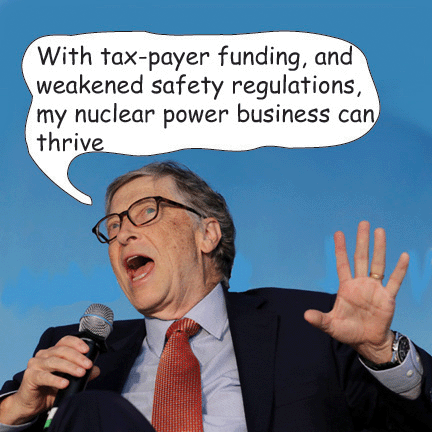
Bill Gates at Global Energy Forum just quietly did not mention his $7 billion involvement in unsatisfactory radioactive waste management company

Paul Waldon Fight To Stop Nuclear Waste Dump In Flinders Ranges SA, 22 Feb 19,  Stanford Energy, has touted Bill Gates as a entrepreneur while denouncing wind and solar calling it unreliable, at a recent Global Energy Form.

However the uncomfortable looking Bill Gates fails to mention his vested interest in the nuclear arena with 108,502,519 shares worth about $7 billion in the company “Republic Services” that manages radioactive waste, and has failed at satisfying the general public and residents of St Louis with the cleanup of Bill and other shareholders toxic waste. Placing money before the health of people in a estranged community can be easy when void of a conscience. https://www.facebook.com/groups/344452605899556/

February 23, 2019 Posted by | secrets,lies and civil liberties, USA | Leave a comment

the nuclear lobby’s dream of small modular nuclear reactors is not likely to come true

The quest for boundless energy http://science.sciencemag.org/content/363/6429/809, Adrian ChoSee all authors and affiliations

Science  22 Feb 2019:
Vol. 363, Issue 6429, pp. 809
DOI: 10.1126/science.363.6429.809  

Summary

For all their innovations, NuScale Power’s small modular reactors remain conventional in one way: They would use ordinary uranium-based reactor fuel that’s meant to be used once and safely disposed of. But for decades, nuclear engineers envisioned a world powered by “fast reactors” that can breed an essentially boundless supply of plutonium that can be reprocessed into fuel. Early in the atomic age, experts believed nuclear energy would one day supply most of the world’s power, raising the specter of a uranium shortage and boosting interest in fast breeder reactors.

However, the reactors are complex and must be cooled with substances such as liquid sodium or molten salt. The chemically intensive recycling process produces plenty of its own hazardous waste. And the closed fuel cycle also would establish a global market for plutonium, the stuff of atomic weapons, raising proliferation concerns. Perhaps most important, the world is in no danger of running out of uranium. So some experts doubt fast reactors will ever become mainstream.

February 23, 2019 Posted by | Small Modular Nuclear Reactors, USA | Leave a comment

Offshore wind could replace UK’s failed plans for new nuclear power

Orsted’s Hornsea Project Spawns Talk of Offshore Wind Replacing Nuclear, Greentech Media,  Danish developer Ørsted said its Hornsea One plant, which started delivering power to the grid this month, could help make up for a lack of planned nuclear generation in the U.K., as plans for new reactors have fallen by the wayside.When complete, Hornsea One will cover more than 157 square miles, making it bigger than the city of Denver, and have a peak capacity of 1.2 gigawatts, thanks to 174 turbines of at least 7 megawatts each.

It will be the biggest offshore wind plant on the planet, dwarfing the current leader, Walney Extension, which Ørsted opened last September with a capacity of 659 megawatts. Ørsted has plans for an even bigger project, the 1.8-gigawatt Hornsea Two plant, in U.K. waters………

Not just a U.K. debate

Given that the U.K. is relying on a largely untested reactor design for upcoming nuclear capacity, it is perhaps legitimate to ask if the reliability of new reactors will be significantly greater than those of gigawatt-scale offshore wind farms built at the same time.

Tom Dixon, wholesale team leader at U.K. consultancy Cornwall Insight, said: “New offshore wind farms being developed are now much more reliable than older offshore sites or their onshore counterparts.”

As a result, he said, “it is credible to say that the shortfall in new nuclear could be made up by offshore wind, with improving operational performance and relatively low costs for the technology, but additional flexibility would be required at times when output is low.”

It is not just the U.K. where offshore wind could potentially take over new nuclear’s mantle.

This month, in the wake of a partnership between Ørsted and Tokyo Electric Power Company, the analyst firm Wood Mackenzie Power & Renewables questioned whether offshore wind could also be a cure for rising energy demand as new nuclear languishes in Japan.

“Rising costs and a lack of public confidence in Tepco’s ability as a nuclear operator have led the company to reconsider its future strategy,” said WoodMac senior analyst Robert Liew. “Tepco’s involvement in offshore wind is a crucial development.” https://www.greentechmedia.com/articles/read/hornsea-spawns-talk-of-offshore-wind-replacing-nuclear#gs.v9EFOjv7

February 23, 2019 Posted by | renewable, UK | Leave a comment

US.-North Korea Summit Likely Focus On Nuclear Weapons Center

NPR,February 20, 20195 Heard on All Things Considered   GEOFF BRUMFIEL

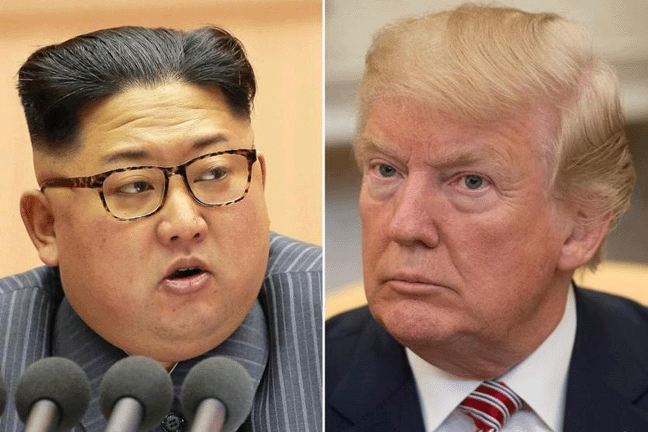
This month’s summit between President Trump and North Korean leader Kim Jong Un is likely to focus on North Korea’s main nuclear weapons center at Yongbyon.

ARI SHAPIRO, HOST:

When President Trump and North Korean leader Kim Jong Un discuss denuclearization in Hanoi, they are likely to focus on one North Korean nuclear facility in particular. NPR’s Geoff Brumfiel introduces us to it.

GEOFF BRUMFIEL, BYLINE: It’s called the Yongbyon Nuclear Research Center……. https://www.npr.org/2019/02/20/696413639/second-u-s-north-korea-summit-likely-focus-on-nuclear-weapons-center

February 23, 2019 Posted by | general | Leave a comment

Ending The U.S. Doctrine of Perpetual War

Mutually Agreed Peace: Ending The U.S. Doctrine of Perpetual War By Ethan Indigo Smith, Contributing Writer for Wake Up World, 22 Feb 19, “Just because you do not take an interest in politics doesn’t mean politics won’t take an interest in you.” ~ Pericles.

Everything is ultimately political these days, but everything is firstly biological. Yet, ignoring our biology and our humanity, the military-industrial complex, with all its toxic modalities, still claims to operate in our best interests.

The fact is, modern politics has become the imposition of institutional formality where individuals and truth once were. Increasingly favoring institutional privilege over individual rights, politicians on all sides of the game act to reinforce and advance the standing of corporations at the expense of our physical world. They embark on resource wars for profit, destroy our environment for energy, construe zealotry as patriotism, and steer a culture of social competition – not cooperation – all the while hiding behind veils of secrecy and meaningless rhetoric. …..

The Nuclear Energy and Armament Experiments

One of the largest tentacles of the military-industrial complex is the nuclear experimentation facet of their operations. These operations include both energy and armament — programs which are inextricably linked, as I will demonstrate – with negative impacts on all life on earth and, and when disaster strikes, capable of negating life altogether.

Maintaining a deafening silence over the ongoing Fukushima disaster, for example, the world’s political heads show zero regard for our biological wellbeing (much less our social wellbeing) in both the formulation and the execution of policy. Instead of shutting down the deadly reactors at Fukushima, the world’s powers simply shut down any information about the situation.

For example, the Japanese government passed a law through Parliament, called the “States Secret Act” following the 2011 Fukushima meltdown. Under this act, both officials and private citizens who leak “special state secrets” (ie. details of the disaster) face prison terms of up to 10 years, while journalists who publish classified information (ie. all relevant information) face up to five years.[1] Meanwhile, in 2011 the U.S. Environmental Protection Agency’s response to increases in detected radiation levels within the United States was to reduce the use of radiation monitoring while at the same time, raising the official allowable levels of radiation in food, water and soil. [2] Of course, this was not reported by mainstream media.

Nor was the 2014 partial shutdown of the Florida Power & Light’s Turkey Point facility in the Miami area, following a steam leak that resulted from the failure of the archaic facility’s cooling system.[3] While mainstream news completely blocked coverage of this potential meltdown situation, the facility remained in operation not because it managed to rectify the cooling problem, but because the corporation lobbied for special permission to violate allowable water temperature safety thresholds from the previous limit of 100’F limit up to 103’F. [4]

The simple reason for the secrecy and suppression of information is that the nuclear experimentation industry is just that — an experiment. Although it is touted as a ‘clean’ technology, the nuclear industry has no mechanism for disposing of the radioactive waste it generates, and no viable plan for such a mechanism in the future. All it has is a plan to contain the mounting radioactive waste it generates each day and store it for the million years it takes for radioactive waste to break down naturally.

o, whether nor not we accept or reject the philosophies of government, it is an inarguable fact that our biology, and that of our grandchildren’s grandchildren’s grandchildren — is at the complete mercy of those individuals who, hiding behind political formality, have their fingers “on the button”. And, for as long as their priorities are clearly shaped by the objectives of the corporate-military-industrial complex, there is very little mercy involved. Instead our collective future and the future of our planet is heavily influenced by corporate profitability and contrived political hemispheres which, with the support of corporate media, teeter between deliberately limited polarities, never really making progress or improvement or exploring possibilities — such as peaceful solutions, or sustainable energy investment — beyond those which may profit those already in power…….

The rise of the military industrial complex changed the whole dynamic of war and peace, and in the process, steered our society from exploring sustainable energy solutions toward the constant danger of nuclear meltdown. Nuclear power generation is inherently risky of itself; both the waste it stores and the pollution it releases pose a largely unseen but no less dangerous threat to our Earth Mother, and to our biology. But it also creates obvious military strike targets for enemy nations which, if detonated, can destroy entire nations in one sweep. Building nuclear power experiments is akin to building a self-destruct button into your nation’s infrastructure; one false move, be it intentional (military) or accidental (like Fukushima), and it destroys the landscape and all who dwell on and around it for an eternity, with no known remedy……..

“I foolishly once believed the myth that nuclear energy is clean and safe. That myth has completely broken down. Restarting nuclear reactors while we still have no place to dispose of nuclear waste is a criminal act toward future generations.” — Morihiro Hosokawa, 79th Prime Minister of Japan

The U.S. Doctrine of Perpetual War

One of the best ways to gain and maintain power is to keep the people in constant fear — in fear of wars, of outsiders, and more recently, of “terrorism”. Maintaining a culture of war-minded fear ensures the public consent to the constant funding of the military-industrial-complex, under the guise of security and protection.

If we look at the history of the Presidents of the United States since the end of the Second World War, we see that each administration invented a presidential Doctrine directly pertaining to war – either inviting involvement in or directly inciting conflict………

the most famously barbarous doctrine was the Bush Doctrine, in which President George W. Bush Jr. essentially declared that the United States was adopting a shoot-first-ask-questions-later policy pertaining to perceived terrorist activities, both in other countries and at home. [19] Advocating the illogical notion of “preventive war”, the Bush Doctrine is based on the faulty reasoning that attacking a potential threat before it attacks the United States is the only way to ensure peace and security, rather than — as history has proven — the most effective way to ensure more wars and security threats…..

The fact is, the United States has been at war for 225 years out of the last 242 years. That’s 93% of the time! Since the Declaration of Independence was written in 1776, the U.S. has actually been at peace (albeit planning for further wars) for a total of only 21 years. [20] Not one U.S. president actually qualifies as a solely peacetime president, and the only time the United States lasted five years without going to war was between 1935 and 1940 — during the period of the Great Depression.

Since U.S. involvement in World War II began in 1940, most of the world’s military operations have been initiated by the U.S., [6] and U.S. military spending today exceeds the rest of the world’s military spending combined. [21]  In addition, the U.S. also supplies in excess of $3 billion each year (over $10 million per day!) in military aid to Israel, funding the continued war in Palestine.[22] ………

Today, the U.S. economy is now so dependent on war, there is no incentive for the U.S. government to strive for peace — it simply isn’t profitable. The U.S. defense industry employs a staggering 3.5 million Americans, while the private companies supporting the military generate in excess of $300 billion in revenue per year. [24]

With the U.S. economy and military operations so intrinsically linked, the American people have over time come to accept its war culture as normal, believing the increasingly ludicrous propaganda that tells us the U.S. is subject to threats from far weaker military nations and that the U.S. is nobly “fighting for peace” — an oxymoron of the highest order. ……….

clearly, the lessons of history and failed Presidential policy have not been learned by those in power in recent years, who claim to have our interests at heart. Barack Obama, for example, despite his (false) doctrine of negotiation and collaboration (“change”) as a contrast to the confrontation and unilateralism of the Bush Jr. era, invested a trillion dollars of U.S. taxpayers’ money into the military industry to develop and build more nuclear weaponry [25] This, despite the fact that the U.S. is already the most heavily armed nuclear nation in the world — something current President Trump, who also campaigned on a platform of “change”, has done nothing to wind back.  ……

The institutions of the United States and Russia may have different perpetrators behind them, they may play different melodies and use different instruments, but in fact they sound very much the same. The collectivism of the oligarchy in the U.S.A. is flavored with corporate tones, whereas in Russia it is dominated by state tones. Different name, same game. In the U.S.A. the divine right of corporations rules and in Russia it’s the godhead of the state the leads the symphony. Either way though, it’s a war song of militant, nationalistic not individual concerns.

In our every deliberation, we must consider the impact of our decisions on the next seven generations.”  ~ Iroquois Maxim

The Indigo Doctrine: Mutually Agreed Peace

We, The People of the World, can supersede institutional war-mongering concerns that belittle individual life, liberty and pursuit of happiness. We have no other choice. If we do not act to mandate Mutually Agreed Peace, we are allowing politicians to shrug their shoulders and say, “it’s politics”, as Earth Mother is ravaged and its inhabitants are systematically annihilated by nuclear, war-driven madness.

………History has shown us that preparing for war doesn’t just lead to more war; it makes war an economic necessity. The only way to ensure peace in our world is to adopt a doctrine of Mutually Agreed Peace in theory and practice; to give peace a budget, give peace a mandate, and give peace all our energy, both politically and personally — and to remove from government, through the power of our will and our numbers, any individual who fails to act on it……. https://wakeup-world.com/2015/08/29/mutually-agreed-peace-ending-the-doctrine-of-perpetual-war/ 
February 23, 2019 Posted by | business and costs, politics international, USA, weapons and war | Leave a comment

With escalating tensions between India and Pakistan, could India consider a pre-emptive nuclear strike?

February 23, 2019 Posted by | India, politics international, South Korea, weapons and war | Leave a comment

If USA US deploys nuclear weapons in Europe RUSSIA and Belarus will consider a joint military response

‘Things will turn NASTY’ Belarus leader issues warning after collapse of nuclear treaty https://www.express.co.uk/news/world/1090969/belarus-news-inf-treaty-world-war-3-russia-v-usa-nato

RUSSIA and Belarus will consider a joint military response if the US deploys weapons in Europe after pulling out of the Intermediate-range Nuclear Forces (INF) Treaty.

By SIMON OSBORNE, Feb 22, 2019 Belarus President Alexander Lukashenko said he fears “things will turn nasty” should the US decision spark a new arms race at a time of increasing global tensions. The US and Soviet Union signed the INF treaty in 1987 in an historic move that effectively removed nuclear weapons from Europe and signalled the beginning of the end of the Cold War.

But Donald Trump has pulled the US out of the accord after accusing Russia of committing repeated violations and Mr Lukashenko fears the security of Belarus could be compromised as a result.

He said: “It is a catastrophe, particularly for us.

“I am afraid the Americans will grab the fleeting opportunity and deploy the missiles in Europe after breaking the treaty. “If they do, things will turn nasty for us, too. Because together with Russia, we will have to think of reciprocal measures.”

He continued: “It would be unavoidable if this happened. It would be even worse if, God forbid, missiles were deployed in Ukraine.

“This is why I am wholeheartedly against dissolving the Intermediate-Range Nuclear Forces Treaty.

“We pursue a peace-loving policy. We don’t need scuffles between major powers, from which, judging from history, we’ve always suffered.

“This is why we don’t need this slaughter, this fight, particularly now around the Intermediate-Range Nuclear Forces Treaty.”

Mr Lukashenko said he believes NATO is keen to deploy missiles in Europe.

He said: “It seems to me that although NATO claims they are not going to deploy these missiles in Europe, they are running a bluff.

“Otherwise, why would they withdraw? Why did they have to destroy this treaty?

“They should have come to terms with China and make it part of the treaty if China was the focus of it.”

February 23, 2019 Posted by | Belarus, politics international, Russia, USA, weapons and war | Leave a comment

An end-of-war declaration would be the first step towards denuclearization of the Korean Peninsula

Denuclearization of the Korean Peninsula begins with a peace declaration, Bulletin of the Atomic Scientists, By David Kim, February 14, 2019 During his State of the Union address, President Donald Trump announced that he will meet with North Korean leader Kim Jong-un at the end of the month to continue a “historic push” for peace on the Korean Peninsula. If one statement stood out from Trump on North Korea, it’s that “much work remains to be done” to achieve complete, verifiable, and irreversible denuclearization on the Korean Peninsula.

Last year’s summit in Singapore between Trump and Kim was historic not for what it achieved on denuclearization, but for what it signaled to the world: Both countries, through the top-down, personality-driven diplomacy of their leaders, are ready to transform their relationship by seeking permanent peace on the Korean Peninsula. The central question moving forward isn’t whether Kim is willing to give up his nuclear weapons; rather it’s whether the United States and North Korea can transform their relationship to a point where Kim and his elites begin to believe their regime can survive without nuclear weapons. More than any other measure, an end-of-war declaration between the two countries would represent the beginning of this transformation. As the State Department’s special representative for North Korea, Stephen Beigun, said in a speechat Stanford University, “President Trump is ready to end this war. It is over. It is done.” Both sides appear ready to make that statement a reality.

Denuclearization is a long-term goal. While some Trump administration officials have suggested otherwise, complete denuclearization isn’t a realistic short- or medium-term goal. After the Singapore summit, President Trump tweeted that North Korea no longer poses a “nuclear threat.” In fact, experts believe that tweet is a decade or more away from being true. It now seems that Trump may have adjusted his views on this point. In a recent tweet, Trump said he looks forward to “advancing the cause of peace” at the next summit in Vietnam, suggesting he accepts that peace and a new relationship should undergird any real denuclearization agreement with North Korea.

Trump should understand that by agreeing to a peace declaration with the North, he won’t necessarily speed up the denuclearization timeline; rather, he’d be laying the foundation for a formal peace regime, an institutional set-up to allow both the United States and North Korea to work toward that goal.  At Stanford, Biegun said the United States is prepared to take parallel steps with North Korea by “simultaneously look[ing] for ways to advance a more stable and peaceful, and ultimately, a more legal peace regime on the Korean Peninsula,” one that can “advance denuclearization.” This is a much more subtle formulation than the previous all-or-nothing approach taken by many US policymakers, the idea that North Korea had to abandon all its weapons first before the United States took any steps such as sanctions relief.

Kim wants an end to the Korean War. Ever since the days of Kim’s grandfather Kim Il Sung’s regime, North Korea has sought a formal peace regime ending the Korean War. The country has repeatedly raised its strong desire for an end-of-war declaration as the next step towards permanent peace. A report on the regime’s state-run news agency, for instance, stated last year “that the issue of the end-of-war declaration should have been resolved a half a century ago.” Trump appears to agree. He reportedly told Kim in Singapore that he’d sign a declaration. Such a peace declaration may serve as a preliminary security guarantee, or litmus test, to see how serious Kim is about denuclearizing.

Unlike a formal peace treaty, an end-of-war declaration, or peace declaration, is a legally non-binding instrument. Getting to a declaration won’t involve difficult negotiations. The document, rather, would represent a symbolic end to a war that has actually been over since 1953. Without abandoning the goal of a peace treaty, Trump could use a declaration to signal to Kim that the United States is serious about negotiating with his regime. As some experts also point out, an end-of-war declaration could be a “game changer” for North Korea because it could help “neutralize the hardliners” within Kim’s regime, creating the breathing space to allow further progress towards denuclearization. It would also counteract the frequent propaganda narrative in North Korea of foreign encroachment………. https://thebulletin.org/2019/02/denuclearization-of-the-korean-peninsula-begins-with-a-peace-declaration/?utm_source=Bulletin%20Newsletter&utm_medium=iContact%20email&utm_campaign=PeaceDeclaration_02152019

February 23, 2019 Posted by | North Korea, politics international, South Korea | Leave a comment

Utah Senate gives preliminary approval to bill that could usher in millions of tons of depleted uranium

Radioactive waste bill gets preliminary approval in Utah Senate, Deseret News, Amy Joi O’Donoghue@amyjoi16, February 20, 2019 SALT LAKE CITY — EnergySolutions is seeking assurances from Utah lawmakers that if it meets disposal requirements and the approval of regulators, it can bury depleted uranium at its Tooele County facility.

February 23, 2019 Posted by | depleted uranium, USA, wastes | Leave a comment

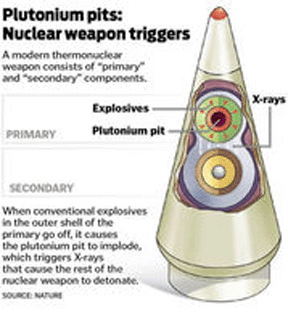
The need to put a stop to plan for plutonium weapon pits at Savannah River Site

No plutonium pit at SRS,   https://www.augustachronicle.com/opinion/20190220/letter-no-plutonium-pit-at-srs By Cassandra Fralix, Lexington, S.C. With the demise of the MOX fuel plant, good riddance, since there wasn’t a buyer for this dangerous material. There is only one option for the more radioactive plutonium waste, and that is long-term storage.

Long-term for Pu-239 is a half-life of 24,100 years. No one can predict what the state of the country will be in five years, much less 24,000, so who will monitor this dangerous material?

The horrible legacy of plutonium waste is one we are living with because of the development of nuclear weapons and nuclear power. Now, we have the Department of Energy’s plan to use Savannah River Site’s plutonium for nuclear weapons purposes. Plutonium, being radioactive and “pyrophoric,” is very difficult to handle, as the workers at SRS can testify to, and Savannah River Site, a Superfund site, continues a never-ending cleanup.

To return Savannah River Site to a weapons manufacturer is a testament to man’s lack of concern for God’s creation – human and environmental. We have seen the warnings from the increase of cancer rates at Rocky Flats, Colo., a plutonium pit producer – available in the Final Summary Report on the Historical Public Exposures Studies on Rocky Flats – to Fukushima, Japan, where the focus now is on the plutonium plant, so much more toxic than that of most other elements used in nuclear processing.

We must put people over profits and stop this maniacal race to our destruction. Say no to plutonium pit production at SRS!

February 23, 2019 Posted by | - plutonium, USA, weapons and war | Leave a comment

Nuclear energy just IS NOT clean energy

Nuclear energy is not the same as clean energy https://chicago.suntimes.com/opinion/illinois-clean-energy-policy-nuclear-energy/  Gail Snyder, board president, Nuclear Energy Information Service , 21 Feb 19“……  While legislation advancing renewable energy and energy efficiency is to be applauded, the $2.3 billion bailout to three privately owned Exelon nuclear energy facilities should be evaluated for its costs and the impact on expanding renewable energy. Of course, legislators should do so promptly, as it seems Exelon did so well with their last bailout that they are going to come back for another.

As energy legislation hits Springfield again, the public will be inundated with the terms “clean,” “renewable,” “green,” “low carbon,” “carbon neutral,” “carbon free,” “non-carbon,” and “net-zero emissions.” These terms will be used interchangeably, which only serves to confuse this fact: Nuclear waste and radioactive releases are not part of the calculus when the nuclear industry and others try to sell nuclear energy as “clean.” It is not.

Legislation that speaks only to “clean” as it relates to managing carbon emissions, without considering the 10,000 tons of nuclear waste in Illinois (the most nuclear waste of any state) is misleading. Also, consideration of the entire nuclear fuel cycle and storage of nuclear waste is carbon- intensive, which is not part of the “clean” calculus either.

We would also like to see Illinois legislators ‘step in’ again on energy policy, but this time with both the “carbon footprint” and the “nuclear footprint” included.

February 23, 2019 Posted by | politics, spinbuster, USA | Leave a comment

Loss of trust between USA and Europe brings nuclear risks

The Rift Between the U.S. and Europe Brings Nuclear Risks, TIME,  By SIMON SHUSTER/MUNICH  February 21, 2019

“…………The loss of trust between the U.S. and Europe was especially palpable at this year’s Munich summit, a traditional show of mutual reassurance among NATO allies. In her speech to the summit, German Chancellor Angela Merkel complained that the U.S. decision to scrap the INF treaty was made without consulting Europe, even though the treaty concerns Europe’s security most of all. “We sit there in the middle with the result,” Merkel said. Minutes later, when Vice President Mike Pence delivered a greeting from his boss, President Donald Trump, the room full of European diplomats responded with stony silence.
Their chief concern at the summit, at least when it comes to nuclear security, was the U.S. move in May to pull out of the deal with Iran. That deal took nearly a decade to negotiate, and it committed the Islamic Republic in 2015 to halt its nuclear-weapons program. Yet despite U.S. intelligence agencies reporting the deal was working, the Trump Administration scrapped it, imposing new sanctions against Iran and pressuring European allies to do the same. Germany, France and the U.K. have so far refused. ……
without the trust to begin negotiations, the world’s system of nuclear checks and balances will continue unraveling, one treaty at a time.  http://time.com/5534357/us-europe-nuclear-risks/

February 23, 2019 Posted by | EUROPE, politics international, USA | Leave a comment

Closing down Yongbyon nuclear facility to be up for discussion at US-North Korea summit

February 23, 2019 Posted by | North Korea, politics international, USA, weapons and war | Leave a comment