U.S. Congress needs to look hard at the rationale for a fast reactor program.
 Are Washington’s ‘Advanced’ Reactors a Nuclear Waste?
Congress needs to look hard at the rationale for a fast reactor program.https://nationalinterest.org/feature/are-washington%E2%80%99s-advanced-reactors-nuclear-waste-43797,
Late last year, the Energy Department (DOE), began work on a new flagship nuclear project, the Versatile Test Reactor (VTR), a sodium-cooled fast reactor. If completed, the project will dominate nuclear power research at DOE. The department’s objective is to provide the groundwork for building lots of fast-power reactors. This was a dream of the old Atomic Energy Commission, DOE’s predecessor agency. The dream is back. But before this goes any further, Congress needs to ask, what is the question to which the VTR is the answer? It won’t be cheap and there are some serious drawbacks in cost, safety, but mainly in its effect on nonproliferation.
Congress has to ask hard questions: Is there an economic advantage to such reactors? Or one in safety? Or is it just what nuclear engineers, national laboratories, and subsidy-hungry firms would like to do?
The answer of DOE’s Idaho National Laboratory, which would operate the reactor, is cast in terms of engineering and patriotic goals, not economic ones: “US technological leadership in the area of fast reactor systems . . . is critical for our national security. These systems are likely to be deployed around the globe and U.S. leadership in associated safety and security policies is in our best national interest.” In other words, we need to build fast reactors because DOE thinks other people will be building them, and we need to stay ahead.
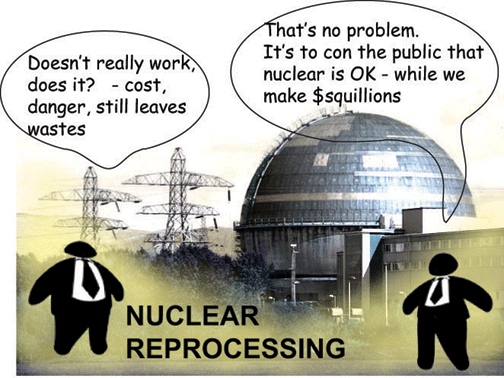
But we then learned there are vast deposits of uranium worldwide, and at the same time many fewer nuclear reactors were installed than were originally projected, so there is no foreseeable fuel shortage. Not only that, the reprocessing of fuel, which is intrinsic to fast reactor operation, has turned out to be vastly more expensive than projected. Finally, by all accounts fast reactors would be more expensive to build than conventional ones, the cost of which is already out of sight. In short, there is no economic argument for building fast reactors.
With regard to nonproliferation, the issue that mainly concerns us is that the fast reactor fuel cycle depends on reprocessing and recycling of its plutonium fuel (or uranium 233 if using thorium instead of uranium). Both plutonium and uranium 233 are nuclear explosives. Widespread use of fast reactors for electricity generation implies large quantities of nuclear explosives moving through commercial channels. It will not be possible to restrict such use to a small number of countries. The consequent proliferation dangers are obvious. And while it is doubtful the U.S. fast reactor project will lead to commercial exploitation—few, if any, projects from DOE ever do—U.S. pursuit of this technology would encourage other countries interested in this technology, like Japan and South Korea, to do so.
With all these concerns, and the lack of a valid economic benefit, why does the Energy Department want to start an “aggressive” and expensive program of fast reactor development? It’s true that so far only exploratory contracts have been let, on the order of millions of dollars (to GE-Hitachi). But the Department is already leaning awfully far forward in pursuing the VTR. It estimates the total cost to be about $2 billion, but that’s in DOE-speak. We’ve learned that translates into several times that amount.
But beyond that, the nuclear engineering community, and the wider community of nuclear enthusiasts, have never given up the 1960s AEC dream of a fast breeder-driven, plutonium-fueled world. Such reactors were to have been deployed by 1980 and were to take over electricity generation by 2000. It didn’t even get off the ground, in part because of AEC managerial incompetence, but mainly because it didn’t make sense.
After the 1974 Indian nuclear explosion and the realization that any country with a small reactor and a way to separate a few kilograms of plutonium could make a bomb, proliferation became a serious issue. In 1976 President Gerald Ford announced that we should not rely on plutonium until the world could reliably control its dangers as a bomb material. The plutonium devotees never accepted this change. Jimmy Carter froze construction of an ongoing fast-breeder prototype, the Clinch River Reactor, about three time the size of the proposed VTR. Ronald Reagan tried to revive it but, as its rationale thinned and its cost mounted, Congress shut it down in 1983. The plutonium enthusiasts thought they got their chance under George W. Bush with a fast reactor and a reprocessing and recycling program under of the rubric of Global Nuclear Energy Partnership. But it was so poorly thought out it didn’t go anywhere. More or less the same laboratory participants are now pushing the VTR.
Congress needs to look hard at the rationale for a fast reactor program. This means getting into the details. At a Senate Appropriations hearing last month on advanced reactors, Sen. Dianne Feinstein said rather plaintively, “We cast the votes, and cross our fingers hoping nothing bad will happen.” That’s not good enough.
Victor Gilinsky is program advisor for the Nonproliferation Policy Education Center (NPEC) in Arlington, Virginia. He served on the Nuclear Regulatory Commission under Presidents Ford, Carter, and Reagan. Henry Sokolski is executive director of NPEC and the author of Underestimated: Our Not So Peaceful Nuclear Future (second edition 2019). He served as deputy for nonproliferation policy in the office of the U.S. secretary of defense in the Cheney Pentagon.
No comments yet.
1 This Month

Petition to revoke the licensing of the Near Surface Nuclear Disposal Facility (NSDF) at Chalk River. https://www.ourcommons.ca/petitions/en/Petition/Details?Petition=e-7247


of the week – STOP SMALL MODULAR REACTORS IN CANADA
To see nuclear-related stories in greater depth and intensity – go to https://nuclearinformation.wordpress.com
-
Archives
- March 2026 (153)
- February 2026 (268)
- January 2026 (308)
- December 2025 (358)
- November 2025 (359)
- October 2025 (376)
- September 2025 (258)
- August 2025 (319)
- July 2025 (230)
- June 2025 (348)
- May 2025 (261)
- April 2025 (305)
-
Categories
- 1
- 1 NUCLEAR ISSUES
- business and costs
- climate change
- culture and arts
- ENERGY
- environment
- health
- history
- indigenous issues
- Legal
- marketing of nuclear
- media
- opposition to nuclear
- PERSONAL STORIES
- politics
- politics international
- Religion and ethics
- safety
- secrets,lies and civil liberties
- spinbuster
- technology
- Uranium
- wastes
- weapons and war
- Women
- 2 WORLD
- ACTION
- AFRICA
- Atrocities
- AUSTRALIA
- Christina's notes
- Christina's themes
- culture and arts
- Events
- Fuk 2022
- Fuk 2023
- Fukushima 2017
- Fukushima 2018
- fukushima 2019
- Fukushima 2020
- Fukushima 2021
- general
- global warming
- Humour (God we need it)
- Nuclear
- RARE EARTHS
- Reference
- resources – print
- Resources -audiovicual
- Weekly Newsletter
- World
- World Nuclear
- YouTube
-
RSS
Entries RSS
Comments RSS
 nuclear-news
Leave a comment