
 Feds sue Hanford contractor, claiming kickbacks and lies defrauded taxpayers out of millions, Tri City Herald , BY ANNETTE CARY, FEBRUARY 08, 2019 RICHLAND, WA
The Department of Justice filed a civil lawsuit Friday against Hanford contractor Mission Support Alliance, accusing it of defrauding the federal government out of tens of millions of taxpayer dollars.
Also named in the lawsuit are former Mission Support Alliance President Frank Armijo, Lockheed Martin Corp. and Lockheed Martin Services Inc……….
Mission Support Alliance (MSA), now owned by Leidos and Centerra Group, holds a 10-year contract valued at $3.2 billion to provide site-wide services at the Hanford nuclear reservation. Services include security, fire protection, utilities and information technology.
The Justice Department is accusing Mission Support Alliance of using half-truths, omissions, kickbacks and outright lies before its purchase by Leidos to get the Department of Energy to consent to a $232 million subcontract to a company with which it had ownership ties.
Lockheed Martin Corp. was a principal owner of Mission Support Alliance in 2010, when Mission Support Alliance awarded a subcontract for information technology services at Hanford to Lockheed Martin Services Inc.
The lawsuit alleges that from 2010 to 2015 the defendants misrepresented billing rates charged to DOE, the effort estimated to be needed to complete work and the anticipated additional profit for the subcontractor.
“Defendants’ fraud allowed them to obtain grossly inflated and improper additional profit on the subcontract,” the Justice Department said in a news release.
The lawsuit said that estimates of costs for payment rates were inflated in some cases by basing them on far more employees to perform work than Lockheed Martin Services Inc. included in its internal budget.
In some cases DOE was billed by both Mission Support Alliance and Lockheed Martin Services Inc. for the same labor, the lawsuit said.
‘GROSSLY INFLATED PRICING’ CLAIMS
The profit paid for Lockheed Martin Services Inc. work was in addition to money Lockheed Martin Corp. was already earning on the same work through its partial ownership of Mission Support Alliance, according to the Justice Department.
DOE repeatedly made clear that the subcontractor, Lockheed Martin Services Inc., could not earn profit on top of what its owner was already being paid through Mission Support Alliance, the lawsuit said.
Armijo, and Rich Olsen, the Mission Support Alliance chief financial officer, also worked on behalf of Lockheed Martin Corp. and misused their positions at Hanford to help Lockheed Martin Corp. obtain grossly inflated pricing, the Justice Department alleged.
In addition to serving at times as the Mission Support Alliance president, Armijo also was a vice president of Lockheed Martin Corp., the lawsuit said.
HANFORD OFFICIALS ALLEGEDLY PAID KICKBACKS
The Justice Department said some employees, including Armijo, told DOE that the subcontractor’s pricing did not contain any additional profit for the subcontract for the same work on which Lockheed Martin Corp. was already earning profit through its ownership of Mission Support Alliance.
The millions of dollars that Armijo and other employees were paid in cash and stock as part of an incentive program amounted to kickbacks for improperly using their Mission Support Alliance positions to provide favorable treatment for Lockheed Martin Corp., the Justice Department alleges. ………https://www.tri-cityherald.com/news/local/hanford/article226014785.html
February 11, 2019
Posted by Christina Macpherson |
Legal, secrets,lies and civil liberties, USA |
Leave a comment
 How the Green New Deal Almost Went Nuclear on Its First Day, Yahoo Finance, Ari Natter and Jennifer A. Dlouhy, Bloomberg, February 9, 2019 — As Democrats unveiled their ambitious Green New Deal to fight climate change on Thursday, a controversy erupted over the role of nuclear power that threatened to undermine the whole effort.
A fact sheet distributed by the office of progressive newcomer Alexandria Ocasio-Cortez, a Democratic representative from New York, said there was no room in the nation’s all renewable-energy future for nuclear plants.
But the reference caught many off guard and back-peddling ensued.
Giselle Barry, a spokeswoman for Senator Ed Markey, a Massachusetts Democrat who is the Green New Deal’s lead Senate backer, disowned the fact sheet and said Markey’s office wasn’t consulted before it was sent out. “We did not draft that fact sheet,” she said.
The stumble irked potential supporters. It also illustrated the political challenges ahead as supporters of the Green New Deal struggle to build consensus on issues that divide environmentalists as well as lawmakers.
Markey sought to do damage control at a midday press conference, emphasizing the proposed resolution doesn’t address specific energy technologies. Language on nuclear power “is not part of this legislation,” he said. “The resolution is silent on any individual technology that can move us to a solution.”
The plan, in the form of a non-binding resolution, weaves together what had been a hodgepodge of progressive proposals and aspirations into a single initiative. It sets a goal of shifting the nation to 100 percent “clean, renewable, and zero-emission energy sources,” within 10 years “to achieve net-zero greenhouse gas emissions through a fair and just transition for all communities and workers.”
The proposal has gathered 60 co-sponsors in the House but has little chance of gaining support in the Republican-controlled Senate, let alone being signed into law by President Donald Trump.
House Speaker Nancy Pelosi, who hasn’t explicitly thrown her support behind the Green New Deal, didn’t appear at the unveiling. She described the plan at another event as “one among many” ways to address climate change.
Some of the biggest climate champions in the Senate, including Sheldon Whitehouse, a Democrat from Rhode Island who delivers frequent floor speeches on the urgent need to act, were notably absent from the news conference unveiling the Green New Deal. For any effort to succeed, it will need support from long-time environmental policy advocates in Congress as well as the ardent activists that have rallied behind Ocasio-Cortez’s vision.
The scale and ambition of the initiative also presents problems. Ocasio-Cortez has pitched it not just as an environmental solution but also a World-War II-style “mobilization” against income inequality and social injustice.
That invites criticism that the whole gambit is socialism run amok. The Chamber of Commerce slammed the proposal in a statement that invoked “failed socialist policies.”
Opposition on the left emerged over the plan’s failure to eventually ban fossil fuels, the leading source of the carbon dioxide emissions linked to global warming.
Friends of the Earth president Erich Pica praised the resolution as “a good first step,” but said it was incomplete. “By failing to expressly call for an end of the fossil fuel era, the resolution misses an opportunity to define the scope of the challenge,” Pica said…………https://finance.yahoo.com/news/green-deal-almost-went-nuclear-090000153.html
February 11, 2019
Posted by Christina Macpherson |
politics, USA |
Leave a comment
 https://www.rt.com/usa/451098-hanford-nuclear-lockheed-lawsuit/ 10 Feb, 2019 Contractors involved in a multibillion decontamination effort at the notorious Hanford nuclear site have been accused of defrauding US taxpayers, according to a lawsuit against Mission Support Alliance and Lockheed Martin.
MSA has a 10-year, $3.2 billion contract with the Department of Energy (DOE) to support the decontamination effort at the decommissioned nuclear production complex known as the Hanford Site. Allowed to pick subcontractors for the nation’s largest and most expensive environmental cleanup at its own discretion, MSA abused its authority and awarded “improper favorable treatment” for kickbacks, the Justice Department claimed this week.
The lawsuit alleges that Lockheed Martin Corporation (LMC) and Lockheed Martin Services Inc. (LMSI) paid more than $1 million to executives of MSA – which was conveniently co-owned by another Lockheed subsidiary at the time – in order to secure a $232 million subcontract to provide management and technology support at the Washington state nuclear site from 2010-2016.
The services were provided at “inflated rates” and in some cases the DOE was even billed twice, by both MSA and Lockheed, for the same work. In addition, the suit accuses Jorge Francisco Armijo, who served as both the Vice President of LMC and President of MSA, of abusing his authority for financial gain by his simultaneously held posts.
“Where Congress has allocated money for specific purposes, we will not tolerate unlawful conduct by contractors who seek to enhance their profits at the expense of taxpayers,” said Assistant Attorney General Jody Hunt of the Department of Justice’s Civil Division.
Lockheed immediately denied the allegations of being involved in the corruption scheme, rejecting any notion that the “corporation or its executives engaged in any wrongdoing.” MSA also brushed aside the accusations, claiming that the company “stands behind” their employees.
The 586-square-mile former nuclear research facility was used to produce plutonium for the nuclear bomb in the Manhattan Project. After over four decades of nuclear fuel production, the site was closed down in 1987, requiring an extensive clean-up of solid and liquid wastes left from the weapons production processes.
February 11, 2019
Posted by Christina Macpherson |
Legal, secrets,lies and civil liberties, USA |
Leave a comment
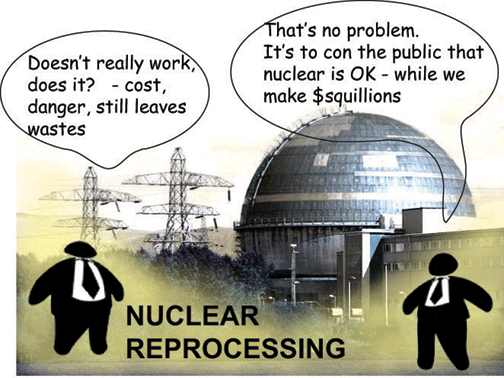
The rise and demise of the Clinch River Breeder Reactor, Bulletin of the Atomic Scientists, By Henry Sokolski, February 6, 2019 This year marks the 36th anniversary of the termination of the Clinch River Breeder Reactor Project, a federally funded commercial demonstration effort. In the very early 1980s, it was the largest public-works project in the United States. Japan, South Korea, China, France, Russia, and the United States are now all again considering building similar plants. For each, how and why Clinch River was launched and killed is a history that speaks to their nuclear future. This history involves more than cost benefit analysis. For the public and political leadership, facts and arguments rarely close an initial sale of a large government-funded, high-tech commercialization program. Nor do they generally goad officials to abandon such projects. Such acts are fundamentally political: Fears and hopes drive them. Certainly, to understand why the US government launched and subsequently killed Clinch River requires knowledge not just of what the public and its political leadership thought, but also of how they felt.
Unwarranted fears of uranium’s scarcity fueled interest in fast-breeder reactors. …….in 1945, uranium 235, a fissile uranium isotope that can readily sustain a chain reaction, was believed to be so scarce, it was assumed there was not enough of it to produce nuclear electricity on a large scale. Scientists saw the answer in fast-breeder reactors………
The Atomic Energy Commission publicly promoted their commercialization with confident, cartoonish optimism. In one publication, the commission asked the upbeat question: “Johnny had three truckloads of plutonium. He used three of them to power New York for a year. How much plutonium did Johnny have left?” The answer: “Four truckloads.”
Unfortunately, this pitch glossed over two stubborn facts. First, because plutonium is so much more toxic and difficult to handle than uranium, it is many times more expensive to use as a reactor fuel than using fresh uranium. Second, because plutonium fast-breeder reactors use liquid metal coolants, such as liquid sodium, operating them safely is far more challenging and expensive than conventional reactors.
When private industry tried in the early 1960s to operate its own commercial-sized fast-breeder, Fermi I, the benefits were negative. Barely three years after Fermi 1 came online, a partial fuel meltdown in 1966 brought it down. It eventually resumed operations before being officially shut down in 1972.
These facts, however, are rarely emphasized. Those backing breeders—whether it be in 1945, 1975, or today—focus not on reliability and economics, but rather that we are about to run out of affordable uranium. For the moment, of course, we are not. Uranium is plentiful and cheap as is enriching it. This helps explain why the United Kingdom, France, Germany, Japan, and the United States, no longer operate any commercial-sized fast-breeder reactors and are in no immediate rush to build new ones………
When the Atomic Energy Commission argued the case for building a breeder reactor in the late 1960s and early 1970s, it projected 1,000 reactors would be on line in the United States by the year 2000 (the real number turned out to be 103) and that the United States would soon run out of affordable uranium. Also, by the mid-1960s, the commission needed a new, massive project to justify its continued existence. Its key mission, to enrich uranium for bombs and reactors, had been completed and was overbuilt. The commission was running out of construction and research projects commensurate with its large budget. A breeder-reactor- commercialization program with all the reprocessing, fuel testing, and fuel fabrication plants that would go with it, seemed a worthy successor.
But the most powerful political supporter of Clinch River, then-President Richard Nixon, focused on a different point. Nixon saw the project less as a commercial proposition than as a way to demonstrate his power to secure more votes by providing government-funded jobs while at the same time affirming his commitment to big-science, engineering, and progress……….
the Energy Department videotaped safety tests it had conducted of how molten sodium might react once it came in contact with the reactor’s concrete containment structure. Concrete contains water crystals. Molten sodium reacts explosively when it comes in contact with oxygen, including oxygen contained in water. What the test demonstrated and the video showed was concrete exploding when it came in contact with liquid sodium.
This set off waves of worry at the department………
Just weeks before the final vote, the Congressional Budget Office released its financial assessment of the Energy Department’s last ditch effort to use loan guarantees to fund the project. Even under the most conservative assumptions, the budget analysts determined that the loan guarantees would only increase the project’s final costs. This helped push the project over a political cliff. The final Senate vote: 56 against, 40 for. All of the 16 deciding votes came from former Clinch River supporters.
No commercial prospects? Militarize. Nixon backed numerous science commercialization projects like Clinch River, including the Space Shuttle Program and the supersonic transport plane……… While the Space Shuttle Program won congressional support, the envisioned satellite contracts never materialized. The program became heavily dependent on military contracts. Finally, our national security depended upon it.
Although Clinch River never was completed, as its costs spiraled, it too attracted military attention. …….
Essentially, it didn’t matter when you asked–1971 or 1983—Clinch River was always another seven years and at least another $2.1 billion away from completion. ……
With Clinch River, what we now know, we may yet repeat. Fast-reactor commercialization projects and support efforts, such as Argonne National Laboratory’s Small Modular Fast Reactor, the US-South Korean Pyroreprocessing effort, the Energy Department’s Virtual (Fast) Test Reactor, France’s Astrid Fast Reactor Project, the PRISM Reactor, the TerraPower Traveling Wave reactor, India’s thorium breeder, Russia’s BN-1200, China’s Demonstration Fast-Breeder Reactor, continue to capture the attention and support of energy officials in Japan, China, Russia, South Korea, France, the US, and India. None of these countries have yet completely locked in their decisions. How sound their final choices turn out to be, will ultimately speak to these governments’ credibility and legitimacy.
In the case of Clinch River, the decision to launch the program ultimately rested on a cynical set of political calculations alloyed to an ideological faith in fast reactors and the future of the “plutonium economy.” Supporters saw this future clearly. As a nuclear engineer explained to me in 1981 at Los Alamos National Laboratory, the United States technically could build enough breeder reactors to keep the country electrically powered for hundreds of years without using any more oil, coal, or uranium. When I asked him, though, who would pay for this, he simply snapped that only fools let economics get in the way of the future.
This argument suggests that the case for fast reactors is beyond calculation or debate, something mandatory and urgent. That, however, never was the case, nor is it now. Instead, the equitable distribution of goods, which is a key metric of both economic and governmental performance (and ultimately of any government’s legitimacy and viability), has always taken and always must take costs into account. In this regard, we can only hope that remembering how and why Clinch River was launched and killed will help get this accounting right for similar such high-tech commercialization projects now and in the future. https://thebulletin. org/2019/02/the-rise-and- demise-of-the-clinch-river- breeder-reactor/?utm_source= Bulletin%20Newsletter&utm_ medium=iContact%20email&utm_ campaign=ClinchRiver_February6
February 11, 2019
Posted by Christina Macpherson |
Reference, reprocessing, USA |
Leave a comment
https://www.denverpost.com/2019/02/08/denver-federal-center-nuclear-reactor-violations/
The Nuclear Regulatory Commission has proposed to have a $7,250 fine levied Concerns over the operation of a nuclear reactor at the Denver Federal Center has one arm of the federal government proposing to fine another and a reactor supervisor has been reassigned with his access revoked.
The Nuclear Regulatory Commission has proposed to have a $7,250 fine levied against the U.S. Geological Survey for “research reactor violations,” according to an NRC news release dated Tuesday.
The NRC carried out two separate investigations of the TRIGA (Training, Research, Isotopes, General Atomics) nuclear reactor, which is used for research, and found violations associated with staffing and training requirements, the release stated.
One investigation was completed on Jan. 18, 2018, the other on June 12, 2018, according to a notice of violation letter which identified the supervisor as Brycen Roy.
Roy, who was reached Friday night by phone, declined comment.
The USGS has “implemented corrective actions,” according to the release, but not before “pausing reactor operations to allow for an assessment of the violations and the operational culture of the reactor organization.”
One violation involved “deliberately falsified documentation showing that reactor operators had completed required training, when in fact the training never took place,” the NRC said. The supervisor presented “false documentation” to an NRC inspector, according to the release
A second investigation found that the supervisor “violated staffing requirements by performing certain reactor tests without a second qualified person present, as required by NRC regulations.”
The USGS can dispute the violation and penalty, or could agree to third-party mediation, the release stated.
The Denver Federal Center, a 623-acre campus which houses 28 agencies in 44 buildings, is surrounded by Lakewood. It’s west of Kipling Street, south of West 6th Avenue and north of West Alameda Avenue.
February 11, 2019
Posted by Christina Macpherson |
safety, USA |
Leave a comment
WW3: France to build ‘unstoppable’ HYPERSONIC NUKES to replace ageing nuclear armoury
FRANCE is set to build a state-of-the-art armoury of hypersonic weapons capable of travelling more than 3,800mph, in a bid to upgrade their ageing nuclear arsenal as they fall behind other world military powers., By THOMAS MACKIE, Express UK :11, Sat, Feb 9, 2019 The French Defence Ministry has promised to test a prototype hypersonic glider missile device in just two years time. “We have decided to issue a contract for a hypersonic glider demonstrator,” Defense Minister Florence Parly said during the unveiling of the V-MaX project. France has already carried out studies on propulsion systems for hypersonic flights as part of a £32 billion overhaul of its nuclear arsenal.
Hypersonic gliders would be carried to the edge of the earth’s atmosphere by a launch vehicle and would then “glide” back to a target on the ground.
France’s main nuclear-tipped air-to-surface cruise missile, the ASMP, is capable of flying up to Mach 3, which is 2,300 mph.
To be deemed hypersonic, the new device must be capable of flying at least five times the speed of sound (3,800mph).
However many hypersonic weapons can travel much faster, with Russia’s latest glider reaching speeds of 20,700mph.
The French Directorate General of Armaments (DGA) admitted the country had “relatively little experience” in the hypersonic field.
Hypersonic weaponry is fast becoming the nuclear weapon of choice among the world superpowers.
In March last year Russia unveiled a new range of weapons, including two hypersonic devices, the Kinzhal air-launched missile and the Avangard hypersonic glide vehicle.
The Avangard hypersonic glide vehicle is capable of flying at least 10 times faster than sound and has been already deployed to the Russian Air Force……….https://www.express.co.uk/news/world/1084928/world-war-3-france-news-hypersonic-nukes-nuclear-weapon-defence-ministry
February 11, 2019
Posted by Christina Macpherson |
France, weapons and war |
Leave a comment












 nuclear-news