Would you go to British Tobacco for education on how to have healthy lungs?
Would you trust the Sugar Industry for education on healthy teeth?
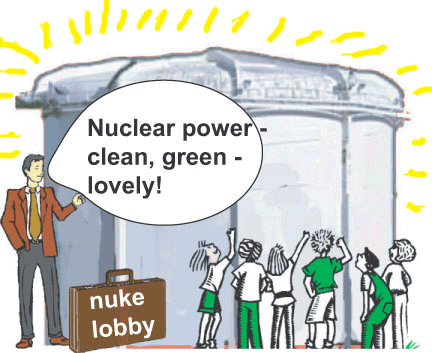
So why on earth are we letting the nuclear industry run the education on the most important aspects of nuclear power – the ones that affect humans, all species, and the environment?
The nuclear experts are big on their technical stuff, how to build a new reactor etc, (but very quiet on how to get rid of its radioactive trash)
But don’t let them be the education authorities on ionising radiation – a cause of cancer, birth defects, genetic effects, environmental effects.
Don’t let them be the education authorities on dealing with climate change.
Don’t let them be the education authorities on prevention of war.
Don’t let them be the education authorities on the supposed economic benefits of nuclear power.
Above all, don’t let the nuclear industry control education about HISTORY – about the bombing of Hiroshima and Nagasaki, atomic testing, about Urals disaster 1957, Mayak, Three Mile Island, Church Rock, Chernobyl, Fukushima…….

And don’t let them get at our kids with their propaganda.




February 9, 2019
Posted by Christina Macpherson |
Christina's themes |
10 Comments
|
Government warned of possible nuclear waste project in Co. Down https://www.agriland.ie/farming-news/winds-to-abate-over-weekend-but-showers-to-persist/, Sylvester Phelan, Feb 8, 2019 Sinn Fein TD Gerry Adams has highlighted the possibility that a Northern Irish site, close to the border, could be earmarked as a potential nuclear waste storage facility at some stage in the future.
The Louth representative has called on the Minister for Communications, Climate Action and the Environment, Richard Bruton, to answers questions on the possible development.
It is understood that the former Sinn Fein leader wrote to the minister inquiring as to whether the Government is “aware of or was consulted about a proposal by the British state’s Radioactive Waste Management group to store waste nuclear material deep underground in the Mournes and Slieve Gullion area?”
Report
The region, in the Mourne Mountains, Co. Down, is noted in a report by the UK government group focusing on a national geological screening exercise for a Geographical Disposal Facility (GDF) in the six counties.
Although the report specifically outlines that there are no plans to site a GDF in Northern Ireland, it states that any future policy decision on geological disposal in Northern Ireland would be a matter for the Northern Ireland Executive and “would be subject to community agreement, planning and environmental consents”.
As a result of the Northern Ireland Executive being currently suspended; the report also states that geological screening outputs will only be used “initially for England and Wales”.
However, Adams is not satisfied with such assurances.
In a statement on the Sinn Fein website the TD said: “The Irish Government must ensure that the British government knows that it will not tolerate any nuclear waste facility being constructed on the island of Ireland.
“The British government is currently investigating sites which could potentially become storage dumps for thousands of tonnes of nuclear waste being produced by the British nuclear industry.
Specifically, the group has examined the Mourne Mountains and the Slieve Gullion region, which have ‘higher strength rock’, as potential sites for what they call a Geological Disposal Facility (GDF).
The TD noted that, in the report, the Radioactive Waste Management group identified that granites and similar strong rocks around Newry may be suitable for a GDF.
Referencing a separate report, by environmental group Greenpeace on the matter, Adams added: “A recent extensive report by Greenpeace – The Global Crisis of Nuclear Waste – has provided a stark warning of the dangers involved in dumping nuclear waste underground.”
He noted that the Greenpeace report dismisses the storing of waste material deep underground as having “shown major flaws which exclude it for now as a credible option”.
“In 2018 the British government commenced an attempt to persuade a community willing to host a radioactive dump. This is their sixth such attempt over the last four decades. So far none have agreed.
“Currently Britain has what Greenpeace has described as ‘one of the largest and most complex nuclear waste problems in the world’,” deputy Adams claimed.
Its nuclear waste legacy has been made “dramatically more dangerous and expensive by its decades long plutonium-reprocessing program based at Sellafield.
“While the Nuclear Waste Management group cannot at this stage construct a nuclear dump in the Mournes or south Armagh without local agreement, that may not always be the case,” deputy Adams warned.
“The Government should also express its opposition to the current construction of a nuclear power plant at Hinkley Point C in Somerset. This is another nuclear facility just across the Irish Sea.”
|
|
February 9, 2019
Posted by Christina Macpherson |
UK, wastes |
Leave a comment
|
Brazil to start detail phase on first nuclear-powered submarine, Victor Barreira, Lisbon – Jane’s Defence Weekly, 07 February 2019 The Brazilian Navy is scheduled on 11 February to begin initial detailing activity, or Phase C, of its first nuclear-powered submarine, SN Álvaro Alberto , the service told Jane’s .A preliminary adjustment document between the General-Coordination of the Nuclear-Propelled Submarine Development Program (COGESN) and Naval Group was signed on 14 December 2018, the navy confirmed to Jane’s on 31 January. Work will be undertaken by the Submarines Development Center (CDS).
Construction, or Phase D, of the Submarino com Propulsão Nuclear Brasileiro (SN-BR) submarine is scheduled to debut in early of 2022, with launch to take place in 2029 followed by testing and culminating with commissioning of the boat in 2030…....(subscribers only) https://www.janes.com/article/86231/brazil-to-start-detail-phase-on-first-nuclear-powered-submarine
|
|
February 9, 2019
Posted by Christina Macpherson |
Brazil, weapons and war |
1 Comment
|
Google refuses to blur nuclear facilities on Google Maps http://www.brusselstimes.com/rss-feed/14011/google-refuses-to-blur-nuclear-facilities-on-google-maps, Alan Hope, 08 February 2019 Internet search giant Google has rejected a request from the Belgian nuclear power regulator to blur out its satellite images of the country’s nuclear power stations for security reasons.
Google will respond positively to requests from private individuals to blur their homes in its Street View mode, and it routinely blurs the faces of people in the streets and car number plates.
But when the Federal Agency for Nuclear Control, together with the federal home affairs ministry, approached Google with a request to blur the satellite pictures of nuclear plants Google refused.
“There have been contacts regarding this issue,” said Google Belgium spokesperson Michiel Sallaets. “But there is no legal basis in Belgium for a request for Google to remove these images.”
For the FANC, the risk is real, particularly the risk of terrorist attacks. The photo shown is a magnification intended to fill the frame with the Doel nuclear power plant; much closer magnification at a high degree of definition is possible with an ordinary laptop. The latest satellite images available for the location date from 2019, so are the best currently available. The image can also be viewed in 3D and dragged to give a full tour of the site. The same applies to the plant at Tihange.
The FANC is not prepared to leave it there, said spokesperson Ines Venneman. “We maintain our point of view. These images must be blurred, and we will investigate any means to have that done. In the first instance we will follow the example of the defence ministry. They succeeded in having satellite images of military sites blurred.”
|
|
February 9, 2019
Posted by Christina Macpherson |
EUROPE, media |
Leave a comment

 Federal Public Prosecutor’s Office calls for emergency measures to prevent failure of tailings dam at former Poços de Caldas uranium mine
Decommissioning Projects – South/Central America 8 Feb 2019
The Federal Public Prosecutor’s Office (MPF)  has recommended to the President of the Indústrias Nucleares do Brasil (INB) and to the President of the National Nuclear Energy Commission (CNEN) that, by March 30, all necessary steps be taken to fully implement the Emergency Action Plan for Dams (Paemb) on the tailings dam of the Mineral Treatment Unit (UTM), located in the municipality of Caldas, south of the state.
This dam contains radioactive material resulting from the first uranium mine operated in Brazil.
The exploration lasted from 1982 to 1995, when it was closed, on the grounds that the activities were economically unfeasible. Even after the end of the mine, the mine pit containing mud with radioactive waste, a decontaminated ore processing plant, dozens of equipment, and the dam with thousands of tons of uranium, thorium and radium waste remains in the mine.
In September of last year, INB noted that an “unusual event” occurred at the UTM-Caldas dam, which was immediately communicated to CNEN and the Brazilian Institute of the Environment (IBAMA) . Such an event consisted of turbidity and reduction of water flow at the outlet of the overflow pipe system of the structure. Also, actions were immediately initiated to investigate the causes of the event, by collecting special samples and intensifying the field inspections and reading the dam instrumentation.
A technical report produced by an emergency contractor at the Federal University of Ouro Preto (UFOP) concluded that the overflow pipe system of the tailings dam is seriously compromised and that the infiltrations found on its walls favor the occurrence of so-called piping.
Piping is a process of internal erosion that damages the structure of the dam, increasing the probability of rupture, which requires immediate measures of correction and intervention [view here].
About two weeks ago, representatives of the Brazilian Nuclear Industries presented to the MPF the measures that are being implemented as a matter of urgency to change the mechanism of the overflow pipe dam system, preceded by a provisional auxiliary system, as well as the Paemb and the schedule of its Implementation. Regarding the Paemb, no concrete action has been taken so far.
For the Federal Public Prosecutor’s Office, the relevance and complexity of the facts, already worrying about the possibility of rupture of the structure, are more serious when the tailings are considered to consist of radioactive material.
The closure of uranium exploration activities occurred in 1995, without concrete measures being taken to decommission UTM-Caldas and environmental recovery for the damages caused. The omission of INB led the Federal Public Prosecutor to file a Public Civil Action No. 4106-80.2015.4.01.3826 , in the year 2015, to demand the full environmental recovery in the area of the project. “The longer this situation lasts, the lack of concrete measures for decommissioning and environmental recovery, the greater the exposure of the environment (fauna and flora) and the population to the risk of serious and harmful events,” warns MPF.
Transparency – Another point addressed in the recommendation concerns the need and the right of the populations neighboring the project, which can be affected in the event of a possible rupture, to receive information about the dam situation in clear and accessible language.
Therefore, the MPF recommended that in five days, INB and CNEN should be widely disseminated to civil society, especially to communities that may be directly affected by a possible incident, about the risks they are exposed to.
The information should cover both the “unusual event” occurred on Sep. 25, 2018, indicating the characteristics and causes of the occurrence, as well as the potential risks arising from the situation in which the dam structure is located, the measures taken by the entrepreneur to stabilization of the enterprise and the content of the Emergency Action Plan (SAP). (MPF Feb. 7, 2019)
The latest Federal Public Prosecutor’s Office action in this case apparently was triggered by the Brumadinho tailings dam disaster on Jan. 25, 2019 (see details). http://wise-uranium.org/udsam.html#POCOSDEC http://wise-uranium.org/udsam.html#POCOSDEC
February 9, 2019
Posted by Christina Macpherson |
Brazil, safety |
Leave a comment
From mining the uranium rich ore, to nuclear abandonment – a dozen by-products more radio toxic than the ore mined to fuel the reactor are discarded. These products are the raffinates culminating in 85% of the total radioactivity that goes directly into the tailings only to migrate throughout the environment.
Products like Radon gas, Polonium-210 with a 140 day half life, Radium-226, with a 1600 year half life, Thorium-230 with a 76,000 year half life are released , and yet only 1kg of Uranium oxide is recovered in every 4,000 kilos mined.
Uranium-238 subjected to neutron bombardment in the reactor becomes Uranium-239 with a 23 minute half life, then that becomes Neptunium-239 with a 2.3 day half life, and that goes on to become Plutonium-239 with a 244,000 year half life, then this spent fuel finally decays to become Uranium- 235 with a half life of 700 million years.
Moreover, x that by no less than 10 to get the life of the radioactive hazard, which equates to no less than 7 billion years, and here we have only just crossed the nuclear industries threshold within the last 76 years with many thousands of nuclear events, and accidents recorded, and yet this is not the only wastes these machines produce with one Canadian CANDU reactor that recorded 100 trillion becquerels of radiation from the Tritium released in just one year.
The nuclear embracing coterie tell us they can safely manage these radioactive wastes, yet there containment vessels are only guaranteed for 25 years not 7 billion years, and a director of Holtec has stated there is no way to remedy a breach of containment. Moreover these nuclear wastes are a gamble and risk that only grows exponentially with every generation.
February 9, 2019
Posted by Christina Macpherson |
2 WORLD, radiation, Reference |
Leave a comment

 Laura N. Vandenberg: It’s time to talk about cancer prevention — and the role of the environment https://www.ehn.org/laura-n-vandenberg-its-time-to-talk-about-cancer-prevention-2628192178.html
An inadequate focus on researching and understanding the role of the environment in cancer prevention is a failure for public health. Laura N. Vandenberg 8 Feb 19,
In his 2019
State of the Union address on Tuesday night, President Trump called for $500 million over the next 10 years to fund research on childhood cancers.
Such funding is crucial to continue tackling the devastating disease. However, missing from the State of the Union—and most other conversations about tackling cancer—is a focus on prevention, specifically the need to research, understand and communicate the role environmental exposures play in cancer risk.
The numbers on cancer incidence and deaths are complex. Although childhood cancer mortality rates have dropped considerably from the 1960s, data from the American Cancer Society shows that incidence rates have increased 0.6 percent per year since 1975.
In this way, childhood cancers are like several others. Between 2005 and 2014, yearly cancer incidence rates rose for several types: thyroid cancer by 4 percent; invasive breast cancer by 0.3 percent in black women; leukemia by 1.6 percent; liver cancer by 3 percent; oral and pharynx cancers by 1 percent in Caucasians; pancreatic cancer by 1 percent in Caucasians; colon cancer by 1.4 percent in individuals younger than 55 years of age; rectal cancer by 2.4 percent in individuals younger than 55; and melanoma by 3 percent in individuals aged 50 and older.
While these cancer rates have increased, overall rates of cancer deaths have started to fall. In fact, since the 1990s, improved detection and treatment, as well as decreased smoking rates, have contributed to significant reductions in cancer mortality.
Reduced deaths from cancer are a great public health victory. These statistics prove that public health interventions like educational programs designed to curb smoking can have dramatic effects.
They also suggest that investments in improved detection and diagnosis are money well spent. A focus on treatments has also improved quality of life for cancer patients and their likelihood of remission.
But where is the call for better cancer prevention? As rates of numerous cancers continue to rise, the failure to identify the causes of cancer remains a disappointment for public health officials and researchers alike.
We know that environmental factors can contribute to cancer risk. Some, like smoking, are avoidable. Others are lifestyle factors that people can change like drinking less alcohol, decreasing consumption of processed meats, using protection from the sun, and increasing exercise.
Yet, other environmental factors like exposures to chemicals in the environment, including endocrine disruptors, have received little attention. While some NIH-funded programs like the Breast Cancer and Environment Research Program have worked to identify chemicals in the environment that promote cancer, funding for cancer prevention initiatives has stagnated.
Despite the limited resources invested in studies of environmental risk factors for cancer, we know enough to take action on some chemicals of concern.
For example, communities contaminated with perfluorinated chemicals, several of which are known to cause cancer, have demanded attention from government officials in addition to asking for more research.
Individuals living in these communities have the right to know how they are being exposed, and what their risks might be – for cancer and other diseases.
It is great that cancer research was raised in the President’s State of the Union speech, and that the difficulties associated with caring for a family member with cancer was mentioned in Stacey Abrams’ rebuttal.
But a failure to focus on prevention, a failure to acknowledge the role of the environment in causing cancer, and a failure to allocate funds to prevention research, are all failures for public health.
Dr. Vandenberg is an Associate Professor of Environmental Health Sciences at the University of Massachusetts Amherst School of Public Health and Health Sciences. Her work on endocrine disrupting chemicals has been funded by the National Institutes of Health including the BCERP program, which focuses on the environmental causes of breast cancer
February 9, 2019
Posted by Christina Macpherson |
health, Reference, USA |
6 Comments

Melting ice sheets may cause ‘climate chaos’: study, Daily Nation, FEBRUARY 7 2019 Billions of tonnes of meltwater flowing into the world’s oceans from the Greenland and Antarctic ice sheets could boost extreme weather and destabilise regional climate within a matter of decades, researchers said Wednesday.
These melting giants, especially the one atop Greenland, are poised to further weaken the ocean currents that move cold water south along the Atlantic Ocean floor while pushing tropical waters northward closer to the surface, they reported in the journal Nature.
Known as the Atlantic Meridional Overturning Circulation (AMOC), this liquid conveyor belt plays a crucial role in Earth’s climate system and helps ensures the relative warmth of the Northern Hemisphere.
“According to our models, this meltwater will cause significant disruptions to ocean currents and change levels of warming around the world,” said lead author Nicholas Golledge, an associate professor at the Antarctic Research Centre of New Zealand’s Victoria University of Wellington.
The Antarctic ice sheet’s loss of mass, meanwhile, traps warmer water below the surface, eroding glaciers from underneath in a vicious circle of accelerated melting that contributes to sea level rise.
Most studies on ice sheets have focused on how quickly they might shrink due to global warming, and how much global temperatures can rise before their disintegration — whether over centuries or millennia — becomes inevitable, a threshold known as a “tipping point.”
But far less research has been done on how the meltwater might affect the climate system itself.
“The large-scale changes we see in our simulations are conducive to a more chaotic climate with more extreme weather events and more intense and frequent heatwaves,” co-author Natalya Gomez, a researcher in the Department of Earth and Planetary Sciences at McGill University in Canada, told AFP.
“By mid-century,” the researchers concluded, “meltwater from the Greenland ice sheet noticeably disrupts the AMOC,” which has already shown signs of slowing down.
This is a “much shorter timescale than expected,” commented Helene Seroussi, a researcher in the Sea Level and Ice Group at the Jet Propulsion Laboratory in California, who was not involved in the study.
RISING WATER LEVEL
The findings were based on highly detailed simulations combined with satellite observations of changes to the ice sheets since 2010.
One likely result of weakened current in the Atlantic will be warmer air temperatures in the high Arctic, eastern Canada and central America, and cooler temperatures over northwestern Europe and the North American eastern seaboard.
The Antarctic and Greenland ice sheets, up to three kilometres thick, contain more than two-thirds of the planet’s fresh water, enough to raise global oceans 58 and seven metres, respectively, were they to melt completely.
Besides Greenland, the regions most vulnerable to global warming are West Antarctica and several huge glaciers in East Antarctica, which is far larger and more stable.
In a second study published Wednesday in Nature, some of the same scientists offered new projections of how much Antarctica will contribute to sea level rise by 2100 — a hotly debated topic………
A special report on oceans by the UN’s Intergovernmental Panel on Climate Change (IPCC), due out in September, will offer a much anticipated estimate of sea level rise.
The IPCC’s last major assessment in 2013 did not take ice sheets — today seen as the major contributor, ahead of thermal expansion and glaciers — into account for lack of data. https://www.nation.co.ke/lifestyle/health/Melting-ice-sheets-may-cause-climate-chaos/1954202-4970670-jhymoo/index.html
February 9, 2019
Posted by Christina Macpherson |
2 WORLD, climate change |
Leave a comment
 SSFL impasse – State disapproves of DOE’s final environmental study , Simi Valley Acorn, February 08, 2019, By Melissa Simon, melissa@theacorn.com State officials overseeing the cleanup at the Santa Susana Field Lab are criticizing a federal agency’s proposal to address contamination on its portion of the former rocket engine testing site. On Jan. 28, the California Department of Toxic Substances Control issued a letter accusing the U.S. Department of Energy of reneging on a 2010 cleanup agreement promising to remove all contamination in its part of the 2,850-acre field lab.
SSFL was used for 50 years in the development of ballistic missiles, rockets and space shuttle equipment. A partial nuclear meltdown occurred in Area IV in 1959, but it wasn’t made public until decades later. The DOE is responsible for removing soil and groundwater contamination in Area IV and the northern buffer zone.
“DOE ignores that its preferred alternative is inconsistent with the (agreement which) clearly defines DOE’s obligation to clean up soils in Area IV to background levels, or reporting limits if no background value exists, on a point-by-point basis,” DTSC officials said in the letter.
The state agency said it intends to hold the U.S. Department of Energy accountable to the requirements of the previous agreement, which involves a more thorough cleanup of the property.
The letter also requested that DOE extend the 30-day comment period, which closed at the end of January, through March 1 to allow more “meaningful public participation and opportunity for comment.”
The letter is in response to the Department of Energy’s final environmental study, which was released Dec. 18.
In the study, the federal agency called for the removal of the remaining buildings in Area IV—a radioactive materials handling facility and a hazardous waste management facility—and recommended a combination of treatment and monitoring to deal with the groundwater. It also proposed a “risk-based” soil cleanup plan, in which any contaminant found is removed. Environmentalists have argued in favor of removing much more soil………..
Five activist groups lobbying for complete site remediation, meaning they want to see the property restored to what it was before SSFL was built, voiced their objections the same day DTSC issued its letter.
The Natural Resources Defense Council, Physicians for Social Responsibility, Southern California Federation of Scientists, Committee to Bridge the Gap, and the Rocketdyne Cleanup Coalition all sent letters Jan. 28 accusing the DOE of breaching the legally binding 2010 agreement and violating fundamental environmental laws.
Denise Duffield, spokesperson for Physicians for Social Responsibility, told the Simi Valley Acorn this week that the DOE’s final study is an “unconscionable breach of its commitment to clean up all of its contamination at SSFL.”
DOE, Duffield asserts, wants to leave behind 98 percent of contamination and just “walk away from remediating much of the contaminated groundwater.”
“Polluters do not get to decide how much of their contamination they get to clean up,” she said. “Also, the (study) fails to take into account the devastating Woolsey fire, which started at and burned much of the contaminated SSFL in November.”
Duffield said her group wants local, state and federal officials to lean on the DOE to revise its final study……..
February 9, 2019
Posted by Christina Macpherson |
safety, USA |
Leave a comment
Russia says open to new nuclear pact https://www.sbs.com.au/news/russia-says-open-to-new-nuclear-pact
Russia is open to considering new proposals for a broader treaty including other countries to replace a suspended Cold War-era nuclear pact with the US. Russia says it would be prepared to consider new proposals from the United States to replace a suspended Cold War-era nuclear pact with a broader treaty that includes more countries.Russia suspended the Intermediate-range Nuclear Forces (INF) treaty at the weekend after Washington announced it would withdraw in six months unless Russia ends what it says are violations of the pact, allegations rejected by Moscow.
The 1987 treaty eliminated the medium-range missile arsenals of the world’s two biggest nuclear powers, but leaves other countries free to produce and deploy them.
US President Donald Trump last week said he would like to hold talks aimed at creating a new arms control treaty.
“We of course saw the reference in president Trump’s statement to the possibility of a new treaty that could be signed in a beautiful room and that this treaty should also include other countries as its participants,” Deputy Foreign Minister Sergei Ryabkov said on Thursday.
“We look forward to this proposal being made concrete and put on paper or by other means…” Ryabkov said at a news conference in Moscow.
Ryabkov said the US had not sent Moscow any concrete proposals for a new pact.
|
|
|
February 9, 2019
Posted by Christina Macpherson |
politics international, weapons and war |
Leave a comment
 UK pupils to join global strike over climate change crisis, Thousands of pupils to walk out of lessons amid growing concern over global warming, Guardian, Matthew Taylor, Sat 9 Feb 2019
‘I feel very angry’: the 13-year-old on strike for climate action The school climate strikes that have led to tens of thousands of young people taking to the streets around the world over recent months are poised to arrive in the UK next Friday.
Thousands of pupils are expected to walk out of lessons at schools and colleges across the country amid growing concern about the escalating climate crisis.
The movement started in August when the 16-year-old schoolgirl Greta Thunberg held a solo protest outside Sweden’s parliament. Now, up to 70,000 schoolchildren each week are taking part in 270 towns and cities worldwide.
Individual protests have been held in the UK, but next week a coordinated day of action is expected to result in walkouts in more than 30 towns and cities – from Lancaster to Truro, and Ullapool to Leeds.
Jake Woodier, of the UK Youth Climate Coalition, which is helping to coordinate the strikes, said Greta’s message about the need for radical, urgent change had struck a chord with hundreds of thousand of young people in the UK. ……..
The UK walkouts are being billed as a chance to build towards a global day of school strikes on 15 March….. https://www.theguardian.com/environment/2019/feb/08/global-school-strikes-over-climate-change-head-to-the-uk
February 9, 2019
Posted by Christina Macpherson |
climate change, UK |
Leave a comment












 nuclear-news